Retrieving Game From Private Land in New Hampshire
It's one of the most stomach-dropping moments a hunter can experience: you make a good shot, track your animal, and then, just as you're closing in, you realize the blood trail leads straight onto private land where you don't have permission. The excitement of the hunt turns instantly into a knot of anxiety. You've got a downed animal, perhaps your trophy of a lifetime, lying just meters away, but a legal boundary stands between you and your hard-earned harvest. This guide is here to walk you through the complex, often frustrating, but absolutely critical process of retrieving game from private land in New Hampshire, offering practical advice and legal insights to help you navigate this delicate situation.
The Gut-Wrenching Reality of a Shot Animal on the Line
There’s nothing quite like the adrenaline dump after the shot, especially if you know it was a good one. You replay the scene in your head, picturing the deer reacting, the thud of the arrow or bullet, and then the dash into the timber. You follow the blood trail, your heart pounding with anticipation, every drop a confirmation of your skill and patience. But then, it happens. The trail veers, perhaps subtly at first, then undeniably, across a property line you didn't even realize was there until that moment. All that anticipation slams into a brick wall of legal and ethical considerations.
The Initial Rush and the Sudden Stop
You’ve been still-hunting a ridge all morning, or maybe you’ve been patiently watching a logging road. Finally, that buck steps out – a nice eight-pointer – and you seize the moment. The shot feels perfect. You wait the recommended time, your mind a whirlwind of excitement and a touch of nerves, before you slip off your stand or step out of the shadows. The initial track is textbook: good blood, maybe a broken branch here or there. You're thinking about the tag, the venison, the story you'll tell. You keep a keen eye out, heart thumping, looking for the tell-tale shape of antlers or hide.
Then you spot it: a "No Trespassing" sign, or maybe a distinct change in logging activity, a well-defined stone wall, or a fence line that marks the edge of a new parcel. You might pull out your mapping app, like onX Hunt, only to confirm your worst fear – that promising blood trail has definitely crossed onto land you don't have permission to be on. The hunt, which moments ago was a joyous pursuit, grinds to a halt. You're left standing on the wrong side of a line, with a strong urge to keep going, but a deeper understanding of the laws and ethics that must prevail. It's a truly deflating moment, one that every hunter dreads but many will face at some point.
Why This Situation is So Common in New Hampshire
New Hampshire's landscape, while beautiful and wild in many areas, is also quite fragmented, especially as you move away from the vast expanses of the White Mountain National Forest. You have a patchwork quilt of public and private land, often with small private woodlots tucked right up against state forests or larger conservation areas. It’s not always a clear delineation, especially in thick cover or rolling terrain where property lines aren't always visibly marked with signs or obvious fences. One minute you're hunting what seems like endless public timber, and the next, your animal has slipped into someone's backyard or a privately owned working forest.
The sheer density of deer in some regions, combined with limited public access in others, means that deer often travel between these different land types. A buck living most of its life on public land might choose to bed down on a quiet private parcel nearby, especially during the rut when they're ranging widely. When you consider the topography – those steep granite ridges and thick softwoods – it’s easy for a deer to put distance between itself and the hunter, often straight across an unmarked boundary. Even with careful scouting and using mapping tools like those from GoHunt or onX Hunt to understand property lines, sometimes an animal simply doesn't read the map. This reality makes understanding retrieval laws even more crucial for hunters in the Granite State.
Understanding New Hampshire's Trespass and Game Retrieval Laws
Navigating the legalities of retrieving game is paramount in New Hampshire. You might feel a strong moral obligation to recover your animal, to prevent waste, but that doesn't automatically grant you the legal right to trespass. Ignoring the law, even with good intentions, can lead to serious consequences, including fines, loss of hunting privileges, and burning bridges with landowners – which ultimately hurts all hunters. New Hampshire Trespass and Permission Law makes it clear: entering private land without permission for any purpose is generally prohibited, and that absolutely includes game retrieval.
Verbal Permission vs. Written Permission
In New Hampshire, the law regarding permission to enter private land is pretty straightforward: you need it. For hunting, specific written permission is often recommended, and in some contexts, legally required. However, for the sole purpose of retrieving a downed animal, verbal permission can be sufficient. This means you don't necessarily need a signed document from the landowner just to cross a property line to pick up your deer. But let's be realistic: getting verbal permission can still be a challenge if you don't know the landowner or they're unreachable.
It's always best practice to seek out the landowner, explain your situation calmly and respectfully, and ask for their direct permission. If they grant it verbally, that's often enough. The key here is direct permission – you can’t just assume silence means yes, or that because you’ve hunted nearby, it’s okay. Remember, Do You Need Written Permission in New Hampshire? emphasizes the safest route for hunting itself, and while retrieval might be a slightly different category, the principle of respect and clear communication remains. Always carry your hunting license and a form of identification, and be prepared to show them exactly where the animal is if they ask to accompany you.
The "Good Faith Effort" and What it Means
What if you can't reach the landowner? Maybe there's no visible house, no contact information, or they simply don't answer their phone. This is where the concept of a "good faith effort" comes into play, though it's important to understand its limitations. A good faith effort means you have made a reasonable, honest attempt to contact the landowner for permission. This might include knocking on doors, calling numbers found through public records (which apps like onX Hunt often provide), or even asking neighbors if they know how to reach the owner. You document these attempts: times, dates, methods of contact, who you spoke with, or if you left a message.
However, a "good faith effort" does not grant you automatic permission to trespass if you fail to reach the landowner. New Hampshire law does not contain a "right to retrieve" clause that overrides trespass laws. If you cannot get permission, even after a diligent effort, entering the property without consent is still trespassing. In such a difficult scenario, your next step would be to contact a New Hampshire Fish and Game Conservation Officer. They have the authority to intervene and attempt to gain permission on your behalf, or in rare, specific cases, may grant you access under their supervision, especially to prevent waste. Always remember, the authority rests with the landowner and, failing that, with law enforcement, not with you as the hunter.
Proactive Strategies: Before the Shot is Fired
The absolute best way to handle a game retrieval situation on private land is to prevent it from becoming a problem in the first place. This means doing your homework long before you ever step foot in the woods with your hunting gear. Forethought and preparation can save you immense stress and potential legal trouble. Scouting New Hampshire Public Land Before Season is crucial, but it's equally important to understand the lay of the private land that borders it.
Scouting and Mapping: Knowing the Boundaries
Before the season even opens, dedicate time to thoroughly scout your hunting area. This isn't just about finding deer sign; it's about understanding the geography, the terrain, and most importantly, the property lines. Use digital mapping tools like onX Hunt or similar apps. These platforms are invaluable because they overlay property ownership information directly onto topo maps and aerial imagery. You can see precisely where public land ends and private land begins, often with landowner names and contact information. Take screenshots or download maps for offline use, because cell service can be spotty in many parts of New Hampshire. onX Layers for New Hampshire Land Status can be a game-changer here.
Walk those boundary lines in the off-season. Look for physical markers like old stone walls, fences, posted signs, or changes in forest management that might indicate a property line. Compare what you see on the ground with your digital maps. Make mental notes, or even drop pins on your GPS, to identify potential "hot zones" where deer might cross onto private land, or tricky corners where boundaries are less clear. Knowing these lines intimately beforehand means you can adjust your stand placement or hunting approach to minimize the chance of a deer running onto land you don't have access to. It's all about calculated risk management.
Building Relationships with Landowners
The single most effective proactive strategy is to build relationships with landowners before you ever have an animal on their property. If you identify private parcels adjacent to your hunting area, especially those that look like good deer habitat, make an effort to connect with the owners. This isn't just about asking for permission to hunt (though that's a great outcome!); it's about introducing yourself, offering to help with chores, or simply letting them know you're a responsible hunter who respects their land. Many landowners are receptive to friendly, respectful individuals.
When you approach them, be polite, dress neatly, and clearly state your purpose. "Hi, my name is [Your Name], and I hunt the state land that borders your property. I noticed your parcel here, and if I ever have an animal run onto your land, I was hoping I could call you for permission to retrieve it?" Offer your phone number and ask for theirs. Even if they don't give you permission to hunt, they might be much more willing to grant access for retrieval if they've met you and trust you. This personal connection is priceless and demonstrates that you’re a responsible member of the hunting community. It's far easier to ask for a favor when you're not in a crisis.
When the Animal Crosses: Immediate Steps and Best Practices
Despite all your best proactive efforts, sometimes an animal still crosses that invisible line. When this happens, your actions in the immediate aftermath are critical. This isn't the time for rash decisions or letting emotion dictate your actions. Staying calm, methodical, and respectful will serve you best.
Securing the Scene and Marking the Last Sign
The very first thing you need to do once you realize your animal has crossed onto private land is to stop. Do not follow the blood trail onto the property without permission. This is trespassing, pure and simple. Instead, mark the last piece of sign you found on your side of the property line. Use flagging tape, a prominent natural landmark, or a GPS waypoint. This allows you to pinpoint the exact location where the trail crossed, which will be crucial information when you speak with the landowner or a Conservation Officer.
After marking the spot, back out of the area quietly and discreetly. Try not to disturb any further sign on the edge of the property, as this might be helpful if you later get permission to continue tracking. Take a deep breath. Gather your thoughts. The animal is likely down, or at least mortally wounded, so a few extra minutes (or even hours, if it's cool weather) won't typically make a difference to the recovery, but rash actions could permanently damage your reputation and ability to hunt in the area.
Contacting the Landowner: The Do's and Don'ts
With the scene secured, your next immediate task is to contact the landowner. This is where your proactive efforts to build relationships (or at least get contact information) pay off. If you have their number, call them. If not, refer to your mapping app like onX Hunt for owner information, or ask a trusted local if they know how to reach them. If there's a visible residence, approach it politely.
Do:
- Be respectful and courteous: Introduce yourself clearly and state your purpose. "Hello, my name is [Your Name]. I was hunting on the [public land/neighboring property] and unfortunately, I believe a deer I shot has run onto your property. I'm calling to respectfully ask for your permission to retrieve it."
- Be honest and transparent: Explain the situation exactly as it happened. Don't embellish or minimize.
- Offer to show them the animal/sign: This builds trust and allows them to verify your story. They might want to accompany you, which is perfectly acceptable.
- Be prepared for a "no": It's their land, and they have the right to deny permission. React calmly and respectfully if this happens.
- Offer to leave no trace: Assure them you will be careful, only go to the animal, and remove all associated debris.
Don't:
- Don't trespass first and ask later: This is a surefire way to upset a landowner and guarantee a "no."
- Don't argue or demand: It's their property, not yours.
- Don't assume anything: Always get clear permission.
- Don't show up in camo with a loaded weapon: Always approach a residence with your firearm unloaded and cased, or left in your vehicle, especially if you're not in season. For retrieval, you'll likely only need your knife.
What if you can't reach them? If phone calls go unanswered, and there's no one home at a visible residence after a reasonable attempt, you've made your good faith effort. At this point, you do not have permission, and you absolutely cannot proceed onto the property.
When Permission is Denied or Unobtainable
This is perhaps the most difficult part of the equation. You've made a good faith effort, but you either can't reach the landowner or they explicitly deny permission. It's a heartbreaking scenario, but it happens. Your ethics and adherence to the law are tested here.
The Role of New Hampshire Fish and Game
If you have made a good faith effort to contact the landowner and cannot obtain permission, your next and only legal step is to contact a New Hampshire Fish and Game Conservation Officer (CO). Do not just walk away from the animal assuming it’s lost, and certainly do not trespass. Call the regional Fish and Game office or the dispatch number. Explain the entire situation, providing all the details: your location, where the animal crossed, your attempts to contact the landowner, and any landowner information you have.
Conservation Officers are law enforcement officials with the authority to mediate these situations. They can often leverage their position to contact landowners who might not respond to a private citizen. In some rare cases, if they deem it absolutely necessary to prevent waste and cannot reach the landowner, they might accompany you onto the property for retrieval. However, it’s critical to understand that even a CO cannot force a landowner to grant access for retrieval if the landowner explicitly denies it. Their role is primarily to facilitate communication and ensure laws are followed. They are also the ones who can help you understand the next steps if retrieval truly becomes impossible.
Ethical Considerations and Personal Responsibility
When permission is denied, or the landowner simply cannot be reached after a diligent effort, you are faced with an agonizing choice. Legally, you cannot trespass. Ethically, no hunter wants to leave a wounded or dead animal to waste. This is where personal responsibility and the broader perception of hunting come into play. Trespassing, even for retrieval, can result in fines, the loss of hunting privileges, and irreparable damage to the reputation of hunters in general. It reinforces negative stereotypes and can lead to more land being posted, reducing access for everyone.
The hard truth is that sometimes, despite your best efforts, you might have to accept the loss of an animal. It’s a bitter pill to swallow, and it goes against every fiber of a responsible hunter’s being. However, upholding the law and respecting private property rights is paramount. It's a reminder that hunting is a privilege, not a right, and that privilege comes with responsibilities. This difficult situation underscores the importance of being incredibly mindful of property lines before you ever take a shot. If you are hunting close to a boundary, you must consider the possibility of an animal crossing and whether you have a retrieval plan in place, even if that means choosing not to take a marginal shot.
Practical Considerations for Retrieval
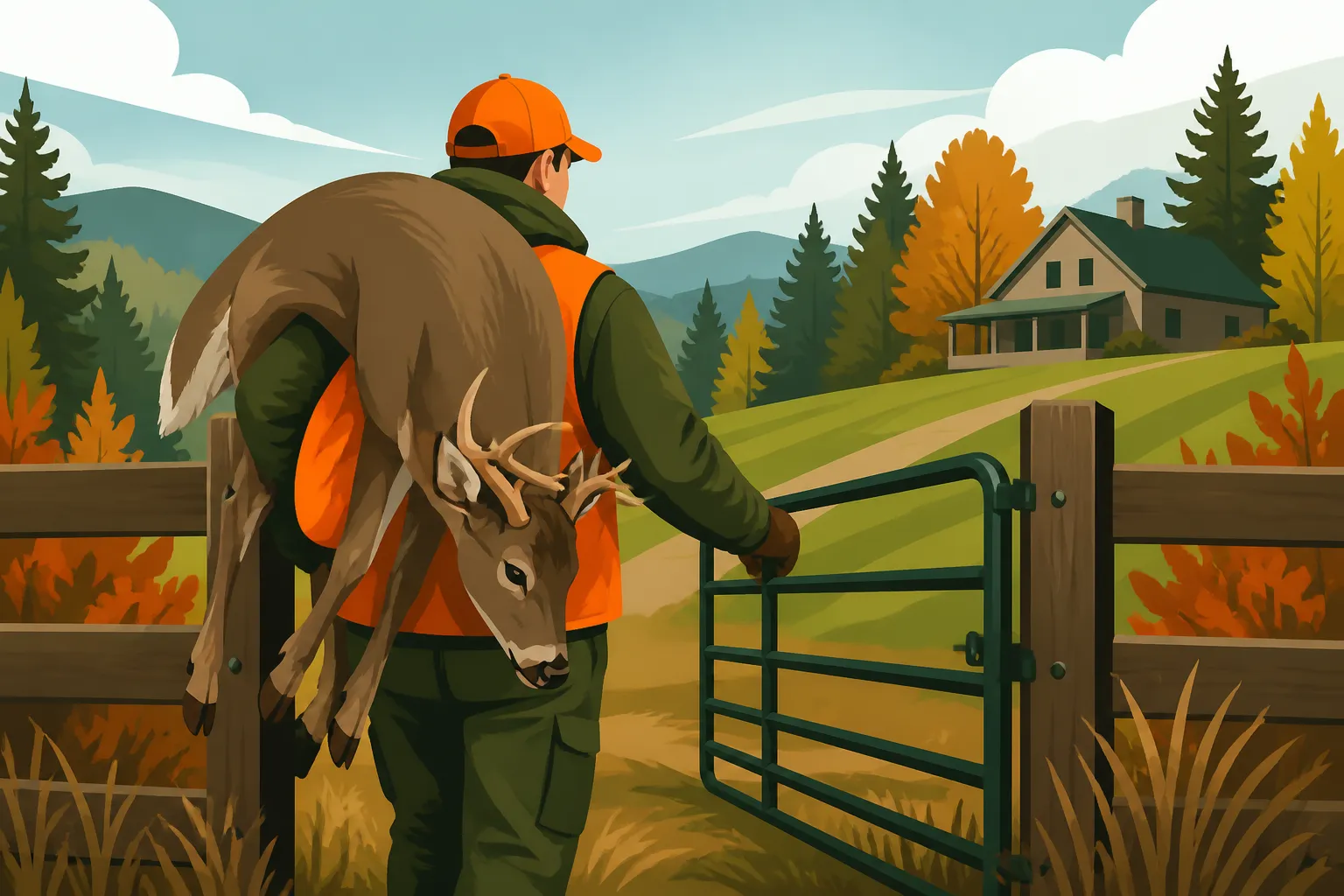
If you are fortunate enough to obtain permission, the job isn't quite over. You still need to retrieve the animal efficiently and respectfully. This involves having the right gear and ensuring you leave the property in the same condition (or better) than you found it.
Equipment for Respectful Retrieval
Once permission is granted, you want to make the retrieval as swift and unobtrusive as possible.
- Game Cart or Drag: Depending on the terrain and the size of the animal, a game cart can be invaluable for minimizing your impact, especially if you have a significant distance to cover. For smaller deer or rougher terrain, a simple game drag or rope will suffice. You'll want to get the animal out as quickly as possible.
- Field Dressing Kit: Ensure you have a sharp knife and gloves. While it's usually best to field dress where the animal drops for cooling, consider if the landowner prefers you drag the animal to a less visible spot or off their property entirely before field dressing. Always ask their preference.
- Trash Bags/Wipes: Be prepared to pack out any trash, flagging tape, or other items you might have used. Leave absolutely no trace behind.
- Mapping Device: Have your onX Hunt or GoHunt app open to navigate directly to your marked waypoint and ensure you stay on the agreed-upon path for retrieval.
- Headlamp/Flashlight: Even if it's daylight, having a light can be helpful for tracking in thick cover or if the retrieval takes longer than expected.
- Gloves: Protect your hands during the process.
The goal is to be efficient, clean, and respectful. Thank the landowner profusely for their generosity and perhaps even offer a small token of appreciation, like a package of venison after processing, if appropriate. Field Dressing a Deer in Cold Weather can be tricky, so be prepared for efficient processing once you've retrieved your animal and transported it to your vehicle.
Registering Your Harvest
After the successful (and often stressful) retrieval, the legal process doesn't end. You still need to register your harvest according to New Hampshire Fish and Game regulations. This is a critical step, regardless of the challenges you faced in retrieving the animal. Ensure you meet the registration deadline, which typically requires registration within 24 hours of harvest.
You can register your deer online, through the New Hampshire Fish and Game mobile app, or at an authorized registration station. Even if the retrieval was difficult, the fact that you harvested the animal legally means you are obligated to register it. Make sure to accurately report the date, time, WMU, and method of take. This data is vital for wildlife management. Registering a New Hampshire Deer Online is usually the easiest route, but be aware of the online registration blackout days if your hunt falls within specific windows.
Successfully retrieving game from private land in New Hampshire is a testament to preparation, respect, and adherence to the law. It’s a situation every hunter hopes to avoid, but one that every hunter should be prepared to handle with grace and integrity.
Disclaimer
This article is for general informational purposes only and does not constitute professional advice. Laws, prices and regulations vary by location and change over time. Consult a qualified professional for guidance on your specific situation.