Working a Connecticut River Bottomland Funnel
Hunting the dense, often swampy river bottoms of the Connecticut River can feel like trying to find a needle in a haystack – thick cover, unpredictable water levels, and whitetails that seem to vanish into thin air. But these challenging areas, with their natural pinch points and critical travel corridors, are absolute whitetail goldmines for those who know how to decipher them. This comprehensive guide will walk you through exactly how to identify, scout, and effectively hunt those crucial bottomland funnels, transforming frustration into successful hunts in one of New Hampshire's most unique deer habitats.
The Unique Allure of Connecticut River Bottomlands for Whitetails
The Connecticut River, as it carves its path through New Hampshire, creates a distinct ecosystem that’s a magnet for deer. These bottomlands are a mosaic of habitat types, offering everything a whitetail needs to thrive and escape pressure, often in close proximity. Understanding why deer love these areas is the first step to hunting them effectively.
A Sanctuary of Food, Water, and Cover
Deer are drawn to the Connecticut River bottomlands primarily because they offer an unparalleled combination of vital resources. The fertile soils along the river support lush vegetation, providing abundant food sources from spring green-up through late fall. Think about the soft mast from wild apple trees, the browse from saplings regenerating after logging, and the lingering green of honeysuckle or other resilient plants that might hold their leaves longer than upland species. These areas often feature diverse deciduous and coniferous stands, offering both food and crucial thermal and security cover year-round.
Beyond just food, the river itself and its associated sloughs, oxbows, and small tributaries provide a constant, reliable water source. In dry periods, when upland seeps might disappear, the river bottom remains hydrated, concentrating deer activity. This proximity to water also creates damp, shaded bedding areas that are cooler in early season warmth and offer a quiet escape from human disturbance. It’s a complete package for a deer: food, water, and security, all within a relatively small, accessible footprint that makes them incredibly appealing, especially when other areas might be lacking.
Navigating the River's Dynamic Landscape
One of the most defining characteristics of the Connecticut River bottomlands is their dynamic nature. The river is constantly at work, shaping the landscape through erosion and deposition, creating new features and altering old ones. This means that year to year, and even within a single season, water levels can fluctuate dramatically, transforming dry ground into flooded timber and vice versa. This constant change can be frustrating for hunters who rely on consistent sign, but it also creates predictable patterns if you know what to look for.
When water levels rise, deer are pushed to higher ground, often concentrating their movement along the edges of the flood plain or on subtle ridges and knolls that remain dry. Conversely, during low water, new travel corridors open up along exposed sandbars or through dried-out sloughs. These shifts in water create temporary but highly effective funnels. Deer adapt quickly to these changes, always seeking the path of least resistance. Your ability to read these water fluctuations and anticipate deer movement in response is absolutely key to success in this unique environment. You can learn more about Hunting the Connecticut River Valley to get a broader perspective on the region.
Pinpointing Pressure Points: Identifying Natural Funnels and Bottlenecks
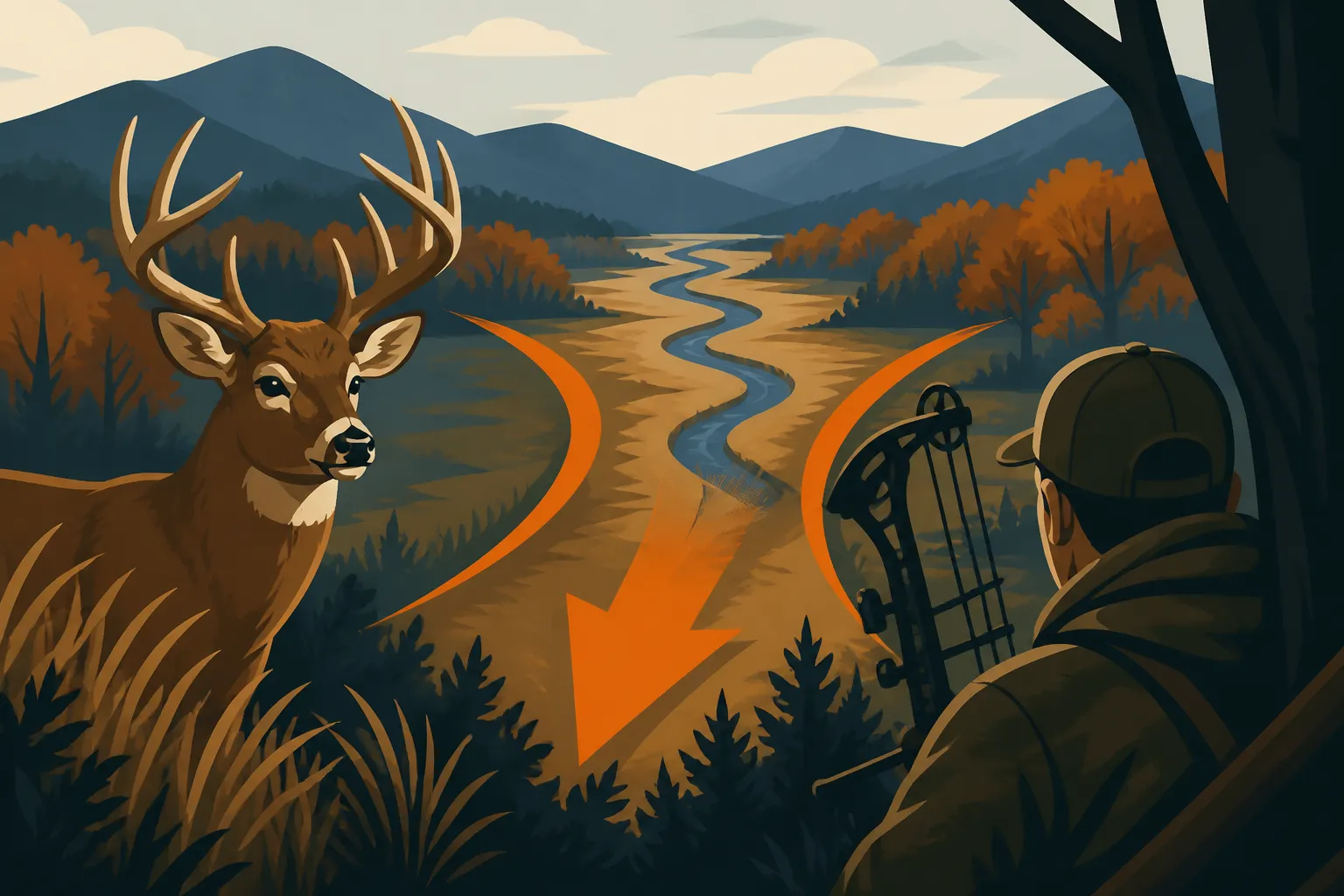
Finding success in the Connecticut River bottomlands hinges on your ability to identify the natural funnels and bottlenecks that channel deer movement. These aren't always obvious, and often require a combination of map scouting and boots-on-the-ground investigation. Forget wide-open woods; here, it’s all about predicting where deer must go to get from Point A to Point B.
Leveraging Mapping Tools for Initial Scouting
Before you even step foot in the woods, modern mapping applications are your best friend. Services like GoHunt or onX Hunt are invaluable for getting a bird's-eye view of the river bottom. Start by looking for the obvious: areas where the river itself creates a hard boundary, forcing deer to travel along a narrow strip of land. Then, zoom in and look for more subtle features. Identify areas where a ridge or an old farm field pushes close to the river, creating a natural pinch point. Scan for old logging roads, often elevated slightly, that might serve as dry travel routes through otherwise wet areas.
Pay close attention to changes in vegetation patterns visible from aerial photos. A distinct line between dense softwood thickets and more open hardwoods often indicates an edge deer will follow. Look for historical oxbows or sloughs that are now dry or semi-dry – these depressions can form hidden travel lanes. Even subtle elevation changes, just a few feet difference, can be critical in bottomlands, providing the only dry ground during certain periods. Map scouting allows you to mark potential funnels and entry/exit routes before you even leave your couch, saving you precious time and effort. GPS and Mapping Apps for New Hampshire Public Land can be a huge asset in this initial phase.
Boots-on-the-Ground Confirmation
Once you've identified potential funnels on your map, it's time to put boots on the ground. There's simply no substitute for walking the terrain, especially in such a dynamic environment. Your goal is to confirm the funnels you identified digitally and find fresh sign that indicates active deer movement. Look for worn trails, especially where two distinct habitat types meet, or where deer are forced to squeeze through a dense thicket. These trails will be much more evident within a funnel.
Focus on finding rub lines and scrape lines. In a funnel, these will often be more concentrated and active, indicating dominant bucks are regularly using the corridor. Look for tracks in soft mud along the river's edge, or where deer cross small streams. Pay attention to downed trees or obstacles that might further constrict movement, creating an even tighter bottleneck. During your scouting, assess the prevailing wind patterns relative to these funnels. A funnel might be perfect, but if the wind is rarely right for you to hunt it effectively, it might not be the best setup. Remember, Scouting New Hampshire Public Land Before Season is not just about finding deer, but understanding how they move through their environment.
Strategic Hunting Tactics for Bottomland Funnels
Hunting these funnels requires a thoughtful approach, adapting your strategy to the specific conditions of the river bottom and the time of year. Whether you're hanging a stand or still-hunting, placement and timing are everything.
Stand Placement for Archery and Firearms
When setting up a stand in a bottomland funnel, concealment is paramount. These areas are often thick, and deer might appear suddenly and close. Look for a tree that offers natural cover around your stand, breaking up your outline. Consider placing your stand slightly off the main trail, allowing deer to pass naturally without looking directly at you. The prevailing wind is your ultimate guide here. Even in relatively flat bottomlands, subtle thermals can still exist, especially near water or changes in elevation. Always position yourself downwind or crosswind of the expected travel path.
During the early archery season, when deer movement might be more subtle, a well-placed stand overlooking a funnel connecting a bedding area to an early-season food source can be lethal. As the season progresses into the firearms season, especially during the rut, funnels become even hotter. Bucks will use these constricted pathways to check for does, or to travel between different doe groups. Placing a stand on a bench or slight rise within the funnel, especially where it offers a view of multiple trails converging, can be highly effective. For more specific season dates, check out New Hampshire Archery Season Dates and New Hampshire Firearms Season Dates.
Still-Hunting and Ground Blind Strategies
Sometimes, hanging a stand isn't practical or desirable in the dense, often wet bottomlands. This is where still-hunting or utilizing ground blinds can shine. When still-hunting, move incredibly slowly, taking a few steps then pausing to scan. Use the dense vegetation to your advantage, moving from cover to cover. Focus on the edges of sloughs, the fringes of thickets, and the subtle high ground. The sound of running water from the Connecticut River itself can often mask your footsteps, allowing for closer approaches.
Ground blinds are also a fantastic option, especially if you can set them up well in advance to allow deer to get used to them. Natural ground blinds, built from downed limbs and brush, blend in perfectly with the chaotic nature of the bottomlands. When using a pop-up blind, brush it in thoroughly. Place it where it offers good visibility into the funnel but is well-hidden from common deer travel lanes. Ground blinds are particularly effective during the New Hampshire Muzzleloader Season Dates, which often takes place when foliage is sparse and concealment becomes harder to find. In both scenarios, choosing appropriate Camo Patterns for New Hampshire Hardwood Cover that blend with the specific bottomland vegetation is crucial.
| Season | Primary Funnel Types | Recommended Tactics | Key Gear Considerations |
|---|---|---|---|
| Early Archery | Cover transitions, subtle dry ridges near water | Treestand overlooking food-to-bedding | Scent control, bug spray, lightweight layers |
| Mid-Season | Oxbow edges, old logging roads, thicket corridors | Still-hunting, mobile stand hunting | Waterproof boots, quiet clothing, compact optics |
| Rut (Firearms) | Ridge/river pinch points, crossings, dense cover edges | Fixed stand, rattling/grunting | Warm layers, binoculars, rangefinder, scent eliminator |
| Late Season | Remaining food sources, thermal cover thickets | Ground blind, slow still-hunt | Insulated boots, heavy layers, hand warmers, thermos |
Overcoming Challenges in River Bottom Hunting
The Connecticut River bottomlands present unique challenges that can frustrate even seasoned hunters. From navigating the wet terrain to dealing with hunting pressure, being prepared for these obstacles is key to turning a tough hunt into a rewarding experience.
Dealing with Water, Mud, and Terrain
Perhaps the most significant challenge in river bottom hunting is the prevalence of water and mud. Waders or tall, waterproof rubber boots are not just recommended, they are essential. You’ll often find yourself wading through ankle-deep water, or slogging through knee-deep mud to access prime areas. Invest in high-quality footwear that offers good traction and keeps your feet dry and warm. Many hunters prefer a comfortable pair of chest waders for crossing sloughs and small creeks, allowing access to areas others won't bother with. Check out suggestions for Best Boots for North Country Bog Hunting, as similar principles apply for wet bottomlands.
Beyond the wetness, the terrain itself can be deceptively tricky. While generally flatter than the White Mountains, river bottoms are often riddled with blowdowns, thick brush, and tangled vines. This makes quiet movement difficult. Practice navigating these obstacles slowly and deliberately to minimize noise. A good headlamp is indispensable for early morning entries and late-night exits, as navigating dense, dark bottomlands in the dark can be disorienting. Always carry a reliable map and compass, or a GPS device with offline maps, because cell service can be spotty in these remote river corridors. This is where tools like GoHunt's offline map capabilities truly shine.
Managing Hunter Pressure and Finding Seclusion
Like any prime hunting habitat, Connecticut River bottomlands can see their share of hunter pressure, especially on public land during peak seasons. However, the very difficulties of this terrain – the mud, the water, the thick cover – often deter many hunters, creating opportunities for those willing to put in the extra effort. The key is to find those secluded pockets that others overlook.
Focus on accessing areas that require a bit more work to reach, perhaps by wading a slough or navigating a dense, brushy section. Look for funnels that are a significant distance from common access points or parking areas. Deer will naturally gravitate to these less-pressured zones. Use mapping applications like GoHunt to identify small parcels of public land that might be overlooked, or sections where a river or large wetland creates a natural barrier, funneling deer into more difficult-to-reach spots. Sometimes, the best funnels are those within a funnel – a tiny pinch point deep within a larger travel corridor that offers just enough security for deer to feel safe. Being aware of Finding Ground That Sees Fewer Hunters is crucial for consistent success. Remember, deer are incredibly adaptable, and they quickly learn where they can find sanctuary from human activity. By understanding and embracing the challenges of the Connecticut River bottomlands, you can unlock some truly exceptional hunting opportunities.
Disclaimer
Hunting is an inherently dangerous activity. This guide provides general information and recommendations for hunting in New Hampshire. Always consult the most current New Hampshire Fish and Game Department regulations, wear appropriate safety gear including blaze orange, and prioritize ethical hunting practices. Conditions in the field can change rapidly, and hunters should always exercise caution and good judgment.