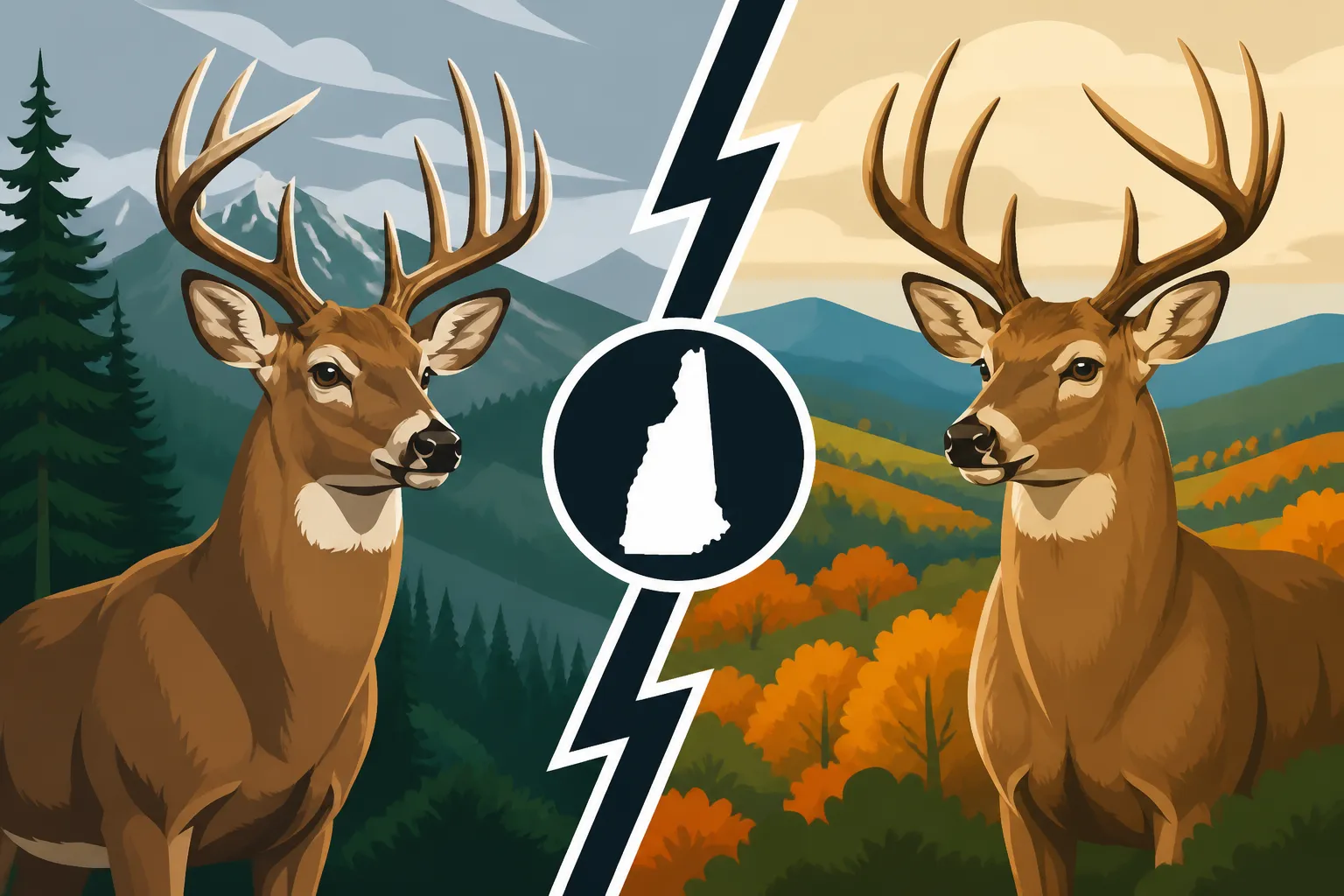
North Country Versus Southern New Hampshire Deer
One of the biggest questions I get from hunters, especially those new to the Granite State or looking to explore beyond their usual haunts, is about the stark differences in deer hunting between New Hampshire's sprawling North Country and its more populated southern regions. It can feel like two completely different states sometimes, with varying deer numbers, antler quality, and even the fundamental strategies you employ. This guide aims to pull back the curtain on these regional variations, giving you a clear picture of what to expect and how to adapt your hunting approach, whether you're navigating the deep woods of Pittsburg or the fragmented woodlots near Nashua.
Understanding New Hampshire's Deer Management Regions
New Hampshire, while a relatively small state, presents a surprisingly diverse landscape for deer hunters. This diversity isn't just aesthetic; it profoundly influences the deer herds and, consequently, the hunting experience. Understanding how the state is broadly divided and managed is the first step to truly grasping the "North vs. South" deer dynamic.
The North Country Divide: What Defines It
When we talk about New Hampshire's North Country, we're generally referring to the vast, wild expanses of Coos County and the northern reaches of Grafton and Carroll Counties. This is the land of tall timber, towering peaks, and sparser human populations. It's often thought of as the "true wilderness" of New Hampshire, where moose outnumber deer in many areas, and the winters are notoriously long and harsh. The rugged terrain, with its dense softwood stands, remote bogs, and challenging elevations, creates a unique environment for white-tailed deer. Here, survival is a daily grind, and deer often live on the edge, battling deep snow, limited food sources, and persistent predators. The deer that call this region home are hardy, resourceful animals, but their numbers and physical characteristics reflect the demanding conditions they face. Think of it as true backcountry hunting, where a successful harvest often means a significant packing effort.
Southern New Hampshire's Diverse Landscape: From Suburbs to Agriculture
Shifting gears entirely, Southern New Hampshire offers a mosaic of habitats, from suburban fringes with scattered woodlots to rolling agricultural fields and mature oak-hickory forests. This region encompasses areas south of the White Mountains, stretching down to the Massachusetts border, including counties like Hillsborough, Rockingham, Merrimack, and Cheshire. Here, human population density is much higher, leading to more fragmented habitat but also a wealth of diverse food sources. You'll find deer browsing in apple orchards, feeding on leftover crops in farm fields, and even becoming accustomed to suburban landscaping. The winters are generally milder, with less persistent deep snow, allowing deer to conserve energy and access food more readily. This environment creates conditions ripe for robust deer populations and often leads to larger-bodied animals with impressive antler growth, making it a different kind of hunting challenge altogether, often focused on smaller parcels and navigating increased human activity.
WMU Differences: How Management Units Reflect Regional Variations
New Hampshire Fish and Game manages deer populations through a system of Wildlife Management Units (WMUs), and these units clearly reflect the North-South divide. For instance, WMUs like A, B, and C dominate the North Country, characterized by lower deer densities and more conservative harvest strategies. These units often have shorter hunting seasons or more restrictive bag limits to help sustain populations. Conversely, WMUs in Southern New Hampshire, such as J2, K, and M, often boast higher deer densities and may have more liberal antlerless permit opportunities. The regulations in each WMU are a direct response to deer population health, habitat availability, and social tolerance for deer. Therefore, understanding the specific rules for your chosen WMU is paramount, as they directly influence when and where you can hunt and what you can harvest. For a detailed breakdown of how seasons are structured across the state, you might want to check out New Hampshire's WMU-Based Deer Season Structure.
Deer Population and Density Across the State
The sheer number of deer, and how concentrated they are, is perhaps the most striking difference between hunting in New Hampshire's North Country and its southern regions. This isn't just anecdotal; it's backed by data and directly impacts a hunter's expectations and strategies.
North Country Deer Numbers: Factors Limiting Population Growth
In the rugged and often unforgiving North Country, deer populations are naturally lower. The primary limiting factors are severe winter weather, habitat quality, and predation. Deep snow, which can persist for months, makes it incredibly difficult for deer to move and access food, leading to significant winter mortality, especially among fawns and older does. This is where you'll often hear about "deer yards," concentrated areas of softwood cover that offer some thermal protection and reduced snow depth. Reading a White Mountain Deer Yard can be crucial for finding deer in these challenging conditions. Food sources are also less abundant and diverse than in the south; dense conifer forests offer less nutritious browse, and agricultural land is scarce.
Moreover, the North Country is prime habitat for moose, and while a majestic sight, their browsing habits can compete with deer for available forage. And let's not forget the predators; healthy populations of coyotes, bobcats, and even black bears contribute to fawn mortality. As a result of these combined pressures, the deer in WMU A, B, and C are typically hard-won trophies. Hunters often spend days, sometimes weeks, covering vast amounts of ground to locate sign or make a deer sighting. This lower density means your encounters are fewer, but when you do find a deer, it often feels like a significant accomplishment. The official New Hampshire Deer Population Estimate will always show these northern WMUs with lower numbers per square mile.
Southern New Hampshire's Thriving Herds: Suburban Sprawl, Food Sources, Milder Winters
Head south, and the story changes dramatically. Southern New Hampshire boasts significantly higher deer densities, fueled by a potent combination of diverse and abundant food sources, milder winters, and a unique adaptation to human-altered landscapes. Suburban sprawl, while fragmenting habitat, often creates edge cover and a buffet of highly nutritious ornamental plants, garden vegetables, and fruit trees. Combine this with traditional agricultural fields providing corn, soybeans, and hay, and the deer in WMUs like K, M, and J2 have an almost year-round smorgasbord.
The milder winters in this region mean less energy expenditure for survival. Deer can maintain better body condition throughout the year, leading to higher fawn survival rates and a more robust overall population. While coyotes are present, the denser human population can sometimes create a "buffer" effect, or at least a different dynamic compared to the remote wilderness of the North. This abundance makes for a different hunting scenario. While public land can still be challenging due to pressure, many hunters find success on smaller private parcels where deer regularly feed or travel. The New Hampshire Deer Population Estimate for these southern regions often reflects thriving, robust herds.
Impact on Hunter Success: How Density Affects Opportunities
The varying deer densities directly correlate with hunter success rates and the overall hunting experience. In the North Country, success often comes from meticulous scouting, understanding deer movements through vast timber, and being prepared for long days of still-hunting or tracking. The reward is often a truly wild, hard-earned deer. Many hunters in this region find their success by deep-woods efforts or learning to identify prime bedding and feeding areas far from roads. Scouting With the New Hampshire Fish and Game App, combined with tools like GoHunt's mapping overlays, can be invaluable for finding these remote spots.
In Southern New Hampshire, while hunting pressure can be higher, the sheer volume of deer often translates to more opportunities. Success here might involve gaining private land permission, meticulously scouting suburban woodlots, or setting up stands along known travel corridors between feeding and bedding areas. The challenge shifts from finding a deer to finding a quality deer or outsmarting pressured animals. You'll often see higher overall harvest numbers in the southern WMUs, reflecting the greater deer density by New Hampshire Region. Understanding these differences helps set realistic expectations and informs the tactics you'll employ, whether you're hunting in a remote wilderness or closer to town.
Physical Characteristics and Antler Development
Beyond sheer numbers, the appearance of New Hampshire's white-tailed deer varies significantly from north to south, particularly when it comes to body size and antler quality. This isn't just a matter of luck; it's a direct result of nutrition, climate, and age structure within the herd.
North Country Bucks: Smaller Body Size, Typically Smaller Racks
Spend any time in the vast timberlands of Northern New Hampshire, and you'll quickly notice that the deer tend to be smaller-bodied compared to their southern cousins. A mature North Country buck might weigh 140-160 pounds live weight, while in the south, a similar-aged deer could easily push 180-200 pounds. This difference is largely attributable to the harsh environmental conditions. Winters are long and severe, forcing deer to expend significant energy just to survive. Food sources, primarily natural browse, are generally less diverse and lower in nutritional value than the agricultural and suburban offerings further south. With limited caloric intake, especially during periods of deep snow, deer must prioritize survival over antler growth.
As a result, North Country bucks typically carry smaller antlers. While a heavy-bodied 8-point buck is a trophy anywhere, a "big" rack in the northern units might be a 6- or 8-point with modest mass and spread. It's not uncommon to see mature bucks with surprisingly small racks for their age, simply because their bodies are dedicating all available resources to maintaining core functions in a tough environment. These are incredibly hardy animals, true survivors of the New England wilderness. If you're wondering Why North Country Deer Run Smaller, it almost always comes back to the battle against nature's elements.
Southern New Hampshire Giants: Better Nutrition Leads to Larger Bodies and Impressive Antlers
Contrast this with Southern New Hampshire, where conditions are far more favorable for deer growth and antler development. Milder winters mean less physiological stress, and the abundance of high-quality forage acts like a year-round protein shake for the deer. Agricultural fields provide readily available carbohydrates, while suburban gardens and ornamental plants offer a wealth of nutrient-rich browse. Even hardwood forests, with their acorn crops, provide a superior diet compared to the conifer-dominated north. This rich nutritional intake allows deer to allocate more resources to growth, resulting in larger body weights and, often, significantly larger antlers.
Southern New Hampshire bucks frequently reach weights of 180-200 pounds or more, and it's not unusual to see impressive 8-, 9-, or 10-point racks with good mass and spread. While Boone and Crockett scores are rare in New Hampshire generally, the vast majority of the state's record book bucks come from the southern WMUs. The combination of better nutrition and often a more favorable age structure (due to less winter mortality) means the potential for mature, trophy-class animals is simply higher. Hunters who specifically target Best New Hampshire WMUs for Big Bucks will often focus their efforts in the southern half of the state.
Genetic vs. Environmental Factors: A Look at What Drives These Differences
While genetics certainly play a role in the ultimate potential of a deer, the stark physical differences between North Country and Southern New Hampshire deer are overwhelmingly driven by environmental factors, primarily nutrition and climate. Deer possess the genetic blueprint for certain antler size and body mass, but that potential can only be realized if they have the necessary resources. In the North, even a genetically superior buck will be limited by a lack of food and the demands of surviving harsh winters. Its body simply can't afford to divert precious energy to grow large antlers if it's struggling to maintain core body temperature or recover from winter's toll.
In the south, where food is abundant and winters are less stressful, deer can more easily express their genetic potential. This doesn't mean northern deer are genetically inferior; it means their environment prevents them from achieving the same physical stature. Age also plays a critical role. Older bucks naturally grow larger antlers, and if survival rates are higher in the south, more bucks will reach those older age classes, further contributing to the region's reputation for larger deer. It's a complex interplay, but one that undeniably shapes the deer herds and what hunters can expect to encounter in different parts of the state.
Habitat and Food Sources
The difference in available habitat and primary food sources is a cornerstone of the North-South deer divide in New Hampshire. These ecological distinctions dictate not only where deer live but also how they thrive, influencing their numbers, size, and behavior.
The Wilds of the North Country: Conifer Forests, Limited Agriculture, Moose Browse Competition
The North Country is defined by its vast, unbroken tracts of forest, predominantly a mix of spruce, fir, and northern hardwoods. While beautiful, these dense conifer stands offer limited nutritional value for deer compared to deciduous forests. Food sources are often sparse and widely dispersed. Deer rely heavily on woody browse from regenerating clear-cuts, young saplings, and shrubs, but these can be buried under heavy snow for extended periods. Agricultural fields, a deer magnet in many regions, are few and far between, largely confined to river valleys or isolated pockets of human settlement.
Adding another layer of complexity is the presence of a healthy moose population. Moose are voracious browsers, and in some areas, competition for preferred woody forage between deer and moose can be significant, especially during harsh winters when food is scarce. Deer in this environment are masters of survival, constantly on the move to find what little nutrition is available. Their diet is typically less varied and lower in critical minerals, contributing to their smaller body and antler size. Hunters need to focus on identifying specific habitat features that offer a reprieve, such as south-facing slopes that melt out earlier, or dense softwood pockets for thermal cover. Knowing where to look for Late-Season Food Sources for New Hampshire Whitetails can make all the difference up north.
Southern New Hampshire's Rich Buffet: Oak Forests, Agricultural Fields, Suburban Browse
Southern New Hampshire, by contrast, is a land of plenty for white-tailed deer. The dominant forest type shifts to more productive oak and hickory stands, which produce abundant acorn crops – a superfood for deer, packed with carbohydrates and fat. These mast crops are a critical seasonal food source, providing energy reserves for the rut and winter. Beyond the natural forests, the landscape is dotted with active and fallow agricultural fields, offering a bounty of corn, soybeans, and other crops that deer readily exploit. Even smaller abandoned apple orchards are highly sought-after.
Perhaps one of the most significant differences is the influence of suburban and exurban areas. While often viewed as a challenge for hunters, these fragmented landscapes provide an incredible diversity of high-quality forage. Deer browse on ornamental shrubs, garden plants, and fruit trees, which are often far more nutritious than natural forest browse. This constant, varied food supply allows deer to maintain excellent body condition year-round, contributing directly to their larger size and impressive antler growth. The ability to find food in diverse settings, from deep woods to backyard edges, highlights the adaptability of Southern New Hampshire deer.
Seasonal Shifts and Adaptation: How Deer Find Food Year-Round in Different Zones
Deer in both regions exhibit remarkable adaptability, but their strategies for finding food vary with the seasons and their distinct environments. In the North Country, spring brings a flush of new growth, and deer will target tender shoots and early green-ups. Summer is a period of recovery and building fat reserves, relying on a variety of browse. As fall approaches, they'll seek out any available hard or soft mast, though it's less common than in the south. Winter sees them retreating to deer yards, conserving energy, and subsisting on woody browse, often losing significant body mass. Hunting a Granite Ridge Saddle might put you in a travel corridor between these seasonal food sources.
Southern New Hampshire deer enjoy a more continuous food supply. Spring greens, summer agricultural crops, and lush suburban browse keep them well-fed. The fall acorn crop is a major draw, pulling deer into oak ridges and woodlots, making for prime hunting opportunities. Even during winter, milder temperatures mean deer can continue to browse on leftover agricultural crops or evergreen shrubs in suburban settings, experiencing less severe nutritional stress. This continuous access to high-quality forage year-round is a key driver of the health and abundance of Southern New Hampshire's deer herds. GoHunt's satellite imagery can be particularly useful for identifying these varied food sources, from oak stands to agricultural fields, whether you're up north or down south.
Hunting Strategies and Considerations
Given the profound differences in deer populations, habitat, and deer behavior between New Hampshire's North Country and its southern regions, it stands to reason that hunting strategies must adapt accordingly. What works well in one area might be entirely ineffective in another.
North Country Tactics: Still-Hunting, Tracking, Deep Woods Efforts
Hunting in the North Country is often a physically demanding affair, requiring patience, stealth, and a willingness to cover considerable ground. With lower deer densities, encounters are less frequent, so the focus shifts from waiting for deer to finding them. Still-hunting, moving slowly and deliberately through the woods, pausing frequently to observe and listen, is a highly effective tactic. Hunters carefully scrutinize terrain, looking for fresh tracks, rubs, scrapes, and feeding areas. If fresh snow falls, tracking a deer in fresh White Mountain snow becomes a viable, albeit challenging, strategy, often leading to a true cat-and-mouse game through the dense timber.
Deep woods efforts are also paramount. Deer in these remote areas are less pressured by humans and often hold to secluded pockets of cover. This means hunters must be prepared to hike miles from the nearest road, venturing into areas that see minimal human activity. Knowing how to use wind and thermals in steep Granite Terrain is critical here, as is understanding how deer use topography to their advantage. A successful North Country hunt is often less about a quick shot from a treestand and more about a methodical, persistent search for a single animal. Your gear needs to reflect this, prioritizing lightweight mobility and insulation for long hours in the cold. You might even find yourself on a multi-day trip, requiring you to consider Gear for a New Hampshire Moose Hunt, as some of that equipment translates to deep woods deer hunting as well.
Southern New Hampshire Approaches: Stand Hunting, Private Land Access, Pressure Management
Southern New Hampshire hunting, while still requiring skill, often leans more towards stand hunting and meticulous scouting of smaller, often fragmented parcels. With higher deer densities, deer are more numerous but also more accustomed to human presence and pressure. Therefore, careful stand placement along known travel corridors between bedding and feeding areas is key. Hunters frequently utilize treestands or ground blinds, especially if Using a Ground Blind on Public Land, to intercept deer moving at dawn or dusk. Finding a funnel between two woodlots can be a deadly effective strategy here.
Access to private land is a significant consideration in the more populated south. Knocking on doors in New Hampshire Farm Country or finding small private tracts in New Hampshire can unlock incredible opportunities, as these areas often hold less pressured deer. However, even on private land, deer can be wary. Pressure management is crucial; overhunting a small parcel can quickly make deer nocturnal. Hunters need to be adept at reading sign, identifying food sources like standing apple orchards, and understanding how deer use fragmented cover to move undetected. The close proximity to human development also means different safety considerations, including being highly aware of your surroundings and backstop.
Gear and Logistics: Adapting Your Setup to the Terrain and Conditions
Your gear choices should directly reflect the regional differences. In the North Country, emphasis should be on warmth, ruggedness, and mobility. Layering for New Hampshire's Cold Hunting Season is critical for enduring long sits or treks in bitter temperatures. Good boots for New Hampshire's Granite Terrain are essential, as you'll be covering steep, uneven ground. A reliable GPS or a robust mapping app like GoHunt, with offline capabilities, is non-negotiable for navigating vast wilderness without cell service. Since you're likely packing out an animal for a long distance, a sturdy frame pack for quartering and hauling meat is a smart investment.
For Southern New Hampshire, comfort in a stand, stealth, and perhaps a bit more focus on optics for identifying deer in denser cover might take precedence. While warmth is still important, you might not face the same extreme cold as regularly. Blaze orange requirements remain, of course. Treestands need to be set up carefully and safely, and portable ground blinds can be invaluable for adapting to changing conditions or gaining access to specific spots. If hunting near agricultural fields, you might consider calls and scents more heavily. Overall, the logistical challenge in the North is often physical endurance and navigation, while in the South, it's more about strategic placement and navigating human landscapes.
Challenges and Conservation Efforts
Hunting in both New Hampshire's North Country and its southern regions comes with a unique set of challenges, some natural and some human-induced. Understanding these challenges and the ongoing conservation efforts helps to appreciate the complexity of deer management in the state.
Winter Severity and Predation: Threats to Northern Deer
The North Country's deer population faces an uphill battle year after year. As discussed, severe winter weather is the primary natural hurdle. Deep snow and prolonged cold deplete deer's fat reserves and increase their susceptibility to disease and predation. During the most brutal winters, fawn survival plummets, and even adult deer can succumb to starvation or exposure. This natural thinning acts as a harsh regulator on the population size.
Predation also plays a more pronounced role in the remote northern forests. With expansive wilderness providing ample cover, populations of coyotes, bobcats, and black bears thrive. Coyotes, in particular, are highly efficient predators of deer, especially fawns, and can also take down adult deer weakened by winter conditions. This constant pressure further limits deer numbers and contributes to a more dispersed population. New Hampshire Fish and Game monitors these factors closely, often adjusting hunting regulations, such as antlerless permits, to help deer populations rebound after tough winters. The long-term health of these herds depends on maintaining a balance within this delicate ecosystem, and hunters play a vital role in data collection and ethical harvesting. You might even consider Coyote Calling New Hampshire Farm Country to help manage some of that pressure.
Suburbanization and Human-Deer Conflict: Issues in the South
In Southern New Hampshire, the challenges are largely anthropocentric, stemming from increased human population density and development. Suburbanization, while providing abundant food sources, also fragments habitat, leading to deer concentrated in smaller, often isolated woodlots. This proximity to humans results in increased human-deer conflict. Deer browsing on ornamental plants, gardens, and agricultural crops can cause significant damage, leading to frustration for homeowners and farmers alike.
Deer-vehicle collisions are another major concern in the south, posing a safety risk to motorists and contributing to deer mortality. With less contiguous forest, deer frequently cross roads as they move between fragmented parcels of cover and food sources. Managing these conflicts often falls to the New Hampshire Fish and Game Department, which may implement special management programs, like targeted antlerless permits, to reduce local deer densities. The goal is to balance the health of the deer herd with the safety and concerns of human residents.
Fish and Game Management: Balancing Regional Populations
New Hampshire Fish and Game faces the complex task of managing these disparate deer populations across the state, aiming for healthy, sustainable herds that also meet the diverse expectations of hunters and landowners. In the North Country, the focus is often on conservation, ensuring that enough deer survive winter to maintain a viable breeding population. This can mean more conservative hunting regulations, careful monitoring of winter tick populations, and assessing habitat quality. The department understands that population recovery in the North is a slow process due to the environmental constraints.
In Southern New Hampshire, management often involves balancing population control with hunter opportunity. With higher deer numbers, the department can afford more liberal harvest opportunities, including antlerless permits, to keep populations in check and mitigate human-deer conflicts. This adaptive management approach is critical. Data from hunter check stations, deer registration via the app, and public input all contribute to shaping these decisions. Whether you're hunting in the remote North or the bustling South, your participation in reporting your harvest and adhering to regulations is a vital part of ensuring the future of New Hampshire deer hunting. Make sure you understand the nuances of New Hampshire's WMU-Based Deer Season Structure for your chosen hunting grounds.
| Feature | North Country (WMU A, B, C) | Southern New Hampshire (WMU J2, K, M, etc.) |
|---|---|---|
| Terrain/Habitat | Vast, dense conifer forests, mountains, bogs | Mixed hardwoods (oak/hickory), agricultural fields, suburban woodlots |
| Deer Population | Lower density, dispersed herds | Higher density, often concentrated in pockets |
| Body Size | Smaller bodied, typically 140-160 lbs (live weight) | Larger bodied, often 180-200+ lbs (live weight) |
| Antler Quality | Generally smaller racks, less mass | Potentially larger racks, more mass and points |
| Primary Food Sources | Woody browse, limited mast, sparse agriculture | Acorns, agricultural crops, suburban browse, varied natural forage |
| Winter Severity | Long, harsh winters with deep, persistent snow | Milder winters, less persistent deep snow |
| Predation Pressure | Higher from coyotes, bobcats, bears | Present, but often different dynamics due to human presence |
| Hunting Style | Still-hunting, tracking, deep woods, high physical demand | Stand hunting, private land access, pressure management, scouting smaller parcels |
| Hunter Success Rate | Often lower, but high satisfaction from hard-earned deer | Generally higher opportunity, but deer can be highly pressured |
Disclaimer
Please remember that hunting regulations, seasons, and licensing requirements can change. Always consult the most current New Hampshire Fish and Game Department hunting digest or their official website before planning your hunt. This guide is for informational purposes only and should not replace official sources. It's your responsibility to know and follow all applicable laws and regulations.