Calling a May Gobbler Off the Roost
That moment when the predawn quiet is suddenly shattered by a thunderous gobble, echoing through the New Hampshire hardwoods from a nearby roost tree… it’s pure magic, isn't it? But then comes the real challenge: convincing that wary old bird to fly down, strut right into your setup, and make the mistake of a lifetime. It’s a delicate dance, full of anticipation and often, unfortunately, frustration when he decides to go the other way or, even worse, "hen up." This guide is here to help you navigate the nuanced world of calling a May gobbler off the roost, transforming those thrilling morning moments into successful hunts. We’ll break down everything from understanding their morning rituals to setting up the perfect ambush, so you can increase your odds of punching that spring turkey tag.
Understanding the Spring Gobbler's Morning Routine
Spring turkey hunting truly begins long before legal shooting light. It starts with a deep understanding of what makes a gobbler tick, especially when he's still perched high above the forest floor. Their morning routine is a critical window of opportunity, but it’s also when they’re often at their most cautious.
The Roosting Behavior of New Hampshire Turkeys
Turkeys, both gobblers and hens, seek the safety of roost trees each evening to escape ground predators like coyotes and foxes. In New Hampshire, you'll often find them favoring tall, sturdy trees with strong lateral limbs that offer good visibility, such as mature white pines, oaks, or even large maples. These trees might be on a ridge, overlooking a field, or near a water source, offering a sense of security before they settle in for the night. They'll fly up to these branches, often with a good deal of clucking and social interaction, settling down as dusk deepens. Identifying these common Turkey Roost Tree Preferences can give you a significant advantage in pre-season scouting.
As the first slivers of light begin to paint the eastern sky, the forest starts to wake up. This is when the gobblers begin to announce their presence. They'll often gobble repeatedly from the roost, not just to proclaim their dominance and location to other gobblers, but primarily to attract hens. These roost gobbles are a crucial indicator for hunters, signaling not only where a bird is but also gauging his general mood or "hotness." A gobbler that’s hammering every few minutes is often more receptive to calls than one that offers only a half-hearted gobble every once in a while.
The "Fly-Down" Period: A Critical Window
The fly-down period is arguably the most exciting and nerve-wracking part of a morning turkey hunt. It's the moment the gobbler descends from his perch to the ground. This transition usually happens shortly after sunrise, or once enough light allows them to clearly see their surroundings. During this time, gobblers are acutely aware of their vulnerability and are often looking for hens to join as soon as their feet hit the dirt. If they see or hear a hen (or what they think is a hen) close by, they are far more likely to commit and fly down in her direction.
The key to success during fly-down is precise timing and believable calling. Too early, and you might spook him; too late, and he might have already flown down and joined real hens or simply wandered off. This brief window, typically lasting only 15-30 minutes after legal light, is when the gobbler is most susceptible to being called in directly off the roost. Once his feet are on the ground, the game changes dramatically; he becomes more cautious, and if he’s with hens, he’s much harder to pull away.
Early Season vs. Late Season Roost Behavior
A gobbler's behavior on the roost can change significantly throughout New Hampshire's spring turkey season. Early in May, when the season first opens, gobblers are generally more aggressive and less wary. They're still fresh into the breeding cycle, eager to find hens, and often haven't been pressured by hunters. Their gobbles might be more frequent and sustained, and they might commit to calls more readily. This is a prime time to capitalize on their natural breeding instincts.
However, as the season progresses into late May, especially if hunting pressure has been high, gobblers often become "educated" or "gobbled out." They might still gobble from the roost, but they become much more cautious. They might fly down and immediately head in the opposite direction of calls, or they might silently slip off the roost if they sense anything amiss. This is when patience and subtlety become paramount. Understanding When New Hampshire Gobblers Go Quiet in Late May is crucial for adjusting your tactics and expectations. They might require more subtle clucks and purrs, or you might need to try more aggressive cutts and yelps to provoke a response, but always reading the bird is key.
Scouting and Set-Up for Roosted Birds
Success in calling a gobbler off the roost rarely happens by accident. It’s the culmination of diligent scouting and a meticulously planned, silent approach and setup. This groundwork can often be the difference between tagging a bird and simply hearing him gobble his way into another hunter’s setup.
Locating Roost Trees Before the Hunt
Pre-season scouting is absolutely non-negotiable for consistent turkey hunting success. To effectively call a gobbler off the roost, you first need to know where he’s roosting. This involves a mix of legwork and smart mapping. Start by driving or walking logging roads and trails in the evenings, just before dark, listening for those tell-tale "gobble, gobble, gobble" sounds. Once you hear one, try to pinpoint its general direction. The best way to confirm a roost tree is to return the next morning, well before light, and listen for the first gobbles. Watch where the birds fly down from. Often, turkeys will use the same roost trees or the same cluster of trees for several nights, or even weeks, especially if they haven't been disturbed.
Mapping tools can be incredibly helpful here. Platforms like GoHunt, for example, offer detailed satellite imagery and topographic maps that can help you identify potential roosting areas – often high points, mature timber edges, or stands of conifers. You can use these maps to mark potential roost locations, plan silent entry routes, and identify optimal setup spots for the next morning. Remember, knowing their preferred Turkey Roost Tree Preferences from your scouting helps you narrow down prime spots. Don't forget to mark prominent features like logging roads or beaver flowages that might influence their travel path once on the ground.
Silent Approaches and Optimal Setup Positions
Once you’ve identified a roosting gobbler, the next crucial step is getting into position without being detected. Turkeys have incredible eyesight, and even a slight movement or an unnatural silhouette can send them sailing in the opposite direction. Your approach needs to be absolutely silent, often starting an hour or more before first light. Use the cover of darkness and natural terrain features to mask your movement. Avoid crunching leaves, snapping twigs, or bumping into brush. A quality headlamp with a red or green light setting can help you see without spooking game.
Your setup position is paramount. You want to be close enough to the roost tree to be heard clearly and entice the gobbler, but far enough away to avoid detection and give yourself room for a shot. Aim for a spot roughly 75-150 yards from the roost, depending on the terrain. Position yourself with your back against a wide tree trunk (like Setting Up Against a Big White Pine) or in thick brush to break up your outline. Ensure you have clear shooting lanes in the direction you expect the gobbler to approach, and remember to clear any ground debris that might interfere with your calls or your gun swing. If you're using decoys, make sure you have good visibility for them from the roost, as discussed in Decoy Placement for Pressured Spring Birds.
Reading the Terrain and Wind Direction
Understanding the terrain and wind (or more accurately, thermals) is vital when setting up for a roosted gobbler. Terrain dictates how sound travels and how turkeys will move once they hit the ground. A gobbler on a ridge might hear your calls from further away, but he might also be wary of descending into a thick bottomland. Conversely, a gobbler in a hollow might be harder to hear but might feel more secure flying down into open woods. Look for natural funnels, like a narrow strip of timber between two fields or a low saddle on a ridge, that can guide a gobbler directly into your setup. Using topographic maps on platforms like GoHunt can help you visualize these terrain features and anticipate turkey movement.
While turkeys don't have a keen sense of smell like deer, wind direction still plays a role in your concealment. A strong wind can make it difficult for gobblers to hear your calls, and it can carry human scent to other ground-dwelling animals like coyotes that might alarm turkeys. More importantly, thermals—air currents that rise as the sun heats the ground and fall as it cools—are a factor. In the morning, as the sun rises, thermals tend to flow uphill. If you're set up below a roosted gobbler, your sound might carry uphill effectively. As the day warms, these dynamics change. Always be mindful of noise discipline, regardless of wind. The primary concern with wind is usually how it affects the turkey's ability to hear your calls and your ability to hear their responses.
The Art of Calling a Roosted Gobbler
Once you're set up, the real work begins: bringing that gobbler off the roost and into your shooting lane. This isn't just about making noise; it's about making the right noise, at the right time, and with the right intention. It's a psychological game as much as it is a tactical one.
The First Calls: Soft Tree Yelp and Fly-Down Cackle
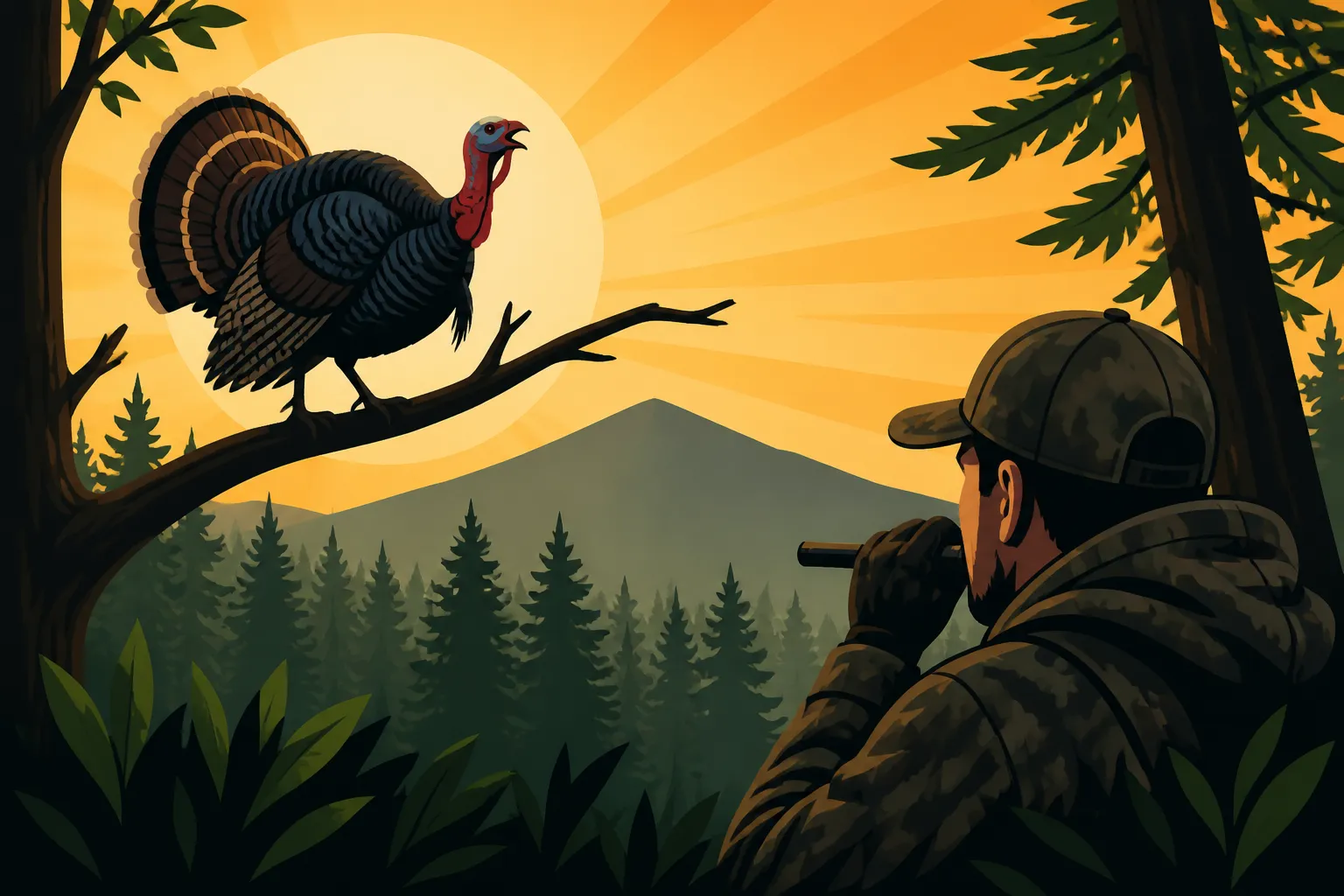
Timing your first calls is crucial. You want to pique his interest without overdoing it or alerting him to your exact location too early. Often, the best time to start calling is when he lets out his first few gobbles from the roost. A soft, subtle "tree yelp" is an excellent choice for an opener. This is a quiet, contented series of yelps that mimics a hen waking up on the roost. It’s not loud or aggressive; it’s just enough to say, "Hey, I'm here, and I'm a hen." Use a friction call, like a slate or pot call, or even a mouth call for this, keeping the volume low.
As legal shooting light approaches and you sense the gobbler is getting ready to fly down (he might be gobbling more frequently, or even hear the tell-tale wing beats of real hens flying down), you can escalate slightly. A "fly-down cackle" is a fantastic call to add at this point. This mimics the excited, rapid clucking and cackling of a hen as she flies down from the roost. It sounds natural and creates a sense of urgency and excitement. You can even simulate wing beats by flapping a cap or small branch against your leg. This combination tells the gobbler that there's a hen ready and waiting for him on the ground. For more specific advice, check out Best Call for a New Hampshire Spring Gobbler.
Aggressive Calling vs. Subtle Enticement
The decision to call aggressively or subtly often depends on the gobbler's response and the stage of the breeding season. Early in May, when gobblers are hot and unpressured, a bit more aggressive calling can be effective. Sharp, loud "cutts" (a series of abrupt, excited clucks) followed by robust "yelps" (a series of higher-pitched, longer clucks) can really get a gobbler fired up, making him gobble hard and commit quickly. This conveys a sense of impatience and readiness from a hot hen, which can be irresistible to an eager gobbler.
However, if the gobbler seems hesitant, or if it's later in the season and he's been called to before, subtlety is often your best friend. Soft "clucks" and gentle "purrs" can convey a sense of calm contentment, making him feel at ease. Sometimes, just a few soft yelps every 10-15 minutes is all it takes. Think of it as simply confirming your presence without being demanding. Too much aggressive calling can sometimes make a wary gobbler suspicious, especially if he's not seeing the hen he's hearing. Always listen to his response: if he's gobbling softer or less frequently, it might be time to back off the aggressive calls.
Patience and Knowing When to Adjust
Patience is a turkey hunter's greatest virtue, especially when working a roosted bird. Once you've made your initial calls and the gobbler has responded, resist the urge to over-call. Give him time to process the information, fly down, and make his approach. Turkeys move slower than you think, often strutting and preening on the way. If he stops gobbling or seems to hang up, give him 10-15 minutes of silence before trying a soft series of clucks or yelps again. Sometimes, that silence is all it takes to make him wonder where that "hen" went, prompting him to come look.
Knowing when to adjust your strategy is also crucial. If a gobbler flies down and immediately heads in the opposite direction, or if he's "hung up" at a certain distance and won't come closer, you might need to make a move. This could involve slowly circling around to get in front of his line of travel or trying a different setup spot. However, repositioning a roosted bird can be risky, as it increases your chance of being spotted. This is where Run-and-Gun Turkey Tactics on Public Land might come into play later in the morning, but for a roosted bird, stealth is key. If the gobbler simply flies down and walks off with real hens, it's often best to pack up and try a new location, rather than pressuring him further. Learning from each experience will make you a better hunter.
Decoy Strategies for Roosted Gobblers
Decoys are an incredibly effective tool for luring a gobbler off the roost and into close range. Turkeys are highly visual creatures, and seeing a "hen" on the ground where they expect one to be can often be the final convincing factor they need to commit. However, decoy use requires careful planning and placement.
Single Hen Decoy: The Classic Approach
For many hunters, a single hen decoy is the go-to choice when targeting roosted gobblers, and for good reason. It’s simple, effective, and less likely to spook a wary bird than a more elaborate setup. The visual of a lone hen on the ground, seemingly oblivious, can be incredibly alluring to a gobbler looking to gather his harem right after fly-down. You're giving him exactly what he expects to see once he drops off the limb.
When placing a single hen decoy, positioning is key. Place it 15-20 yards from your setup, creating an ideal shooting distance for an approaching gobbler. Position it slightly off to one side of your anticipated shooting lane, ensuring the gobbler approaches with his attention fixed on the decoy, not on you. Consider the decoy's pose: a feeding hen pose often conveys calm and contentment, while a breeding or receptive hen pose can be a more aggressive invitation. In areas with high hunting pressure, a feeding hen might be less intimidating. Make sure the decoy is visible from the roost tree, offering a clear line of sight, which is an important consideration for Decoy Placement for Pressured Spring Birds.
Hen and Jake Decoy Spreads
Sometimes, a single hen isn't enough, or you want to provoke a stronger, more aggressive response from a gobbler. This is where adding a jake decoy to your spread can be incredibly effective. A jake, a juvenile male turkey, represents a potential rival to an adult gobbler. Seeing a jake near a hen can ignite a powerful territorial instinct in a mature gobbler, driving him to confront the perceived intruder and claim the hen for himself. This strategy works particularly well when dealing with a gobbler that's responding well but seems hesitant to fully commit.
When using a hen and jake spread, place the hen decoy in the receptive or feeding pose, and the jake decoy 2-3 yards behind her, facing her. This mimics a jake trying to breed a hen, which is a red flag for any dominant gobbler. Place this pair about 20-25 yards from your setup, ensuring that the gobbler will approach the jake head-on, giving you a clear shot as he struts in. Using mapping apps like GoHunt can help you plan decoy placement in relation to your stand and the likely fly-down path, ensuring maximum visibility and effectiveness.
Decoy Placement and Visibility
The best decoy in the world is useless if a gobbler can't see it from his roost tree or on his approach. Visibility is paramount. When setting up, walk out to where you expect the gobbler to fly down and look back towards your decoy spread. Are there any branches, bushes, or terrain features blocking the view? Clear these obstructions if possible. Turkeys have fantastic eyesight, and they will scan the ground carefully before committing to fly down. A decoy that suddenly appears after they’ve landed can sometimes be a red flag.
Consider the angle of the sun as well. Position your decoys so they aren't silhouetted against the bright morning sky, making them harder to distinguish. Instead, try to have the sun shining on them if possible, enhancing their natural colors. If you’re hunting near a field edge, place decoys just inside the timber line or right on the edge where they're most visible to a bird flying down from trees further back in the woods. Ensure your decoys are stable and won't spin wildly in the wind, which can look unnatural and spook an approaching gobbler.
Common Challenges and Troubleshooting
Even with the best scouting and setup, turkey hunting can throw you curveballs. Gobblers are wild animals, and their behavior can be unpredictable. Knowing how to react when things don't go according to plan is what separates a seasoned hunter from a novice.
The "Hung-Up" Gobbler: Why He Won't Commit
Perhaps the most common frustration in spring turkey hunting is the "hung-up" gobbler. You've called him in, he's gobbling his head off, but he just won't come that last 50-75 yards. He might be standing behind a ridge, on the other side of a fence, or just out of sight in thick cover, strutting and gobbling but refusing to step into your shooting lane. There are several reasons for this behavior:
- He's expecting the hen to come to him: Gobblers are inherently lazy and dominant. They expect hens to come to them. If your calls are too static, he might just wait for you to close the distance.
- Presence of real hens: If he has real hens with him, they will almost always dictate his movement. He won't leave live hens for a phantom one, no matter how good your calls are.
- Obstacles: A fence, a creek, a dense brush line, or even just a slight rise in the terrain can be enough to make him pause, especially if he can't see the "hen."
- Wary of the setup: If he's been pressured before, he might be suspicious of the area or the sounds. He's looking for anything unnatural.
- Predator presence: Even a distant coyote or hawk can make a gobbler incredibly cautious and unwilling to move into the open.
To counteract a hung-up gobbler, try these tactics:
- Go silent: Sometimes, ceasing all calling for 10-15 minutes can make him nervous and curious enough to come investigate the silence.
- Move away: If he's hung up at 70 yards, try backing off 15-20 yards, calling softly as you go. This mimics a hen losing interest and moving away, sometimes provoking him to follow.
- Aggressive comeback: If silence fails, try an aggressive series of cutts and yelps, mimicking a hen that's getting impatient.
- Flock talk: If you suspect real hens are present, try imitating soft hen clucks and purrs, subtly trying to draw the real hens towards you, and thus, the gobbler.
Dealing with Obstacles and Other Turkeys
New Hampshire's varied terrain means you'll encounter obstacles: stone walls, barbed wire fences, creeks, and thick swampy areas. A gobbler, even a hot one, might refuse to cross these barriers if he can't clearly see a reason to. Pre-scouting helps identify these areas, allowing you to set up on the correct side of an obstacle. If you're caught off guard, and a gobbler hangs up behind an obstacle, you might need to make a move. Carefully and quietly try to reposition yourself to eliminate the barrier or get to his side of it. This is a high-risk, high-reward maneuver that demands extreme caution and stealth.
The presence of other turkeys is also a significant factor. If a gobbler flies down with a whole harem of real hens, your chances of pulling him away plummet. Those real hens are his priority. In this scenario, trying to "call the hens away" from the gobbler can sometimes work. If you can get the hens curious and coming towards your setup, the gobbler will often follow. If jakes are present, they can sometimes mess up your setup by coming in first and alarming the gobbler, or worse, scaring him away before he commits. Be ready for these dynamics.
What to Do When the Roost Hunt Fails
It's going to happen. You hear a gobbler sound off beautifully from the roost, you set up perfectly, you call your heart out, and he flies down and vanishes into the woods, or simply walks off with real hens. Don't despair, and don't take it personally. Turkey hunting is tough, and these birds are incredibly smart. When a roost hunt fails, it’s not the end of the day; it’s simply time for a new approach.
First, give the area some time to cool down, perhaps 30-45 minutes. The gobbler might have moved off, but another one might still be in the area, or the same gobbler might circle back. Then, it's time to transition to a more mobile, "run-and-gun" style of hunting. This involves actively walking, stopping every 100-200 yards to call loudly and listen for responses. Focus on areas where you know turkeys like to feed or strut later in the morning, such as open hardwoods, field edges, or logging roads. This is where your pre-season scouting, potentially aided by GoHunt maps, will pay dividends again, as you’ll know general areas where turkeys frequent throughout the day. Remember, you have a New Hampshire Two-Bird Spring Limit, so there’s always another opportunity. Learn from the experience, adjust your tactics, and keep hunting!
Turkey Calling Guide for Roosted Gobblers
Here's a quick reference for common turkey calls and how they apply to calling a gobbler off the roost.
| Call Type | Description | Best Use for Roosted Gobblers | Common Sound Effect |
|---|---|---|---|
| Tree Yelp | Soft, contented series of yelps, low in volume, mimics a hen waking up. | First call of the morning, just before legal light, to signal your presence. | Yeeowp, yeeowp, yeeowp (soft, drawn out) |
| Fly-Down Cackle | Rapid, excited series of clucks and cackles, often accompanied by wing beats. | As hens (or the gobbler) are about to fly down, creating a sense of urgency and excitement. | Cutt-cutt-cutt-CACKLE! |
| Plain Yelp | A series of 5-7 clear, distinct yelps, louder than a tree yelp. The basic turkey "hello." | After fly-down, if the gobbler is on the ground but hesitant, to maintain interest. | Yelp, yelp, yelp, yelp |
| Cluck | A single, sharp, short note; a basic contact call or alert. | Soft, single clucks every few minutes after fly-down to maintain contact without over-calling. | Putt! |
| Purr | Soft, rolling, contented sound often made by feeding hens. | Very subtle invitation if a gobbler is hung up or wary; signals calm and safety. | Prrrrrrrrrr (soft, rolling) |
| Cutt | Sharp, excited, often aggressive series of short, choppy clucks. | To challenge a gobbler or simulate an excited hen; can be used if he's hung up or needs a confidence boost. | Cutt-cutt-Cutt-CUTT! (loud, sharp) |
| Gobble | The distinctive call of a male turkey. | Not usually used by hunters to a roosted gobbler, but rather to locate birds before legal light (shock gobble). | Gobble-gobble-gobble! |
Disclaimer
Hunting is an inherently dangerous activity. The information provided in this guide is for informational purposes only and should not be taken as a substitute for proper training, adherence to all local, state, and federal hunting regulations, and common sense. Always prioritize safety, understand your equipment, and scout thoroughly. New Hampshire Fish and Game regulations are subject to change; always consult the most current digest before heading into the field.