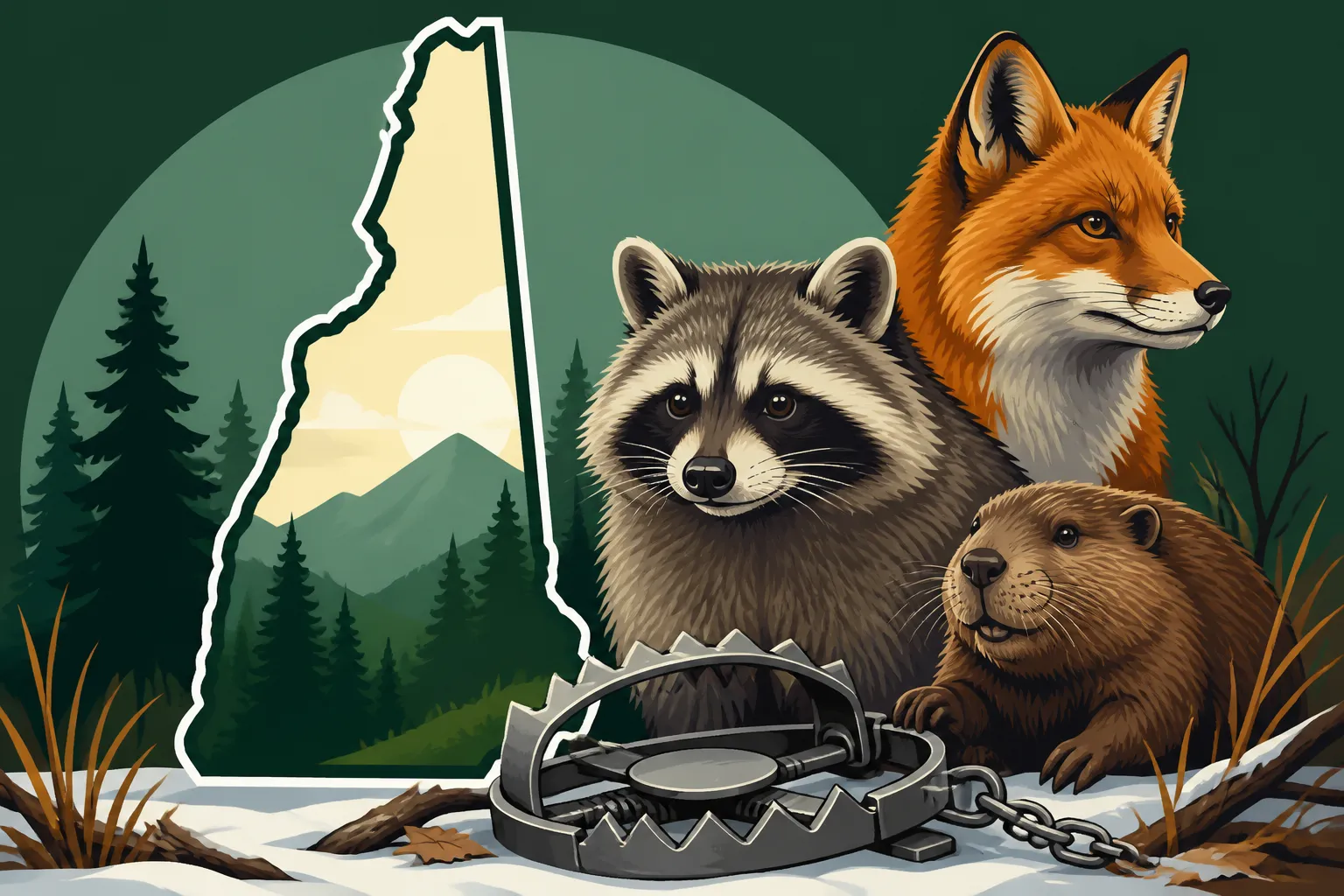
Trapping New Hampshire Furbearers
Trapping furbearers in New Hampshire can feel like stepping into a different era, demanding a deep understanding of the land, animal behavior, and a maze of regulations. It's not just about setting a trap; it's about ethical practice, knowing your specific Wildlife Management Unit (WMU) rules, and really connecting with the rhythm of the Granite State's wild places. This guide aims to demystify the process, offering seasoned advice on navigating the regulations, choosing the right gear, and implementing responsible trapping techniques for a successful and ethical season.
Understanding New Hampshire's Furbearer Landscape
Key Furbearer Species and Their Habitats
New Hampshire is blessed with a diverse array of furbearer species, each playing a unique role in our ecosystem and offering distinct challenges and rewards for the trapper. From the elusive bobcat to the industrious beaver, knowing where these animals live, what they eat, and how they move is the bedrock of successful trapping. You're not just setting a trap; you're entering into a conversation with the landscape itself, learning to read the subtle cues nature provides.
Take the beaver and muskrat, for instance. You'll find them almost exclusively in aquatic environments – the slow-moving rivers, the quiet ponds, the marshy edges of beaver flowages. Understanding their dam-building habits, their lodges, and their travel routes along submerged runs is crucial. For these species, your scouting will involve reading water, looking for fresh cuttings, and pinpointing pinch points along their aquatic highways. You might even find yourself Hunting a Beaver Flowage Edge for signs of their activity, noting how they utilize natural cover and underwater trails.
Then you have the foxes (red and gray) and coyotes, which are far more adaptable. You’ll find them in open farmlands, forested tracts, suburban fringes, and even the edges of our mountain towns. Their diets are broad, ranging from small rodents and rabbits to fruit and carrion. Trapping these can mean setting up in diverse areas, from field edges to logging roads. Meanwhile, species like bobcats and fishers prefer denser, more remote forested areas, often associated with mixed woods or conifer stands. They're more solitary and require careful scouting for sign like tracks, scat, and active travel corridors, often along old logging trails or natural funnels through the timber. Species like mink and otter, while tied to water, will also travel over land, making them a unique challenge.
The Role of Trapping in Wildlife Management
It's easy for folks outside the trapping community to misunderstand why we trap, but it's much more than just harvesting furs. Trapping is a vital tool in New Hampshire's comprehensive wildlife management strategy, helping to maintain healthy populations and mitigate conflicts between wildlife and human interests. Without it, certain furbearer populations could spiral, leading to habitat degradation, disease spread, and economic damage, impacting everything from timber to local infrastructure.
Consider the impact of uncontrolled beaver populations. While beneficial in moderation, too many beaver can flood valuable timberland, block culverts, and damage agricultural fields, creating serious property issues for landowners. Regulated trapping helps keep these populations in check, ensuring a balance between their ecological benefits and human needs. Similarly, trapping can help manage coyote populations, particularly in areas where they might be impacting livestock or deer fawn recruitment. It’s a proactive approach that ensures the overall health of the ecosystem, which is something we all care deeply about.
The New Hampshire Fish and Game Department relies on trappers to provide data and help achieve management goals. This isn't just a free-for-all; it's a carefully regulated activity designed to be sustainable and beneficial. Trappers often act as the eyes and ears on the ground, reporting observations that contribute to a broader understanding of furbearer health and distribution. This cooperative effort ensures that species remain abundant for future generations to enjoy, whether through trapping, hunting, or simply observing them in their natural habitat.
Navigating New Hampshire's Trapping Regulations and Licensing
Essential Licenses and Permits for Trappers
Before you even think about setting steel in New Hampshire, you absolutely need to make sure your legal ducks are in a row. It’s not just a good idea; it’s the law, and the fines for non-compliance can be steep. First and foremost, you'll need a valid New Hampshire hunting or trapping license. For most furbearer trapping, you’ll be looking at the New Hampshire Trapping License Requirements. This isn't just a formality; it demonstrates that you've completed the necessary education and understand the responsibilities that come with trapping.
Beyond the basic license, some specific furbearers or methods might require additional permits. For instance, if you're trapping beaver or otter, there might be specific tag requirements, similar to how deer or moose tags work for hunters. You typically receive these tags when you purchase your license, and they must be affixed to the animal immediately upon harvest. Always check the current New Hampshire Hunting and Trapping Digest; it’s your bible for the season. Don't rely on last year's knowledge, as regulations can and do change annually.
You can usually purchase your licenses and permits directly through the New Hampshire Fish and Game online portal or at authorized vendors across the state. Many trappers find it most convenient to manage their licenses online, especially if they are also buying other permits like for hunting. Carrying proof of your license, whether physical or digital, is essential when you're out on the trapline. Neglecting these fundamental steps can lead to severe penalties, including fines and loss of privileges, so always prioritize being fully compliant.
Season Dates and Bag Limits by Species
This is where things get really specific and where you must pay close attention. New Hampshire's furbearer seasons are not uniform; they vary by species and sometimes even by region (though less so for trapping than for deer hunting). Missing a season opener or, worse, trapping outside the legal dates can land you in serious trouble and jeopardize conservation efforts. For example, the season for New Hampshire Fox and Bobcat Trapping Season will have specific start and end dates, and usually specific bag limits on bobcats, if they're open for harvest at all (bobcats are highly regulated and often have restricted seasons or are closed entirely).
Coyote trapping often has a very long season, sometimes year-round with certain restrictions, but it’s crucial to know the specific New Hampshire Coyote Hunting Season Rules if you're combining methods (e.g., using calls then setting traps). For beaver and otter, seasons are typically set to coincide with prime fur conditions and biological cycles, often opening after the initial cold snaps and running well into spring. The best way to stay on top of this is to grab the current year's digest as soon as it's released, usually in late summer. I've found it helpful to mark the season dates on a wall calendar or even set reminders on my phone, especially for those species with shorter windows. It's a small detail that can save a lot of headaches later.
Here's a simplified look at general furbearer seasons in New Hampshire. Always consult the current Fish & Game Digest for exact, up-to-date regulations.
| Furbearer Species | General Season Window (Consult Digest for Exact Dates) | Typical Bag Limit | Notes |
|---|---|---|---|
| Beaver | Late Oct – Mid-April | No limit | Specific tagging & reporting rules apply |
| Muskrat | Late Oct – Mid-April | No limit | Often targeted with similar aquatic sets |
| Otter | Late Oct – Mid-April | 4 per season | Specific tagging & reporting rules apply |
| Fox (Red & Gray) | Late Oct – End of Feb | No limit | Can be trapped with land or water sets |
| Coyote | Oct – End of March (Trapping); Year-round (Hunting) | No limit | Check differences between trapping and hunting rules |
| Fisher | Late Oct – End of Jan | 1 per season | Highly prized fur; check specific WMU rules |
| Bobcat | Highly restricted/Often Closed | Very limited/0 | Conservation status; verify open seasons carefully |
| Mink | Late Oct – End of March | No limit | Often caught incidentally in muskrat/beaver sets |
| Raccoon | Early Sept – Mid-Dec | No limit | Good for beginner trappers due to accessibility |
| Skunk | No closed season (check local ordinances) | No limit | Primarily for nuisance control or incidental catch |
Legal Trapping Methods and Equipment Restrictions
New Hampshire has stringent rules about the types of traps you can use, where you can place them, and how they must be marked. These regulations are designed to ensure humane treatment of animals, minimize non-target catches, and promote public safety. Ignoring them isn't just illegal; it's unethical and can give all trappers a bad name. For instance, body-gripping traps (like Conibears) have specific size restrictions and setback requirements from public ways or buildings. You can't just slap a large Conibear anywhere near a trail; you need to ensure it's safely out of reach of pets and people, or in a water set where accidental catches are less likely.
Leghold traps (sometimes referred to as foothold traps) also have size limits and often require specific features like laminated jaws, offset jaws, or swivels and shock springs to prevent injury to the animal. There are also strict rules concerning trap tags – every trap you set needs to be clearly marked with your name and address or your New Hampshire Fish and Game ID number. This helps enforcement officers identify legal traps and allows them to contact you if there’s an issue. It’s also crucial to understand the nuances of legal equipment, much like understanding New Hampshire Crossbow Equipment Requirements for hunting. When scouting, having a reliable mapping app like GoHunt on your phone can help you identify public ways and property boundaries, ensuring you're setting your traps legally and respectfully. This is invaluable when you're trying to figure out if you're 50 feet from a trail or 100 feet from a dwelling.
Ethical Trapping Practices and Animal Welfare
Quick Check and Dispatch Protocols
Ethical trapping isn't just a buzzword; it's the core of responsible furbearer management. It demands that trappers minimize suffering and ensure a quick, humane end for any animal caught. This means adhering to strict trap check regulations. In New Hampshire, typically, all traps, other than those set completely under ice, must be checked at least once every 24 hours. This daily check is non-negotiable. It ensures that an animal isn't left in a trap for an extended period, which reduces stress, injury, and exposure to predators. Failing to check traps promptly is a serious ethical and legal breach.
When you approach a trap, do so cautiously and quietly. You never know what you might find, and startling an animal can be dangerous for both of you. Always assume an animal is alive and potentially aggressive. Upon discovery of a caught animal, the dispatch must be swift and humane. This typically involves a quick, precise shot to the head for larger animals, using a small caliber firearm (.22 rimfire), or a sharp, forceful blow to the skull for smaller furbearers, ensuring immediate unconsciousness and death. Methods like drowning for aquatic furbearers are often acceptable and effective when done properly and swiftly, minimizing distress. This isn't for the faint of heart, but it's a necessary and non-negotiable part of the ethical trapper's responsibility. Your New Hampshire Hunter Education Requirements course, or a specific trapper education course, will cover these protocols in detail, emphasizing the importance of humane handling.
Avoiding Non-Target Species and Relocation
One of the biggest concerns for both trappers and the general public is the accidental capture of non-target animals, especially domestic pets or protected species. Responsible trappers employ several strategies to minimize this. Location is paramount: avoid setting traps in areas heavily frequented by dog walkers, hikers, or where protected species are known to reside. Trap choice also plays a role; for example, using smaller traps in certain areas can reduce the likelihood of catching a larger non-target animal, while exclusion devices or specific set types can further filter catches.
Another strategy is using "exclusion devices" or setting traps in ways that make them less accessible to non-targets. For instance, dog-proof traps are specifically designed to be difficult for most animals other than raccoons to activate. If, despite your best efforts, you do catch a non-target animal, you must know how to safely and legally release it, if it's unharmed and an allowed species. Releasing a domestic animal is generally straightforward, but releasing a protected wild species might require contacting New Hampshire Fish and Game for guidance. The rules around New Hampshire Wildlife Rehabilitation for Injured Game or unintended catches are clear: you can't just move an animal to another location without proper permits, as this can spread disease or create new ecological problems or stress on the relocated animal. Always prioritize the welfare of the animal and respect the regulations.
Setting Up Your Trapline in New Hampshire's Diverse Terrain
Scouting and Location Selection for Success
Setting a successful trapline in New Hampshire is 90% scouting and 10% actual trapping. You can have the best traps and lures, but if they're not in the right spot, you're just wasting your time. This isn't a passive activity; it's an active hunt for information, often starting months before the season opens. You're looking for fresh sign: tracks, scat, rub lines, dens, active feeding areas, and travel corridors. For beaver, you're looking for fresh cuttings and well-worn runs in the water. For fox and coyote, you're identifying natural funnels, pinch points, and scent posts along field edges, logging roads, or small wooded fingers.
Mapping tools are invaluable here. Applications like GoHunt, along with the New Hampshire Fish and Game app, can provide detailed aerial photography, topographic maps, and land ownership data. This allows you to identify potential Public Hunting Land in New Hampshire, navigate tricky terrain, and even visualize how animals might move through a specific area before you ever step foot on it. You're essentially Reading Aerial Photos for North Country Deer but applying that same principle to furbearers – understanding habitat features and how they influence animal movement. Look for areas where different habitat types converge – a marsh meeting a hardwood ridge, a cornfield bordering a thicket, or a small creek meandering through a timber stand. These are often high-traffic zones for furbearers.
When scouting, don't just look for where animals are, but how they are using the landscape. Are they following an old stone wall? Are they consistently crossing a narrow section of a creek? Are they denning under an old blowdown? Pinpointing these predictable patterns will dramatically increase your chances of success. It's about thinking like the animal you're trying to catch and anticipating their movements.
Practical Setups for Water and Land Traps
The art of trapping truly shines in the execution of your sets. A well-chosen location needs a well-executed set to be effective. For water trapping (beaver, muskrat, otter, mink), common sets include:
- Runway Sets: Placing a trap directly in an active travel run, often partially submerged. These are powerful because animals are almost guaranteed to use these pathways between feeding and denning areas.
- Lodge/Den Sets: Placing traps near the entrance of a beaver lodge or muskrat den. This requires careful approach to avoid disturbing the animals too much and ensuring the trap is deep enough to prevent freezing or being seen.
- Feeding Area Sets: Utilizing a mound of fresh cuttings (a "castor mound" for beaver) with a trap nearby. The natural curiosity of other beavers will draw them in.
- Culvert Sets: Placing traps in culverts where animals are forced to pass through a narrow opening. These are excellent choke points, but require careful anchoring and public safety considerations.
For land trapping (fox, coyote, bobcat, raccoon, fisher), you'll primarily use foothold traps and some body-gripping traps in protected cubbies:
- Dirt Hole Sets: Simulating a burrow where an animal might investigate food or scent. This involves digging a small hole, placing bait/lure, and burying a trap nearby, blended naturally into the ground with surrounding debris.
- Flat Sets: Similar to dirt holes but without the hole, using a natural object like a log or rock as a visual attractant for a scent post. The lure is placed on the object, not in a hole.
- Scent Post Sets: Using a raised object (tuft of grass, small bush) as a point of interest for an animal to mark, placing a trap strategically nearby. This leverages their territorial marking behavior.
- Blind Sets: Placing a trap directly in a known travel lane without any bait or lure, relying solely on the animal's natural movement. This is a very advanced technique that requires intimate knowledge of animal paths.
Remember, blending your set into the natural environment is critical. Animals are incredibly wary, and anything out of place can make them avoid your trap. Using a Ground Blind on Public Land is an analogy for the need to be invisible; your trap set should be equally discreet and natural. Always make sure your traps are solidly anchored to prevent escape.
Utilizing Lures and Baits Effectively
Lures and baits are the final pieces of the puzzle that draw furbearers to your precisely placed traps. They are essentially olfactory and visual advertisements, signaling an attractive opportunity to a passing animal. The key is understanding what each species finds appealing and how to use these attractants in a way that encourages investigation without alarming them. The right lure can turn a good location into a great one.
Baits are typically food items – meat scraps for predators like coyotes and fox, fish for otter and mink, or vegetables/apples for raccoons. The fresher and more natural the bait, the better, though some trappers prefer a slightly rancid scent for certain species due to its stronger, lingering aroma. Lures, on the other hand, are concentrated scents designed to stimulate curiosity, hunger, or territorial instincts. These can be gland lures (made from the animal's own glands), urine, or food-based lures (like sweet, musky, or skunky smells). New Hampshire also has specific rules on New Hampshire's Natural Lure Restrictions, so be sure to check those before using any attractants derived from deer or moose.
Placement is crucial. For dirt hole sets, a small amount of lure or bait placed in the hole, with the trap set slightly off to the side, works wonders. For flat sets, it might be smeared on a raised object. Always consider the wind direction to carry the scent downwind into potential travel corridors, maximizing its reach. And remember, less is often more with lures; a powerful, overwhelming scent can sometimes be too alarming and deter cautious animals. Experimentation and paying attention to what's working (or not working) in your specific area is key to mastering the use of lures and baits.
Processing and Utilizing Your Harvested Furbearers
Field Care and Skinning Techniques
Your work isn't over once you've successfully trapped and humanely dispatched an animal. The quality of the fur, and thus its value, depends heavily on proper field care and skinning. The clock starts ticking as soon as the animal is harvested. Especially in warmer weather, getting the animal cooled down is paramount to prevent spoilage of the fur and meat. If you're deep in the woods, consider a cool spot in the shade or even bringing a cooler with ice if practical, as quick cooling maintains the integrity of the pelt.
Skinning is an art form that takes practice and patience. Each species has a slightly different skinning technique, but the general principle is to remove the pelt cleanly, without cuts or holes, and to remove as much fat and flesh as possible. For most furbearers like fox, coyote, and fisher, they are "cased" skinned, meaning the pelt is pulled off like pulling a sweater inside-out, leaving the fur on the inside. Beaver and muskrat are typically "open" skinned, laid flat. After skinning, the pelt needs to be properly fleshed (removing remaining fat and meat with specialized tools) and then stretched and dried on a form. This might sound daunting, but there are excellent instructional videos and experienced trappers who can show you the ropes, or you can find detailed guides through resources like GoHunt. Taking pride in this final step ensures you're honoring the animal and maximizing the potential of your harvest.
Marketing and Selling Your Furs
For many trappers, the allure of the trapline isn't just the chase, but also the economic return from selling furs. The fur market fluctuates, driven by fashion trends, international demand, and even global politics. Knowing the market and understanding how to grade your furs can significantly impact your income. Historically, reputable fur buyers travel through New England during trapping season, purchasing pelts directly from trappers. There are also larger regional or national fur auctions, such as those held by the North American Fur Auctions (NAFA) or the Fur Harvesters Auction (FHA), where you can ship your furs for sale.
Before selling, it's wise to research current market prices for different species and different grades of fur. A well-prepped, clean, and properly stretched pelt will always fetch a higher price than a poorly handled one, making the effort in field care and skinning truly pay off. Connecting with local trapping associations or experienced trappers can provide invaluable insights into the current market and where to sell your furs for the best return. Even if the prices are low, the experience of trapping, the connection to nature, and the meat from species like beaver and raccoon often make the effort worthwhile. It's a craft that rewards dedication and skill.
Preparing Furbearer Meats and Other Products
Beyond the fur, many furbearers offer excellent table fare and other valuable products. It’s a common misconception that furbearers are just for their pelts; a responsible trapper utilizes as much of the animal as possible, embodying a deep respect for the resource. Beaver, for example, is renowned for its rich, dark meat, often compared to pot roast or beef. Slow-cooked, stewed, or ground, it's a delicious and sustainable source of protein that many outdoor enthusiasts enjoy. Raccoon meat, while often fattier, can also be quite tasty when properly prepared, often requiring trimming of excess fat and slow cooking with savory spices.
Even species like coyote, while not typically eaten, can yield valuable canine teeth for crafts or a cleaned skull for display. Bear fat, when rendered, can be used for cooking or even in traditional medicines and balms, prized for its high energy content and versatility. Utilizing these other parts of the animal is a testament to the trapper's commitment to minimizing waste and understanding the full value of their harvest. There are numerous recipes available online and in old homesteading books for preparing furbearer meats, encouraging you to explore the full bounty of your efforts and appreciate the diverse contributions of these animals to our ecosystem.
Disclaimer
The information provided in this guide is for general informational purposes only and is not intended as legal advice. Hunting and trapping regulations in New Hampshire are subject to change. Always consult the most current New Hampshire Fish and Game Department hunting and trapping digest or visit their official website for the most accurate and up-to-date laws, rules, and season dates before engaging in any hunting or trapping activities. It is your responsibility to know and follow all applicable laws.