Hunting a Standing Corn Field for Deer
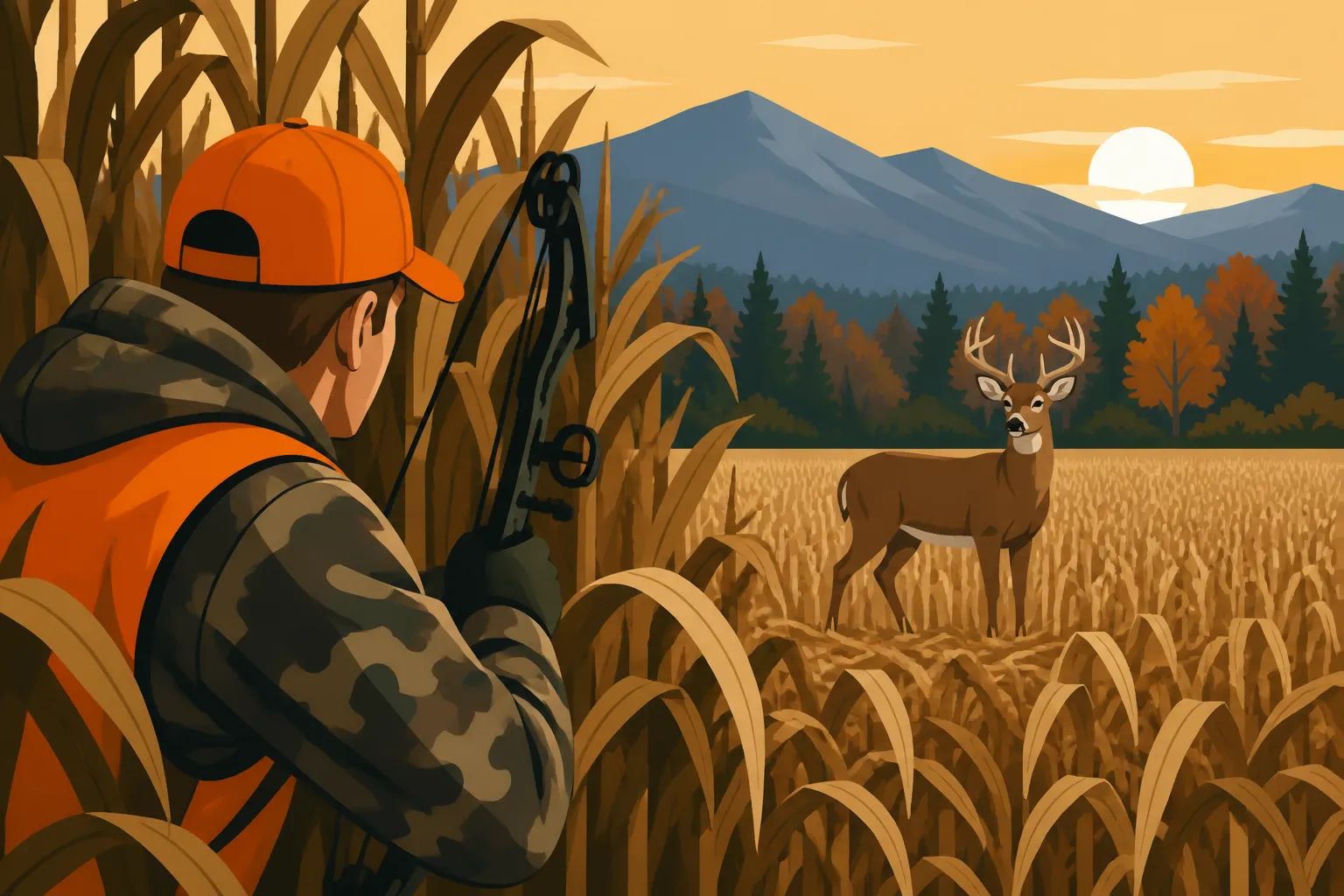
Hunting deer in standing corn fields in New Hampshire can feel like trying to find a needle in a haystack – those whitetails have an incredible amount of cover and food, allowing them to disappear into thin air. This guide will walk you through the frustrating but rewarding challenge of effectively scouting, tracking, and ultimately harvesting deer that utilize these prime late-season food sources.
Understanding Deer Behavior in Standing Corn
Deer are incredibly adaptable creatures, and their behavior shifts dramatically when they have access to a standing cornfield. It's not just a food source; it's an entire ecosystem for them, offering everything they need to thrive, often right under our noses.
Why Deer Love Standing Corn
Imagine a deer's perfect world: unlimited, high-energy food right next to impenetrable cover that offers both concealment from predators and shelter from the elements. That's precisely what a standing cornfield provides. For much of the late summer and fall in New Hampshire, as natural forage dwindles, the corn becomes a crucial caloric supplement. It's a high-carbohydrate meal that helps them pack on fat reserves for the coming winter and sustain themselves through the rigors of the rut.
Beyond the nutrition, the dense stalks offer unparalleled security. A deer can bed down just a few rows deep and be virtually invisible. The rustling leaves provide a natural sound barrier, masking their movements and making it difficult for hunters to hear them. This creates a sense of safety that encourages deer to spend the majority of their time within the confines of the field, often only venturing out at the edges under the cover of darkness. They feel protected, and that feeling of security is a powerful magnet, especially for mature bucks who are notoriously wary.
Daily Movement Patterns Within the Field
Deer in standing corn often establish distinct, albeit subtle, movement patterns. They don't just wander aimlessly. During daylight hours, they typically bed deep within the corn, usually in the thickest, most secluded sections. As evening approaches, they'll begin to move towards the edges of the field, often following established deer trails that lead to a specific "dining area" within the corn or to an adjacent woodlot or food plot. These trails can be surprisingly hard to detect, as they're often just slight depressions in the rows, or faint paths between the stalks.
Morning movements are essentially the reverse. After feeding through the night, deer will slowly filter back into the core of the cornfield, seeking out their bedding areas before first light. However, increased hunting pressure or even a slight change in weather can throw these patterns completely off. A wise hunter knows that observing these subtle entry and exit points is critical. Sometimes, deer will even stage just inside the corn, browsing on the outer rows before committing to a crossing or an adjacent wooded area. This is where a good scouting app can come in handy; using the GoHunt app to mark these observations on an aerial map can help you visualize patterns over time.
Impact of Weather and Pressure
New Hampshire's weather can be unpredictable, and both cold fronts and sudden warm spells will influence how deer use a cornfield. On bitter cold days, especially after a frost or an early snow, deer are often more active within the corn, feeding more heavily to meet their increased metabolic demands. They might stay bedded longer in the thick cover to conserve energy, but when they do move, they'll be focused on feeding. Conversely, during unusually warm periods, deer might become more nocturnal, staying bedded deep in the coolest parts of the corn during the day and only emerging after dark.
Hunting pressure is another significant factor. If a cornfield is heavily hunted, deer will quickly adapt by becoming almost entirely nocturnal, entering and exiting only in the darkest hours. They'll learn to avoid common entry points and will be extra skittish. This is why it’s so important to be discreet with your access and exit routes, minimizing disturbance. If the adjacent woods are getting hammered, the cornfield becomes an even more attractive sanctuary, possibly causing deer to spend even more daylight hours completely hidden within the stalks. Understanding these factors helps you determine When the New Hampshire Rut Peaks and how deer movements might change in these fields during that crucial time.
Scouting Strategies for Cornfield Deer
Effective scouting is the backbone of successful cornfield hunting. You can't just walk in and expect to bump into a deer; they're masters of concealment. It requires patience, keen observation, and often, a little technological assistance.
Pre-Season Reconnaissance
Long before the hunting season begins, ideally in late summer, take the time to drive or walk the perimeter of the cornfield. Look for obvious deer trails leading into and out of the corn, especially those connecting to woodlots, creek bottoms, or thick cover nearby. Pay close attention to corners, natural funnels created by hedgerows, or sections where the corn abuts a dense forest edge. These are often primary travel corridors.
During this phase, resist the urge to walk deep into the standing corn itself. You don't want to disturb the deer or leave your scent any more than necessary. Instead, use binoculars to glass the edges from a distance, particularly during dawn and dusk. Look for deer entering or exiting the field. Note where the corn is thinnest or where deer might have created natural "doorways" by pushing through the stalks. These early observations will give you a baseline understanding of how deer might initially be using the area. Knowing Where New Hampshire Bucks Bed in Thick Cover in adjacent areas can also provide clues about where they might stage before entering the corn.
In-Season Sign Reading
Once hunting season is underway, your scouting shifts to reading fresh sign. Walk the edges of the field carefully, looking for fresh tracks in the mud, especially after a rain. Look for droppings, which can indicate feeding and bedding areas. Don't just look for trails leading into the corn; look for paths within the first few rows that run parallel to the edge. These can be "staging trails" where deer move along the inside perimeter before committing to crossing into the open.
Keep an eye out for rubs and scrapes along the field edges or in adjacent woodlots. Bucks often hit these before entering the corn or after exiting. A particularly hot scrape line along a logging road bordering a cornfield is a huge indicator of consistent buck traffic. If the corn is dry enough, you might even find small pockets where deer have bedded down just inside the stalks, leaving behind matted-down areas. This kind of nuanced sign reading is essential for pinpointing those prime locations. Don't forget to pay attention to Reading New Hampshire Mud for Fresh Deer Movement.
Using Technology for Intel
Modern technology can give you a significant advantage when scouting large cornfields. Start with high-resolution aerial maps. Platforms like the GoHunt app or other digital mapping tools are invaluable here. You can identify pinch points, funnels, subtle elevation changes, and hidden pockets of cover within or around the field. These maps allow you to scout hundreds of acres from your couch, planning your approach and stand locations long before you ever get boots on the ground. You can mark potential entry and exit routes, specific trees for stands, and even plan your access routes to minimize disturbing deer.
Trail cameras are another powerful tool, especially placed on trails leading into the corn, or on scrapes along the edges. Consider using a cellular trail camera if your property has service; this allows you to monitor deer activity in real-time without repeatedly visiting the field and leaving scent. Place cameras at key intersections of trails or near the mouth of a suspected entry point into the corn. Be mindful of New Hampshire's regulations regarding trail camera use on public versus private land. For detailed mapping and public land boundaries, tools like the GoHunt app are invaluable, providing crucial data for Reading Aerial Photos for North Country Deer and ensuring you are always on legal ground.
Effective Hunting Tactics in Standing Corn
Once you've done your homework scouting, it's time to put a plan into action. Hunting standing corn requires a unique blend of patience, stealth, and sometimes, aggressive tactics.
Stand Placement and Access
When choosing a stand location, whether a treestand or a ground blind, wind direction is absolutely paramount. Deer have an incredible sense of smell, and a shifting breeze can ruin your hunt instantly. Always prioritize the wind. For treestands, focus on trees along the edges of the cornfield that offer a clear view of known entry/exit points or trails. Look for locations where a trail might funnel deer into a specific opening or where they might pause before entering an adjacent woodlot. An ideal spot might be where the cornfield meets a dense cedar thicket, creating a natural funnel.
Ground blinds can be incredibly effective when hunting corn. They offer excellent concealment, especially if brushed in properly with corn stalks and local vegetation. Set them up far enough into the corn to break up your outline, but still offering shooting lanes to where you expect deer to move. Ensure your access and exit routes to your stand are completely hidden and don't cross any major deer trails. This often means walking a much longer, circuitous route to get to your setup unnoticed. Remember, success often hinges on being unseen and unheard during your approach. For public land scenarios, utilizing a well-placed Using a Ground Blind on Public Land can significantly increase your odds.
Still-Hunting and Drives
Sometimes, sitting still isn't enough, especially in vast cornfields. Still-hunting through the corn can be incredibly effective, but it requires immense patience and an understanding of deer movement. The key is to move slowly, often taking only a few steps every minute or two, pausing constantly to listen and look. Use the rows themselves as your guides, moving with the wind or a slight crosswind. Look for subtle movements, a flick of an ear, or a patch of hide through the stalks. The rustling of the corn can mask your sound, but it can also mask the deer's. Focus on sections of the field where you've seen fresh sign or where the corn is particularly thick, indicating potential bedding areas. This method is similar to applying Still-Hunting White Mountain National Forest Timber, just in a different cover type.
Deer drives can also be highly productive, especially in larger cornfields. This usually requires a group of hunters: "pushers" who slowly walk through the corn, and "blockers" who are strategically positioned along the edges of the field to intercept deer as they try to escape. Communication between the pushers and blockers is critical for safety and success. Pushers should move methodically, pausing often, and making some noise (but not too much) to encourage deer to move. Blockers need to be completely still, silent, and ready, anticipating where deer are most likely to try and slip out. This is a tactic often best reserved for the late season when other food sources are scarce.
Timing Your Hunt
The timing of your hunt is just as crucial as your location. Early mornings and late evenings are generally the most productive times to catch deer entering or exiting the cornfield. During these periods, deer are transitioning between bedding and feeding, making them more vulnerable. Focus on the first and last hour of legal shooting light.
However, don't discount mid-day hunts, especially on overcast days or during periods of high deer activity, like the rut. On these days, deer might move more within the cornfield itself, or make short excursions into adjacent cover. If a strong weather front is moving in, deer often become active just before it hits, trying to get a last meal in. Pay attention to those transition times when deer are likely to be on their feet. For instance, knowing how to interpret how deer use Hunting a Funnel Between Two Woodlots can inform when they might move from the corn into other cover types.
| Hunting Method | Pros | Cons | Ideal Conditions |
|---|---|---|---|
| Treestand | Excellent vantage point, scent dispersion, clear shooting lanes. | Limited mobility, fixed location, wind dependent. | Predictable deer movement, clear edges, light pressure. |
| Ground Blind | Great concealment, comfortable, adaptable to varying terrain. | Limited visibility, scent pooling, requires good brushing-in. | Dense cover, near travel routes, moderate pressure. |
| Still-Hunting | Highly mobile, covers ground, adaptable to deer location. | Requires extreme patience & stealth, difficult to carry gear. | Calm days, moderate cover density, locating bedded deer. |
| Deer Drive | Can push deer out of dense cover, effective for large fields. | Requires multiple hunters, safety concerns, can educate deer. | Heavy cover, high deer density, late season, controlled areas. |
Gear and Equipment for Cornfield Hunting
Being properly equipped can make a significant difference in your success and comfort while hunting standing corn in New Hampshire. The unique environment of a cornfield demands specific considerations for your apparel, optics, and weapon choice.
Essential Apparel
Layering is always critical for New Hampshire hunting, and cornfields are no exception. Start with a moisture-wicking base layer, followed by insulating layers, and topped with a waterproof and windproof outer shell. Even if the air temperature isn't frigid, the dew and moisture clinging to corn stalks can quickly soak through inadequate clothing. You'll want sturdy, waterproof boots that can handle walking through potentially muddy rows or wet stalks. Make sure they offer good ankle support, as the uneven ground in a cornfield can be tricky.
Camouflage patterns that mimic open hardwoods or brush are generally effective along the edges, but if you're still-hunting deep inside the corn, patterns with a vertical element or those designed for tall grass can be even better. A facemask and gloves are essential not only for concealment but also to protect your skin from the abrasive corn leaves. Remember, New Hampshire requires hunters to wear a certain amount of blaze orange during specific seasons, so ensure your outer layers meet these regulations while still allowing you to blend as much as possible with the environment.
Optics and Navigation
When you're peering through dense corn stalks, clarity and magnification in your optics are crucial. A good pair of binoculars, usually 8x or 10x magnification, will help you pick out subtle movements or parts of a deer through the cover. You might not see a full deer, but catching an ear flick or a patch of hide can be enough. A rangefinder is also vital, especially since judging distance in the uniform rows of a cornfield can be deceptive. Knowing the exact yardage to potential shooting lanes or openings will ensure ethical shots.
For navigation, a GPS device or a smartphone app with downloaded maps (like the GoHunt app) is indispensable. Getting disoriented in a large cornfield, especially on a cloudy day or after dark, is surprisingly easy. Mark your entry point, stand location, and any observed deer sign. This technology also helps you respect property lines and ensures you can confidently Finding New Hampshire Property Lines when hunting adjacent to different landowners. An offline mapping capability is a must, as cell service can be spotty in some rural New Hampshire areas.
Weapon Choice Considerations
The best weapon for hunting standing corn depends on personal preference and the specific hunting season. For firearms hunters, a shotgun with slugs is a popular choice, especially if you're still-hunting or participating in a drive. Their effectiveness at closer ranges and their ability to handle dense cover are advantageous. Rifles are also suitable, particularly for stand hunting along edges where longer shots might present themselves. Choose a caliber known for good terminal ballistics, as quick, clean kills are paramount in thick cover where blood trailing can be challenging.
Archery hunters will find that a bow or crossbow can be very effective in cornfields. Shots are typically at close range, often under 30 yards, making them ideal for archery equipment. Crossbows are permitted in certain WMUs during the archery season, so verify the rules for your specific hunting area. Regardless of your weapon, ensure it is sighted in perfectly and you are proficient with it at the ranges you expect to encounter. The dense environment means you might have only a small window for a shot, so confidence in your equipment is key. For those considering crossbows, understanding Setting Up a Crossbow in New Hampshire's Approved Units is a must.
Overcoming Common Challenges
Hunting standing corn isn't without its unique set of challenges. The thick cover, potential for scent contamination, and the difficulty of tracking a deer can test even the most experienced New Hampshire hunter.
Wind and Scent Control
This is arguably the biggest challenge in cornfield hunting. Deer live by their noses, and a standing cornfield, with its dense, often humid air, can hold and swirl scent in unpredictable ways. Your scent can easily drift down a row, alerting deer far ahead of your position or circling back to your stand. Strict scent control is paramount. This means showering with scent-eliminating soap, washing your hunting clothes in scent-free detergent, and storing them in airtight containers.
Always hunt with the wind in your favor, even if it means taking a less ideal stand location or approaching from a more circuitous route. If you're still-hunting, move into the wind or with a slight crosswind. If the wind is swirling or unpredictable, it might be best to wait for a better day. A portable ozone generator used on your clothing or in your blind can sometimes help, but nothing replaces playing the wind correctly. Always have a clear understanding of Wind and Thermals in Steep Granite Terrain, as these principles apply to cornfields, albeit in a different way.
Noise Management
The rustling of corn stalks can be a blessing and a curse. While it can mask your movement to some degree, it can also amplify your own noise or make it difficult to hear deer moving. When still-hunting, move incredibly slowly and deliberately. Wear quiet clothing that won't snag or make swishing sounds against the stalks. Avoid carrying loose items that can clank or rattle. Every step should be intentional, and every pause an opportunity to listen intently.
For stand hunting, the challenge shifts to silent access and egress. Plan your route to avoid walking through dry, brittle corn stalks if possible. Stick to field edges or established trails that you've cleared. If you're setting up a ground blind, do so well in advance of the season, allowing deer to get accustomed to its presence, and ensure it's brushed in silently. Minimal noise is always the goal, whether you're moving or sitting.
Recovering a Deer
Hitting a deer in standing corn can be incredibly exhilarating, but the real work begins with the recovery. Blood trailing in thick corn can be a nightmare. The stalks are dense, the ground can be uneven, and blood trails can be minimal or quickly obscured by dew, rain, or falling leaves. Always wait a sufficient amount of time after the shot – at least 30 minutes for a good hit, several hours for a questionable one – before beginning your track. This allows the deer to bed down and expire.
Mark your shot location clearly. Use brightly colored flagging tape to mark the start of the blood trail and every subsequent drop of blood or sign. Move slowly and methodically, looking for blood on the stalks, broken corn leaves, and tracks. If the blood trail becomes sparse, expand your search pattern in ever-widening circles. Consider recruiting a friend to help, ensuring you don't contaminate the trail by walking over it. If you lose the trail and darkness sets in, back out and return at first light with fresh eyes. Having a plan for Blood Trailing After Dark in New Hampshire is crucial, but it's always better to avoid that situation if possible.
Final Considerations for a Successful Cornfield Hunt
Hunting standing corn demands dedication and a thoughtful approach. Beyond the tactics, keeping a few overarching principles in mind can dramatically increase your chances of success.
Patience and Persistence
Deer in cornfields often feel invulnerable. They know they have the advantage of cover, and they use it to their full extent. This means you might sit for hours, or even days, without seeing a single deer emerge. It requires immense patience to wait for that one perfect opportunity. Don't get discouraged if your first few hunts are slow. The deer are there; it's a matter of timing and outsmarting them. Persistence, scouting diligently, and adapting your strategy based on deer sign and weather patterns will eventually pay off. Sometimes the best strategy is simply to keep showing up.
Respect for the Landowner
Remember that these cornfields are private property and someone's livelihood. Always obtain explicit permission from the landowner before scouting or hunting. Be clear about your intentions and respect any specific requests they may have. Avoid driving vehicles into the field, causing damage to crops, or leaving any trash behind. Leave the area cleaner than you found it. Offering to help with chores or sharing some of your venison can go a long way in maintaining a good relationship and ensuring future hunting opportunities. This goes hand-in-hand with Knocking on Doors in New Hampshire Farm Country to gain access.
Safety First
Hunting, especially in thick cover like a cornfield, always demands a commitment to safety. Be absolutely certain of your target and what lies beyond it before taking any shot. The dense stalks can obscure other hunters, farm equipment, or even residential areas. Wear sufficient blaze orange during the appropriate seasons to ensure you are visible to other hunters. If you're participating in a drive, establish clear communication protocols and stick to them. Always unload your firearm when crossing fences or encountering obstacles. Familiarize yourself with New Hampshire's hunting regulations and safety guidelines before heading into the field. This applies to every hunt, whether it's Hunting the November Firearms Opener or a late-season archery pursuit.
Disclaimer
Please be aware that hunting regulations, seasons, and licensing requirements in New Hampshire can change. It is your responsibility to consult the most current New Hampshire Fish and Game Department regulations and obtain all necessary licenses and permits before engaging in any hunting activity. This guide is for informational purposes only and does not constitute legal advice or replace official state guidelines.