Hunting the Shotgun-Only Fall Turkey Window
There's nothing quite like the crisp air of a New Hampshire fall, the leaves blazing with color, and the satisfying crunch underfoot as you head into the woods. But when it comes to fall turkey hunting, especially during that unique shotgun-only window, many hunters feel a distinct shift from the familiar spring gobbler game. The challenge of locating those elusive fall flocks and coaxing them into shotgun range can be incredibly frustrating. This comprehensive guide is designed to cut through that frustration, offering practical advice and seasoned strategies to help you navigate New Hampshire's shotgun-only fall turkey season with confidence and, hopefully, a full game bag.
Understanding New Hampshire's Fall Turkey Season Dates and Rules
Fall turkey hunting in New Hampshire has its own distinct flavor and a specific set of rules that every hunter needs to understand before heading afield. It’s not just a casual extension of the spring season; it’s a whole different ballgame, and knowing the regulations is your first step toward a successful hunt.
When the Shotgun-Only Window Opens and Closes
New Hampshire's fall turkey season typically opens in early September and runs for a set period, but there's a specific "shotgun-only" week tucked into that timeframe that often catches hunters off guard or leaves them scratching their heads. For most of the season, archery equipment is also permitted for fall turkeys, giving bowhunters a long window of opportunity. However, the designated shotgun-only week usually falls in late October or early November. This period is a critical time for many hunters who prefer the reliable stopping power and range of a shotgun, or who simply don't have access to appropriate archery gear. The exact dates can shift slightly year-to-year, so always double-check the current New Hampshire Fish and Game Department's Hunting Digest.
The rationale behind this specific window often relates to hunter safety and managing pressure. By concentrating shotgun use to a defined week, it helps to delineate hunting periods and methods. This period often coincides with cooler weather, which can influence turkey behavior as they focus heavily on feeding and bulking up for winter, making them somewhat more predictable if you know what to look for. It's also a time when many of the leaves have fallen, improving visibility but also making it harder for turkeys to hide. Understanding these nuances can help you plan your time in the woods more effectively. If you're planning your fall hunts, make sure to mark this window on your calendar specifically for turkey. For more detailed information, checking the official guide on New Hampshire Fall Turkey Season Dates is always a smart move.
Legal Shotguns and Ammunition for Fall Turkeys
When you're out there chasing fall turkeys with a shotgun in New Hampshire, it’s crucial to know exactly what kind of firearm and ammunition is permitted. Generally, shotguns 20 gauge and larger are legal, with 12 gauge being the most popular choice for its pattern density and range. However, smaller gauges, like a 20 gauge, can be incredibly effective, especially for younger hunters or those sensitive to recoil, provided they are properly patterned. The key isn't just the gauge, but the shot size and the choke you use.
For fall turkeys, you're usually looking at shot sizes like 4, 5, or 6 lead, or their heavier-than-lead equivalents. Many experienced turkey hunters swear by heavier-than-lead loads, such as those from Federal Premium or Winchester, which offer increased density and energy retention, extending your effective range slightly. A full or extra-full choke is almost universally recommended to achieve the tight, dense pattern needed to cleanly harvest a turkey. Before you hit the woods, take your chosen setup to the range and pattern it at various distances (20, 30, 40 yards) to understand its true capabilities. Knowing your maximum ethical range is paramount to making a clean, humane shot. Remember, an ethical shot in the fall involves targeting the head and neck, just like in spring, to quickly dispatch the bird.
Licensing, Permits, and Bag Limits
Getting all your paperwork in order is a non-negotiable part of hunting, and fall turkey hunting in New Hampshire is no different. First and foremost, you'll need a valid New Hampshire hunting license. On top of that, a specific fall turkey permit is required. This permit is typically available for purchase through the New Hampshire Fish and Game Department's online portal or at authorized agents throughout the state. It's a small investment that grants you the privilege to pursue these wily birds.
The bag limit for fall turkeys in New Hampshire is generally one bird of either sex during the entire fall season. This is a significant difference from the spring season, where hunters often have a two-bearded-bird limit. That single bird can be taken during the archery portion or the shotgun-only window, but once you've harvested one, your fall turkey tag is filled. After a successful harvest, reporting your turkey is mandatory. This can often be done online through the Fish and Game website or app, or at an approved check station. This data is vital for wildlife biologists to monitor turkey populations and ensure sustainable hunting opportunities for future seasons. Always carry your license and permit with you, either physically or electronically, to avoid any issues afield. Details on specific permits can be found by researching New Hampshire Fall Turkey Permit Rules.
Scouting and Locating Fall Flocks During the Shotgun Window
Fall turkeys are different animals than their spring counterparts. They're not driven by breeding, but by survival – primarily finding food and staying safe. This means your scouting efforts need to focus heavily on their dietary needs and daily routines, which can be remarkably consistent if you put in the legwork.
Identifying Key Fall Food Sources
The secret to finding fall turkeys lies in understanding their stomach. After the leaves drop and insects become scarce, turkeys shift their focus to readily available, calorie-rich food sources. Acorns, especially from red and white oak varieties, are absolute magnets. They'll scratch through layers of leaves to get to them. Beech nuts, if you're hunting in areas with beech trees, are another high-value target. In agricultural areas, waste grain from cornfields, soybean fields, or even newly planted winter wheat can draw huge flocks. Wild grapes, apples from abandoned orchards, and even berries from certain shrubs can also be on their menu.
Pre-season scouting is absolutely paramount. Don't wait until the shotgun window opens to start looking. Get out there a few weeks prior, even in early fall, to identify which trees are dropping mast crops. Walk creek bottoms, power lines, and logging roads, looking for scratchings, droppings, and tracks. A patch of woods with a good acorn crop can hold turkeys for weeks, sometimes even all winter. If the acorn crop is poor in one area, turkeys will travel to find better forage, so be prepared to adjust your hunting grounds. Knowing which areas were productive in prior years can give you a significant head start, but always verify current conditions.
Reading Sign and Understanding Fall Roosting Habits
Turkeys leave a lot of evidence of their presence if you know how to interpret it. Fresh scratchings in the leaves, particularly broad, raking marks, indicate where a flock has been feeding. Look for these around oak stands or field edges. Droppings can tell you about the size and sex of birds. Large, coiled droppings usually mean a gobbler, while smaller, more amorphous ones are often from hens or poults. Dust bowls – shallow depressions where turkeys have "bathed" to rid themselves of parasites – are another clear sign of activity.
Fall roosting habits are also driven by safety and proximity to food. Turkeys prefer to roost in tall, mature trees, often pines or large hardwoods, particularly those on a ridge or overlooking a valley, which gives them a commanding view of their surroundings. They'll fly up to roost before dark and typically fly down shortly after first light. Finding a fall roost is gold, as it tells you exactly where birds will be at dawn. Look for droppings and feathers under large trees, particularly on slight inclines. Using binoculars or a spotting scope at dusk or dawn can sometimes allow you to spot birds flying up or down, confirming a roost site. Turkeys are creatures of habit, and often use the same roosting areas night after night, especially if food is plentiful nearby.
Using Technology for Pre-Season Scouting
In today's hunting world, technology can be a powerful ally in your scouting arsenal, especially when trying to pinpoint fall turkey hotspots. Mapping apps like GoHunt are invaluable for pre-season reconnaissance. You can use aerial imagery to identify different timber types – distinguishing stands of mature oaks from pine plantations or clear-cuts. Topographical maps can reveal subtle elevation changes, benches, and saddles that turkeys might use for travel or roosting. You can also mark potential food sources like abandoned apple orchards or crop fields right on your map.
Before you even step foot in the woods, you can analyze different parcels of public land, looking for areas with a confluence of good roosting habitat and prime food sources. Identifying these areas virtually can save you hours of aimless walking. When you do hit the field, these apps allow you to mark fresh sign, potential roost trees, and travel corridors, building a comprehensive picture of turkey activity. Offline map capabilities are crucial in many remote New Hampshire areas where cell service is spotty or nonexistent. Utilizing these tools effectively can give you a significant advantage, helping you narrow down vast tracts of land to the most promising turkey grounds. Remember, a good starting point for scouting public lands is often Reading Aerial Photos for North Country Deer, which can be adapted for turkeys.
Effective Shotgun-Only Hunting Tactics for Fall Turkeys
Once you've done your homework and located some birds, the real fun begins. Fall turkey hunting with a shotgun requires a different approach than spring, focusing on breaking up flocks and calling them back, rather than just luring a lone gobbler.
The "Flock Busting" Method and Its Nuances
The flock busting method is arguably the most effective and classic tactic for fall turkeys, especially during the shotgun-only window. The idea is simple: locate a flock, intentionally spook them, scattering them in all directions, and then wait for them to re-group, using calls to draw them back into range. The magic happens because scattered turkeys, especially the younger birds, feel vulnerable and will instinctively try to re-establish contact with the flock.
Here’s how it works: first, you need to find a flock. This could be by glassing a field at dawn, listening for clucks and yelps, or simply stumbling upon them while still-hunting. Once you spot them, the goal is to rush them, running towards them shouting and making as much noise as possible. The aim is to get them to fly or run off in different directions, not just one. After they’ve scattered, immediately find a good, concealed setup. A fallen log, a dense thicket, or a portable ground blind works well. Wait quietly for 15-30 minutes, letting things settle down. Then, begin with soft, reassuring "kee-kee" runs or lost hen yelps. These calls mimic lost birds trying to re-group. The younger birds, especially, are susceptible to this. Be patient, as it can take anywhere from minutes to hours for a bird to come back. Often, they'll come in silently, so constant vigilance is key. You might also find it useful to learn about Breaking Up a Fall Turkey Flock for more detailed strategies.
Calling Strategies for Scattered Fall Turkeys
After you’ve successfully busted a flock, your calling strategy becomes paramount. Unlike spring, where you're often trying to sound like the most attractive hen to a dominant gobbler, in the fall, you're trying to sound like a lost, lonely bird yearning to re-join its family. The "kee-kee run" is your bread and butter here. This high-pitched, almost whistle-like call mimics the sound of a lost young bird. Start with a few kee-kees, then add a soft yelp or two, as if a lost poult is calling out to its mother or siblings.
Lost hen yelps, which are usually a bit louder and more insistent than the soft yeeeelp, yeeeelp, yeeeelp of a spring tree yelp, are also highly effective. These calls convey distress and a desire for reunification. Avoid aggressive calling. You're not challenging a tom; you're offering comfort to a scattered bird. A simple cluck and purr can also be used as a finishing call once a bird is visible and heading your way, signaling contentment. Remember to vary your calls; sometimes less is more. Don't overcall. Listen carefully for responses. Turkeys often come in slowly, clucking or yelping softly as they approach, trying to pinpoint the source of the sound. This is where patience and keen hearing pay off. Consider exploring tips on Best Call for a New Hampshire Fall Flock to refine your technique.
Setting Up for the Shotgun Shot
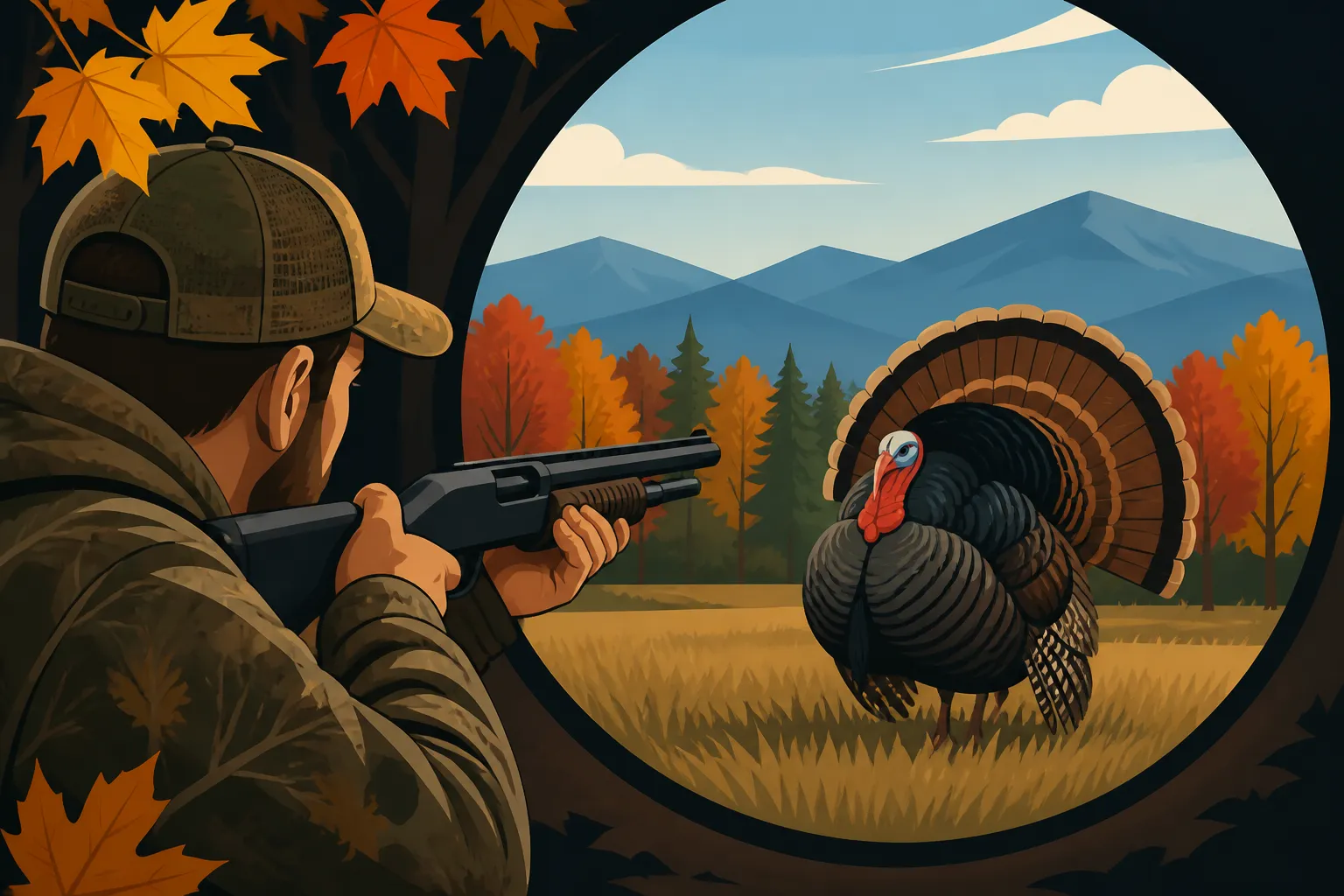
Your setup is critical for a successful shotgun shot at a fall turkey. Turkeys have incredible eyesight, perhaps their greatest defense mechanism, so concealment is not just important, it's absolutely vital. As soon as you scatter a flock, or if you're calling to an intact flock, find the thickest cover available that still allows you a clear shooting lane. A natural blind made from fallen trees, dense shrubs, or a small ground blind can be incredibly effective. Ensure your backdrop is solid, breaking up your outline.
Position yourself so that the turkeys will ideally approach from a direction that gives you a comfortable shooting angle without having to make excessive movements. Anticipate their approach. If you’re calling, expect them to try to circle and pinpoint the source of the sound. Many hunters will position themselves with a large tree at their back, providing both concealment and a stable resting point for their shotgun. When a bird comes into range, remain absolutely still. Wait for the bird to offer an ethical head and neck shot. With a shotgun, your effective range is generally 30-40 yards, maybe slightly more with specialized loads and chokes, but practice your patterning to know your limits. Don't rush the shot. A calm, well-placed shot is always better than a hurried, missed one. Don't forget that using a ground blind on public land can be a game-changer for concealment.
Maximizing Success and Ethical Considerations in the Fall Shotgun Window
Hunting during the fall shotgun window isn't just about bagging a bird; it's about doing it responsibly, ethically, and maximizing your chances of success by adapting to the conditions and the birds themselves.
Dealing with Hunting Pressure and Wary Birds
New Hampshire's public lands, while abundant, can experience hunting pressure, especially during popular seasons like the fall turkey window. This pressure can make birds incredibly wary, forcing them into thicker cover or more remote areas. If you find birds are shutting down or avoiding your calls, it's time to adapt. One strategy is to hunt mid-week, when many fair-weather hunters are at work. This can provide a quieter environment and make birds less skittish. Another tactic is to scout deeper into public land, away from easy access points and roads. Turkeys that rarely encounter humans are often less wary and more responsive to calls.
Consider altering your calling cadence or even the type of calls you're using if birds are ignoring standard kee-kees. Sometimes, a subtle cluck or purr, barely audible, is all it takes to pique their curiosity when louder calls have spooked them. Patience is also key; pressured birds often take longer to respond or approach. They might circle widely, trying to spot the source of the call before committing. Using your GoHunt app or other mapping tools to identify remote pockets of habitat that might be overlooked by other hunters can also pay dividends. Look for difficult-to-access terrain, such as steep ravines or dense swamps, that offers sanctuary for pressured birds.
Weather Considerations and Adapting Your Approach
Fall weather in New Hampshire can be wildly unpredictable, swinging from mild, sunny days to cold, blustery conditions with rain or even early snow. Each weather type impacts turkey behavior and requires an adaptation in your hunting strategy. On crisp, clear, cool mornings, turkeys are often very vocal and active, making it an excellent time for flock busting and calling. They’ll be eager to hit the ground and feed.
However, if a cold front rolls through or it's raining steadily, turkeys tend to be less vocal and might stick to dense evergreen cover to stay dry. In these conditions, still-hunting or slowly moving through known feeding areas becomes more effective. Look for them scratching under pines or along protected ridge lines. If there's a light snow, tracks become incredibly easy to spot, providing a clear roadmap to their recent activity. Remember, proper layering is essential to staying comfortable and focused, regardless of the weather. Investing in good waterproof gear and insulated layers, like those discussed in Layering for New Hampshire's Cold Hunting Season, can make or break your hunt in changing conditions. Don't let a little rain send you home; often, it pushes birds into more predictable patterns.
Field Dressing and Game Care in Cooler Temperatures
Successfully harvesting a fall turkey is a moment of triumph, but the work isn't over. Proper field dressing and game care are crucial to ensuring the meat is high-quality and delicious. In cooler fall temperatures, you have a bit more leeway than in the heat of spring, but prompt attention is still important. As soon as possible after the shot, field dress your turkey. This involves removing the entrails, which helps the carcass cool down quickly and prevents bacterial growth. You can do this right where the bird falls, or if you're near a road, you can transport it a short distance.
Once field dressed, allow the bird to cool thoroughly. If temperatures are above freezing, hanging the bird in a shady, breezy spot is ideal. If it's cold enough, you can transport it back to camp or home without immediate refrigeration, but avoid piling it in a warm vehicle trunk. Many hunters prefer to skin fall turkeys rather than plucking, as the feathers can be tougher and less desirable than spring birds. The meat can then be breasted out, or you can take the legs and thighs as well, offering a substantial amount of lean, flavorful meat. Properly cared-for fall turkey is excellent table fare, perfect for a slow-cooker chili or a hearty roast.
| New Hampshire Fall Turkey (Shotgun-Only) Quick Reference |
|---|
| Typical Window |
| Legal Shotguns |
| Recommended Shot Sizes |
| Choke Recommendation |
| Bag Limit |
| Permit Required |
| Mandatory Reporting |
| Primary Fall Food Sources |
| Key Tactic |
| Ethical Shot Placement |
Disclaimer
The information provided in this guide is for general informational purposes only and is not intended as legal advice. Hunting regulations, dates, and requirements are subject to change by the New Hampshire Fish and Game Department. Always consult the most current official New Hampshire Hunting Digest or contact the New Hampshire Fish and Game Department directly before planning any hunting activities to ensure compliance with all applicable laws and regulations.