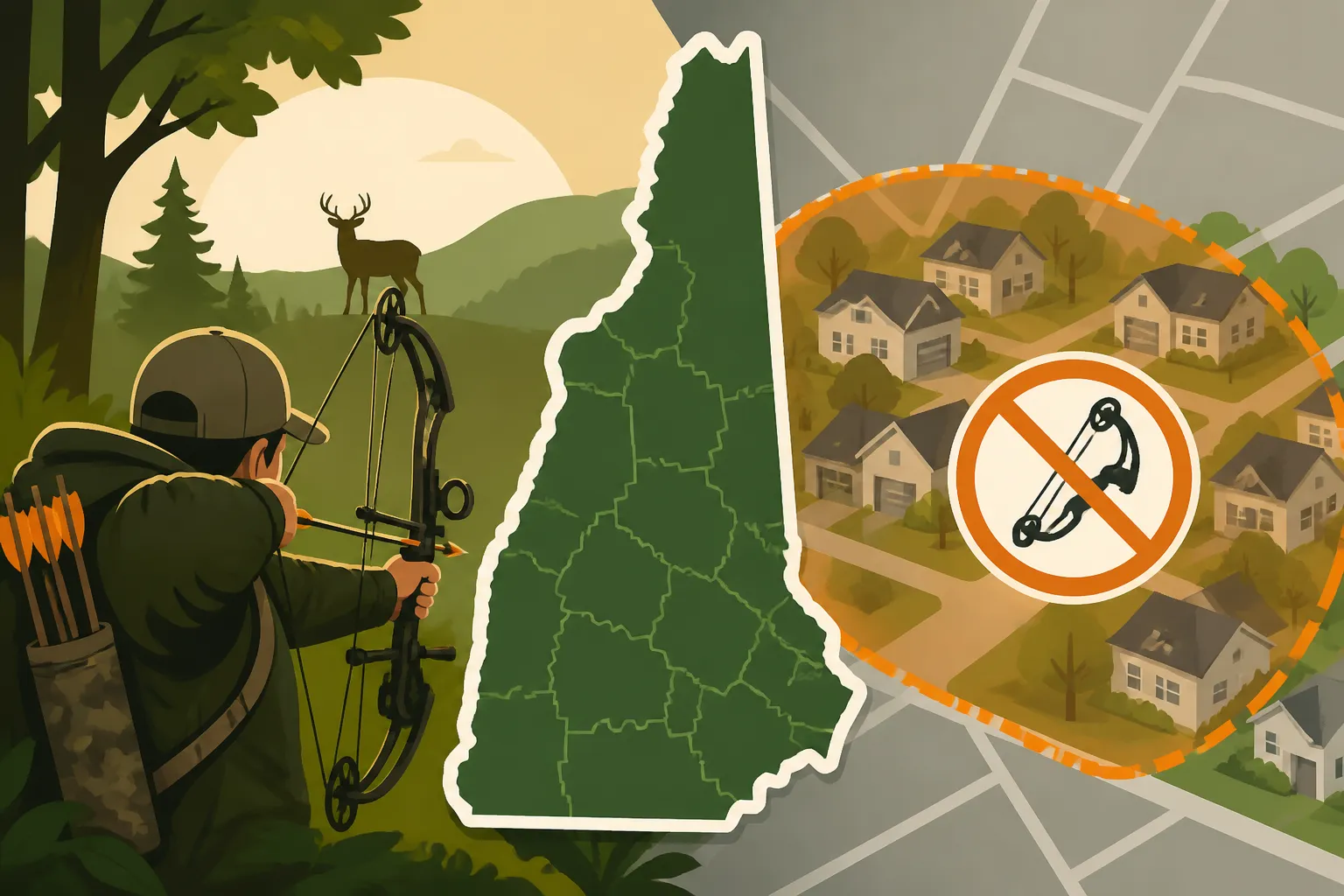
New Hampshire Archery-Only Suburban Zones
For many New Hampshire hunters, the idea of chasing whitetails conjures images of deep woods, granite ridges, and vast stretches of wilderness. But the reality is, deer populations thrive just as much, if not more, in our more settled areas, often creating headaches for homeowners with munched landscaping and increased traffic hazards. This often leaves hunters wondering how to access these deer-rich areas safely and legally without venturing into the backcountry. This guide is all about navigating those unique opportunities and challenges: understanding New Hampshire's archery-only suburban zones and how you can ethically and effectively hunt them.
The Rise of Archery-Only Suburban Zones and Their Purpose
Let's be honest, living with deer can be a mixed bag. They're beautiful animals, no doubt, but when they're constantly raiding your hostas, munching on your wife's prize-winning petunias, or worse, causing frequent fender-benders on the back roads, their charm quickly wears thin. Many New Hampshire communities, especially those bordering or within more populated areas, face significant deer management challenges. These areas often lack the expansive forested tracts suitable for traditional firearms hunting, and the proximity to homes, schools, and roads makes discharging a rifle or shotgun a non-starter for safety reasons.
Why Archery Becomes the Primary Solution
This is where archery-only suburban zones, or areas that function as such due to local ordinances, step in as a crucial tool. Archery equipment, while still incredibly powerful and lethal in the right hands, offers a significantly smaller zone of impact compared to a firearm. An arrow's effective range is much shorter, and its flight path is generally much more contained, making it a far safer option in areas with higher human populations and property density. This allows for controlled deer population management in places where it would otherwise be impossible or unsafe. The quiet nature of archery also causes less disturbance to residents, making it a more palatable solution for towns grappling with deer issues.
Addressing Community Concerns and Safety
The creation or de facto existence of these zones isn't just about hunter opportunity; it's a direct response to community needs. Residents want solutions to deer overpopulation, and wildlife agencies recognize archery as the most responsible method in these sensitive environments. The primary concern is always public safety, followed closely by addressing property damage and ecological impacts from overbrowsing. Hunters who participate in these programs become an essential part of the solution, helping to maintain a healthy deer herd balance while minimizing risks to the public. It's a partnership where responsible hunting meets urban wildlife management, and it requires a heightened level of awareness and ethical behavior from every archer.
Identifying New Hampshire's Archery-Friendly Populated Areas
Unlike some states that might have explicitly designated "urban deer management zones," New Hampshire primarily relies on its statewide hunting regulations in conjunction with local town ordinances to define these archery-only areas. This means there isn't one single map showing "archery-only suburban zones" across the whole state. Instead, you need to understand where firearms discharge is restricted at a municipal level, effectively making archery the only legal hunting method in those specific locations.
Understanding the Role of Local Ordinances
Most New Hampshire towns have ordinances restricting the discharge of firearms within certain distances of dwellings, schools, or public buildings, or even within certain town boundaries entirely. These regulations often prohibit the use of rifles, shotguns, and muzzleloaders, but they typically do not prohibit archery equipment. This creates a patchwork of de facto archery-only zones in and around many of our more developed communities. Think towns in the southern tier, the Lakes Region, or even the fringes of larger cities like Concord, Manchester, or Nashua. Hunters need to do their homework here: simply knowing the state's New Hampshire's WMU-Based Deer Season Structure isn't enough. You must actively check the municipal ordinances for the specific town or city you intend to hunt. This information is usually available on the town's official website or by contacting the town clerk or local police department.
Prime Regions and Specific Examples
While a comprehensive list would be impossible due to varying and changing local rules, certain regions naturally lend themselves to these archery-only opportunities.
- Southern New Hampshire: Areas in Hillsborough and Rockingham counties, with their mix of residential development and smaller woodlots, are prime examples. Towns like Bedford, Amherst, Hollis, Litchfield, and parts of Londonderry often have restrictive firearms ordinances.
- Lakes Region: The developed shorelines and surrounding towns near Lake Winnipesaukee, Squam Lake, and Lake Sunapee also commonly feature these types of regulations. Areas within Moultonborough, Meredith, or Wolfeboro, for instance, might have significant archery-only potential.
- Merrimack Valley: Communities along the Merrimack River corridor, blending residential with agricultural and wooded sections, often present similar scenarios. Places like Bow, Hooksett, or Allenstown could have these pockets.
It's vital to remember that "public land" in these highly populated areas is scarce. You're almost exclusively looking at hunting on private land with explicit permission. A tool like GoHunt, with its detailed parcel maps and landowner information, can be invaluable for identifying potential hunting grounds and the property owners to contact for permission. It's about finding those small, overlooked woodlots, agricultural fields, or even larger suburban properties where deer seek refuge from the pressures of more open hunting areas. Hunting Small Private Tracts in New Hampshire is often the name of the game here, and gaining landowner trust is paramount.
| Region | Typical Characteristics | Hunting Implications | Key Action for Hunters |
|---|---|---|---|
| Southern Tier | High population density, fragmented habitat, many small woodlots | Likely local firearms restrictions, abundant private land hunting opportunities | Research town ordinances, seek private land permission |
| Lakes Region | Developed shorelines, recreational areas, seasonal residents | Strict local rules around dwellings, focus on non-developed parcels with permission | Verify local town bylaws, identify less-trafficked properties |
| Merrimack Valley | Mixed residential, commercial, and agricultural land | Varying ordinances, potential for larger private land access (farms) if secured | Check town hall for firearms discharge laws, contact farmers |
| Seacoast/Exeter Area | Coastal towns, higher property values, small scattered woods | Very strict local rules, limited opportunities but highly under-pressured deer | Extremely thorough permission seeking, understand local nuances |
Rules and Regulations for Hunting in Archery-Only Zones
Hunting in New Hampshire's archery-only suburban zones means you're operating under a dual layer of regulations: state-level Fish and Game rules and specific municipal ordinances. Ignoring either can lead to serious legal trouble and give all hunters a bad name, which we definitely want to avoid.
State Archery Regulations
First and foremost, you must adhere to all state-level regulations for archery hunting in New Hampshire. This includes possessing a valid New Hampshire Hunting Licenses and What They Cost, including an archery permit. You need to know the statewide New Hampshire Archery Season Dates and abide by bag limits for your specific WMU. For deer, New Hampshire allows the use of bows and crossbows during the archery season. If you're using a crossbow, you'll need to be aware of the specific rules regarding their use in the state, including any WMU restrictions, as discussed in Crossbow Hunting New Hampshire's Twelve WMUs. Your archery equipment must meet minimum draw weight and arrow/broadhead specifications to ensure a quick and ethical kill. For instance, broadheads must have at least two cutting edges and be at least 7/8 inch wide. Mechanical broadheads are permitted.
Navigating Local Municipal Ordinances and Private Land Permission
This is where things get really specific and where most hunters run into confusion. As mentioned, towns have different firearms discharge ordinances. It's your responsibility to know them.
- Setback Distances: Many towns specify a minimum distance from occupied dwellings, schools, or public recreation areas where you cannot discharge a projectile – even an arrow. These distances vary widely, so don't assume. Some towns might require 150 feet, others 300 feet, and some might be more restrictive. This is paramount for safety and legality.
- Private Land Permission: In these suburban environments, almost all hunting takes place on private property. This means you absolutely must have explicit permission from the landowner. A verbal "sure, go ahead" might be okay, but getting something in writing is always best to avoid misunderstandings, especially if you plan to hang a stand or hunt repeatedly. Asking a New Hampshire Landowner for Permission isn't just a courtesy; it's a legal requirement and the foundation of ethical hunting in these areas. You'll want to review New Hampshire Posted Land Rules to understand your rights and responsibilities when dealing with private property.
- Weapon Restrictions: While state law allows archery, a local ordinance could, theoretically, impose further restrictions, though this is rare for archery equipment itself. However, they might restrict where you can use it based on property lines or other features. Always double-check.
It's also worth noting that because deer populations in these zones can be higher and less pressured by firearms, special antlerless permits or expanded archery seasons might be available in certain WMUs to help control numbers. Always check the annual New Hampshire Fish and Game Hunting Digest for the most up-to-date information on New Hampshire Deer Reporting Requirements and any specific regulations for the WMU you're hunting.
Strategies for Success in Archery-Only Suburban Zones
Hunting deer in suburban areas presents a unique set of challenges and opportunities. These aren't your typical big-woods deer; they're often highly accustomed to human activity, which can make them both more elusive and, ironically, easier to pattern if you know what to look for.
Scouting and Understanding Deer Behavior
Successful suburban archery hunting starts with intense and intelligent scouting. These deer live in close proximity to people, so their patterns revolve around avoiding direct human interaction while exploiting available food and cover.
- Food Sources: Deer here will feast on suburban landscaping (hostas, azaleas, fruit trees), gardens, and agricultural remnants. Identify these prime feeding areas, especially during the early archery season. Later in the season, they'll hit overlooked apple trees, oak stands, and any remaining browse.
- Cover: Deer will utilize surprisingly small pockets of thick cover – a dense brush patch behind a housing development, a riparian buffer along a creek, or a forgotten woodlot between two properties. They often bed very close to homes, only moving out at dawn and dusk. Learn to "read" these small pieces of cover. Where New Hampshire Bucks Bed in Thick Cover in these environments can be a small, dense thicket just off a backyard.
- Travel Corridors: Deer will use natural funnels like drainage ditches, fence lines, overgrown hedgerows, and the edges of wooded strips to travel discreetly between bedding and feeding areas. Look for pinch points where these corridors narrow, forcing deer past a specific spot.
Utilize tools like satellite imagery (e.g., Google Earth, GoHunt) to identify property lines, dense cover, and potential travel routes from an aerial perspective. Then, boots on the ground during the off-season are critical to confirm sign and identify specific stand locations. Look for fresh tracks, droppings, rubs, and scrapes, even if they're right next to someone's backyard.
Stand Placement and Low-Impact Hunting
Given the close quarters and human presence, your hunting approach must be low-impact and discreet.
- Tree Stands vs. Ground Blinds: Tree stands are often the go-to for elevation and concealment, helping you shoot down into small clearings safely. However, a well-brushed-in Using a Ground Blind on Public Land (or private land with permission) can also be highly effective, especially if natural cover is limited or you need to hide your movement near a sensitive area. Consider a pop-up ground blind if you need mobility or a quick setup.
- Entry and Exit Routes: This is paramount. Deer in suburban zones are highly sensitive to pressure. Plan your approach and departure carefully to avoid spooking deer, especially when approaching or leaving your stand. Use natural cover, walk quietly, and time your movements with periods of low human activity if possible. Avoid walking through bedding areas.
- Shot Angles and Recovery: With neighbors close by, ethical shot placement for quick, clean kills is non-negotiable. Practice intensely to ensure you can make a precise shot. Have a solid recovery plan in place. If a deer runs onto a neighbor's property, you must have permission to retrieve it. Discuss this with the landowner before you hunt. Knowing Blood Trailing After Dark in New Hampshire can be crucial, but always factor in landowner comfort and local noise ordinances.
Dealing with Pressure and Landowner Relations
These areas, while often overlooked by rifle hunters, can still have significant archery pressure from other ethical bowhunters or even nuisance complaints from residents.
- Adapt to Pressure: Deer become wary of routine. Vary your stand times, entry points, and even your approach paths if possible. Hunt the edges of human activity, as deer often feel safer closer to homes where they perceive less hunting pressure.
- Be a Good Neighbor: This cannot be stressed enough. Your actions reflect on all hunters. Be courteous, respectful, and always adhere to your agreement with the landowner. Park where you're supposed to, leave no trash, and share your harvest if appropriate. Keep a low profile. Building trust with one landowner can sometimes lead to permission on adjacent properties. Remember, these landowners are doing you a huge favor by allowing you to hunt, and you want to ensure the opportunity remains for future seasons.
| Strategy | Details | Benefit |
|---|---|---|
| Hyper-Local Scouting | Focus on small pockets of cover, neglected corners of properties, drainages, and overgrown fencerows. Identify specific food sources like suburban gardens, fruit trees, and small oak stands. Use online mapping tools (like GoHunt) to identify property boundaries and potential access points. | Pinpoints deer hot spots and travel routes in unexpected places, leveraging deer's adaptation to human areas. |
| Stealthy Access/Exit | Plan routes that minimize disturbance to both deer and neighbors. Utilize natural cover (hedgerows, deep ditches) for approach. Avoid walking directly through perceived bedding areas. Consider approaching during periods of low human activity to maintain a low profile. | Prevents educating deer and avoids disturbing residents, increasing the longevity of your hunting spot. |
| Ethical Shot Selection | Due to proximity to homes and potential for public view, prioritize clean, ethical shots within your effective range. Practice often to ensure accuracy. Always consider a deer's likely travel path after the shot and ensure you have landowner permission for retrieval on adjacent properties. | Ensures quick, humane kills and minimizes potential for negative public perception or conflicts. |
| Landowner Relationship | Always ask for explicit permission, ideally in writing. Provide contact information and clearly communicate your hunting plans. Offer to help with property tasks. Be discreet, quiet, and leave no trace. Consider offering venison as a thank-you. | Secures and maintains crucial access to private land, potentially opening doors to other opportunities. |
| Adapt to Pressure | Suburban deer are used to human activity but wary of hunting pressure. Vary your stand locations, hunting times, and entry routes if possible. Hunt overlooked corners that other hunters might ignore. Focus on mid-day movement if deer are bedding very close to homes. | Keeps deer less predictable and increases your chances in pressured environments. |
This style of hunting demands respect, diligence, and a keen understanding of both wildlife and human dynamics. It's not for everyone, but for those willing to put in the effort, it offers incredible opportunities to harvest deer close to home and contribute positively to local wildlife management.
Disclaimer
Please note: Hunting regulations and local ordinances are subject to change. It is the responsibility of every hunter to consult the most current New Hampshire Fish and Game Hunting Digest and verify all local municipal ordinances before hunting in any area. This article is for informational purposes only and does not constitute legal advice.