Pass-Shooting Geese on a Split-Season Field
It’s a familiar sight for many New Hampshire waterfowlers: you’ve been granted permission to hunt a prime cornfield or agricultural parcel, only to find the resident Canada geese have wised up to your decoy spread the moment the first few shots ring out. Those big birds get smart fast. If you're struggling to lure wary geese into your spread, especially during those tricky split seasons, understanding the art of pass-shooting might just be the game-changer you need. This guide will walk you through how to effectively target geese using this often-underestimated tactic in New Hampshire's diverse fields.
Understanding New Hampshire's Split Goose Seasons
New Hampshire’s waterfowl seasons are carefully structured to align with migratory patterns and local populations, often incorporating "split seasons." This means there might be an early season, a closure, and then a later season. It can be a bit confusing to keep track of, but it’s absolutely critical for success, and for staying on the right side of the law.
The Rationale Behind Split Seasons
Split seasons for waterfowl, particularly geese, are designed by wildlife managers to maximize hunting opportunities while also protecting the resource. Often, an early season targets local, resident Canada geese before they become too wary and before the main migratory push arrives. These local birds might be found in agricultural fields throughout the state, from the fertile Connecticut River Valley to the more suburban fringes. By having a break in hunting pressure, it allows the population to rest and distribute, and then a later season can coincide with the arrival of more migratory birds from further north, offering a fresh batch of unpressured birds. This also helps manage hunter crowding and ensures a sustainable harvest over the long term. It’s a delicate balance, and understanding this underlying strategy can help you anticipate goose behavior throughout the season.
Key Dates and Zone Considerations
New Hampshire is divided into two main waterfowl zones: the Northern Zone and the Inland Zone. The specific opening and closing dates, as well as bag limits, can vary significantly between these zones and year to year, especially for geese. For instance, the Northern Zone, generally covering Coos and northern Grafton counties, often sees earlier freeze-ups and migratory movements, leading to slightly different season structures. The Inland Zone, which covers the majority of the state, often has a more traditional split. You'll want to religiously check the New Hampshire Fish and Game Department's annual hunting digest or their online portal for the most current dates. Missing a season opener by even a day or misinterpreting a zone boundary can mean a missed opportunity or, worse, a violation. Apps like GoHunt can be invaluable for cross-referencing these dates with your specific hunting location, making sure you’re always up-to-date. Keep in mind that the federal duck stamp requirement and HIP certification are also vital for all migratory bird hunters in New Hampshire.
Here’s a simplified example of how dates might look (always verify current year dates!):
| Season Segment | Typical Dates (Inland Zone Example) | Target Birds | Hunting Pressure |
|---|---|---|---|
| Early Resident Goose | Sept 1 – Sept 25 | Local, Resident | Low to Moderate |
| Season Closure | Sept 26 – Oct 15 | (No Hunting) | Reset |
| Main Fall Goose | Oct 16 – Nov 30 (Split) | Migratory & Local | Moderate to High |
| Late Fall Goose | Dec 15 – Jan 10 (Split) | Migratory | Varies |
Note: These dates are purely illustrative. Always consult the current New Hampshire Fish and Game digest.
This table highlights the "split" aspect, with specific windows of opportunity. Knowing these dates is step one. Step two is understanding why geese might be using certain fields during these different segments, which often comes down to food sources and resting areas.
The Art of Pass-Shooting Geese
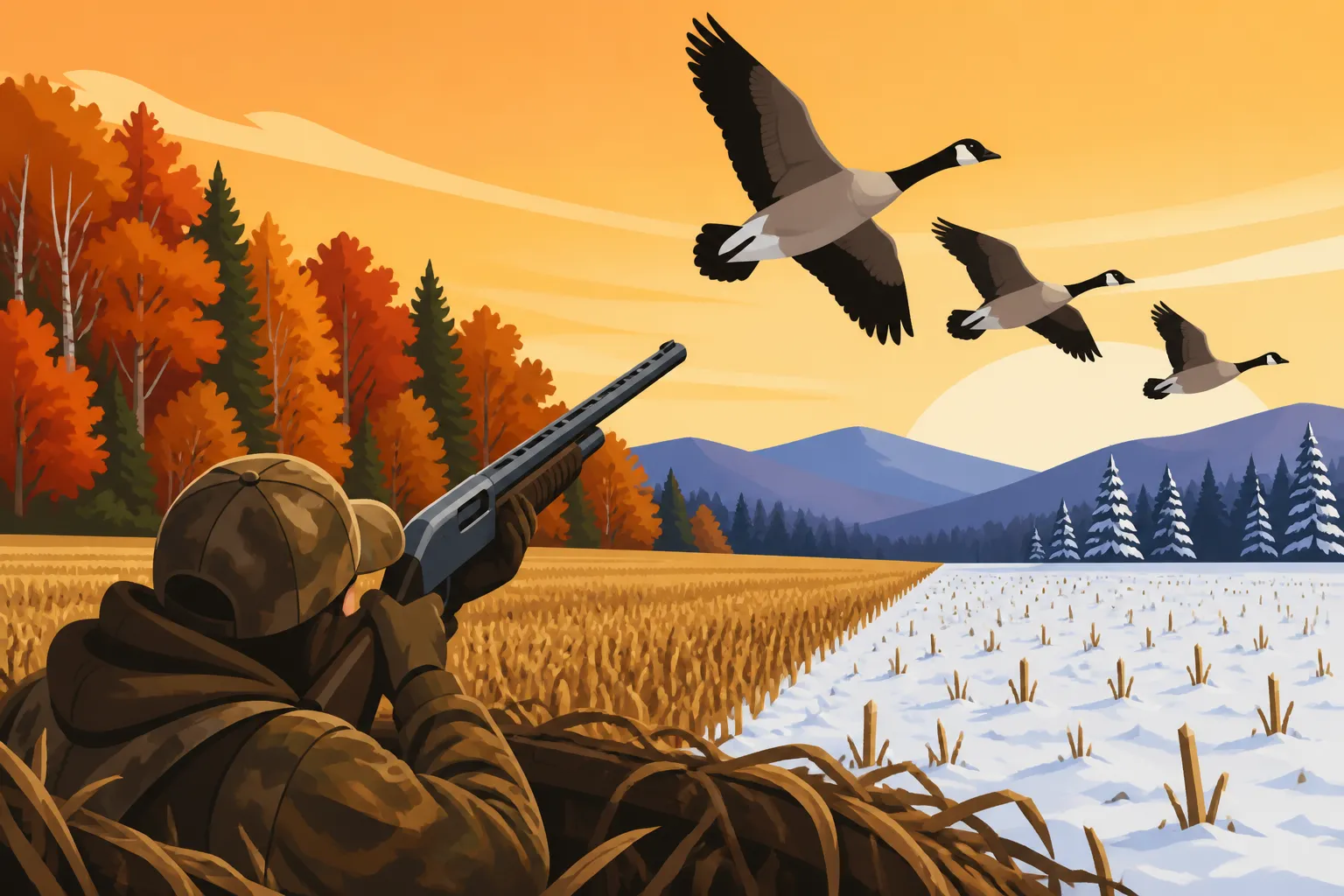
Pass-shooting is fundamentally different from decoying. Instead of trying to convince birds to land among your fakes, you're intercepting them as they fly from one location to another – typically from a roosting area to a feeding area, or vice versa. It’s a tactic that demands patience, good concealment, and excellent wing-shooting skills.
What is Pass-Shooting and Why it Works
Pass-shooting involves positioning yourself along a known flight path that geese use as they travel. You're essentially ambushing them as they "pass" by, rather than trying to lure them down. This method often works best when geese are heavily pressured, decoy-shy, or simply too numerous and wary to commit to a spread. Think about those big flocks that fly over your elaborate spread without so much as a glance – those are prime candidates for pass-shooting. It capitalizes on their predictable daily routines, especially their travel between water (roosts) and fields (feeding). In New Hampshire, where many public lands can see significant pressure, and private land access often means hunting educated birds, pass-shooting can yield impressive results when decoying fails. It’s a less gear-intensive approach in some ways, but more reliant on diligent scouting and keen observation.
Identifying Flight Corridors and Staging Areas
The key to successful pass-shooting lies in precise scouting to identify these flight corridors. Geese are creatures of habit. They will often use the same general routes day after day, especially if they are efficient paths between their roosting lakes or ponds and their preferred feeding fields. Look for natural funnels, such as draws, tree lines, river bends, or even power line cuts that birds tend to follow. These act as "highways" in the sky for geese. Staging areas are also critical – these are fields, sandbars, or open water spots where large groups of geese gather before making their final flight to a specific feeding location or before heading to their roost. A field adjacent to a large lake, like Lake Winnipesaukee, might serve as a key staging area, with birds radiating out to surrounding agricultural lands. Observing morning and evening flights will give you the best clues. Pay attention to their altitude, general direction, and how they react to landmarks. Sometimes, just sitting on a high vantage point before the season opens, or even during a closed period, can reveal these crucial patterns. This is where meticulous scouting with mapping tools, like those found on GoHunt, can illuminate hidden travel lanes you might otherwise miss.
Ethical Shooting Distances and Shot Selection
When pass-shooting, the temptation can be strong to take long shots at geese that appear to be within range. However, ethical hunting demands that we only take shots that offer a high probability of a clean kill. For large birds like Canada geese, this generally means limiting shots to 40-50 yards, maximum. Anything beyond that significantly increases the chance of wounding a bird, which is something no responsible hunter wants. Practice your swing and lead on clays or a patterning board to understand your effective range. Your shotgun, choke, and ammunition choice all play a crucial role here. For shot selection, larger steel shot sizes like BB, BBB, or even T are often recommended for geese, providing the necessary energy and penetration at those longer, but still ethical, distances. Using a tight choke, such as a full or improved modified, will help maintain a dense pattern for pass-shooting. Remember, it's better to pass on a marginal shot than to wound a bird and potentially lose it.
Field Selection and Scouting for Success
Picking the right field isn't just about finding geese; it's about finding their fields. This involves understanding what attracts them and then verifying their presence and patterns.
Prime Field Types for Geese
Geese are primarily grazers, and in New Hampshire, that means they are often drawn to agricultural fields. Cut cornfields are absolute magnets, especially after harvest when they can easily glean leftover kernels. But don't overlook standing corn, especially if it's been knocked down by wind or combines, creating easy access to the ears. Green winter wheat, rye, or clover plots are also highly attractive, providing tender shoots for them to feed on. Often, these fields are located in river valleys, such as along the Connecticut River, or in the fertile areas of the Merrimack Valley, where large-scale agriculture is more common. Identifying these food sources is paramount. They’ll also utilize hayfields, especially those with some water nearby. If you can find a field that offers both a desirable food source and a relatively unobstructed approach for incoming birds, you're halfway there.
Scouting Before the Hunt
Scouting is your most critical tool for pass-shooting. It needs to be thorough and happen before you ever bring a gun into the field. Start by identifying potential fields on maps, noting any large water bodies nearby that might serve as roosts. Then, conduct visual reconnaissance at dawn and dusk. Drive or walk the perimeter of fields, using good optics, to observe where geese are flying, landing, and feeding. Are they flying low over a particular treeline? Are they consistently entering a field from a specific corner? Look for physical signs of goose activity too: droppings, plucked grass, or trampled corn stalks are all indicators. Note which fields they are using most heavily and how many birds are present. Pay attention to wind direction on your scouting days, as this can influence their flight paths. Remember, a little legwork before the season can save you hours of sitting in the wrong spot during the hunt. This is also where you'll want to ensure you have secured proper landowner permission if hunting private land, as required by New Hampshire law.
Reading Goose Behavior and Patterns
Geese are incredibly intelligent birds, and their patterns are rarely random. They react to pressure, weather, and available food. In the early part of the split season, resident geese might be more predictable, flying short distances from local ponds to nearby fields. As the season progresses and migratory birds arrive, and hunting pressure mounts, their patterns can become more complex. They might use different fields on different days, or alter their flight paths to avoid perceived threats. On calm days, they might fly higher and disperse more broadly. On windy days, they often fly lower and use protected corridors. Heavy hunting pressure in one area might push them to a less disturbed field. Understanding these nuances – how wind dictates their approach, how sun angle affects their visibility, or how pressure from other hunters (or even predators like coyotes) might change their habits – is crucial. Observing them without disturbing them will teach you the most.
Essential Gear and Setup for Pass-Shooting
Pass-shooting, while less decoy-intensive, still requires careful consideration of your equipment and concealment. Your setup dictates whether you'll be visible to wary birds or just another bump on the landscape.
Shotguns, Loads, and Chokes
For pass-shooting geese, you'll want a reliable 12-gauge or 10-gauge shotgun. The added firepower of a 10-gauge can be beneficial for those longer ethical shots, but a 12-gauge with 3 or 3.5-inch shells is perfectly adequate. As mentioned earlier, steel shot is mandatory for waterfowl. For geese, heavier loads of BB, BBB, or T shot are ideal for delivering enough knockdown power at range. A good quality load from manufacturers like Federal, Winchester, or Kent will perform consistently. Pairing this with a full or improved modified choke is critical for maintaining a tight pattern density, which is essential for hitting fast-moving targets at extended distances. Experiment with different loads and chokes on a pattern board before the season to understand your gun's effective range and pattern. Remember, a tight pattern is your friend, but it also means less room for error in your lead.
Concealment Strategies
Concealment is paramount in pass-shooting. Geese have incredible eyesight. You need to blend seamlessly into the environment. If you're hunting a cut cornfield, your best bet might be a layout blind designed to mimic stubble. These blinds, like those from Avery or Rogers Sporting Goods, lie flat on the ground and can be brushed in with local vegetation to become virtually invisible. If you're hunting along a treeline, a small, pop-up blind or even just a ghillie suit can work, allowing you to hide in the shadows. Natural cover, like a ditch or a hedgerow, can also provide excellent concealment. However, if using natural cover, make sure it offers a complete break-up of your outline. Don't just stand behind a single bush; you need depth and shadows. Wearing camo patterns that match your surroundings – whether it's late-season cornfield stubble or evergreen boughs – is also crucial. Keep your face covered with a mask and wear gloves. Any shine from your skin or equipment can flare birds. Learn to build a natural blind, brushing it in with corn stalks, weeds, or branches from the immediate area.
Decoy Usage or Lack Thereof in Pass-Shooting
Interestingly, often no decoys are used in pure pass-shooting scenarios. The whole point is to intercept birds that aren't committing to a spread. However, there are times when a minimal spread can be beneficial. If you're on the fringe of a feeding field and birds are flying towards it, a small, ultra-realistic spread of a dozen full-body decoys might help draw them a little closer to your flight path, giving you a better shot. But be cautious: if geese are completely decoy-shy, even a few fakes might be enough to make them veer off course. A common strategy is to only use a few "sentinel" full-body decoys or silhouettes to give the impression of other geese already on the ground, but not enough to suggest a full feeding frenzy they might be avoiding. This really depends on how pressured the birds are. For purist pass-shooting, stick to excellent concealment and let the birds’ natural flight paths do the work. This differs significantly from strategies for Decoying Ducks on New Hampshire's Connecticut River or Layout Blind Hunting a Northern Zone Field, where decoys are the core of the strategy.
Strategic Positioning and Safety
Once you’ve scouted and gathered your gear, where you choose to set up and how you manage safety are the next critical considerations. These elements can be the difference between a successful hunt and a frustrating, or even dangerous, one.
Optimal Hunter Placement in a Field
Your positioning is everything in pass-shooting. You want to be directly under or just off the edge of the established flight corridor. This often means finding a point where geese habitually cross a specific feature – like a low point in a ridge, a gap in a treeline, or where they shift altitude to enter or exit a field. Consider the sun's position throughout your hunting window. You generally want the sun at your back or to your side, making it harder for geese to see you and easier for you to see them. Wind direction is also vital; geese prefer to land and take off into the wind. If they are flying into a headwind, they will often fly lower and slower. If they have a tailwind, they'll be higher and faster, making shots much tougher. Try to position yourself so that incoming birds will be flying into the wind as they pass over you. Think about your backdrop: a dark treeline behind you will help you disappear more effectively than open sky. If you’re hunting with a partner, ensure you're spread out enough to cover different angles of the flight path, but still close enough for safe communication and clear shooting lanes. You might be interested in reading about Hunting a Funnel Between Two Woodlots for more insights on positioning in natural corridors.
Communication and Safety Protocols
Hunting in a field, especially when pass-shooting, demands strict safety protocols. Always know where your hunting partners are. Before the hunt begins, establish clear zones of fire and stick to them. Never swing your gun outside your predetermined safe shooting lanes, especially when shooting at overhead birds where it's easy to lose track of others. Wear blaze orange or blaze pink when walking to and from your setup, especially during New Hampshire's firearms deer season, even if you’re only hunting waterfowl. While not legally required for waterfowl hunters in a blind or concealed position, it's a good practice to be visible when moving. When geese are approaching, communicate clearly and calmly: "Birds left!" or "Your bird, John!" Use a whistle to alert other hunters to incoming birds if they are looking the other way. Ensure your shot falls within safe parameters, always being aware of houses, roads, or livestock beyond the field. The use of a satellite communicator, especially when hunting remote North Country fields without cell service, can be a crucial safety tool, allowing you to contact help in an emergency.
Adapting to Changing Conditions
Geese are constantly adapting, and so must you. Their patterns aren't set in stone, and conditions can change rapidly in New Hampshire.
Wind, Weather, and Their Impact
New Hampshire weather is notoriously fickle, and these changes directly influence goose behavior.
A strong wind, particularly out of the northwest, can push migratory birds through the state faster and often lower. Geese will use the wind to their advantage, flying into a headwind to land or take off, and using a tailwind for swift travel. This means your setup might need to be adjusted daily based on wind direction. On a calm, bluebird day, geese might fly higher and more spread out, making pass-shooting more challenging. Cloudy, drizzly days, however, can bring birds down lower, sometimes right over your head. Snowfall can also alter flight patterns, often forcing birds to seek out open, accessible fields. Pay attention to fronts: before a cold front, birds might feed aggressively, while after a severe cold snap, they might move south entirely. Apps that track wind speed and direction, like Weather Underground or local weather forecasts, should be checked religiously before each hunt.
Pressure and Mid-Season Adjustments
As the season progresses, geese become "educated" – they learn quickly where hunting pressure is highest. This is especially true during the later segments of New Hampshire's split seasons when birds have been shot at repeatedly. A field that was hot on opening day might be devoid of birds a week later. They'll shift their feeding patterns, use different fields, or adjust their flight paths to avoid known danger zones. This is where adaptability is key. If your usual pass-shooting spot isn't producing, don't be afraid to move. Scout a new field, look for a new flight corridor, or try a different time of day. Sometimes, switching from a morning hunt to an evening hunt, or vice-versa, can yield different results as birds use different routes to and from their roosts. Pay attention to reports from other hunters (or even observations of non-hunting birdwatchers) about goose activity in different parts of the state. Remember, while some flocks may become extremely wary, new migratory birds are always moving through, offering fresh opportunities. Using resources like the New Hampshire Fish and Game app to scout new areas or checking current harvest reports can provide insights into where birds are being taken, which might indicate concentrations of geese. Understanding Hunting Pressure on New Hampshire Public Land can help you predict where birds might seek refuge.
Disclaimer
Always consult the most current New Hampshire Fish and Game Department hunting regulations before heading afield. Season dates, bag limits, and specific rules can change annually. This article is for informational purposes only and does not supersede official state regulations.