Wind and Thermals in Steep Granite Terrain
Hunting in New Hampshire's steep granite terrain presents a unique set of challenges, and perhaps none are as frustrating or as critical to success as deciphering the unpredictable dance of wind and thermals. Many of us have experienced that crushing feeling when a seemingly perfect approach is ruined by a swirling gust of wind, carrying our scent directly to the deer we've spent hours stalking. This comprehensive guide will peel back the layers of atmospheric movement, helping you understand, predict, and ultimately leverage these invisible forces to your advantage when you're deep in the Granite State's rugged hills and mountains.
Understanding the Basics of Wind and Thermals
Before we dive into the nitty-gritty of hunting in New Hampshire's dramatic landscapes, it’s crucial to firmly grasp the fundamental principles that govern air movement. This isn't just about feeling a breeze on your cheek; it's about understanding the invisible currents that carry your scent, and with it, your success or failure. In steep terrain, these forces are magnified and localized, creating a complex puzzle for any hunter.
The Fundamental Difference: Wind Versus Thermals
When we talk about "wind," we're generally referring to the larger-scale, prevailing air currents driven by regional weather systems and pressure differentials. Think of the consistent breeze you might feel across an open field, or the strong gusts that come with a passing cold front. This kind of wind is often predictable on a macro scale, as weather apps and forecasts can give you a pretty good idea of its general direction and speed. However, even these broader winds can be significantly influenced and deflected by the massive obstacles presented by New Hampshire's mountains.
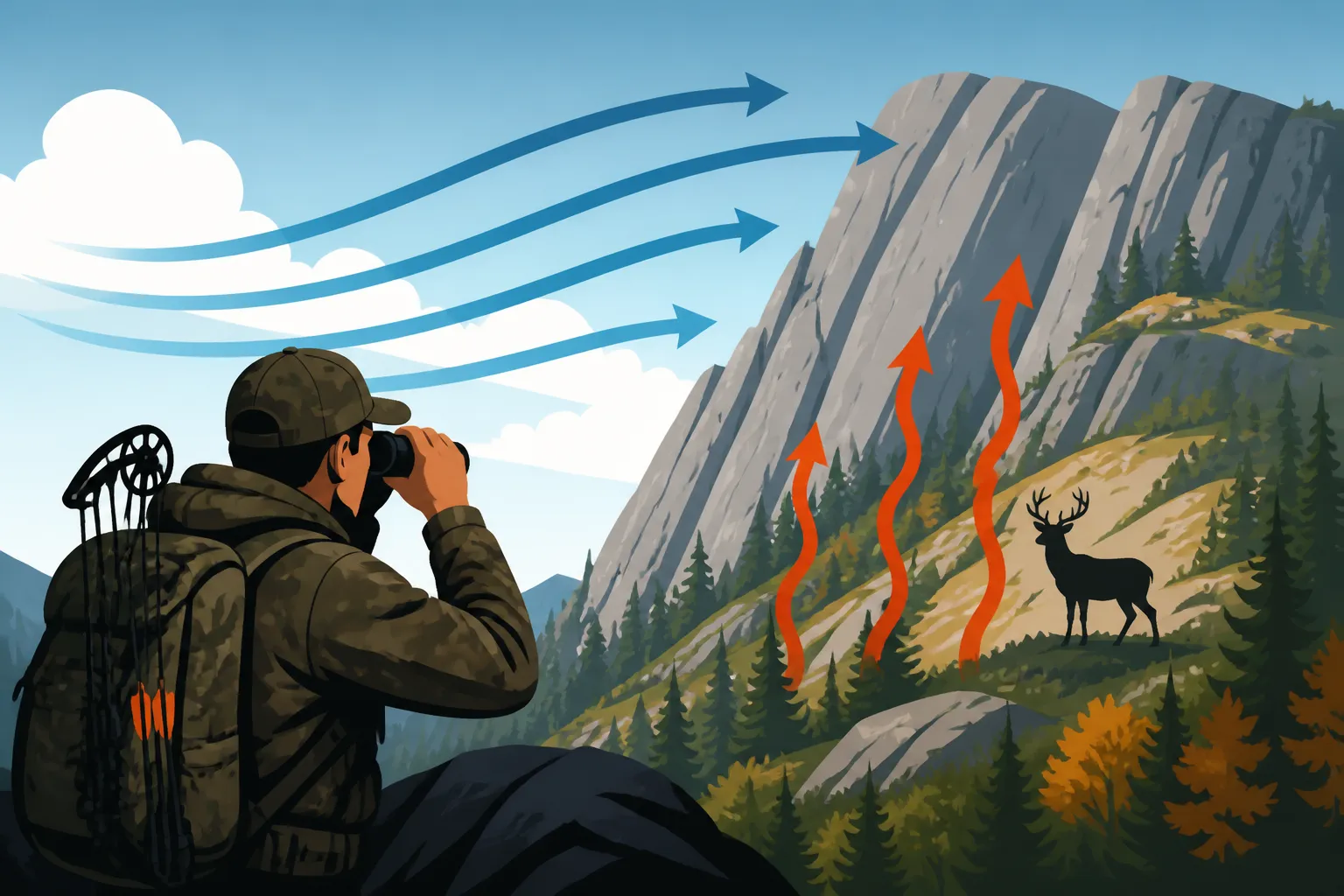
"Thermals," on the other hand, are much more localized and are primarily driven by temperature differences in the air directly above the ground. They are essentially localized air convection currents. As the sun warms the earth, the ground heats the air immediately above it, causing that warmer, lighter air to rise (an updraft). Conversely, as the sun sets and the earth cools, the air above it also cools, becoming denser and sinking (a downdraft). These thermal movements are particularly pronounced in steep terrain because the slopes themselves facilitate the channeling and movement of these rising and falling air masses. Imagine the steep sides of Mount Washington or the rugged ledges around Franconia Notch; these act like massive chimneys and drains for thermal air movement.
How Topography Shapes Air Movement
New Hampshire's granite peaks, deep valleys, and dramatic ravines aren't just scenic backdrops; they are active participants in shaping the wind and thermal currents that will make or break your hunt. The sheer scale and ruggedness of this terrain create a microclimate effect that can baffle even experienced hunters. A steady westerly wind at tree-top level might be completely absent or even reversed at the bottom of a steep ravine, leading to a false sense of security about your scent cone.
Consider a deep valley or a "notch" in the mountains. During the day, as the sun beats down on the valley walls, the air in the valley heats up. This warm air then begins to rise, often funneling directly up the valley itself or along the warmest, sunniest slopes. This creates a strong "valley breeze" or updraft. As evening approaches and the sun drops behind the peaks, the valley floor and its shaded slopes cool rapidly. The cooler, denser air then begins to sink, draining down the valley and slopes, creating a downdraft that can carry your scent downhill for surprising distances. This phenomenon is critical to understand when Hunting the White Mountains High Country, as these dynamics are constant.
Ridge lines and saddles also play a huge role. Air currents, both regional wind and localized thermals, will often be compressed or accelerated as they flow over or around these features. A prevailing wind hitting a steep ridge might be forced upwards, creating a strong updraft on the windward side and a swirling, unpredictable eddy on the leeward side. A saddle, acting like a natural low point, can funnel air, causing it to accelerate and become more concentrated. This is why Hunting a Granite Ridge Saddle requires such careful consideration of air currents. Understanding these topographical influences is paramount to predicting where your scent will go and, therefore, where you need to be positioned.
Reading the Landscape for Thermal Cues
Being able to visually read the landscape for thermal cues is an acquired skill, but it’s one that will drastically increase your success rate in New Hampshire’s challenging terrain. It’s not just about looking at a map; it’s about observing the nuances of the environment throughout the day.
Morning Thermals: The Updraft Challenge
The early morning hours, often prime time for deer movement, are also when thermals begin their daily transition. As night gives way to dawn, the cold, dense air that has settled into the lowest elevations during the night begins to warm. This is a critical period where cold air still "drains" downhill and settles in depressions, but as the sun crests the eastern peaks and hits the slopes, pockets of warmer air start to rise.
Initially, you might experience a period of very light, unpredictable air movement as the cold air tries to cling to the ground while the first warm updrafts begin. However, as the sun gains strength and heats the ground—especially south-facing slopes or dark rock formations that absorb heat quickly—you’ll notice a more consistent upward flow. This is the classic "morning thermal" or updraft. This rising air can carry your scent directly up the mountain, making approaches from below incredibly risky. If you're planning an ascent to a ridgeline, you need to be acutely aware that your scent is likely being carried ahead of you, uphill. Many hunters find success by getting above their hunting area before first light, allowing them to hunt downwards as the thermals rise. This strategy aligns well with tactics like Hanging a Stand on a Granite Ridge.
Evening Thermals: The Downdraft Dilemma
Just as reliably as morning thermals rise, evening thermals fall. As the sun dips towards the western horizon, the direct solar radiation diminishes, and the ground, especially in shaded areas and lower elevations, begins to cool. The air directly above these cooling surfaces cools rapidly, becoming denser and heavier. This cooler, heavier air then begins to sink and flow downhill, creating a consistent downdraft. This phenomenon is often referred to as a "thermal drain."
This falling air will carry your scent downhill, settling into draws, stream beds, and valley floors. For hunters, this means that approaching an evening stand from above your target area can be extremely effective, as your scent will be carried away from the game below you. Conversely, trying to hunt uphill in the evening is often a recipe for disaster, as your scent will tumble down the slope ahead of you, alerting any deer in the area. The challenge here is knowing when that transition from rising to falling air actually occurs. It's not a sudden switch; rather, it’s a gradual shift that begins as the sun starts to drop and shadows lengthen. It often becomes most pronounced in the last hour or two of daylight, a prime time for deer movement.
Mid-Day Anomalies and Flat Wind
While morning and evening thermals often follow predictable patterns, the middle of the day can be a completely different beast. As the sun reaches its zenith and warms the entire landscape more evenly, the strong localized thermal currents tend to weaken or become much more erratic. You might experience periods of very light, "flat" wind that lacks a consistent direction, or even swirling eddies caused by localized heat pockets and minor topographical features. This is where New Hampshire's varied terrain can really throw a curveball.
During these mid-day hours, larger regional wind patterns might assert more dominance, but even then, the steep slopes can cause deflection and turbulence. Hunting during this time can be particularly challenging because predicting scent dispersal becomes less reliable. This is often a good time for still-hunting very slowly into the wind, or for repositioning if you’ve been busted. It's also a period where the wind might die down almost completely, leaving you feeling exposed. Carrying a wind checker is absolutely essential during these periods to constantly monitor the subtle shifts. Sometimes, even a slight breeze can be enough to carry your scent, and being aware of it is half the battle. This variability underscores why continuous observation and adaptation are key to navigating New Hampshire's hunting environments.
Strategic Hunting Approaches in Variable Wind
Understanding the theoretical physics of wind and thermals is one thing; applying it effectively in the field is another. New Hampshire's steep, granite terrain demands a highly strategic approach to hunting, where every decision, from your entry route to your stand placement, must account for the invisible currents of air.
Positioning for Success: Playing the Shifting Air
The most crucial aspect of hunting successfully in New Hampshire's mountains is intelligent positioning. This means constantly thinking about where your scent is going, not just now, but where it will go as conditions change. For morning hunts, if you know thermals will rise, your best bet is often to approach from above your target area. This allows your scent to dissipate harmlessly above the deer as you descend. Conversely, for evening hunts, a higher entry point lets your scent drain down and away from the deer moving into lower feeding areas.
Consider hunting an "edge" where two different thermal systems might meet, such as the transition from a sun-drenched slope to a shaded ravine. These areas can be unpredictable. Instead, try to set up on a micro-ridge or bench just below the main ridgeline, where you can catch the rising morning thermal above you and have a clear shot into the thicker cover below. When still-hunting, always try to keep the wind or thermal movement in your face or quartering. This might mean making a much longer, more circuitous route to get to your desired hunting area, but it significantly reduces your chances of being winded. Hunters utilizing the GoHunt app often use its advanced mapping features to identify optimal ridge lines and benches that offer strategic thermal advantage, even marking potential stand sites based on anticipated wind direction.
Scent Control Beyond the Bottle
While scent-eliminating sprays, specialized clothing, and ozone generators certainly have their place, they are merely tools in a much larger strategy. In the unpredictable thermals of New Hampshire, absolute scent elimination is a myth. The real game-changer is playing the wind and thermals, minimizing how often your scent intersects with deer travel paths. This is where realistic expectations come into play.
Focus on the fundamentals: shower with scent-free soap, wash your hunting clothes in scent-free detergent, and store them in airtight containers. Avoid filling your vehicle with gas or stopping for coffee in your hunting clothes. But beyond that, it’s about tactical movement. If you're on a morning climb, assume your scent is rising and plan your approach accordingly. If you're working a steep hillside in the evening, know your scent is falling and adjust. Use natural barriers like deep ravines or thick stands of conifers to help disperse or block your scent. During the crucial rut period, when bucks are more active, your ability to manage your scent cone through smart positioning becomes even more vital. Understanding when New Hampshire Bucks Bed in Thick Cover will also help you determine ideal approach vectors to avoid detection.
Using Technology to Your Advantage
Modern technology offers incredible tools to help predict and verify wind and thermal patterns in real-time. Don't leave home without them, especially when tackling New Hampshire's complex topography.
A good quality wind checker, whether it's a simple squeeze bottle with powder or a small electronic device, is indispensable. You should be using it constantly, especially during periods of transition or when you enter new terrain. A quick puff of powder can reveal subtle downdrafts or swirls that you’d never feel on your skin. Beyond that, many hunters rely on advanced mapping applications like GoHunt. These apps can provide detailed topographical maps that show elevation changes, potential funnel points, and natural thermal drains. More importantly, some integrate hyper-local weather forecasts, including predicted wind direction and speed at various elevations. While no app can perfectly predict every micro-thermal swirl in a steep granite ravine, they offer a powerful advantage for planning your approach and stand locations before you even step foot in the woods. When Scouting With the New Hampshire Fish and Game App, cross-referencing with a dedicated wind forecasting app can provide a layered understanding of air movement in your target area.
Real-World Scenarios and Adaptations
Applying these principles to real hunting situations in New Hampshire’s diverse terrain is where the rubber meets the road. Knowing how to adapt on the fly is a hallmark of an experienced woodsman.
Hunting a Granite Ridge Saddle
Ridge saddles are notorious deer crossing points, especially during the rut, as bucks travel between drainages with less elevation change. However, they are also thermal traps. Imagine a saddle between two peaks. During the morning, as the sun hits both slopes, thermals will rise from both sides, often meeting and swirling in the saddle itself. This can create unpredictable wind currents right where you expect deer to cross.
To hunt a saddle effectively, you often need to position yourself slightly below the saddle on the downwind/down-thermal side, ideally with a prevailing wind that carries your scent away from the approach paths. In the morning, this means being on the leeward side if possible, or higher up one of the peaks if the thermal is rising strongly. In the evening, you might want to be on the windward side, allowing your scent to be carried downhill and away. Always check your wind frequently, as the air currents in saddles are prone to changing with even slight alterations in temperature or sunlight. This strategy, combined with knowledge of Reading Aerial Photos for North Country Deer, helps identify the most consistent thermal patterns.
Working a Steep Ravine or Notch
Ravines and notches are natural funnels for deer movement, but they are also absolute thermal highways. The deep, V-shaped cuts in the landscape act like giant air channels. In the morning, expect a strong updraft to flow right up the center of the ravine as the sun warms its walls. In the evening, the reverse is true; cold air will pour down the ravine like water, creating a powerful downdraft.
Hunting these features requires precise timing and positioning. For a morning hunt, you ideally want to be either above the ravine, waiting for deer to come up, or on a bench along the side, where you can watch the bottom with your scent rising harmlessly. Trying to still-hunt up a ravine in the morning is almost guaranteed to blow deer out. For an evening hunt, setting up above the ravine on the downwind side, or on a ridge where your scent is flowing away and downhill, gives you the best chance. You can then watch for deer moving down into or across the ravine. The sheer granite faces and dense timber within these areas can also create unique wind eddies, so constant wind checking is non-negotiable. Don't forget that using your GoHunt app's contour lines and topographical shading can help you visualize these thermal highways before you even step foot in them.
Post-Frontal Winds and Their Impact
A cold front pushing through New Hampshire can dramatically alter wind and thermal dynamics. Often, immediately after a strong cold front, you'll experience clear skies, cooler temperatures, and a strong, consistent wind from the northwest or west. While this prevailing wind might be easier to predict on a macro level, the steep terrain will still cause deflections and turbulence.
The colder air itself will also impact thermal strength. Strong, consistent winds can sometimes overpower and homogenize localized thermals, leading to less pronounced updrafts and downdrafts. However, the underlying thermal principles still apply, just perhaps to a lesser degree. Always prioritize the prevailing wind, but remain vigilant for subtle thermal shifts, especially in sheltered areas or deep draws. A good strategy during post-frontal conditions might be to hunt areas that are somewhat protected from the direct blast of the strong wind but still offer good visibility, such as a leeward slope or a thick stand of timber that acts as a windbreak. This is also a fantastic time to think about Cold-Weather Sitting Strategy in the North Country, as deer often become more active after a front.
| Time of Day | Thermal Pattern (Steep Terrain) | Scent Direction | Ideal Hunter Position | General Approach |
|---|---|---|---|---|
| Early Morning | Cold air drains, then warms and rises (updraft) | Primarily uphill | Above target area (watching below) | Descend into position or hunt from high |
| Mid-Day | Thermals weaker, inconsistent, or flat | Variable, erratic | Adapt to prevailing wind/terrain | Still-hunt slowly, reposition |
| Late Afternoon/Evening | Warm air cools, sinks (downdraft) | Primarily downhill | Above target area (watching below) | Hunt from high, watch low |
| Night | Consistent downdraft | Downhill | N/A (not actively hunting) | N/A |
Disclaimer
Hunting is an inherently dangerous activity. Always prioritize safety, understand and follow all New Hampshire Fish and Game Department regulations, and respect private property. The information provided here is for educational purposes only and should not be a substitute for comprehensive hunter education and personal experience. Always hunt with a plan, inform others of your whereabouts, and be prepared for changing weather and terrain conditions.