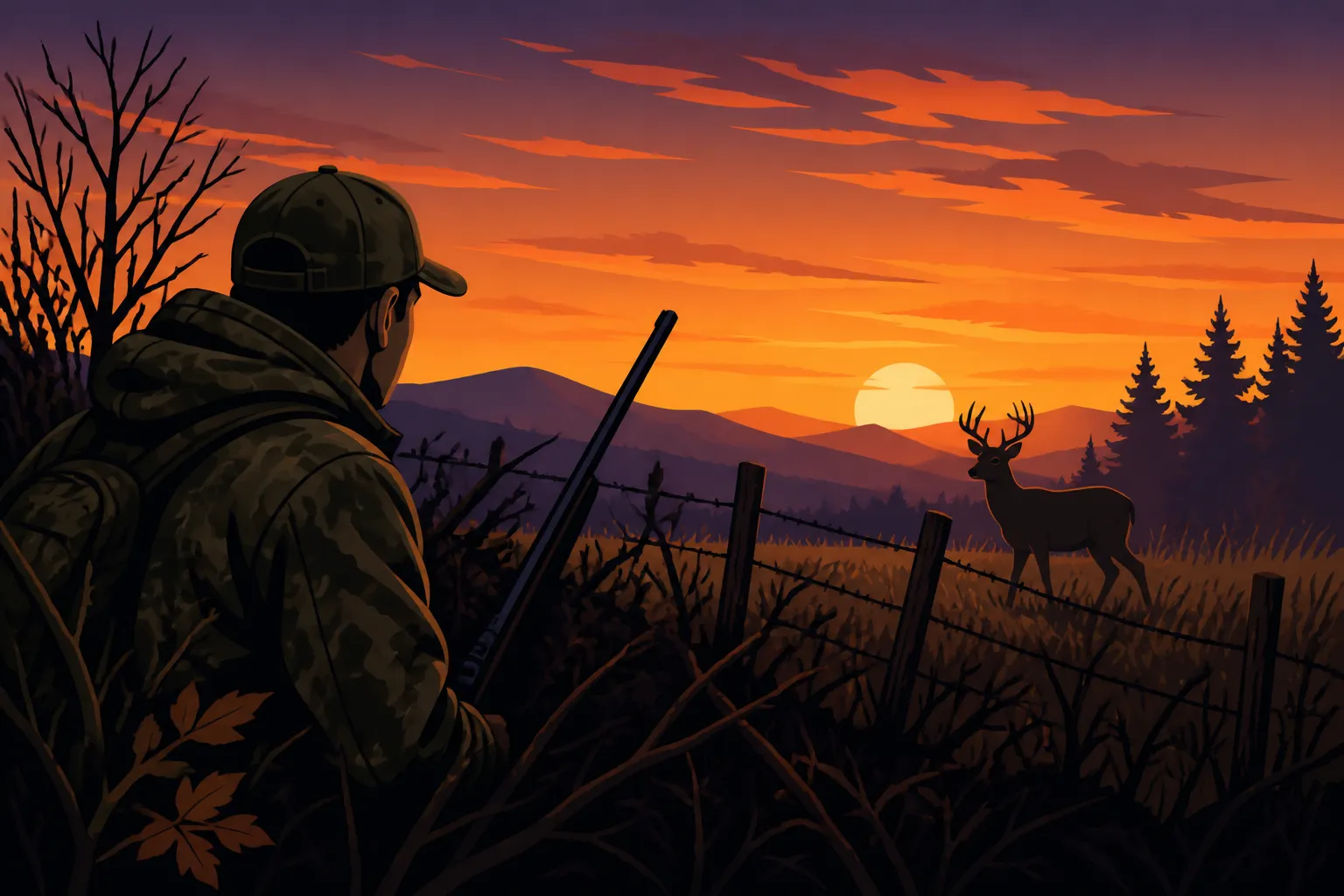
Hunting a Brushy Fence Row at Dusk
The last hour of daylight in New Hampshire can be truly magical for deer hunters, yet it’s often the most frustrating. You’ve likely spent hours in your stand, only for deer to suddenly materialize out of dense cover as the sun dips below the horizon, leaving you scrambling or second-guessing your setup. It feels like they know exactly when to move, and they do! This comprehensive guide will illuminate the secrets of hunting brushy fence rows at dusk, showing you how to identify, scout, and effectively position yourself to capitalize on these prime, often-overlooked travel corridors.
Why Brushy Fence Rows are Deer Magnets at Dusk
Brushy fence rows might appear to be nothing more than haphazard lines of overgrown vegetation, but for New Hampshire whitetails, they are frequently critical travel corridors and prime staging areas, particularly as evening approaches. These narrow, linear strips of thick brush, small saplings, and tangled growth offer a profound sense of security and concealment that larger, more open expanses of timber or agricultural fields simply cannot provide. Deer, especially mature bucks, are inherently cautious creatures, preferring to move under the cover of darkness or dense foliage rather than exposing themselves in wide-open spaces.
These natural barriers or property line markers often serve as critical linkages between different habitat types. Imagine a deer bedding down in a thick, secluded pine stand during the day, needing to travel to a prime evening food source like a mature oak flat dropping acorns or a productive alfalfa field. A brushy fence row provides the perfect low-profile pathway, allowing them to traverse these distances unobserved. As dusk descends, deer instinctively begin their transition from the safety of their bedding areas to their chosen feeding grounds. The brushy fence row effectively becomes their clandestine highway, enabling them to move with confidence, shielded from potential predators and the discerning eyes of hunters.
Beyond mere concealment, these fence rows often harbor a surprising abundance of forage. You might discover wild apple trees, thorny brambles laden with berries, or patches of succulent woody browse, depending on the season and specific location. Even if the primary draw isn't a bumper crop of acorns, the accessible browse within the row itself, combined with the security it offers, makes it an attractive stopover. Furthermore, the topography and vegetation within and around a fence row can create subtle thermal advantages and wind currents that deer are adept at exploiting. They can browse along the edges, scent-check for rivals, and feel secure while making their deliberate journey towards their evening meal. Overlooking these seemingly minor linear features is akin to ignoring a major deer thoroughfare; they are often hotspots of activity.
Scouting the Fence Row: Reading the Sign
Successfully hunting a brushy fence row at dusk requires a foundational understanding gained through meticulous scouting, both boots-on-the-ground and with digital tools. You can’t just pick any random fence row and expect success; you need to identify the ones that are actively being used by deer with a clear purpose. This is where advanced mapping applications can be incredibly valuable. Tools like GoHunt allow you to leverage satellite imagery, topographical maps, and property line overlays to pinpoint these linear strips of cover, especially those that logically connect known bedding areas to obvious food sources. Look for fence rows that intersect other cover, make sharp turns, or create natural pinch points where deer movement would be concentrated.
Once you’re out in the woods, your mission is to identify fresh deer sign, and not just isolated tracks. You’re looking for a consistent pattern of movement. Are there well-defined trails running parallel to the fence, or even paths that cut directly through the thicker sections? Inspect the softer ground, particularly where the fence row traverses a low, damp area or a stream crossing, for fresh tracks. The presence of deer droppings, especially if they appear recent, is a strong indicator of active use. Crucially, keep an eye out for rubs and scrapes along the edges of the brushy growth. While a scrape line might not run directly through the densest parts of the row, you'll often find them at its ends or where it briefly opens up, signaling that bucks are actively checking these travel routes. For more detailed insights into deciphering these crucial indicators, our guide on Reading New Hampshire Mud for Fresh Deer Movement offers valuable tips.
It's vital to identify the specific entry and exit points deer are utilizing along the fence row. Are they consistently stepping out into a particular corner of a field? Are they pushing through a specific section of brush to access an adjacent woodlot? These precise crossings and funnel points are your high-percentage spots. You might even discover small deer beds nestled just inside the thickest pockets of the fence row, particularly on the side that provides a thermal advantage or shelter from the prevailing wind. Understanding where a deer feels secure enough to pause or stage before venturing into the open is paramount for strategic stand placement. Furthermore, considering what Late-Season Food Sources for New Hampshire Whitetails these fence rows might lead to can help predict evening movement patterns.
Setting Up for Success: Positioning for the Shot
Having identified a promising brushy fence row, your next critical step is to execute a strategic setup that maximizes your shot opportunity without revealing your presence to approaching deer. This involves careful consideration of several factors: wind direction, thermal currents, and your shooting lanes. For an evening hunt, the prevailing wind is almost always the most important factor, as deer will be moving from their bedding areas. Ideally, you want the wind blowing away from their anticipated approach path and towards where they are likely heading to feed. This might mean setting up on the leeward side of the fence row to catch scent before they arrive. If you’re hunting in challenging topography, understanding Wind and Thermals in Steep Granite Terrain will be critical, as these micro-currents can behave unpredictably.
Your choice of stand dictates your approach. If suitable trees are present and robust enough, a treestand offers the advantages of elevated scent dispersal and a superior vantage point over the often-dense brush. Look for a sturdy tree that provides natural cover, allowing you to blend seamlessly with the fence row itself. If you’re on public land where suitable trees are scarce, or on private property where you prefer a more subtle approach, a well-camouflaged ground blind can be exceptionally effective. The natural thickness of the fence row can provide excellent concealment, often negating the need for an overly elaborate blind setup. Remember that when utilizing a ground blind on public land, local regulations might apply, and it's always best practice to brush it in naturally using local vegetation to make it disappear into its surroundings. Our guide on Using a Ground Blind on Public Land offers more insights.
Aim to position your stand or blind approximately 15-25 yards off the primary deer trail within or alongside the fence row, or at a confirmed crossing point. This distance provides an ethical shooting range for both bow and firearm hunters while allowing enough room for drawing a bow or maneuvering a rifle. Clear your shooting lanes carefully, but avoid over-cutting, as excessive disturbance can alert deer to your presence. Crucially, meticulously plan your entry and exit routes. You must be able to approach and leave your stand completely undetected, especially during the sensitive dusk period. Consider pathways that utilize terrain features, natural cover, or even a less-frequented section of the fence row to minimize disturbance to nearby bedding or feeding areas. Utilizing the detailed mapping features and terrain analysis available through GoHunt can significantly aid in this intricate planning process, helping you pinpoint the best routes.
The Dusk Advantage: Timing Your Hunt
Hunting a brushy fence row at dusk is all about leveraging a deer's natural behavioral patterns and the diminishing light conditions. Deer, particularly the most elusive mature bucks, frequently delay emerging from their secure cover until the very last moments of legal shooting light, feeling most confident under the protective shroud of twilight. This strategy often demands immense patience, but the rewards can be truly significant. The prime window for action along these fence rows typically encompasses the final 30 to 45 minutes of legal shooting light, often extending right up until the closing bell. This is precisely when deer initiate their transition from daytime security to their evening feeding forays. The principles discussed in our article on Hunting a Beaver Flowage Edge at Dusk share a similar focus on capitalizing on these late-day movements.
Your approach for a successful dusk hunt should be characterized by minimal movement and heightened observation. Aim to be in your stand or blind at least an hour, if not two, before sundown. This allows the woods to settle around you and provides ample time for any initial disturbance to dissipate. Equip yourself with quality binoculars, even as the light begins to fade, to meticulously scan the edges of the fence row and any adjacent open fields. Look for the most subtle indicators of deer presence: a flick of an ear, a slight shift in vegetation, or the faint outline of a deer blending into the deepening shadows. As the light dwindles, deer confidence typically swells, making them more inclined to step into the open or utilize these linear features with greater audacity. Using a reliable rangefinder is absolutely essential for confirming distances in dim light, ensuring you can make a precise and ethical shot.
It’s important not to become discouraged if you don't witness any deer activity until the very final minutes of your hunt. This is often precisely when the most cautious and largest deer choose to make their appearance. Should you be fortunate enough to take a deer, ensure you have a robust recovery plan in place, especially given the low-light conditions. An excellent headlamp for a pre-dawn climb or a post-dusk tracking job is an indispensable piece of gear. Mark your shot location meticulously and, if the shot wasn't unequivocally perfect, grant the deer ample time before initiating a track. Waiting just a little longer can dramatically improve your chances of a successful recovery, particularly with dwindling light and potentially challenging terrain. Remember that understanding Where New Hampshire Bucks Bed in Thick Cover means you’re likely hunting close to their sanctuary, so they won’t be far.
| Aspect of Hunt | Key Considerations for Brushy Fence Rows (Dusk) | Specific Actions for Success | Ideal Gear | Strategic Outcome |
|---|---|---|---|---|
| Location Selection | Connecting bedding to food, pinch points | Use mapping apps (GoHunt), identify specific crossings | GoHunt app, topographical maps | High-traffic area identified |
| Scouting | Fresh sign, entry/exit points, staging areas | Look for worn trails, fresh tracks/droppings, rubs at termini | Trail cameras, good boots, keen observation | Predictable deer movement patterns |
| Stand Placement | Wind direction, shooting lanes, concealment | 15-25 yds off trail, downwind, blend with natural cover, clear lanes | Treestand/Ground blind, trim saw, rangefinder | Ethical shot opportunity, undetected presence |
| Timing & Patience | Last 30-45 mins of light, deer confidence increases | Be in stand early, minimal movement, constant scanning | Binoculars, headlamp (for exit), warm clothing | Maximize encounter with cautious deer |
| Post-Shot | Low-light recovery, ethical tracking | Mark shot, give ample time, systematic tracking, powerful light | Headlamp, flagging tape, compass/GPS | Successful and ethical game recovery |
Disclaimer
The information provided in this guide is for educational and informational purposes only. Hunting regulations and best practices can change, and it is the responsibility of each hunter to understand and comply with all current federal, state, and local laws and regulations. Always prioritize safety, ethical hunting, and respect for wildlife and private property. This guide does not replace official hunting education or direct consultation with local wildlife authorities.