New Hampshire Firearms Discharge Setback Rules
One of the biggest anxieties for any hunter, whether you're a seasoned veteran or just starting out in the Granite State, is the fear of unknowingly violating a critical safety regulation. It’s not just about getting a ticket; it’s about upholding the integrity of our sport and, most importantly, ensuring the safety of everyone, both hunters and non-hunters alike. Getting caught discharging a firearm too close to a dwelling or public area can lead to serious consequences, and the rules aren't always crystal clear at first glance. This comprehensive guide will break down New Hampshire's firearms discharge setback rules, helping you understand exactly where and when you can safely and legally take your shot.
Understanding New Hampshire's Basic Firearms Discharge Rules
Navigating the legalities of discharging a firearm in New Hampshire can feel like a complex puzzle, especially when you're out in the field and need to make a split-second decision. At its heart, the state's regulations are designed to prevent accidents and maintain public safety, which is something every responsible hunter wholeheartedly supports. Knowing these foundational rules is the first step toward a safe and enjoyable hunting experience.
The Core "Safety Zone" Distance
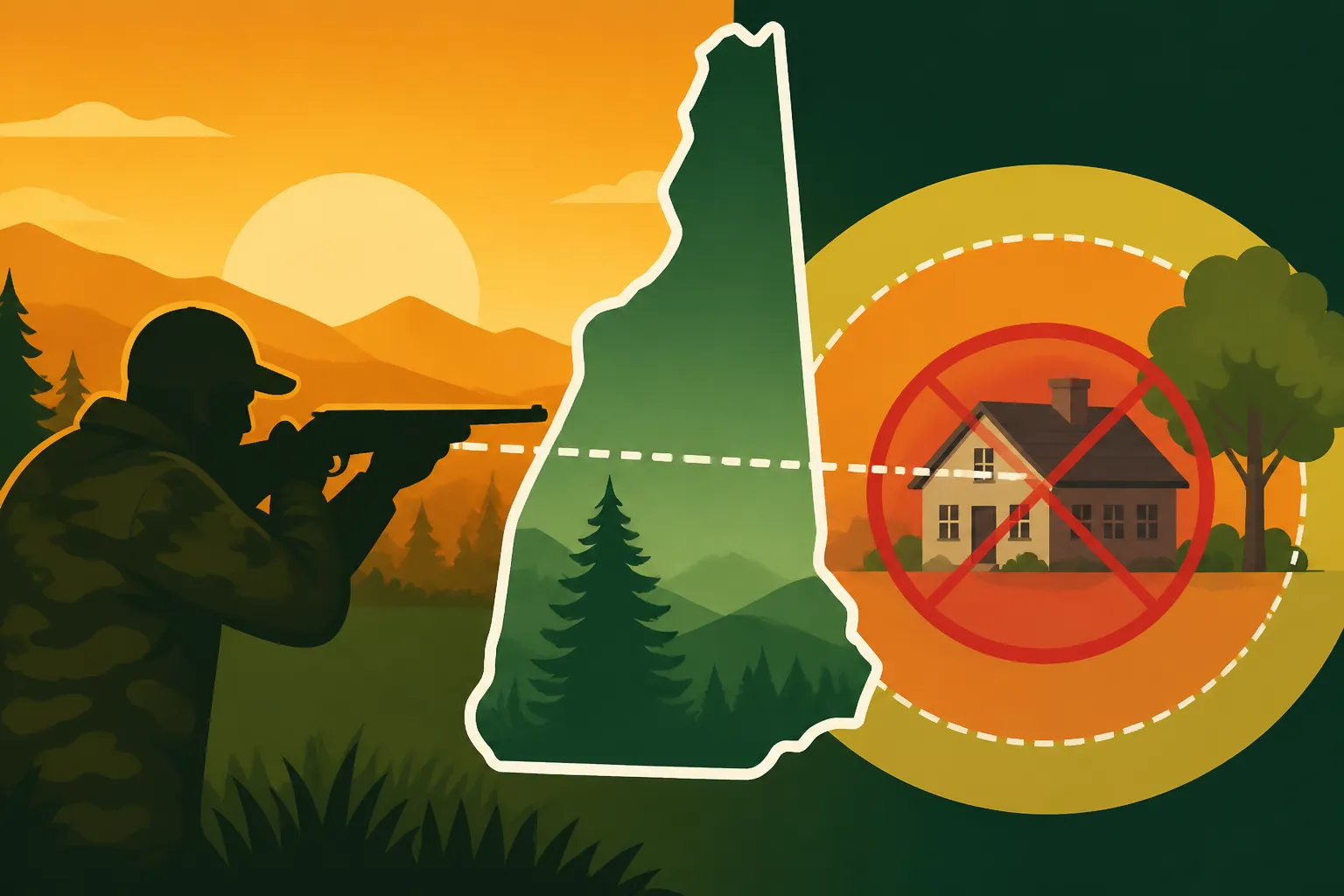
The cornerstone of New Hampshire's firearms discharge regulations revolves around what’s often called the "safety zone" or setback distance. Generally, state law prohibits discharging a firearm or bow and arrow within 300 feet of a permanently occupied dwelling, a school, or a public building, unless you have explicit written permission from the owner or legal occupant. This 300-foot perimeter is crucial, and it’s not just an arbitrary number; it’s a distance established to provide a buffer of safety around places where people live, learn, or gather. Think about it: a misjudged shot, a ricochet, or even just the sound of a gun going off too close can cause alarm, or worse, harm. This rule applies whether you're hunting deer, bear, or even small game, making it a universal consideration for anyone carrying a weapon in the field.
It's vital to focus on the "permanently occupied" part of the dwelling definition. An abandoned, dilapidated shack deep in the woods might technically be a structure, but if it's not permanently occupied, the 300-foot rule might not strictly apply to that structure. However, this doesn't mean you should ever take unnecessary risks. Always use common sense and err on the side of caution. Even if a building appears vacant, you never know when someone might be visiting or working on it. The spirit of the law is about preventing harm and disturbance, so if there's any doubt about occupancy, treat it as if it were occupied. This principle is a cornerstone of responsible hunting and helps ensure the future of our sport by maintaining positive public perception.
Exceptions and Specific Scenarios
While the 300-foot rule is broad, there are some important nuances and exceptions to understand. For instance, if you're on your own property and discharging a firearm, the 300-foot setback rule doesn't apply to your own dwelling or outbuildings, assuming you're doing so safely and legally. This means if you have a large parcel of land and a safe backstop, you can typically sight in your rifle or practice shooting without worrying about your own home. However, you still need to be mindful of any neighboring occupied dwellings and adhere to the 300-foot rule relative to their property. It's a common misconception that owning land gives you carte blanche to shoot anywhere; it doesn't extend to impacting your neighbors' safety or peace.
Another critical exception is when you have direct permission from a landowner. If you’re hunting a private tract and a dwelling is within 300 feet, securing written permission from that specific property owner for firearm discharge within that safety zone is your golden ticket. This is where building good relationships with landowners really pays off. Never assume verbal permission is enough; written consent protects both you and the landowner. You might even be able to negotiate permission to hunt Hunting Small Private Tracts in New Hampshire if you're respectful and clearly understand the setback rules for their property. And, of course, designated shooting ranges are specifically designed and permitted for firearm discharge, operating under their own safety protocols which typically supersede these general hunting setback rules.
Navigating Specific Environments and Situations
New Hampshire offers a diverse landscape for hunters, from dense North Country timber to more open, agricultural areas. Each environment presents its own set of challenges and considerations when it comes to safely and legally discharging your firearm. Understanding how the setback rules apply in these varied settings is crucial for any hunter.
Public Lands vs. Private Lands
The concept of safety zones doesn't change whether you're on public land or private land, but how you apply it certainly does. On public areas like the White Mountain National Forest or one of the many New Hampshire Wildlife Management Areas, you might encounter scattered cabins, trail shelters, or even administrative buildings. The 300-foot rule applies to these just as it would a private home. The challenge on public land is that property lines and occupied structures might not be clearly marked, making it imperative for you to do your homework. Tools like GoHunt or the New Hampshire Fish and Game app can be invaluable for identifying land ownership and potential structures. Before you head out, use these resources to scout your chosen area, looking for any cabins, campsites, or other structures that might fall within your hunting zone.
When hunting private land, the situation often feels a bit clearer because you've hopefully already secured permission from the landowner. However, this doesn't absolve you of responsibility for nearby unaffiliated properties. For example, you might have permission to hunt a large parcel, but if a neighboring property has an occupied dwelling just over the line, you still need to maintain that 300-foot buffer from their home. This is where understanding Finding New Hampshire Property Lines becomes paramount. A lot of hunters run into trouble not because they intend to break the law, but because they simply don't know exactly where a boundary lies or that an occupied structure is just out of sight. Always prioritize knowing your surroundings, regardless of who owns the land.
Roads, Trails, and Waterways
Beyond dwellings, New Hampshire law also addresses firearm discharge near public roads, trails, and even across certain waterways. It’s generally unlawful to shoot from or across a public highway. This isn’t just about the setback; it's also about the direction of fire and ensuring that projectiles don't endanger motorists or pedestrians. Imagine the danger of a bullet traveling down a road or across a trail where families might be hiking. The rule is pretty straightforward: if you’re standing on a paved or public dirt road, or looking to shoot across one, it’s a no-go. You’ll need to be off the traveled portion of the road and have a clear, safe line of fire into your hunting area, away from the road itself.
Similarly, shooting across certain waterways, especially those heavily used by boaters or kayakers, can also be restricted or just plain dangerous. While there isn't a blanket 300-foot rule for all waterways, the principle of a safe backstop and knowing your target and beyond always applies. If you're hunting along the Connecticut River, for example, you need to be acutely aware of boat traffic and houses on the opposite bank. Always consider the potential for a bullet to travel much farther than you anticipate, especially with modern rifle calibers. Safety around roads, trails, and popular waterways is not just a legal requirement but a fundamental ethical responsibility that speaks volumes about a hunter's respect for public safety.
Urban and Suburban Fringe Areas
As New Hampshire's population grows, more and more hunting opportunities exist on the fringes of suburban and even urban areas. This is where the firearms discharge rules become particularly tricky and require heightened awareness. While some WMUs like Hunting the WMU I2 Reaches Into the Suburban Fringe or even WMU K offer deer hunting, the likelihood of encountering occupied dwellings, schools, and public buildings increases dramatically. In these areas, the 300-foot setback rule isn't just a guideline; it's a constant, in-your-face reality.
Hunters in these zones often find their options limited to small, irregular parcels of woods, or narrow strips of land between developments. This necessitates an even more meticulous approach to scouting and knowing your exact location. Some towns or cities also have their own ordinances that might be even stricter than state law. Always check with local authorities if you're unsure about hunting within town limits. In these environments, carrying a detailed mapping tool like GoHunt becomes less of a luxury and more of a necessity. You might find that the only safe shot available is with a bow during Bowhunting New Hampshire's Long Archery Season, or by utilizing a ground blind for a more contained shot, rather than a rifle. The key is adaptation and an unwavering commitment to safety.
Practical Tips for Responsible Firearms Discharge
Understanding the letter of the law is one thing, but applying it safely and ethically in the field is another. Responsible firearm discharge goes beyond simply avoiding a legal infraction; it's about making sound judgments that protect lives, prevent property damage, and uphold the positive image of hunting in New Hampshire.
Always Know Your Backstop
This is the golden rule that transcends all setback distances and legal jargon: Always know your backstop. The 300-foot rule for dwellings is a minimum, but a bullet can travel for miles depending on the caliber and angle of discharge. A safe backstop means that whatever you shoot at, if you miss or the bullet passes through your target, it will harmlessly embed itself in the earth, a hill, or a thick stand of trees without endangering anything beyond. Shooting up a ridge without knowing what's on the other side, or aiming into an open field with a road far in the distance, is an absolute no-go.
Think about the terrain you’re hunting. Are you in rolling hills where a hill can serve as a natural backstop? Or are you in flat, open country where a missed shot could travel for an alarming distance? Wind and thermals in steep granite terrain can also affect bullet trajectory, making it even more important to be aware of your surroundings. Before you even shoulder your firearm, visualize the bullet's path and impact point. If there’s any doubt—any doubt at all—about what lies beyond your target, you must pass on the shot. No deer, no turkey, no bear is worth risking an accident or property damage. This mindset is at the core of New Hampshire Hunter Education Requirements and should be second nature to every hunter.
Utilizing Mapping Tools and Scouting
In today's age, technology is a hunter's best friend, especially when it comes to adhering to discharge rules. Gone are the days of relying solely on paper maps and vague directions. Mapping apps like GoHunt, or the official New Hampshire Fish and Game app, provide invaluable satellite imagery, topo maps, and crucially, property lines. These tools can highlight occupied structures, identify public land boundaries, and even show you trails and roads that factor into setback calculations. Use them! Spend time before your hunt, Scouting New Hampshire Public Land Before Season, to identify potential problem areas.
When you're actually in the field, GPS functionality on these apps can pinpoint your exact location, allowing you to quickly determine if you’re within a legal shooting zone. For instance, if you're still-hunting white mountain national forest timber, you can zoom in and see if that faint trail in the distance is actually a marked public trail or a private driveway leading to a camp. This proactive approach saves you from making a costly mistake in the heat of the moment. Furthermore, using these tools can help you find overlooked spots that are both productive and safely away from inhabited areas, maximizing your chances while minimizing risk.
When in Doubt, Don't Pull the Trigger
This is the ultimate safety rule, and it's something every hunter, regardless of experience, must internalize. If you are unsure about your backstop, if you can’t positively identify your target, or if you suspect you might be within a prohibited setback distance, do not pull the trigger. It’s far better to let an animal walk away than to risk an accident, injury, or a legal violation. The legal consequences of violating firearms discharge rules can range from significant fines to license revocation, and even criminal charges, depending on the severity of the incident.
Beyond the legal ramifications, there's the moral and ethical responsibility. An accidental injury or property damage not only harms individuals but casts a long shadow over the entire hunting community, making it harder for all of us to enjoy our traditions. Be patient, be vigilant, and always prioritize safety over opportunity. Understanding the New Hampshire Public Land Hunting Hours and respecting the sanctity of private property, even if you don't have explicit permission to hunt it, are crucial parts of this ethical code. Take the time to understand these rules, use your resources, and be the safest hunter you can be.
Here's a quick reference table for New Hampshire's key setback rules:
| Rule Type | Distance Required | Applies To | Exceptions / Notes |
|---|---|---|---|
| Safety Zone | 300 feet (91.4 meters) | Permanently occupied dwellings, schools, public buildings | Requires written permission from owner/occupant. |
| Public Highway | Generally prohibited | Shooting from or across a public highway | Must be off the traveled portion and shoot away from the road. |
| Waterways | Varies, caution advised | Heavily trafficked rivers, lakes, ponds | No specific statewide setback, but safe backstop and awareness crucial. |
| Own Property | No setback to your own dwelling | On land you own/occupy legally | Still applies to neighboring occupied dwellings. |
| Shooting Ranges | N/A | Designated, permitted ranges | Operate under specific safety rules; generally exempt from general setbacks. |
Disclaimer
This article is for general informational purposes only and does not constitute professional advice. Laws, prices and regulations vary by location and change over time. Consult a qualified professional for guidance on your specific situation.