Fixed Versus Mechanical Broadheads in Timber
As archers, we pour our hearts and souls into scouting, practice, and dialing in our bows, only to arrive at that crucial moment in the timber, questioning if we've made the right choice in broadheads. The dense woods of New Hampshire, with their challenging shot angles and unpredictable encounters, can make the debate between fixed-blade and mechanical broadheads feel like a never-ending riddle. This guide aims to clear up that confusion, offering a deep dive into the pros and cons of each, helping you select the perfect projectile for your Granite State hunts.
Understanding the Core Differences: Fixed vs. Mechanical
The choice between a fixed-blade and a mechanical broadhead isn't just about aesthetics; it’s about fundamental design philosophies that dictate how they perform downrange and upon impact. Both are designed to achieve a swift, ethical harvest, but they go about it in distinctly different ways, each with its own set of advantages and considerations, especially when navigating the varied cover found across New Hampshire.
What Defines a Fixed-Blade Broadhead?
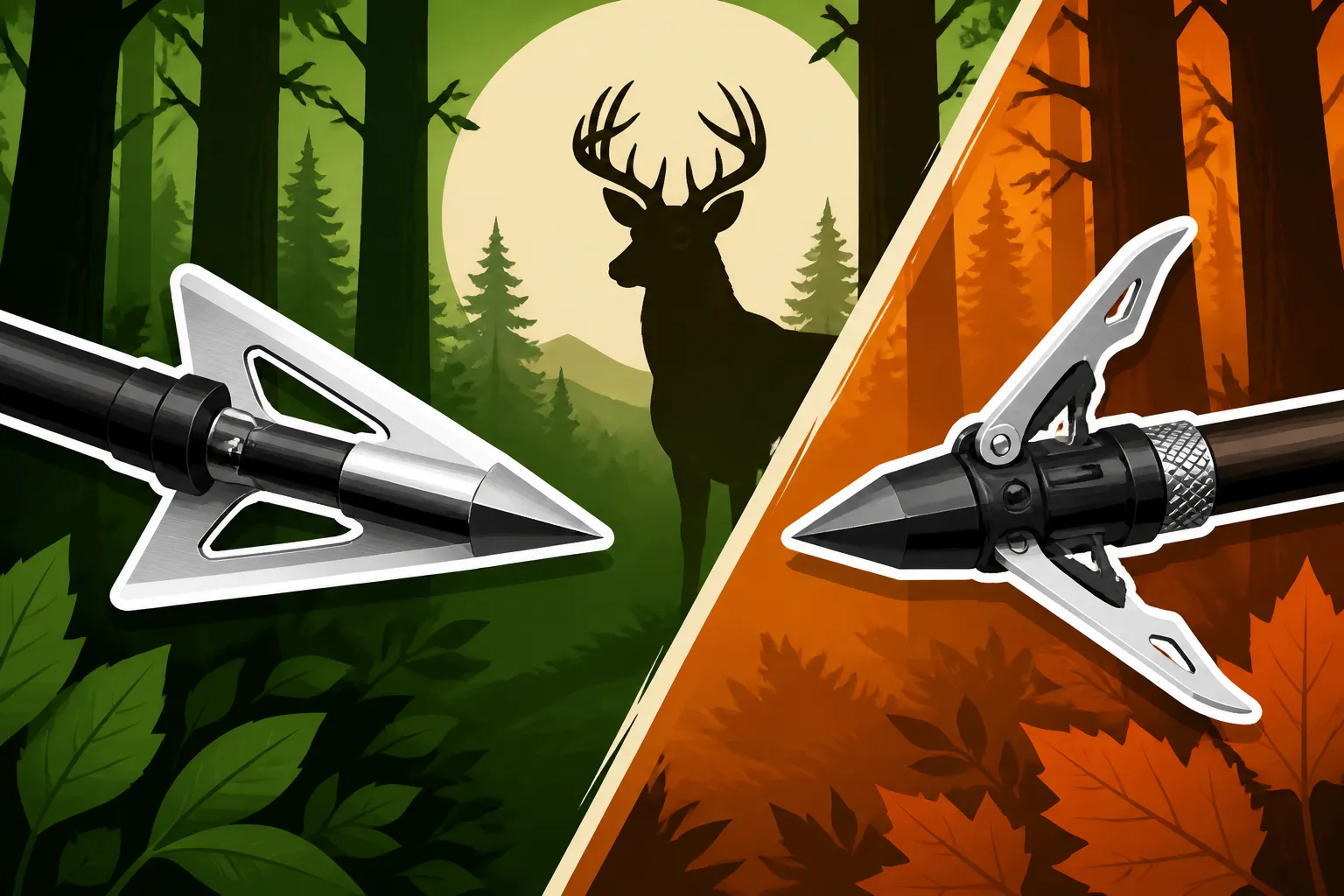
Fixed-blade broadheads are the traditional workhorses of bowhunting, boasting a design that has remained largely unchanged for generations. They consist of a solid ferrule with two, three, or four razor-sharp blades permanently affixed or integrated into the head. These blades are rigid and unmoving, creating a consistent cutting diameter from the moment they leave the bowstring until they exit the animal. Think of them as miniature knives attached to the front of your arrow – what you see is precisely what you get, no moving parts, no deployment mechanisms, just pure, unyielding cutting surface.
The beauty of a fixed-blade broadhead lies in its simplicity and brute force. When you send one flying, its full cutting diameter is always presented to the target, immediately beginning to sever tissue. This design is inherently robust, built to withstand tremendous impact, whether it's punching through thick hide, rib bones, or even glancing off a small twig. Their consistent profile often means more predictable flight characteristics in certain conditions, especially for bows that are meticulously tuned. For many veteran hunters in the White Mountains and across New Hampshire's timber, this steadfast reliability is exactly why they'll never hang up their fixed blades.
How Mechanical Broadheads Operate
Mechanical broadheads, often called expandable broadheads, represent a more modern approach to terminal performance. Unlike their fixed-blade counterparts, mechanicals feature blades that are tucked away or folded back against the ferrule during flight. This creates a smaller, more aerodynamic profile, which proponents argue leads to enhanced accuracy, often mimicking the flight of a field point. Upon impact with the target, usually triggered by the resistance of the animal's hide, the blades deploy or "expand" outwards, creating a significantly larger cutting diameter than their in-flight profile would suggest.
The engineering behind mechanical broadheads is all about maximizing the wound channel while minimizing in-flight drag. Different designs feature various deployment mechanisms, from spring-loaded blades to those that pivot on impact, but the goal is the same: deliver a wide, devastating cut once inside the animal. This expansive cutting diameter is a major draw for hunters, as it theoretically increases the chances of hitting vital organs and creating a more substantial blood trail. However, this added complexity also introduces variables—will the blades deploy correctly? Will they hold up to bone impact? These are questions that occupy the minds of archers considering mechanicals for dense New Hampshire cover.
The Enduring Appeal of Fixed-Blade Broadheads in Timber
For many, myself included, there's a deep-seated trust in fixed-blade broadheads, especially when hunting the dense, unforgiving timber of New Hampshire. It's not just nostalgia; it's a belief born from experience that sometimes, the simplest tools are the most reliable when the stakes are high.
Reliability in Tough Conditions
Imagine you're tucked into a treestand in the Monadnock Region, a mature buck slowly working its way through thick spruce and cedar. A small, unseen twig, barely thicker than your finger, is between you and the kill zone. With a fixed-blade broadhead, that twig is often just a momentary deflection, a minor obstacle that the sturdy, unmoving blades can power through or around, still maintaining enough energy and integrity to reach your target. There's no concern about blades pre-deploying prematurely from brush contact or failing to open upon impact. What you shoot is what hits the deer, a steadfast confidence that’s invaluable in the unpredictable woods.
This inherent reliability extends beyond unexpected brush contact. Fixed blades generally consist of fewer moving parts, or often none at all, reducing the chances of mechanical failure in the field. Cold New Hampshire mornings, damp hunting conditions, or an accidental bump against your quiver can wreak havoc on delicate mechanisms. A fixed blade simply doesn't care; its solid construction is designed to perform regardless of external factors, giving you one less thing to worry about when that trophy whitetail finally steps out.
Penetration Power Through Bone and Hide
The deep woods and thick cover in New Hampshire often mean a shot isn't always perfectly clean, and sometimes, you're faced with an ethical shot that might involve a rib or shoulder bone. This is where fixed-blade broadheads truly shine. Their unyielding, fixed cutting surfaces and often steeper blade angles are engineered for maximum penetration. They don't have to use energy to deploy blades; all of an arrow's kinetic energy is immediately focused on pushing that sharpened steel through whatever lies in its path.
Many fixed-blade designs, particularly those with a strong cut-on-contact tip, are like tiny chisels, designed to split and push through bone rather than rely solely on blade sharpness to cut through it. This can be a critical advantage when an arrow strikes a shoulder blade or a rib, increasing the likelihood of passing through to the vitals and creating two holes for a better blood trail. In areas with larger-bodied deer, like some of the more agricultural zones in southern New Hampshire, this robust penetration can be the difference between a quick recovery and a long, difficult track. You need something that won't give up when it meets resistance.
Durability and Reusability
Another often-overlooked benefit of fixed-blade broadheads is their sheer durability and potential for reusability. A well-constructed fixed blade, after a successful harvest, can often be cleaned, re-sharpened, and put back into service. While blades might need replacement if significantly dulled or bent, the ferrule itself is typically robust enough to handle multiple impacts. This can be a cost-effective choice in the long run, as you're not constantly replacing entire broadheads after every successful hunt or practice session.
Think about the rough and tumble nature of hunting in New Hampshire. Your gear takes a beating. Arrows can glance off rocks, bury themselves in unforgiving soil, or pass through thick brush after an animal. A fixed blade is generally designed to endure these abuses better than a mechanical head with its more intricate moving parts. Even for practice, a dedicated practice fixed blade can be shot repeatedly into targets without concern for blade deployment or damage, allowing you to fine-tune your setup without sacrificing expensive hunting heads.
The Advantages of Mechanical Broadheads for Modern Archers
While fixed blades hold a special place, mechanical broadheads have revolutionized bowhunting for many, offering distinct advantages that appeal to the modern archer, particularly those seeking maximum forgiveness and larger wound channels. The growth in popularity of mechanicals in New Hampshire speaks volumes about their performance and appeal.
Field Point Accuracy Potential
Perhaps the most compelling argument for mechanical broadheads is their ability to fly with field-point-like accuracy. Because their blades are tucked away during flight, they present a smaller, more aerodynamic profile to the wind. This significantly reduces the "planing" effect that can sometimes plague fixed blades, where the broadhead's larger surface area can catch the wind and cause the arrow to drift or impact differently than a field point. For archers who struggle to get fixed blades to group consistently with their field points, mechanicals can be a game-changer.
This enhanced accuracy means less time spent meticulously paper tuning and walk-back tuning broadheads, and more confidence in the shot. When you're facing a critical moment in the woods, knowing your arrow will hit exactly where your pin is, regardless of the projectile on its tip, provides an immense psychological edge. For hunters setting up their bows for deer season, the ease of achieving consistent broadhead flight with mechanicals can save hours of frustration and build crucial confidence for the season ahead.
Massive Cutting Diameters and Wound Channels
Once a mechanical broadhead impacts its target and the blades deploy, the resulting cutting diameter can be dramatically larger than most fixed blades. While a typical fixed blade might offer a 1-inch to 1.25-inch cutting diameter, many mechanicals expand to 1.5 inches, 2 inches, or even larger. This substantial increase in cutting surface means a larger wound channel, designed to create more tissue damage, sever more blood vessels, and lead to a quicker, more humane harvest.
The argument for larger wound channels is simple: more damage means a faster bleed-out and a better blood trail. In the dense undergrowth and leaf litter that often characterizes New Hampshire's hunting terrain, a copious blood trail can be the difference between recovering a deer quickly and losing it. For hunters who prioritize a wide cutting swath and maximum trauma upon impact, mechanical broadheads offer a compelling solution that directly addresses the goal of an ethical, efficient kill. This is especially true for archers seeking to maximize their chances with a less-than-perfect shot.
Reduced Wind Drift Concerns
Wind is the enemy of arrow flight, and anyone who has hunted a blustery fall day in New Hampshire knows how quickly a seemingly perfect shot can go awry. Fixed-blade broadheads, with their exposed blades, are more susceptible to wind drift than their mechanical counterparts. That larger surface area acts like a tiny sail, pushing the arrow off course, especially at longer distances or in strong crosswinds.
Mechanical broadheads, with their compact, aerodynamic profile during flight, are far less affected by wind. This means that if you're hunting open fields adjacent to timber, or even elevated ridges where wind funnels through, a mechanical broadhead can provide greater accuracy and consistency. For those who push the ethical limits of their shot distance, or simply want to minimize the variables introduced by Mother Nature, the reduced wind drift of mechanicals offers a distinct advantage, ensuring your arrow stays truer to its intended path.
Factors to Consider When Choosing for New Hampshire Timber
The decision between fixed and mechanical broadheads isn't black and white. It depends heavily on your individual hunting style, your equipment, and the specific challenges presented by New Hampshire's diverse hunting landscape. Taking the time to evaluate these factors can lead you to the broadhead that gives you the most confidence.
Your Hunting Terrain and Target Species
New Hampshire offers a vast array of hunting environments, from the sprawling, unforgiving wilderness of the White Mountain National Forest to the dense, swampy lowlands of the Connecticut River Valley, and the rolling hills and agricultural edges of the southern regions. Each of these terrains presents unique considerations for broadhead choice. If you primarily still-hunt through thick softwoods where shot distances are short and brush deflection is a constant concern, the robustness of a fixed blade might be more appealing. Still-Hunting White Mountain National Forest Timber demands a broadhead that can handle rough encounters.
However, if your hunts often take you to the edges of large fields or open hardwood ridges where longer shots are possible and wind might be a factor, a mechanical broadhead's accuracy could shine. Consider the specific species too. While deer are our primary focus, if you occasionally pursue smaller game with a bow, a mechanical's wider cut might be overkill, whereas a fixed blade is versatile for various game. Understanding the typical shot distances you encounter and the density of cover will heavily influence which broadhead design will serve you best.
Bow Setup and Arrow Speed
The characteristics of your bow setup play a significant role in broadhead performance. Modern compound bows, especially those with high poundage and fast IBO ratings, generate considerable kinetic energy and arrow speed. These high-performance setups can often make either broadhead type fly well, but there are nuances. Faster bows can sometimes exacerbate the planing issues of fixed blades, making them harder to tune, while they can drive mechanicals with incredible force.
Conversely, traditional archers, or those shooting bows with lower draw weights and slower arrow speeds, might lean towards fixed blades, particularly cut-on-contact designs, to ensure maximum penetration. These broadheads don't rely on explosive kinetic energy to deploy; they simply cleave their way through. For a hunter with a relatively slower setup, choosing a broadhead that prioritizes penetration over a massive cutting diameter can be a wise decision. Test both extensively with your specific bow and arrow combination to see what performs best.
Ethical Harvest Considerations
At the end of the day, our primary goal as ethical hunters is a quick, humane harvest. Both fixed and mechanical broadheads are capable of achieving this when placed correctly. The question becomes, which one gives you the most confidence in delivering that ethical shot in the varied conditions of New Hampshire? If you lack confidence in your fixed blades flying accurately, that could lead to a less-than-ideal shot. If you worry about a mechanical failing to deploy in a critical moment, that too can undermine your ethics.
Consider your personal shooting proficiency and experience level. A newer archer might benefit from the field-point accuracy of a mechanical to build confidence, while a seasoned veteran might trust the unwavering penetration of a fixed blade. Ultimately, the "best" broadhead is the one that you shoot with the most consistent accuracy and have the most faith in when that moment of truth arrives. It's about minimizing variables and maximizing your chances for a clean kill.
Tuning Your Setup: Making Either Broadhead Fly True
Regardless of whether you choose fixed or mechanical, proper tuning is absolutely paramount to achieving ethical and consistent arrow flight. A poorly tuned bow will send even the "best" broadhead off course, leading to frustration and potentially wounded game. Don't skip this critical step; your success in New Hampshire's timber depends on it.
Paper Tuning for Perfection
Paper tuning is a foundational step in ensuring your broadheads fly true, and it's something every bowhunter should master. It involves shooting an arrow through a piece of paper suspended a few yards in front of your target. The tear in the paper reveals how your arrow is leaving the bowstring – ideally, you want a perfect bullet hole, indicating the arrow is flying straight and true from the start. A "poor" tear (nock high, nock low, left or right tear) indicates issues with your rest, nocking point, or cam timing that need to be addressed.
For fixed-blade broadheads, paper tuning is non-negotiable. Any inconsistencies in arrow flight will be magnified by the broadhead's exposed blades, leading to erratic grouping downrange. Even for mechanicals, while they might be more forgiving, achieving a perfect bullet hole in paper ensures maximum kinetic energy retention and consistent blade deployment. Don't just shoot through paper once; repeat the process to confirm your adjustments. This step ensures that your broadhead, no matter its design, has the best possible start to its flight.
Walk-Back Tuning and Broadhead Flight
After achieving a decent paper tune, walk-back tuning takes the process a step further, specifically addressing broadhead flight over distance. This method involves shooting a field point and your broadhead-tipped arrow at a target from varying distances, typically starting at 20 yards and walking back to 30, 40, or even 50 yards, without adjusting your sight pins. The goal is for both field points and broadheads to impact the same vertical line, or at least very close.
If your field points and broadheads consistently impact differently at longer distances, it indicates that your fixed blades are "planing" or that there are still subtle inconsistencies in your arrow's flight. Adjustments to your rest, nocking point, or even slight changes to arrow spine can often resolve these issues. While mechanicals are often praised for field-point-like flight, walk-back tuning can still reveal if there are any subtle differences that need to be ironed out. Tuning a Bow for Broadhead Flight is an art as much as a science, and mastering it will make you a more confident archer, ready for whatever New Hampshire's timber throws at you. For serious hunters, utilizing resources like GoHunt to analyze terrain maps and potential shot distances can help inform how critical precise broadhead flight at various ranges might be for a particular hunting area.
My Personal Take: A Blended Approach for New Hampshire Whitetails
After years of chasing whitetails and other game through New Hampshire's diverse landscapes, I've come to appreciate the strengths of both fixed and mechanical broadheads. The truth is, there isn't one "perfect" broadhead for every single scenario. Instead, I've found that a flexible approach, understanding when each design shines, offers the most consistent success.
The Case for Both in Your Quiver
For me, the decision often comes down to the specific hunt and terrain I anticipate. If I'm heading deep into the thick, steep ravines of the White Mountains, or still-hunting dense beaver flowages where shot distances are tight and brush contact is a real possibility, I often lean towards a robust fixed blade. Its unwavering reliability and penetration power through any unexpected resistance give me peace of mind. Hunting a Beaver Flowage Edge can be a brutal test of gear. I want something that won't fail.
However, if I'm hunting a stand overlooking a more open hardwood ridge in the Monadnock region, or sitting a food plot edge where longer shots and wind might be factors, a mechanical broadhead's superior accuracy and massive wound channel become incredibly appealing. It's about playing to the strengths of each design. Some hunters even carry a mix in their quiver, ready to adapt to an evolving hunting situation, though I usually stick to one broadhead per hunt to maintain mental consistency.
Practicing with Your Chosen Broadhead
The most critical piece of advice I can offer, regardless of your broadhead choice, is to practice, practice, practice with the actual broadhead you intend to hunt with. Don't just shoot field points all summer and expect your broadheads to fly the same. Take the time to shoot your fixed blades or mechanicals at various distances, from different positions (standing, kneeling, from a treestand), and in varied weather conditions. This builds crucial muscle memory and confidence.
Knowing exactly how your broadhead flies under pressure is invaluable. A fixed blade that's been proven accurate out to your ethical hunting range, or a mechanical that you've watched deploy perfectly into a target, fosters the confidence needed to make a clean, ethical shot when that buck finally steps into view. Your broadhead choice is important, but your familiarity and confidence with that choice are even more so. Take advantage of mapping tools like GoHunt to visualize potential shot scenarios in the terrain you'll be hunting, then practice those exact shots.
Broadhead Comparison: Fixed vs. Mechanical
| Feature | Fixed-Blade Broadheads | Mechanical Broadheads |
|---|---|---|
| Design | Blades permanently affixed to ferrule, no moving parts. | Blades fold back in flight, deploy on impact. |
| Flight Profile | Can be susceptible to planing and wind drift; requires precise tuning. | Aerodynamic, often flies like a field point; less wind drift. |
| Penetration | Excellent; all energy focused on pushing through, ideal for bone. | Good to excellent; some energy used for deployment, then cuts. |
| Wound Channel | Consistent, generally smaller cutting diameter (1-1.25"). | Often significantly larger cutting diameter (1.5-2.5"+). |
| Reliability | Very high; few moving parts, less prone to failure or pre-deployment. | Generally high; potential for mechanical failure or pre-deployment (rare with quality heads). |
| Durability | Very good; often reusable if not severely damaged, easy to resharpen. | Moderate; blades often need replacement after impact. |
| Ideal for | Dense timber, heavy brush, uncertain shot angles, heavier bone impact. | Open areas, longer shots, lighter bone impact, maximizing blood trail. |
| Tuning Needs | Critical and can be challenging to achieve perfect flight. | Generally easier to tune to field points, but still requires verification. |
Disclaimer
This article is for general informational purposes only and does not constitute professional advice. Laws, prices and regulations vary by location and change over time. Consult a qualified professional for guidance on your specific situation.