Hunting a Ridge-Top Saddle for Rutting Bucks
Finding those elusive rutting bucks in New Hampshire's diverse and often challenging terrain can feel like searching for a needle in a haystack. Many hunters spend countless hours in the woods, only to miss the crucial moments when a mature buck is on the move. But what if there was a reliable terrain feature that bucks consistently use during the rut, offering you a prime opportunity? This guide will dive deep into understanding, scouting, and effectively hunting ridge-top saddles, a classic deer highway for rutting whitetails in the Granite State.
What Makes a Ridge-Top Saddle a Deer Magnet
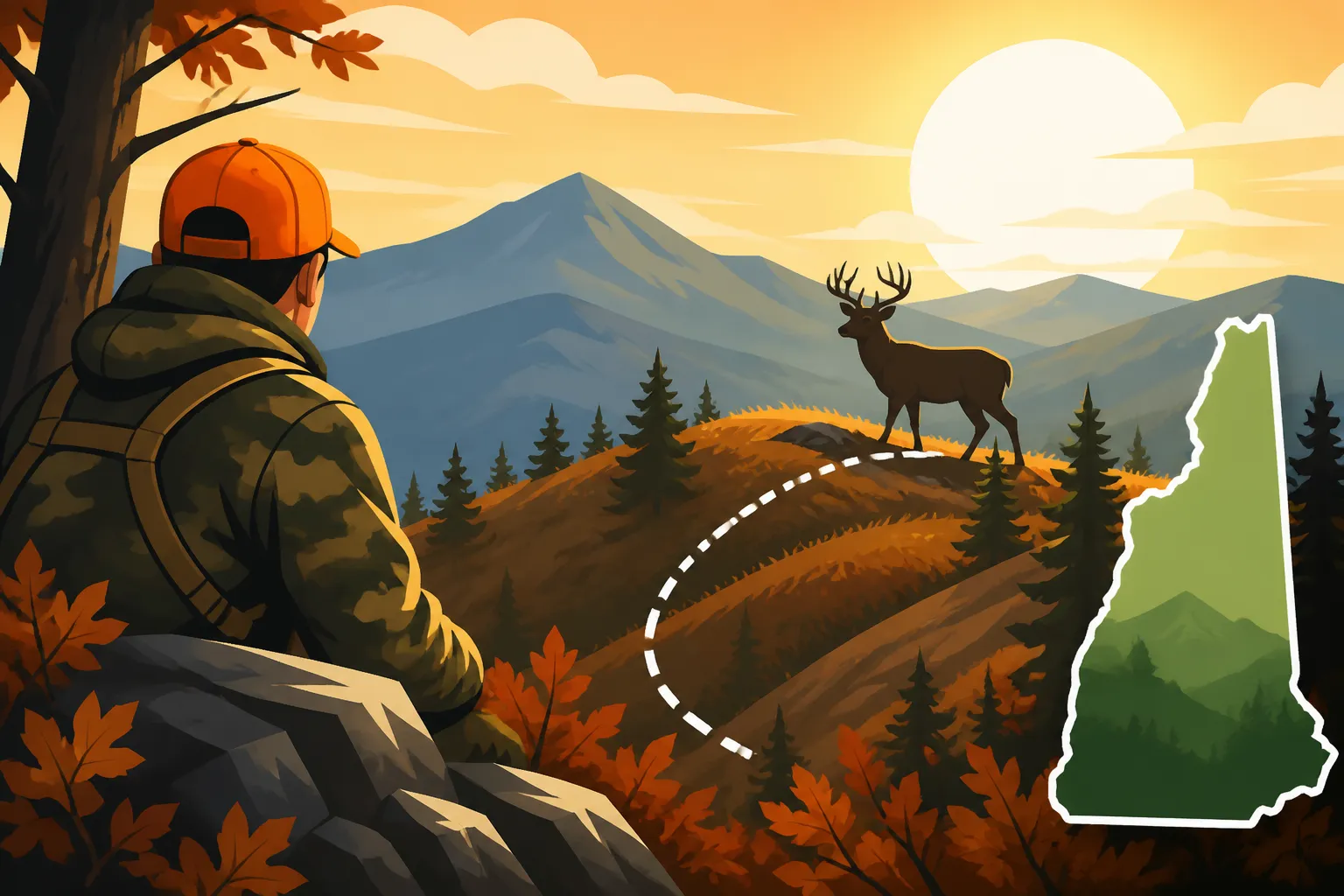
A ridge-top saddle, often simply called a saddle, is essentially a low point or a dip along a ridge line, connecting two higher points. Imagine two hilltops with a gentler, lower section between them. This geological feature is an absolute magnet for deer, especially during the rut, and understanding why is your first step to success. It’s not just a random dip; it’s a strategic travel corridor.
Think about a buck that's on a mission, whether it's cruising for does, scent-checking a territory, or chasing a hot doe. Moving over the very top of a high, steep ridge is often inefficient and exposes them. Skirting the base can also be longer and might put them in less secure cover. The saddle offers the path of least resistance, a natural highway that allows them to travel with minimal effort while still often being able to utilize the wind to their advantage and stay in or near security cover. It's like finding the deer's version of a well-worn Interstate highway, complete with exit ramps and rest stops.
Natural Funnels and Strategic Advantages
Beyond being an easy travel route, saddles act as natural funnels. Deer, being creatures of efficiency, will naturally gravitate towards these constricted pathways. This is especially true in the rugged New Hampshire landscape, where steep granite ridges and dense timber can make travel anywhere else arduous. When bucks are actively seeking does during the rut, they'll use these funnels to cover ground quickly, scent-check for receptive does, and often encounter other deer. A buck cruising a saddle might be checking for signs of a doe that just passed through, or actively pushing one across.
Furthermore, these spots often offer strategic advantages for deer. The wind currents in saddles can be tricky but also predictable once you understand them. Deer often use thermals, those rising and falling air currents, to their advantage, particularly at dawn and dusk. A buck moving through a saddle at first light might be using the rising thermals to carry his scent upwards, while a deer moving at last light might be taking advantage of falling thermals to detect danger below. Knowing how to interpret these subtle shifts is critical for understanding deer movement and ultimately, for Wind and Thermals in Steep Granite Terrain.
Scouting Strategies for Identifying Key Saddle Locations
Finding the right saddle isn't about just spotting any dip on a ridge; it's about finding the best one. Pre-season scouting is absolutely paramount, as it allows you to identify these critical locations without spooking deer. You're looking for signs of consistent deer activity, not just a one-off track. This involves a combination of aerial reconnaissance and boots-on-the-ground investigation.
Start your scouting by pouring over detailed topographic maps and aerial imagery. Tools like GoHunt or other advanced mapping platforms are incredibly valuable here. Look for prominent ridge lines that run for some distance. Then, identify distinct dips or low points. These are your potential saddles. Pay attention to how these saddles connect different terrain features – perhaps a bedding area on one side to a food source on the other, or a thick cedar swamp to a stand of mature oaks. Look for areas where several ridge fingers converge or where saddles might connect to old logging roads or clear-cuts, as these often create additional travel corridors. This digital mapping approach can save you countless hours of wandering aimlessly. For deeper insights into using these tools, consider checking out resources like onX Layers for New Hampshire Land Status.
Ground Truthing and Sign Interpretation
Once you’ve identified a few promising saddles on your maps, it’s time to hit the woods. This is where you confirm your hypotheses and truly understand the deer’s preferred pathways. Ideally, you want to do this during the late summer or early fall, well before hunting pressure begins. When you’re on the ground, look for well-worn deer trails cutting through the saddle. These paths will often be evident, appearing as faint troughs in the forest floor, especially where the terrain is rocky or where leaves have been pushed aside.
Beyond trails, search for fresh rubs and scrapes. During the pre-rut and peak rut, bucks will actively create these signposts to communicate with other deer. Rubs, where a buck has scraped his antlers on a small tree, indicate his presence and aggression. Scrapes, patches of bare earth where a buck has pawed away leaves and urinated, are communication hubs, especially if there's an overhanging branch (a "licking branch") above it. The presence of multiple fresh rubs and scrapes in and around a saddle confirms that bucks are not just passing through, but actively using this area as part of their rutting circuit. The size of the rubs can even give you a clue about the size of the buck using the area. A really active scrape line along a logging road leading into a saddle is a prime indicator. Understanding these signs is key to Scouting New Hampshire Public Land Before Season.
Effective Hunting Tactics for New Hampshire Ridge Saddles
So, you've found your saddle, complete with fresh sign and obvious travel routes. Now, how do you hunt it effectively? This isn't about simply setting up anywhere; it's about strategic positioning, considering all the elements, and understanding deer behavior during the rut.
One of the most crucial elements when hunting a ridge-top saddle is understanding wind and thermals. New Hampshire's mountainous terrain creates complex air currents that can foil even the best-laid plans. During the morning, as the sun warms the earth, thermals will typically rise, carrying your scent uphill. In the evening, as the air cools, thermals fall, carrying your scent downhill. You need to position yourself not just for the prevailing wind, but also for these thermal shifts, which can often be more impactful in steep country. A good rule of thumb is to set up slightly below the saddle, allowing your scent to be carried over where deer are expected to travel, or catching them as they approach. For more on this, check out Wind and Thermals in Steep Granite Terrain.
Stand Placement and Approach
When choosing a stand location, whether a treestand or a well-brushed ground blind, you want to be able to cover the most likely travel paths through the saddle without being detected. Look for mature trees that offer good concealment and a clear shooting lane. Ideally, your stand should be positioned 20-30 yards off the main trail, slightly downwind or crosswind, depending on the anticipated deer movement and thermal patterns. Don't be afraid to Hanging a Stand on a Granite Ridge if the terrain allows, as elevation can give you a better vantage point and help manage your scent.
Your approach and exit routes are just as important as your stand placement. You want to be able to get into and out of your stand without alerting any deer. This might mean using a circuitous route, walking along a stream bed, or utilizing dense cover. Avoid walking directly through the saddle or along obvious deer trails when you’re going in or out. The goal is to be a ghost in the woods, leaving no trace of your presence. A quality pair of Best Boots for White Mountain Granite Trails can make all the difference for a quiet, stealthy approach.
Calling and Decoying in Saddles
During the rut, calling can be incredibly effective in saddles. Bucks are actively seeking does, and they're often willing to investigate sounds. Grunt calls can mimic a buck trailing a doe or another buck, while doe bleats can pique the interest of cruising bucks. Start with soft, infrequent calls and escalate if you don't get a response. Sometimes, a short, aggressive rattling sequence can draw in a curious buck, especially if you're targeting those mature, dominant animals. However, use rattling sparingly, as it can also alert wary deer to your presence if overdone. For tips on vocalizations, look into Grunt Calls in Mature New Hampshire Hardwoods and Rattling Volume in Thick Softwood Cover.
While not always practical in dense New Hampshire timber, a single doe decoy can sometimes be effective, particularly if positioned downwind of your stand in an open-enough lane. A buck seeing a lone doe might commit to checking her out, offering you a shot. However, decoys require specific conditions and open sight lines, so they might be better suited for more open country rather than the thick, rocky saddles of the White Mountains.
Timing Your Hunts for Peak Rut Activity
Knowing when to hunt a ridge-top saddle is just as crucial as knowing how. These hotspots are most productive during specific phases of the rut, when buck activity is at its highest. New Hampshire's deer season is structured to provide opportunities throughout these crucial periods, but understanding the peak times for your specific WMU will significantly increase your odds. For general season dates, refer to New Hampshire's WMU-Based Deer Season Structure.
The Pre-Rut and Peak Rut
The pre-rut, typically late October into early November in New Hampshire, sees bucks beginning to cruise more widely, establishing dominance, and actively making rubs and scrapes. This is an excellent time to hunt saddles, as bucks are using them to check for does and for territorial patrols. They're on the move, but perhaps not as frantically as in the peak. Early mornings and late evenings are prime during this phase.
The peak rut, which often falls during the second and third weeks of November, is when bucks are most actively chasing and breeding. This is your absolute best window for saddle hunting. Bucks will be traveling incessantly, sometimes all day long, following scent trails and pushing does. During this time, they are often less cautious, their minds driven by primal urges. Sitting all day in a well-chosen saddle during the peak rut can yield incredible results. This aligns perfectly with opportunities during Hunting the Rut in Early-to-Mid November. You might even catch a buck moving during midday hours, which is rare outside of this intense period.
Late Rut and Post-Rut Cruising
Even as the peak rut winds down, typically late November into early December, saddles can still be productive. Bucks might be tired and less frenzied, but they will still be cruising for any remaining receptive does. They’re also starting to transition back to feeding patterns, meaning saddles connecting bedding areas to late-season food sources can be excellent choices. Additionally, bucks might use saddles as security routes as they recover from the rigors of the rut and seek out Where New Hampshire Bucks Bed in Thick Cover.
Remember, successful saddle hunting is about patience, stealth, and a deep understanding of deer behavior combined with the nuances of New Hampshire's terrain. Don't be discouraged if you don't see a buck on your first sit; consistency and proper preparation are key to finally connecting with that Granite State giant.
| Factor | Pre-Rut Saddle Strategy | Peak Rut Saddle Strategy | Late Rut Saddle Strategy |
|---|---|---|---|
| Buck Behavior | Scouting, scent-checking, establishing dominance | Actively chasing does, cruising intently | Seeking last receptive does, beginning recovery |
| Wind Priority | Consistent wind for scent checking | Less critical due to frenzied movement, but still important | Consistent wind for scent checking |
| Stand Placement | Overlooking scrapes/rubs, funnel points | High traffic corridors within the saddle | Near remaining food sources leading to saddle |
| Calling | Light grunts, social bleats | Aggressive grunts, rattling, doe bleats | Light grunts, estrus bleats |
| Approach/Exit | Stealth paramount, avoid disturbing | Still stealthy, but can be more forgiving | Stealth paramount |
| Time of Day | Early morning, late evening | All day, especially midday | Early morning, late evening |
Disclaimer
Hunting is an activity with inherent risks. Always prioritize safety, understand and adhere to all New Hampshire Fish and Game laws and regulations, and respect private property. The information provided in this guide is for educational and informational purposes only and should not replace professional guidance or your own thorough research. Conditions in the field can change rapidly, and your judgment and safety precautions are paramount.