Choosing a Rifle Twist Rate for Timber Shots
There’s nothing quite like the feeling of easing through New Hampshire’s timber, stalking quietly through the hardwoods or softwoods, knowing a big buck could be just around the next blowdown. But for all the magic of hunting our dense forests, there's a unique frustration that comes with choosing the right rifle setup – specifically, the rifle twist rate. It's a detail that can feel incredibly technical, but it’s absolutely critical to bullet stability and accuracy, especially when those shots are close and quick, often through tight windows in the woods. This guide aims to demystify rifle twist rates, helping you understand how they impact your bullet's performance and how to choose the best setup for those quintessential New Hampshire timber shots.
Understanding Rifle Twist Rate Basics
Before we dive into the nitty-gritty of choosing the right twist for our Granite State woods, let’s lay down some foundational knowledge. It can feel like rocket science, but I promise, it's more about understanding how your bullet flies.
What Exactly Is Twist Rate?
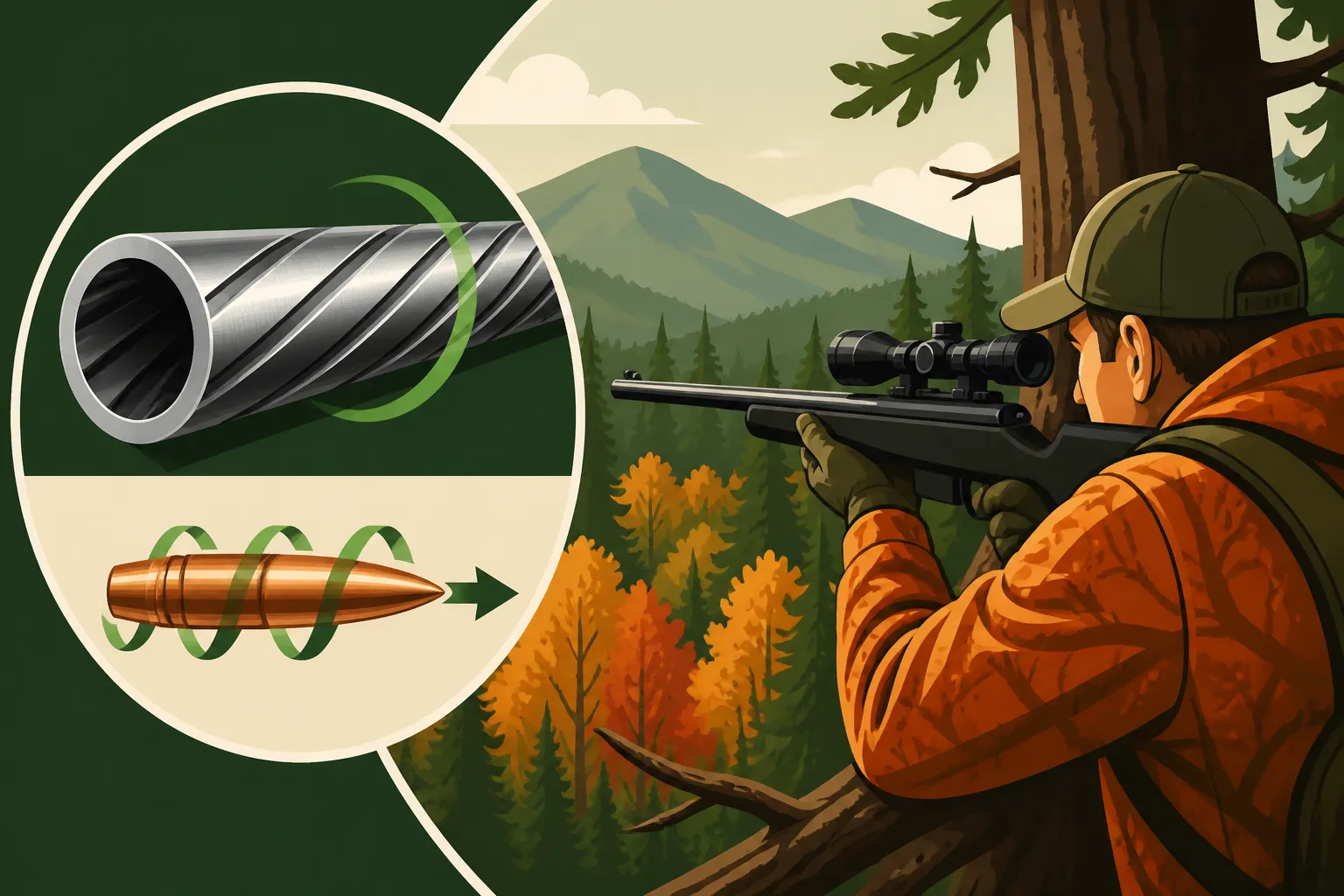
At its simplest, a rifle's twist rate refers to how quickly the rifling inside your barrel spins the bullet. Imagine the inside of your rifle barrel, not as a smooth pipe, but as having grooves carved into it that spiral down its length. These grooves are the "rifling." The twist rate is expressed as a ratio, like 1:10" or 1:12". This ratio means that for every 10 or 12 inches the bullet travels down the barrel, it completes one full rotation. So, a 1:10" twist means the bullet spins once every ten inches, while a 1:12" twist means it spins once every twelve inches. The lower the second number, the faster the twist. A 1:8" twist is faster than a 1:12" twist, for instance.
This internal spinning motion is absolutely vital for accuracy. Without it, a bullet would tumble end-over-end, flying erratically and barely hitting the broad side of a barn, let alone the vitals of a deer. The spin stabilizes the bullet, much like the spin stabilizes a football thrown by a quarterback or the spin on a frisbee. It keeps the bullet pointed forward, allowing it to fly true to its target. It's often one of those things you don't think about until you start diving deep into precision or specialized hunting scenarios.
How Twist Rate Stabilizes a Bullet
The physics behind bullet stabilization are fascinating, even if we just grasp the basics. When a bullet travels through the air, it's constantly battling drag and various forces that want to knock it off course. The gyroscopic stability imparted by the rifling's spin is what keeps it flying nose-first. Think of a spinning top: as long as it's spinning fast enough, it stays upright. Slow its spin, and it wobbles and falls. The same principle applies to your bullet.
If a bullet isn't spinning fast enough for its length and weight, it becomes unstable. It might "yaw" (wobble side-to-side) or even tumble, leading to keyholing (where the bullet impacts the target sideways) and drastically reduced accuracy. On the flip side, too much spin can sometimes, in rare cases, also cause issues, particularly with very light, fragile bullets that might disintegrate from centrifugal force, but this is less common with modern hunting ammunition. The goal is to find that sweet spot where the bullet is perfectly stabilized for its journey to the target, ensuring a clean, ethical shot. This is especially true when you're making those critical shots on game in places like the White-Tailed Deer Across New Hampshire areas.
The Timber Hunter's Dilemma: Bullet Weight and Velocity
Hunting in New Hampshire's dense timber presents unique challenges. Long-range, flat-shooting capabilities often take a back seat to factors like brush penetration, energy transfer at closer ranges, and reliability in tight quarters. This directly influences the type of bullet we often choose, and subsequently, the twist rate needed to stabilize it.
Why Heavier, Slower Bullets Are Often Preferred in New Hampshire Timber
In the thick woods of New Hampshire, from the deep ravines of the White Mountains to the overgrown clear-cuts in the North Country, shots are rarely beyond 150 yards, and often much closer. For these scenarios, many experienced hunters favor heavier-for-caliber bullets moving at moderate velocities. Why? First, a heavier bullet carries more momentum, which can be advantageous if it encounters light brush or twigs on its path to the target. While no bullet is truly "brush-bucking," a heavier, slower bullet tends to deflect less dramatically than a lighter, faster one. This isn't a license to shoot through heavy cover, mind you, but it offers a slight edge in marginal situations.
Secondly, a heavier bullet often retains its energy better at the relatively short distances encountered in timber. When it hits game, it's designed to expand reliably at lower velocities and transfer maximum energy, creating a devastating wound channel. You're not trying to buck wind over open fields like out West; you're trying to put a deer down swiftly and ethically within a tight shooting lane. This makes bullets like a 180-grain .30-06 or a 165-grain .308 a popular choice for New Hampshire's November Firearms Deer Season, for instance. The focus shifts from velocity-driven trajectory to reliable terminal performance.
The Relationship Between Twist, Bullet Length, and Stability
Here's where it gets a little more nuanced: twist rate doesn't care about bullet weight as much as it cares about bullet length. While heavier bullets generally mean longer bullets within a given caliber (assuming similar construction), it's the length that dictates how much spin is needed for stabilization. A longer bullet has more surface area for aerodynamic forces to act upon, making it inherently harder to stabilize. Think of trying to throw a short, stubby dart versus a long, thin spear – the spear needs more spin to fly straight.
So, if you're choosing those heavier-for-caliber bullets for timber hunting – perhaps a 150-grain .30-30 or a 200-grain .35 Whelen, which are typically longer than their lighter counterparts – you'll need a faster twist rate to ensure they spin sufficiently and fly accurately. A bullet that is not adequately stabilized will wobble, waste energy, and might even miss entirely, turning a promising hunt into a frustrating, unethical outcome. This is why knowing your bullet choice and matching it to your rifle's twist is paramount for success in New Hampshire's varied terrain. Even when you're Hunting a Beaver Flowage Edge, where shots might be shorter, you need that consistent accuracy.
Practical Twist Rate Considerations for New Hampshire Terrain
Now that we understand the basics, let's talk about how this applies directly to your hunting rifle here in New Hampshire. It's about matching your tools to the task at hand.
Common Calibers and Their Ideal Twist Rates for Timber
Many of us hunt with classic calibers well-suited to New Hampshire's woods. Here’s a quick look at some popular choices and what twist rates generally work best for the heavier bullets often preferred in timber:
| Caliber | Common Twist Rates | Recommended for Heavier Timber Bullets (e.g., higher end of typical hunting weights) |
|---|---|---|
| .243 Winchester | 1:10" | 1:9" to 1:10" (for 90-105 grain bullets) |
| .270 Winchester | 1:10" | 1:10" (for 140-160 grain bullets) |
| 7mm-08 Remington | 1:9.25" to 1:10" | 1:9.25" (for 150-160 grain bullets) |
| .30-30 Winchester | 1:10" to 1:12" | 1:10" (for 170-grain or heavier, especially with longer polymer tips) |
| .308 Winchester | 1:10" to 1:12" | 1:10" (for 165-180 grain bullets) |
| .30-06 Springfield | 1:10" to 1:12" | 1:10" (for 180-200 grain bullets) |
| .35 Remington | 1:16" | 1:16" (for 200-220 grain bullets, standard for this cartridge) |
| .45-70 Government | 1:20" to 1:24" | 1:20" (for 300-405 grain bullets, often heavier in timber) |
This table is a general guideline. Many manufacturers will offer different twist rates in the same caliber, so it's essential to check your specific rifle. For instance, a .308 Win with a 1:12" twist might struggle slightly to stabilize some of the longest 180-grain bullets, while a 1:10" twist would handle them perfectly. When you're looking at new rifles or planning your next season's setup, sites like GoHunt often provide specifications that include twist rates, which can be a huge help.
How to Determine Your Rifle's Twist Rate and What It Means
So, how do you figure out what twist rate your current rifle has? It's easier than you might think, and you don't need any fancy tools.
First, check your rifle's barrel or owner's manual. Often, the twist rate is stamped on the barrel itself, usually near the receiver or on the underside, though it can be tiny. The owner's manual is another excellent resource.
If you can't find it there, you can measure it yourself with a cleaning rod, a tight-fitting patch, and a permanent marker:
- Prep Your Rod: Insert a tight-fitting cleaning patch onto a jag at the end of your cleaning rod. Make sure it's snug enough to engage the rifling.
- Mark the Rod: With the rod inserted just into the chamber end of the barrel, mark a line on the rod (with the marker or a piece of tape) that's parallel to the bore. You can also place a piece of tape on the handle of the rod, again parallel to the bore.
- Push and Watch: Slowly push the cleaning rod down the barrel, keeping gentle pressure on the handle so the patch follows the rifling. As you push, the rod will rotate.
- Measure the Rotation: Watch your mark. Once it completes exactly one full rotation (360 degrees), stop pushing. Mark the rod at the muzzle end.
- Calculate: Remove the rod and measure the distance between your two marks. That measurement is your rifle's twist rate. For example, if the distance is 10 inches, your twist rate is 1:10".
Knowing this number is crucial, especially if you plan to Best Bullet Weight for New Hampshire Whitetails or other game where bullet performance is key. It lets you confidently choose ammunition that will perform optimally in your rifle, whether you're still-hunting in the White Mountain National Forest Timber or sitting a treestand overlooking a Hunting a Funnel Between Two Woodlots.
When a "Faster" Twist Might Still Be Your Friend
While we often associate faster twists with long-range shooting and very high ballistic coefficient (BC) bullets, there are situations in New Hampshire timber where a faster twist (e.g., 1:8" or 1:9" in a .30 caliber) can still be advantageous, even if you’re not shooting across vast distances. If you're a fan of those incredibly long, heavy-for-caliber monolithic or bonded bullets, designed for deep penetration and high weight retention, these often require a faster twist to stabilize. These bullets might not be about reaching out to 500 yards, but rather about maximizing terminal performance on a close-range deer or even a bear, providing a higher margin of error for bullet construction integrity upon impact.
Additionally, some hunters prefer to use one rifle for a variety of hunting scenarios, including possible trips out of state or for different game. A slightly faster twist might offer more versatility, allowing you to shoot a broader range of bullet weights and lengths accurately, giving you more options in your ammunition selection. It's about thinking ahead and considering the full spectrum of your hunting needs, even if 90% of your shots are within 100 yards. When looking through ammunition on a site like GoHunt, understanding your twist rate can help you narrow down suitable options faster.
Making the Right Choice and Testing Your Setup
Ultimately, selecting the right twist rate is about optimizing your rifle's performance for your specific hunting style and the environment you hunt in. It's a combination of knowledge and hands-on testing.
Balancing Velocity, Bullet Weight, and Twist for Optimal Performance
The "perfect" setup for New Hampshire timber hunting involves a delicate balance. You want enough velocity to ensure reliable bullet expansion and energy transfer, a bullet weight that offers good momentum and terminal performance, and a twist rate that stabilizes that bullet perfectly.
- For shorter, stubbier bullets (often lighter for their caliber), a slower twist (e.g., 1:12" in a .30 caliber) might be perfectly adequate, even ideal, as too much spin can occasionally cause issues with lighter, less robust bullet jackets.
- For longer, heavier bullets (favored for deeper penetration and energy retention in timber), a faster twist (e.g., 1:10" in a .30 caliber) is usually required to ensure proper stabilization.
It’s often a process of elimination or careful research. Start with your intended bullet choice for your typical New Hampshire timber hunt. Then, research what twist rate is generally recommended for that bullet in your chosen caliber. Finally, check your rifle's twist rate. If they align, you're likely in good shape. If they don't, you might need to reconsider your bullet choice or, in some cases, consider a different rifle. Resources available on the New Hampshire Fish and Game website or through hunting platforms like GoHunt can often guide you toward recommended loads for specific calibers.
The Importance of Range Testing Your Chosen Setup
All the theory in the world means nothing if your rifle doesn't perform in the real world. Once you’ve chosen your bullet and confirmed your rifle’s twist rate, the absolute most critical step is to get to the range and test your setup thoroughly.
- Group Size: Shoot groups at typical timber ranges (50-150 yards). Are they consistently tight? Are there any flyers or signs of instability (like keyholing, though this is usually obvious)?
- Different Loads: If one load isn't performing, try another with a slightly different bullet weight or construction, always keeping your twist rate in mind. Sometimes, a specific bullet just "likes" a particular barrel better, even with the "right" twist rate.
- Conditions: Test in various conditions if possible, though mostly focus on what you'll encounter in the woods.
- Practice from Hunting Positions: Don't just shoot from a bench. Practice from kneeling, standing, or using a shooting stick, as you might when Hanging a Stand on a Granite Ridge or making a quick shot from a ground blind.
The goal is to build confidence in your rifle and ammunition combination. You want to know, without a doubt, that when that opportunity presents itself, whether you're seeing a buck after Hunting the Rut in Early-to-Mid November or drawing down on a bear, your bullet will fly true and deliver the performance you expect. Understanding and optimizing your rifle's twist rate for timber shots is an often-overlooked aspect of preparing for a successful and ethical hunt here in the beautiful and challenging New Hampshire woods.
Disclaimer
This article is for general informational purposes only and does not constitute professional advice. Laws, prices and regulations vary by location and change over time. Consult a qualified professional for guidance on your specific situation.