Vehicle Rules on New Hampshire Public Land
It’s a common scenario for us hunters in New Hampshire: you’ve spent weeks scouting a promising new public land parcel, found some killer sign, and you're envisioning that perfect sunrise walk-in. Then, you pull up to what looked like a perfectly good access road on the map, only to find it chained, gated, or plastered with "No Motorized Vehicles" signs. It’s frustrating, right? Understanding where you can and can't drive your vehicle on New Hampshire’s vast public lands is crucial not only for a successful hunt but also for staying on the right side of the law. This guide is here to unravel the complexities, helping you navigate the various rules and regulations surrounding vehicle use on our beloved public hunting grounds.
Decoding New Hampshire's Public Land: Know Before You Go
New Hampshire offers an incredible amount of public land for hunting, from expansive national forests to state forests and dedicated Wildlife Management Areas (WMAs). However, each type of land often comes with its own set of rules regarding vehicle access, and what might be allowed in one area could get you a hefty fine in another. It’s not just about finding a good hunting spot; it's about understanding the specific land manager’s regulations. This often feels like trying to read a treasure map with cryptic clues, but with a little groundwork, you can make sense of it all.
White Mountain National Forest Vehicle Regulations
The White Mountain National Forest (WMNF) is a vast, beautiful expanse, covering over 800,000 acres across New Hampshire and into Maine. It’s a crown jewel for many hunters, offering challenging terrain and opportunities for a variety of game. While it feels wild and untamed, there are very specific rules about where you can drive, and those rules are often designed to protect the fragile ecosystem and preserve the wilderness experience. You can't just drive off-road wherever you please.
Many of the forest roads within the WMNF are seasonally gated, meaning they're open to vehicles at certain times of the year and closed for others. These closures are typically in place during mud season (spring thaw) to prevent damage, and often extend through the hunting season to reduce pressure on game and promote foot traffic. It's easy to get excited seeing a road on a map only to find it closed, forcing a much longer walk than anticipated. Always check the current status of roads directly with the Forest Service before heading out. They usually have detailed motor vehicle use maps (MVUMs) that show exactly which roads are open, which are closed, and which have specific restrictions.
Beyond designated roads, cross-country travel with any motorized vehicle, including ATVs, dirt bikes, and even electric bicycles on trails not specifically designated for them, is generally prohibited. This means if you're planning on using an ATV to haul out a deer, you need to ensure you're on a trail specifically marked for such use, and those are few and far between, especially in hunting areas. Most hunting access will involve shank’s mare, so be prepared for a walk. Always be sure to look up the current Camping Rules on White Mountain National Forest Land if you're planning an overnight stay, as those too have specific vehicle considerations.
State Forests and Reservations Access
New Hampshire's State Forests and Reservations are another excellent resource for hunters, offering diverse habitats and often being a bit closer to population centers than the deep woods of the WMNF. These lands are managed by the New Hampshire Department of Natural and Cultural Resources (DNCR), Division of Forests and Lands. Their rules for vehicle use can vary slightly from one state forest to another, but generally, they adhere to a more consistent policy.
Similar to the WMNF, most State Forests restrict motorized vehicle use to designated roads and parking areas. You won't find many opportunities for off-road vehicle travel here, either. The main purpose of these rules is conservation, public safety, and preventing damage to forest roads and trails. Many of these areas have gated logging roads or old access tracks that might look inviting but are explicitly closed to public vehicle traffic. It's critical to respect these closures; ignoring a "No Entry" or "Gated" sign not only risks a fine but also jeopardizes future access for all hunters.
Some state forests might have specific regulations around snowmobile use in winter, which can sometimes provide unique access opportunities for late-season hunting or scouting, but these are often limited to designated snowmobile corridors and seasons. For the most part, consider state forests as walk-in hunting areas once you've parked your truck. You might find a good logging road for Still-Hunting White Mountain National Forest Timber or a perfect spot for Hunting a State Forest Logging Road, but you'll be doing it on foot.
Wildlife Management Area (WMA) Vehicle Rules
Wildlife Management Areas (WMAs) are specifically managed by the New Hampshire Fish and Game Department with wildlife habitat and public recreation, including hunting, in mind. These areas are incredibly valuable, but because their primary focus is wildlife, vehicle access is often even more restricted than in state or national forests. The goal is to minimize disturbance to game and maintain critical habitat.
In most WMAs, vehicle access is limited to clearly marked parking areas and main access roads. Many internal roads and trails within WMAs are strictly closed to all motorized vehicles. This means that while you might be able to drive to the edge of a WMA, your hunting experience inside will almost certainly be on foot. These restrictions are in place to ensure that wildlife is not unduly stressed by vehicle traffic and that the habitat remains undisturbed. Think of WMAs as sanctuaries where human impact, especially from vehicles, is deliberately minimized.
It's common to find strategically placed gates, boulders, or earthen berms blocking access to interior roads within WMAs. These aren't there to annoy you; they're there to protect the resource. Disregarding these barriers can lead to significant penalties. Before you head to a new WMA, it’s always a good idea to check the Fish and Game website or call the regional office to clarify specific rules for that location. Understanding How New Hampshire WMAs Are Managed can give you a better appreciation for these stringent rules.
General Rules for Motorized Vehicles on Public Land
Beyond the specific nuances of each land type, there are overarching rules that apply to motorized vehicles on virtually all public hunting lands in New Hampshire. These are the basic tenets you need to keep in mind, regardless of whether you're deep in the North Country or on the suburban fringe. Ignorance of the law is never a valid excuse, and enforcement officers are out there ensuring compliance, especially during popular hunting seasons.
Staying on Designated Roads and Parking Areas
This is arguably the most fundamental rule for vehicle use on New Hampshire's public lands: stay on designated roads. This means paved roads, gravel roads, and clearly marked dirt roads that are open to public vehicular traffic. It does not mean old logging skids that look like a road, or a faint two-track leading into the woods. If it isn't clearly maintained and marked as a public motor vehicle route, assume it's closed.
Parking is another critical aspect. Always park in designated parking areas or pull-offs where your vehicle is entirely off the main travel way and does not impede traffic or block access for emergency vehicles or other users. Parking alongside a narrow forest road in a way that creates a hazard or blocks a gate is a surefire way to get a ticket or, worse, have your vehicle towed. Be mindful of turnarounds, fire lanes, and areas specifically marked "No Parking." We've all seen those trucks haphazardly parked, almost daring a ranger to write them up. Don't be that hunter.
The goal is to minimize your footprint. Driving off-road, even a short distance, can damage vegetation, compact soil, create ruts, and spread invasive species. It also sets a bad precedent, making it harder for land managers to justify continued public access. If you're using an app like onX Hunt or GoHunt, pay close attention to the land ownership layers and look for any marked roads or parking areas. These tools can be incredibly helpful in pre-planning your access and avoiding surprises.
ATV and Off-Highway Recreational Vehicle (OHRV) Restrictions
This is where a lot of confusion and frustration can creep in for hunters. While ATVs and other OHRVs are a legitimate form of recreation in New Hampshire, their use on public hunting lands is heavily regulated and often restricted. Many hunters dream of using an ATV to get deeper into the woods or to assist with game recovery, but the reality is often far more constrained.
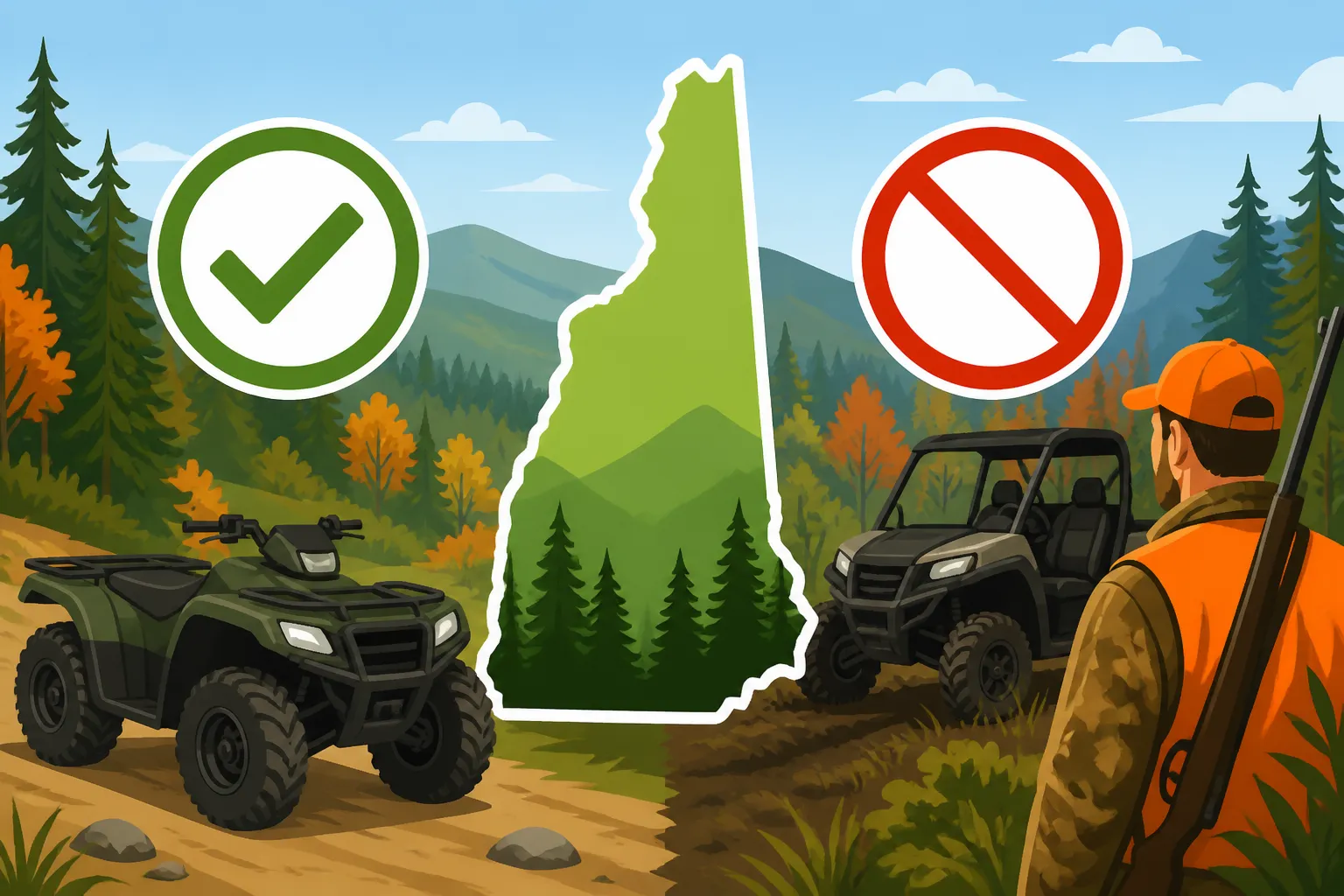
Generally, ATVs and OHRVs are not allowed on trails or roads within the White Mountain National Forest, State Forests, or WMAs unless those trails are specifically designated and marked for OHRV use. These designated OHRV trails are typically part of a specific trail network and are often separate from traditional hunting areas. The vast majority of internal woods roads and trails you encounter while hunting are not open to ATVs, regardless of whether they appear to be good for such use. You really need to check the local regulations for specific information regarding ATV Rules on New Hampshire Forest Roads.
It’s important to understand the difference between public roads and OHRV trails. Just because a trail is open to OHRVs doesn’t mean it automatically provides hunting access, or that you can drive off it to recover game. The New Hampshire Fish and Game Department and the Bureau of Trails work hard to manage these systems, but hunters need to be diligent about understanding where they can legally operate. Using an OHRV where prohibited can result in substantial fines, vehicle impoundment, and a loss of hunting privileges. It's simply not worth the risk.
Vehicle Weight and Size Restrictions
While less common, some public land access roads, particularly in more remote State Forests or WMAs, may have weight or size restrictions. These are usually in place to protect older bridges, culverts, or less-maintained road surfaces from damage. You might see signs indicating "No Vehicles Over X Tons" or "No Commercial Vehicles." For the average hunter driving a pickup truck or SUV, this isn't usually an issue, but if you're pulling a large trailer or driving a heavier-than-average vehicle, it's something to be aware of.
Another consideration, though not a "rule" per se, is the practicality of your vehicle. Many forest roads are unpaved, narrow, and can become rough, rocky, or muddy, especially after rain or during shoulder seasons. While not explicitly prohibited, attempting to navigate these roads in a low-clearance sedan can lead to getting stuck or damaging your vehicle. It's common sense, really. If you're heading deep into the woods, a reliable 4×4 with good ground clearance will save you a lot of headache and potentially a costly tow. Always assess the road conditions and know your vehicle’s limitations before venturing too far off the beaten path.
Specific Scenarios and Common Pitfalls
Even with the general rules in mind, real-world situations can throw a curveball. Hunters often encounter specific dilemmas related to vehicle access that aren't always clear-cut. Let's delve into some of those common pitfalls and how to navigate them safely and legally.
Gated Roads and Barricaded Access
Perhaps the most common frustration hunters face is encountering a gated or barricaded road that, on the map, looked like prime access. It's a gut-punch when you've planned your morning around driving to a specific point, only to find a chain across the road. These gates are everywhere on New Hampshire public land – in the White Mountain National Forest, State Forests, and especially WMAs. They are usually placed for very good reasons: protecting sensitive habitat, preventing illegal dumping, controlling erosion, or simply managing seasonal access.
The rule here is simple and non-negotiable: do not go around, over, or under a gate or barricade. These are clear signs that vehicle access is prohibited beyond that point. Period. Attempting to bypass a gate, even if you think you’re being clever and leaving no trace, is trespassing and a violation of public land use regulations. It risks property damage (yours and the gate's), and it also breeds resentment among land managers and other users. A good map, whether paper or a digital app like onX Hunt, will often indicate gated roads, allowing you to plan your walk-in strategy accordingly. Sometimes, those gates are exactly why a spot holds a big buck; it reduces pressure by forcing others to walk further. Embrace the walk! Sometimes you'll find Hunting a Gated Logging Road Beyond the Public Lot offers great rewards.
Parking on Shoulders and Blocking Access
You’ve found your spot, and there’s no designated parking area. So, you pull off onto the shoulder of a forest road. What seems like a minor inconvenience can quickly become a problem if not done correctly. The key is to ensure your vehicle is completely off the travel portion of the road and that you are not blocking any potential access points. This means no blocking gates, no blocking intersecting trails, and no impeding the flow of traffic, even if it’s just logging trucks or other hunters.
Consider the width of the road and whether a larger vehicle, like a maintenance truck or an emergency responder, could still easily pass. If the shoulder is too soft or narrow to safely park without protruding into the roadway, then it's not a legal or safe parking spot. You might need to drive further to find a suitable pull-off or designated area, even if it means adding a bit more walking to your hunt. It's also worth checking for any "No Parking" signs, which are sometimes posted in areas where visibility is poor or where heavy equipment needs clear access.
Dealing with "Class VI" Roads
New Hampshire has a unique category of roads known as "Class VI" roads. These are public roads that towns are not required to maintain. They can range from perfectly passable gravel roads to completely overgrown, barely discernible tracks that might as well be trails. For hunters, they present a confusing gray area: they are technically public rights-of-way, but their condition often makes them impassable for regular vehicles.
The legal status of vehicle use on Class VI roads can be complex and often depends on the specific town's ordinances. Some towns might explicitly prohibit motorized vehicle use beyond a certain point, while others might allow it as long as the road is not actively gated or posted against such use. It's a real headache to try and figure out. The best practice is to assume motorized vehicle access is restricted or impossible on Class VI roads unless you have definitive, current information to the contrary from the local town or New Hampshire Fish and Game. If a Class VI road is gated or clearly impassable, treat it as closed to vehicles. These are often great for Hunting a Class VI Forest Road on foot, as they can lead to remote, less pressured areas.
Planning Your Access: Tools and Tips for Smart Hunters
Navigating vehicle rules on New Hampshire's public lands requires forethought and the right tools. You can't just wing it and expect to always find open access. Being prepared means less frustration, more hunting time, and a greater chance of success.
Utilizing Mapping Applications and Online Resources
In this day and age, a good mapping app is an indispensable tool for any New Hampshire hunter. Applications like onX Hunt and GoHunt provide detailed satellite imagery, topographic maps, and crucial land ownership overlays that can save you hours of guesswork and prevent accidental trespassing or illegal vehicle use.
Here's how these apps can help with vehicle rules:
- Land Ownership Layers: Immediately identify public vs. private land. This prevents you from inadvertently driving onto private property where vehicles are prohibited.
- Road Designations: Many apps, especially onX Hunt, will show forest roads and often indicate which ones are gated, private, or have seasonal closures. While not always 100% current for every small gate, they are a fantastic starting point. You can overlay the "Motor Vehicle Use Maps" (MVUMs) that the Forest Service publishes for the White Mountain National Forest directly into some of these apps, which is incredibly helpful.
- Topography and Satellite Imagery: These layers help you visualize the terrain. An old logging road that looks clear on a topo map might be completely overgrown and impassable on satellite imagery. You can also spot potential parking areas or pull-offs where you can safely leave your vehicle.
- Waypoint Dropping: Mark potential access points, parking spots, and known gates while scouting or from home. This allows you to plan your walk-in route more effectively.
Beyond apps, the New Hampshire Fish and Game Department website is a treasure trove of information. They often have maps and specific regulations for WMAs. The U.S. Forest Service website for the White Mountain National Forest has its MVUMs available for download, which are the definitive source for WMNF vehicle rules. Don't be afraid to pick up the phone and call a local Fish and Game office or Forest Service ranger district if you have specific questions about a particular road or area. Remember to check out onX Layers for New Hampshire Land Status to maximize your map application's utility.
Scouting with Vehicle Rules in Mind
When you’re doing your pre-season scouting, don’t just look for deer sign or turkey roosts; actively scout your access points and consider vehicle rules. Drive the access roads you plan to use. Look for gates, signs, and suitable parking. If a road looks questionable or too rough for your vehicle, make a mental note to plan a longer walk.
Think about the time of year you’ll be hunting. A road that’s perfectly passable in late August might be a muddy mess in November or snow-covered in December. Plan alternate routes or be prepared for a longer hike if conditions deteriorate. Knowing How Far to Walk From a Forest Road can give you an advantage, allowing you to access areas that others might skip because of the effort involved.
During your scouting, if you see an area where vehicles are clearly violating rules (e.g., driving around a gate, parking illegally), report it to the appropriate authorities. Protecting our public land access means being good stewards and ensuring everyone follows the rules. This isn't about being a "snitch"; it's about preserving hunting opportunities for the future.
Preparing for Game Recovery Without Vehicle Access
This is a big one, especially if you’re hunting larger game like deer or moose. The reality is that on most public land in New Hampshire, you will likely be recovering your animal on foot, sometimes over considerable distances and challenging terrain. Very few areas allow vehicle access for game retrieval. Planning for this before you pull the trigger is paramount.
Consider carrying a quality game cart, especially if you hunt areas with relatively flat terrain or old woods roads. For steeper, more rugged country like the White Mountains, a good pack frame capable of carrying quartered meat is essential. Learn how to field dress and quarter an animal efficiently in the woods. While it's tempting to think about driving right to your downed game, that's often not an option. Be prepared for a physically demanding pack-out, potentially even needing to make multiple trips.
Having a headlamp, extra water, and a small first-aid kit for yourself (and your hunting partners) are critical for a late-night recovery. And always let someone know where you're hunting and when you expect to be back, especially if you plan to be off-road and deep in the woods. Recovering a deer from a granite ravine in the dark is no small feat!
Understanding and respecting vehicle rules on New Hampshire's public lands is more than just avoiding a fine; it's about being a responsible hunter and ensuring these valuable resources remain accessible for generations to come. It might mean a longer walk, but often, the effort required to reach those more remote spots is exactly what makes the hunting experience so rewarding. Safe hunting, and happy trails!
Disclaimer
This article is for general informational purposes only and does not constitute professional advice. Laws, prices and regulations vary by location and change over time. Consult a qualified professional for guidance on your specific situation.