How Far to Walk From a Forest Road
Oh, the forest road. It’s a love-hate relationship for so many of us New Hampshire hunters, isn't it? On one hand, it's our gateway to the woods, a convenient starting point after a long drive. On the other, it often feels like a crowded waiting room, with every truck parked along the shoulder signaling that the "easy" hunting is probably long gone. The real question that haunts us is: how far do you really need to walk from that familiar gravel or pavement to find unpressured game? This guide is going to dig deep into that question, helping you understand the factors that drive game away from roads and giving you strategies to push a little further for better success.
The Lure and The Trap of the Forest Road
Let's be honest with ourselves, the convenience of hunting close to the truck is incredibly tempting. After a busy week, the thought of a quick hunt, an easy walk in, and a short drag out is almost irresistible. You can grab a coffee, hit the woods, and be back at the diner before most folks are even out of bed. It’s comfortable, it’s familiar, and it requires less physical exertion – all things that appeal to the human spirit, especially when we’re just looking for a little peace and quiet, and maybe a deer.
Why Roads Are So Appealing (and Deceptive)
That initial ease of access is a huge draw. We all do it: we pull off, look at a promising patch of woods right there, and tell ourselves, "I'll just check this spot. It looks good." And sometimes, especially during youth weekend or early archery season, you might even get lucky. The feeling of being close to your vehicle, knowing a warm heater and a comfortable seat are just a short walk away, can be a powerful mental comfort. It feels safer, less daunting, and somehow, more achievable.
But here’s the rub: if it’s appealing to you, it’s appealing to virtually every other hunter who drives down that same road. That roadside convenience becomes a double-edged sword. Every truck, every footsteps, every scent cone from a passing hunter piles on the pressure. Those easy-access spots, the ones that look so good on a map or from the road, often become "hunter soup" – stirred up, pressured, and largely devoid of mature, daylight-active game. It's a common frustration to scout a beautiful area near a forest road, only to find it riddled with old boot tracks when you return on opening day.
The Immediate Impact of Roadside Pressure
Game animals, especially whitetail deer, are incredibly smart and adaptable. They learn human patterns and pressure points with remarkable speed. When a forest road sees constant vehicle traffic, opening day hunters, or even just regular hikers and dog walkers, those animals quickly adjust their behavior. They become more nocturnal, moving only under the cover of darkness. They might cross a road, but they're unlikely to linger or feed openly right next to it during hunting hours.
Think about it: have you ever driven a logging road at dawn and seen a buck dart across? You might think, "Wow, there's deer here!" But that same buck likely spent the night feeding further back in the timber and is now heading to a deep, secure bedding area well away from the road. The immediate impact of roadside pressure creates a kind of invisible "buffer zone" where deer, moose, bear, and even turkeys largely avoid daylight activity. You might find tracks crossing the road, but rarely a fresh rub or scrape line set up within bow range of the asphalt. This phenomenon means that even if a prime looking patch of hardwoods is only a few hundred yards from your truck, if it’s consistently hammered by other hunters, it might as well be barren land.
Factors Influencing Your Trek: More Than Just Miles
Deciding how far to walk isn't just about picking a number; it's a strategic calculation based on the specific game you're after, the lay of the land, and the density of hunter traffic. A quarter-mile might be a long way in one type of terrain, and a mere hop in another. The key is to think like the animal and anticipate where they'll seek refuge and food given the pressure they face.
Understanding Game Behavior and Species Specifics
Different game animals react to human presence and roads in distinct ways, dictating how far you might need to push.
- Deer: Whitetail deer, particularly mature bucks, are masters of evasion. In heavily hunted areas of New Hampshire, a buck might treat a forest road as a hard boundary for daylight activity. They will use the thickest cover available, often preferring dense softwood swamps, regenerate clear-cuts, or rocky ravines to bed during the day. This means that to get into their comfort zone, you often need to put significant distance between yourself and the nearest road. Think about where those New Hampshire Bucks Bed in Thick Cover – it's rarely within sight of a two-track. You might need to walk a solid half-mile, or even a mile or more, to get beyond the immediate pressure zone and into their preferred daytime haunts.
- Moose: In the deep North Country, moose can sometimes appear less skittish around roads, especially in remote areas where traffic is minimal. However, they still prefer secluded areas for feeding and bedding, such as beaver flowages, remote bogs, or regenerating cuts. While you might spot one grazing by a logging road, hunting success often involves getting off the beaten path and into those thicker, wetter environments. You might be able to access the edge of a prime Hunting a New Hampshire North Country Moose Bog from a road, but the real action is often a trek deeper in.
- Bear: New Hampshire bears are opportunistic and intelligent. If bait sites are being used, those might be near roads for ease of access (within legal parameters, of course). However, when hunting natural feeding areas, bears will often travel to less disturbed patches of mast or berry bushes. If you’re not hunting over bait, you'll likely need to walk into areas with good natural food sources that are less frequented by humans. Remember to check regulations on Baiting New Hampshire Bears Legally by WMU if that's your preferred method.
- Turkey: Spring gobblers might roost near roads, especially in mature hardwoods, but after flying down, they often move quickly into fields or deeper woods to feed and strut. Fall turkeys, especially flocks, will range widely and can be found almost anywhere there's food and cover, but sustained pressure near roads will push them further afield.
- Waterfowl: Duck and goose hunting often involves access points along rivers, lakes, or marshes that are road-adjacent. However, the prime shooting spots, where birds feel safest to land and feed, usually require a paddle, a boat ride, or a significant walk-in to get away from other hunters. To get into a good position for Decoying Ducks on New Hampshire's Connecticut River, you might launch from a public ramp, but your final setup will be well away from it.
The Role of Terrain and Habitat
The landscape itself plays a massive role in how far you actually need to walk, regardless of the map distance. A quarter-mile through a thick, steep blowdown can feel like two miles on flat, open ground. These natural barriers often act as "hunter filters," discouraging casual hunters and creating sanctuaries for game animals.
Consider areas with steep, rocky slopes, dense cedar swamps, or impenetrable thickets of young spruce. These are the places where deer and other game feel secure, precisely because they're a pain for humans to navigate. A logging road that runs along the base of a sharp granite ridge, for instance, might offer "easy" access, but the steep climb up to a Hunting a Granite Ridge Saddle above that road will deter many. That 200-yard vertical ascent might be only a short horizontal distance from the road, but its difficulty makes it feel much further, concentrating game there. Similarly, a thick, mucky beaver flowage might be relatively close to a road, but few hunters are willing to slog through it, creating a haven on the other side. Look for these natural deterrents – they are your best friends for finding unpressured game.
Mapping Tools and "Access Gaps"
This is where modern technology truly shines and can give you a significant advantage. Tools like onX Hunt and GoHunt are indispensable for identifying those critical "access gaps" – areas of public land that are physically close to roads but effectively far due to terrain or indirect access. They let you move beyond simple road-to-point measurements and see the nuances of the landscape.
When you're scouting with these apps, don't just look for green (public) land. Zoom in and study the topography:
- Steep contours: Where are the sharp elevation changes? These are often less-traveled areas.
- Wetlands and water bodies: Swamps, bogs, and stream networks can be tough to cross, acting as natural barriers.
- Private land boundaries: Look for public land "fingers" or "islands" that are surrounded by private property but accessible via a narrow corridor. These can be incredible sanctuaries if other hunters don't realize they're there or don't want to navigate the tricky access.
Use the satellite imagery on onX Hunt to identify thick cover, mature timber stands, or potential food sources (like old apple orchards or clear-cut edges) that are a hike away from the road. You can plan your route, mark waypoints, and even use the offline map feature when you're deep in the New Hampshire backcountry with no cell service. Scouting With the New Hampshire Fish and Game App can also be a game-changer, helping you locate these hard-to-reach spots. These tools help you visualize the "effort" distance, not just the linear distance, allowing you to strategically choose a path that others might overlook due to perceived difficulty.
Practical Strategies for Going Deeper
It's one thing to know why you should walk further, but it's another to actually do it consistently. Developing practical strategies and embracing a different mindset will help you push past the comfortable limits and into more productive hunting grounds.
The "Minimum Distance" Mindset
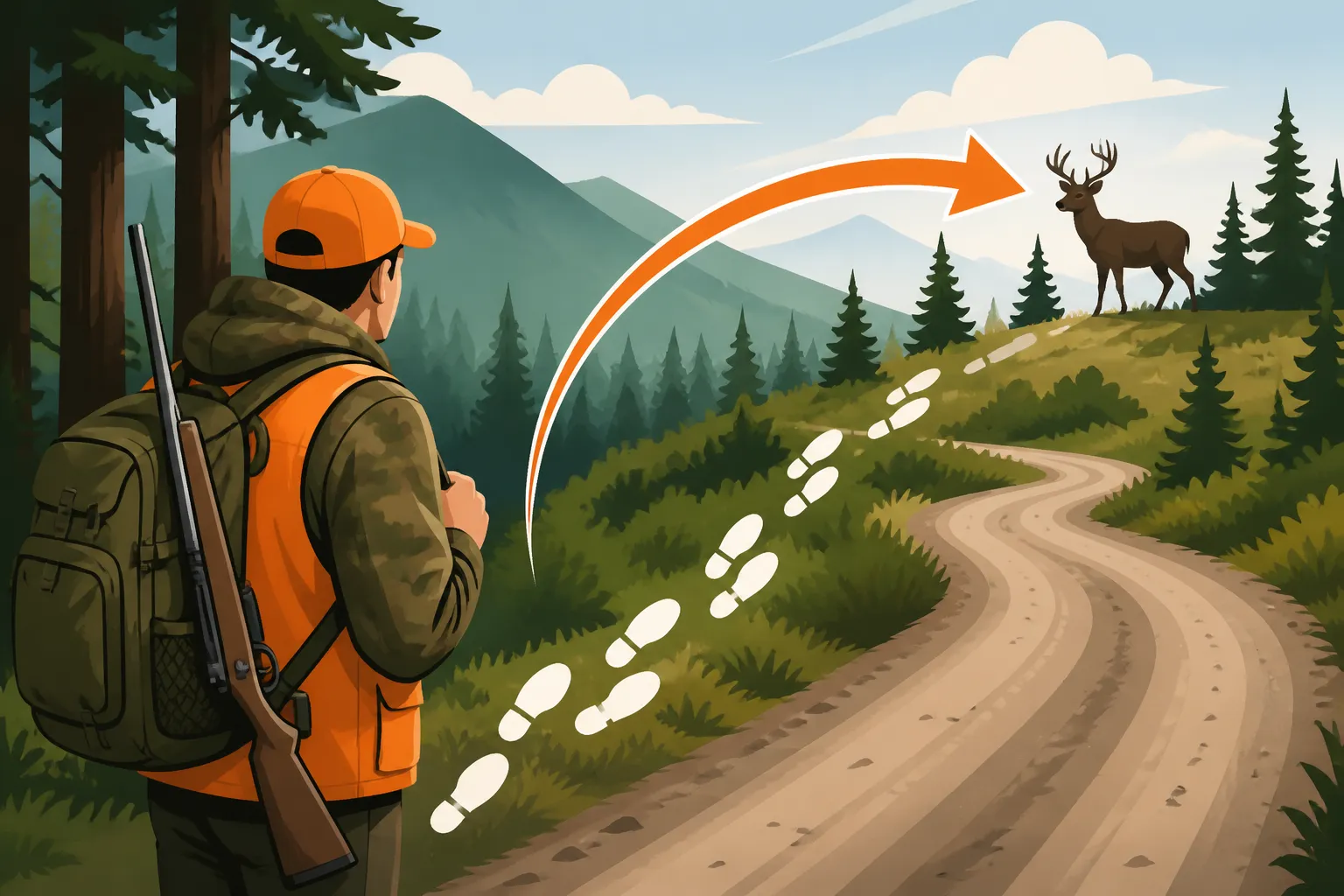
While there's no single magic number, adopting a "minimum distance" mindset can be a great starting point, especially for deer in high-pressure areas. Consider a baseline of at least a half-mile (about 800 meters) from any main forest road or commonly used access point. For really pressured areas, pushing that to a full mile (1.6 km) or more can often put you in a different league entirely. This isn't just about walking a specific distance; it's about getting beyond where the casual hunter is willing to go.
The actual distance will be heavily influenced by the factors we discussed above: terrain, cover, and game species. In a dense, mountainous region like parts of the White Mountain National Forest, 500 yards up a steep, rocky ravine might put you in more remote territory than two miles on a flat, open logging road in the North Country.
Here’s a rough guide to help you conceptualize minimum walking distances:
| Game Species | Pressure Level | Typical Minimum Walk (from easy access) | Key Terrain to Target (further in) |
|---|---|---|---|
| Whitetail Deer | Low/Sparse | 0.25 – 0.5 miles | Thick clear-cuts, mature hardwood ridges |
| Whitetail Deer | Medium/Common | 0.5 – 1 mile | Steep drainages, softwood swamps, dense cedar stands |
| Whitetail Deer | High/Heavy | 1+ miles | Remote benches, far side of MUD/SWAMP, deep valleys |
| Moose | Remote/Low | 0.25 – 0.75 miles | Secluded bogs, beaver flows, mature timber fringes |
| Moose | Accessible/Medium | 0.75 – 1.5 miles | Unbroken timber, edges of large, deep wetlands |
| Black Bear | Natural Feed | 0.5 – 1.5 miles | Oak ridges, berry patches in dense cover, remote clear-cuts |
| Wild Turkey | General Roost/Feed | 0.25 – 0.75 miles | Remote fields, dense woodlots away from houses |
| Waterfowl | Marsh/River | 0.5 – 1 mile (paddle/walk) | Blind sites, remote oxbows, back channels |
Note: These are general guidelines. Always scout your specific area and adjust based on local conditions and sign.
Planning Your Approach and Exit
Walking further means your hunt starts long before you reach your stand or still-hunting area. Meticulous planning is crucial for both success and safety. Use your mapping apps (onX Hunt, GoHunt) to identify natural funnels or subtle terrain features that can guide you quietly through the woods. Look for old logging cuts, faint game trails, or changes in elevation that allow you to move with the wind and thermals. Your entry and exit routes should be as quiet and scent-free as possible. This often means leaving the truck an hour or two earlier than you think you need to, moving at a snail's pace, especially in the dark.
Consider what you're carrying. Every extra pound on your Best Pack for a Nine-Day Moose Hunt adds up when you're a mile deep in the woods. Pack smart, focus on essentials, and leave the non-critical gear behind. The challenge of walking in is often compounded by the challenge of getting a game animal out. A long walk in with an empty pack suddenly becomes an arduous, hours-long ordeal if you connect with a buck or bear, especially if you're dealing with challenging terrain like a steep ravine. Dragging a Deer Out of a Granite Ravine is no small feat; plan for it by considering gear like game carts (if terrain allows) or knowing how you’ll quarter and pack out meat.
Embracing the "Hard Work" Advantage
Here’s the undeniable truth: the vast majority of hunters simply aren't willing to walk far from the road. This isn't a judgment; it's a fact that creates a massive opportunity for those who are. Every extra hundred yards you put between yourself and the road is a step away from 90% of the other hunters. You’re effectively siphoning yourself into a different pool of opportunity.
This "hard work" advantage requires physical conditioning. Start walking, hiking, and training well before the season. Get comfortable carrying a loaded pack. Mental toughness is equally important. When that little voice in your head tells you to turn back, to settle for that easy-access spot, you need to push through it. Remind yourself that the reward – unpressured game, a deeper connection to the wild, and often, more success – is worth the effort. There’s a special satisfaction in harvesting an animal from a spot that you earned through sweat and determination, a place where you know few others bother to tread.
By extending your range, even by a quarter-mile or a half-mile beyond where most stop, you drastically increase your chances of encountering game that hasn't been spooked, driven, or educated by constant human presence. This is often how you find the older, wiser bucks that have survived multiple hunting seasons. It's about Finding Ground Others Walk Past on public land. It's about earning your success, one step at a time, away from the crowds and into the true wild of New Hampshire.
Disclaimer
This article is for general informational purposes only and does not constitute professional advice. Laws, prices and regulations vary by location and change over time. Consult a qualified professional for guidance on your specific situation.