Choosing a Scope Magnification for Timber Country
If you've ever spent time hunting New Hampshire's dense woodlands, you know the frustration of trying to pick out a deer through thick alders or a stand of pines. It's not like hunting wide-open Western plains where you can glass for miles. Here in the Granite State, quick, close-range shots are the norm, and choosing the right scope magnification for our timber country can make or break your hunt. This guide will delve deep into the nuances of selecting a rifle scope that truly performs in the challenging, yet rewarding, environments of New Hampshire's forests.
The Unique Challenges of New Hampshire's Timber Country for Optics
Hunting in New Hampshire isn't just about bagging game; it's about navigating the rugged terrain, understanding the subtle movements of deer through dense cover, and being ready for a shot that often materializes out of nowhere. This unique environment places very specific demands on your optics, and ignoring them can lead to a lot of "if only I had…" moments.
Close-Quarters Encounters and Fast Target Acquisition
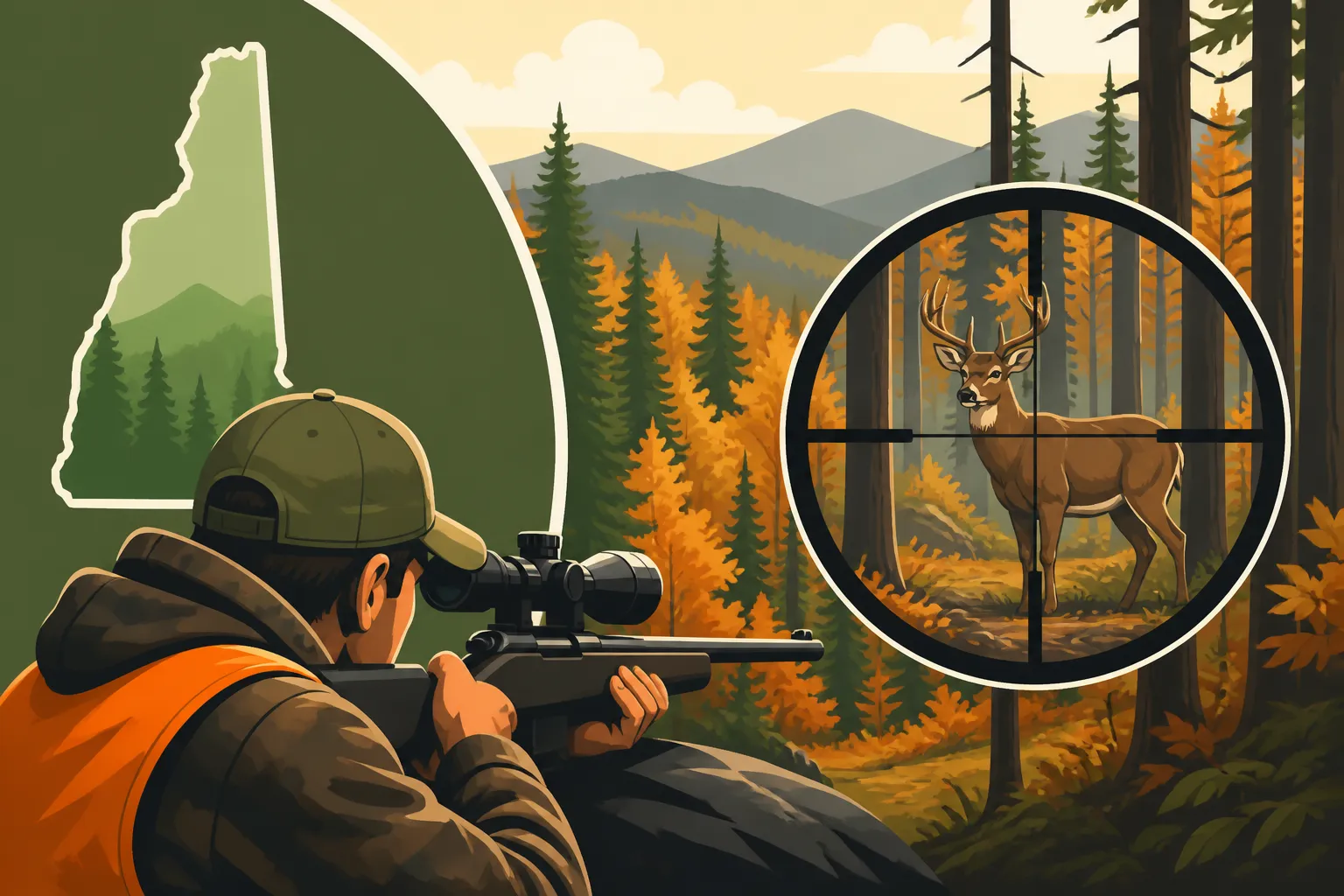
Picture this: you've been Still-Hunting White Mountain National Forest Timber for hours, moving slowly through a mix of hardwoods and softwoods, your senses on high alert. Suddenly, a flash of brown, a flick of a tail, and a deer is slipping through the dense hemlocks at 30 yards. In these situations, you don't have time to fiddle with a high-magnification scope, trying to find your target in a narrow field of view. Our woods are tight, tangled, and often unforgiving. Shots often present themselves as deer burst from thickets or cross small openings, demanding immediate target acquisition.
The very nature of our dense woods, with their thick underbrush and close-growing trees, means that many of your shots will be at much shorter ranges than in other parts of the country. A high-power scope, while great for punching paper at the range or picking off prairie dogs, becomes a major hindrance when you need to quickly shoulder your rifle, find a deer moving through the brush, and make a precise shot. That wide field of view offered by lower magnification isn't just a luxury; it's a necessity for tracking movement and getting on target before the opportunity vanishes into the timber.
Variable Light Conditions Under the Canopy
Walk into a dense New Hampshire forest, even on a sunny day, and you'll notice how quickly the light dims under the canopy. Add to that the fact that prime hunting times often occur at dawn and dusk, or during overcast, rainy, or snowy days, and you're constantly dealing with challenging light conditions. That perpetual shadow means your scope needs to gather as much available light as possible to provide a clear, bright image.
High magnification, while making things appear closer, also inherently narrows the exit pupil – the beam of light leaving the eyepiece that enters your eye. A smaller exit pupil means less light reaching your eye, resulting in a darker, harder-to-discern image, especially in those crucial low-light moments. You might pick up movement, but confirming legal antlers or finding a clear lane through the branches becomes exponentially harder if your scope isn't transmitting enough light effectively. Trying to peer through a dim, high-powered optic at first light is a recipe for eye strain and missed opportunities.
Obstructions and Limited Visibility
New Hampshire timber is rarely clean. It's a maze of branches, saplings, fallen logs, and thick leaves for much of the season. Even in late fall and early winter, with leaves down, the skeletal branches still create a visual clutter. With a high-power scope, these foreground obstructions become exaggerated. What might be a small branch easily ignored with the naked eye or on a lower power becomes a thick, blurry bar across your sight picture at 9x or 12x. This phenomenon, often called the "bushnell effect" or simply a cluttered view, makes finding a clear shot lane incredibly difficult.
It's not just the physical obstructions; even subtle atmospheric conditions can become a problem. Humid air or a light drizzle can cause mirage on higher magnifications, further obscuring your view. The psychological impact of looking through a scope that feels like a straw, surrounded by blurry obstacles, can be immense. It can lead to hesitation, forcing you to pass on a shot that a lower-power, wider field-of-view scope might have clearly presented. You need an optic that helps you see through the woods, not get lost in them.
Understanding Scope Magnification for Timber Hunting
Now that we've chewed on the challenges, let's talk about what kind of scope magnification actually helps us overcome them here in New Hampshire. It's all about finding that sweet spot between seeing enough detail and maintaining the broad view crucial for our hunting environments.
The Low-End Advantage: 1x, 2x, 3x Magnification
For many New Hampshire hunters, the low end of their variable scope is where most of the magic happens. A setting of 1x or 2x magnification offers an incredibly wide field of view, making it feel almost like a red dot sight, but with the added benefit of precise crosshairs. This is absolutely critical for those lightning-fast, close-range encounters where a deer might only be visible for a few seconds. Whether you're still-hunting a ridge or sitting near a Hunting a Funnel Between Two Woodlots, being able to quickly acquire your target as it appears from dense cover is paramount.
With a low-power setting, you can keep both eyes open, giving you better situational awareness and peripheral vision, which is a huge advantage when trying to track a moving animal through the trees. Many popular variable scopes, such as 1-4x, 1-6x, or 2-7x, provide this essential low-end capability. Think of a scenario where you're working through a thick growth of saplings, and a buck suddenly steps out at 40 yards. A 1x or 2x setting allows you to immediately put the crosshairs on its vitals without fumbling, giving you the best chance at a clean, ethical shot. It simplifies the aiming process under pressure, which is priceless in the woods.
The High-End Trade-Off: When More Isn't Better in the Woods
While it might be tempting to think "more power is better," in New Hampshire's timber country, higher magnification settings (like 9x, 12x, or even higher) often do more harm than good. When you crank up the zoom, your field of view shrinks dramatically, turning your scope into a narrow tunnel. This makes it incredibly difficult to locate a deer that's moving, or even one standing still in dense cover, especially if it's not exactly where you expected it to be. The slight movements of your body, which are often unavoidable when shooting off-hand or from an improvised rest, become greatly magnified, making a steady sight picture almost impossible to maintain.
Most deer shot in New Hampshire's deep woods are taken within 100 to 150 yards, often much closer. At these distances, anything over 6x or 7x is usually overkill. It exaggerates the "bushnell effect" we talked about, making even small twigs appear like substantial obstacles. Moreover, a high-power scope often requires a larger objective lens to maintain light transmission, adding bulk and weight to your rifle – something you'll feel keenly after a long day of Hunting a Granite Ridge Saddle. It's a trade-off that rarely pays off in the timber.
Finding the Sweet Spot: Variable Power Ranges
So, what's the sweet spot? For most New Hampshire deer hunting in timber, a variable scope with a magnification range from 1x to 6x, 2x to 7x, or 3x to 9x will serve you exceptionally well. These ranges offer the best of both worlds: a low end that's perfect for rapid target acquisition in close quarters, and a high end that provides enough magnification for those slightly longer, more open shots you might encounter, say, at the edge of a field or a logging road.
A 2-7x scope, for instance, allows you to dial down to 2x for excellent field of view when a buck pops out at 30 yards, but also gives you 7x for a more precise shot at 100-125 yards across a clear-cut. This versatility is key. You're not stuck with a single, limiting magnification. For hunters using tools like GoHunt or similar mapping applications to scout potential clearings or longer shooting lanes, a scope that can adapt to varying terrain within a single hunt becomes incredibly valuable. It allows you to tailor your optics to the specific scenario, rather than being forced to hunt within the limitations of your gear.
Here's a quick comparison of common scope magnification ranges and their typical utility in New Hampshire's timber country:
| Magnification Range | Low End Advantage | High End Use | Best for New Hampshire Timber | Typical Shot Distances |
|---|---|---|---|---|
| 1-4x | Excellent, very wide FOV, fast acquisition | Short to medium range, good for clarity | Highly Recommended | 10-75 yards |
| 1-6x | Excellent, true 1x for both eyes open | Mid-range, good for brushy openings | Highly Recommended | 10-100 yards |
| 2-7x | Great, good for quick, close shots | Mid-range precision, can reach out | Excellent All-Rounder | 20-125 yards |
| 3-9x | Good, slightly narrower FOV at 3x | Mid to longer range, decent versatility | Very Popular | 30-150 yards |
| 4-12x | Acceptable, but sometimes too much | Longer shots, open areas | Situational, less ideal for dense timber | 50-200+ yards |
| 6-24x | Poor for timber, too narrow FOV | Long-range hunting, target shooting | Not Recommended for timber | 200+ yards |
Practical Considerations and Setup for Your Timber Scope
Beyond just the magnification numbers, there are other crucial elements to consider when setting up your scope for hunting New Hampshire's challenging timber. These details can significantly impact your success in the field.
Objective Lens Size and Light Transmission
The objective lens, the one at the front of your scope, plays a significant role in how much light your scope can gather. Generally, a larger objective lens can gather more light, potentially offering a brighter image. However, there's a practical limit in timber country. A huge 50mm or 56mm objective lens might be great for long-range target shooting, but it adds considerable weight and bulk to your rifle, often requiring higher scope rings. This can throw off the balance of your firearm and make it cumbersome to carry through thick brush. More importantly, it can also lead to an uncomfortable, high cheek weld, making consistent shot placement difficult.
For New Hampshire's woods, a 32mm, 40mm, or 42mm objective lens is typically more than sufficient, especially when paired with quality glass and good lens coatings. Modern manufacturing techniques mean that a well-made 40mm objective can often outperform a cheaply made 50mm in terms of light transmission and clarity. The coatings on the lenses are critical for maximizing light passage and reducing glare, which is incredibly important in those shadowy woods. Ultimately, balancing light gathering with a practical, lightweight profile is key for maneuverability and comfort during long hunts.
Reticle Choices for Fast-Action Timber Hunting
The reticle—the crosshairs or aiming point inside your scope—can also make a big difference in the timber. When deer appear quickly from cover, you don't want a busy, cluttered reticle that makes it hard to quickly find your aiming point. Simpler is often better for fast-action hunting. Classic reticles like a Duplex, German #4, or a simple BDC (Bullet Drop Compensator) with minimal hash marks are excellent choices. They provide a clear, uncluttered sight picture that allows for quick target acquisition.
Consider reticles with an illuminated center dot or crosshair. In very low light, such as during Cold-Weather Sitting Strategy in the North Country just before dawn, a faintly illuminated reticle can make all the difference in being able to see your aiming point against a dark animal or shadowy background, without obscuring the target itself. Just remember, an illuminated reticle is meant to be subtle; too bright, and it can actually hinder your night vision.
Mounting Height and Eye Relief
Proper scope mounting is non-negotiable, especially for hunting scenarios where speed and consistency are vital. Eye relief is the distance your eye needs to be from the eyepiece to see a full, clear picture. Too little, and you risk a "scope bite" to the brow; too much, and you'll struggle to quickly acquire a full field of view. Ensure your scope is mounted to allow for consistent, comfortable eye relief when you shoulder your rifle, regardless of your shooting position (standing, kneeling, or off-hand, which are common in our woods).
The height of your scope rings is also important. While you need enough clearance for your objective lens, mounting a scope too high can make it difficult to get a natural, consistent cheek weld on your rifle stock. A poor cheek weld means inconsistent head position, which translates to inconsistent aiming and accuracy. For timber hunting, where shots are often taken quickly and not always from a perfectly stable bench, a low, comfortable mount that allows for rapid, natural sight acquisition is paramount. Your rifle should feel like an extension of yourself, not a separate piece of equipment you have to wrestle into position.
Integrating Your Scope Choice with Hunting Style and Conditions
Your scope is just one piece of the puzzle. How it integrates with your personal hunting style, the specific conditions you face, and your overall preparation will dictate its true effectiveness in the field.
Still-Hunting vs. Stand Hunting in the Woods
Your primary hunting method in New Hampshire will heavily influence your ideal scope setup. If you're a still-hunter, slowly stalking through the woods, pausing to scan, and moving with the wind, you're constantly seeking out deer in dense cover. For this active style, speed is paramount. A lower magnification range (like 1-6x or 2-7x) with a wide field of view is a massive advantage. You need to be able to throw the rifle up and get on target instantly when a deer materializes, which is a frequent occurrence when Hunting a Clear-Cut Regrowth Edge or following a ridge line.
Conversely, if you primarily hunt from a fixed stand or blind, perhaps overlooking a known deer trail or a Hunting a Green Field Planted for Deer, you might have more defined shooting lanes and slightly longer sight distances. In this scenario, you might be able to tolerate a slightly higher magnification on the top end, such as a 3-9x, as you have more time to scan and less need for instant target acquisition from a dynamic position. However, even from a stand, the vast majority of New Hampshire timber shots are well within the capabilities of a lower-power scope. Consider how much Hunting Pressure on New Hampshire Public Land might force deer into the thickest cover, meaning even stand hunters will likely face close-quarters opportunities.
Adapting to Weather and Season
New Hampshire weather is famously unpredictable, and it can dramatically impact visibility. Fog, rain, and snow can quickly reduce your effective range and clarity. A scope with excellent light transmission and good hydrophobic coatings on its lenses will maintain a clearer image in adverse conditions. When rain is sheeting down, or fog rolls in, a clear, bright image on a low-power setting will be much more effective than struggling to see through a dim, high-magnification view.
Hunting in the late season, during New Hampshire's November Firearms Deer Season or even into the early December archery season, means colder temperatures and often snow on the ground. Your scope needs to perform reliably in these conditions. Ensure that any moving parts (like the magnification ring) operate smoothly, even when cold, and that your objective and ocular lenses are free from fogging due to internal moisture or external condensation. A scope designed for rugged use, able to withstand the bumps and scrapes of timber hunting in rough weather, will be a much better investment.
Testing Your Setup Before Season
Don't wait until opening day to discover your scope isn't ideal. The firing range is a good start, but it doesn't fully replicate hunting conditions. Take your rifle into the woods where you plan to hunt. Practice shouldering your rifle quickly and acquiring targets at various, realistic distances, especially those short, unexpected ones. Try it in low light conditions, mimicking dawn and dusk. Get a feel for how fast you can find a target at 25 yards on 2x power versus 7x power.
This practical testing will reveal any issues with eye relief, mounting height, or whether your chosen magnification range truly works for your eyes and your hunting style in New Hampshire's timber. It's about building muscle memory and confidence. The more you practice, the more intuitive your rifle and scope become, allowing you to focus on the hunt itself rather than wrestling with your gear. Take the time to truly get to know your setup, and you'll be much better prepared when that big buck finally steps out.
Disclaimer
This article is for general informational purposes only and does not constitute professional advice. Laws, prices and regulations vary by location and change over time. Consult a qualified professional for guidance on your specific situation.