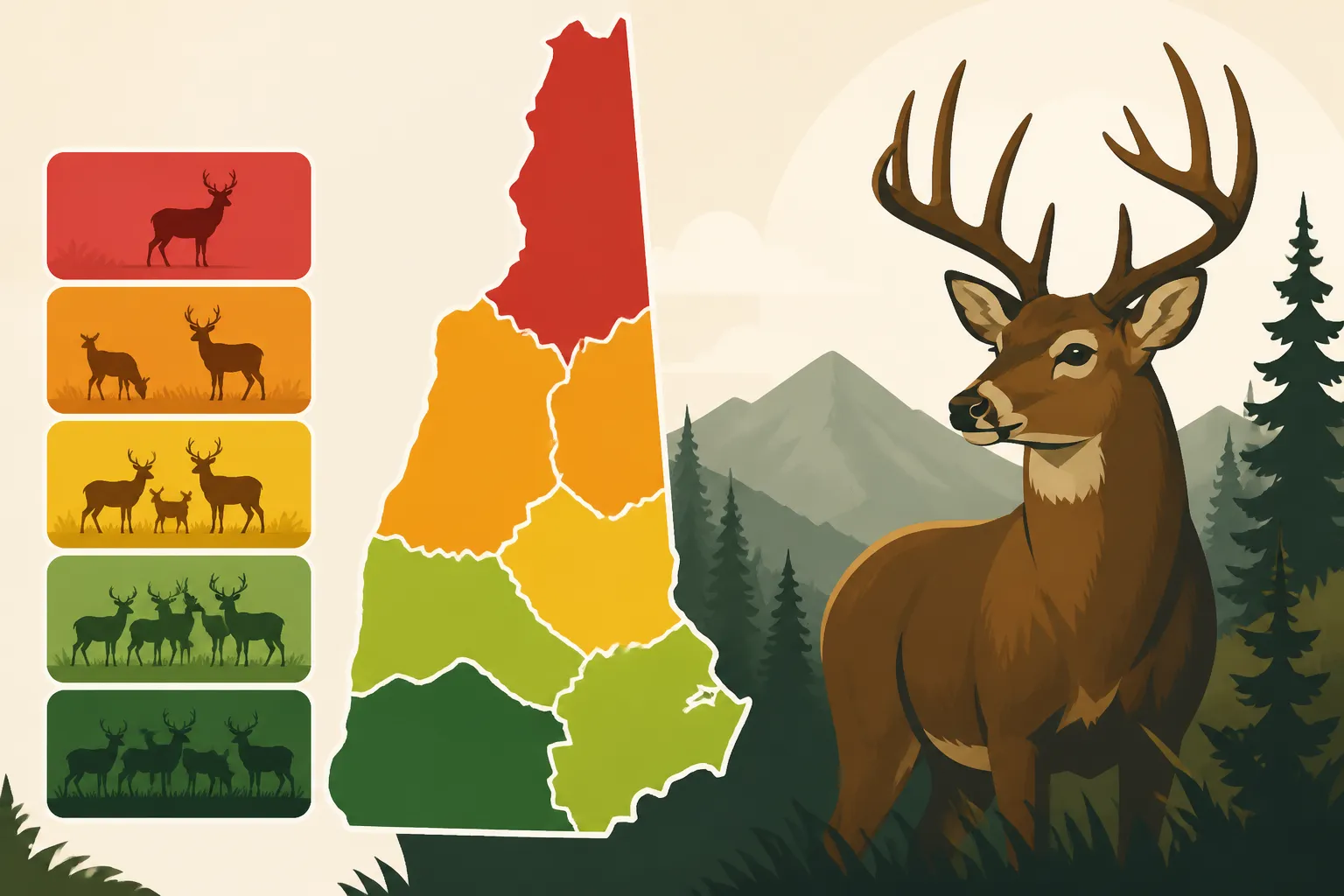
Deer Density by New Hampshire Region
It's a common lament around the campfire, isn't it? "The deer just aren't here anymore!" or "They're everywhere in that town, but not a track to be found near me." Understanding where deer thrive, and where they're a bit more elusive, is absolutely crucial for any hunter in New Hampshire. This comprehensive guide is here to shed light on the varying deer densities across our beautiful Granite State, helping you pinpoint the most promising areas and adjust your hunting strategies accordingly.
Understanding New Hampshire's Deer Density Landscape
When we talk about "deer density," we're really talking about the number of deer per square mile in a given area. It’s not just an arbitrary number; it’s a critical piece of the puzzle that dictates everything from how often you'll see a deer to how successful your season might be. New Hampshire's landscape is incredibly diverse, ranging from dense suburban areas to vast, unbroken wilderness, and each environment supports its deer population differently.
What "Deer Density" Really Means for Hunters
For us hunters, deer density translates directly into opportunity. In areas with higher densities, your chances of encountering deer during a still-hunt, seeing them from a stand, or finding fresh sign are significantly amplified. Conversely, in low-density zones, you'll likely need to work harder, cover more ground, and rely on meticulous scouting to locate pockets of deer. It's not about being easy or hard, but about understanding the playing field. A high-density area might mean more competition from other hunters, while a low-density area often means more solitude and a chance to track a truly mature animal that's seen little pressure. This understanding can help you decide if you're looking for a freezer full of venison or a challenging pursuit of a trophy buck.
Factors Influencing Regional Deer Numbers
So, what makes deer numbers higher in one part of the state and lower in another? It's a complex interplay of several factors. Habitat quality is paramount: areas with a mix of agricultural fields, regenerating clearcuts, and mature hardwoods provide diverse food sources and cover, leading to higher densities. Winter severity also plays a huge role; harsher winters, especially in the northern reaches, can lead to increased winter mortality, particularly among fawns and older deer. Human population density is another factor; while heavy development can push deer out, suburban and exurban areas often provide abundant forage (think gardens and ornamental plantings) and reduced hunting pressure in certain pockets, leading to localized high densities. Lastly, predator populations, such as coyotes, can influence fawn survival, especially in more remote areas. It’s a delicate balance that New Hampshire Fish and Game monitors closely when setting annual season structures and bag limits, as detailed in New Hampshire's WMU-Based Deer Season Structure.
The Lush Southern Tier: High Density Hotspots
If you're looking for areas with generally higher deer numbers, the southern tier of New Hampshire often delivers. This region benefits from a milder climate, more fragmented forest, and a patchwork of agricultural lands and suburban development that provides excellent browse and cover. It's a different kind of hunting than the big woods, but it can be incredibly productive.
Suburban Edges and Farmland Pockets
Picture the towns south of Concord, or areas around Manchester and Nashua. While these are bustling human centers, they're also ringed by prime deer habitat. These "suburban edges" often feature woodlots interspersed with fields, power lines, and residential properties where deer feel relatively safe. They adapt to human presence, often feeding at night in backyards and bedding down in surprisingly small patches of cover during the day. The hunting pressure here can be intense on accessible public parcels, but if you can secure permission on private land, you might find deer densities that would make a northern hunter green with envy. These areas often have ample food sources, from acorn flats to forgotten apple orchards, and sometimes even planted green fields, making them ideal for Hunting a Green Field Planted for Deer.
Monadnock and Merrimack Valleys
Moving westward into the Monadnock Region, and eastward into the Merrimack Valley, you'll find a more traditional hunting landscape, but still with robust deer numbers. The Monadnock Region's rolling hills, mixed hardwoods, and historic farmlands offer fantastic opportunities. The Merrimack River corridor, with its fertile bottomlands and riverine forests, acts as a natural funnel for deer movement, especially during the rut. These areas are characterized by a blend of mature timber, regenerating clear-cuts, and smaller agricultural plots, providing a diverse diet for deer. Here, patience and careful scouting are key. Utilizing mapping tools like those from GoHunt can help you identify these pockets of prime habitat and potential travel corridors.
Central New Hampshire: A Balance of Opportunity
Central New Hampshire often presents a mix of habitat types and, consequently, a more varied deer density picture. It's not as universally high-density as the deep south, nor as sparse as the true north, offering a fascinating blend of challenges and rewards.
Lakes Region Dynamics
The Lakes Region, with its numerous large and small bodies of water, presents a unique set of challenges and opportunities. Shorelines, peninsulas, and islands can create natural funnels and sanctuaries for deer. The habitat around these lakes is often a mix of dense softwood thickets, mature hardwoods, and some residential development. Deer here have learned to navigate the terrain, using the water as a barrier or a travel route. While access can sometimes be tricky due to private land ownership around popular lakes like Winnipesaukee, diligent scouting on state and town forests can reveal surprisingly high concentrations of deer, especially in remote coves or undeveloped shorelines. Understanding how deer utilize these unique aquatic landscapes is key to success.
The Connecticut River Corridor Influence
Along New Hampshire's western border, the Connecticut River Valley is a prime example of how a major waterway can create a corridor of rich habitat. The fertile floodplains and agricultural lands adjacent to the river provide consistent food sources, drawing deer from the surrounding uplands. These river bottoms and nearby fields often hold excellent deer numbers, particularly when agricultural crops like corn are present. However, hunting pressure can be high in easily accessible areas. Scouting these river corridors requires understanding deer movement patterns between feeding areas in the fields and bedding areas in the adjacent woodlands. This region can offer exceptional hunting, especially if you can get permission on private land bordering the river, or identify less-pressured public parcels. Hunters looking to understand deer patterns here might find insight in articles like Working a Connecticut River Bottomland Funnel.
Northern New Hampshire: Navigating the Backcountry Challenge
The northern reaches of New Hampshire are often characterized by vast, unbroken forests, higher elevations, and significantly harsher winters. This leads to generally lower deer densities compared to the central and southern parts of the state. However, "lower density" doesn't mean "no deer"; it simply means you'll need to adjust your expectations and strategies.
The Vast White Mountain National Forest
The White Mountain National Forest is an immense tract of public land, offering unparalleled solitude and a true wilderness hunting experience. However, the sheer scale, rugged terrain, and deep snows mean deer densities are naturally lower here. Deer tend to concentrate in specific areas, often in lower elevations, south-facing slopes, or sheltered valleys where winter browse is more accessible and snow depths are less severe. Finding these deer often involves extensive scouting, relying on features like old logging roads, clear-cuts, and natural funnels between mountain ridges. Hunting here is often a physically demanding endeavor, rewarding those who are willing to put in the miles and carefully read the sign. It's a place where you'll be Finding Sign in White Mountain Timber and truly earning your venison.
Coos County's Great North Woods
Further north, into Coos County and the "Great North Woods," you'll find similar, if not even more pronounced, challenges. This is moose country, and while deer do exist, their numbers are generally the lowest in the state. The long, cold winters and extensive softwood forests can limit deer populations. However, pockets of higher deer density can be found around logging operations, which create new growth and browse, or in sheltered river valleys. Successful hunting in these remote areas often involves focusing on these specific habitat types, or even adapting tactics used for other species. For instance, understanding the terrain for Hunting a New Hampshire North Country Moose Bog might also lead you to deer habitat nearby. Hunters here often cherish the solitude and the challenge of pursuing a truly wild northern buck.
Comparing Regional Deer Harvest and Trends
Understanding regional deer density is certainly helpful, but looking at actual harvest data provides a concrete picture of where hunters are finding success. The New Hampshire Fish and Game Department meticulously tracks harvest numbers, offering valuable insights into population trends and hotspots.
Annual Harvest Data Across WMUs
New Hampshire is divided into Wildlife Management Units (WMUs), and the Fish and Game Department provides annual harvest reports broken down by these units. Generally, WMUs in the southern half of the state (like K, J2, H2, I2) consistently show higher total deer harvests compared to those in the north (like A, B, C, E). This directly correlates with the deer density differences we've discussed. However, it's not just about raw numbers. A WMU with a high overall harvest might also experience significant hunting pressure, while a lower-harvest WMU might yield fewer deer but potentially larger, older animals due to less pressure. It's a trade-off many hunters consider. You can often find detailed information on these numbers in the New Hampshire Deer Harvest Records.
Let's take a look at a generalized comparison of some WMUs by region:
| WMU (Region) | General Deer Density | Typical Habitat | Annual Harvest (Trend) | Hunting Pressure | Key Challenge/Opportunity |
|---|---|---|---|---|---|
| K (South) | High | Suburban, Farmland, Mixed Woodlots | High (Stable/Slight Increase) | High | Private land access, small woodlot tactics |
| H2 (South) | High | Mixed Hardwoods, Residential, Pockets of Agriculture | High (Stable) | Moderate-High | Understanding deer adapting to human presence |
| F (Central) | Moderate | Lakes Region, Mixed Forest, Shorelines | Moderate (Stable) | Moderate | Navigating unique water-influenced habitat |
| D2 (Central) | Moderate-High | Connecticut River Valley, Agriculture, Bottomlands | Moderate-High (Stable) | Moderate-High | River corridor funnels, field edge hunting |
| E (North) | Low | White Mountain National Forest, High Elevation | Low (Stable/Slight Decline) | Low-Moderate | Extreme terrain, finding wintering yards |
| A (North) | Very Low | Great North Woods, Extensive Softwood, Remote | Very Low (Stable) | Low | Long-range scouting, wilderness skills |
Note: This table provides generalized information. Actual data varies year to year. Always consult the most recent NH Fish and Game reports for precise numbers.
Long-Term Trends and Management Strategies
New Hampshire's deer population has seen various trends over the decades. In many southern and central WMUs, deer populations are robust and often managed to allow for a healthy balance with human interests and habitat capacity. In the north, management often focuses on mitigating the impacts of severe winters and maintaining a viable, though lower, population. The state utilizes a combination of season lengths, bag limits, and specific regulations (like antlerless permits) to manage these populations. Understanding these trends and strategies, which you can read more about in New Hampshire Deer Population Estimate, can give you a better grasp of what to expect in your chosen hunting grounds. It also highlights the dedication of wildlife managers to ensure sustainable hunting opportunities for future generations.
Regional Scouting and Hunting Strategies Based on Density
Knowing the general deer density in a region is one thing; actually using that information to improve your hunting is another. The most successful hunters are those who adapt their tactics to the specific environment and the deer living within it.
Adapting Tactics for High-Density Areas
In areas with high deer density, such as the southern tier or fertile river valleys, you might think hunting would be easy. Not necessarily! Higher density can often mean more hunting pressure, making deer warier and more nocturnal. Your strategies here might focus on:
- Understanding Pressure Points: Deer in high-density areas often learn to avoid main trails and easily accessible public lands. Utilize mapping tools like GoHunt to identify small, overlooked parcels of public land, or focus on securing permission on private property where pressure is lower. Look for thick cover adjacent to residential areas where deer might bed during the day.
- Stand Placement: With more deer, you might find more rub lines and scrape lines. Instead of just focusing on one, look for consistent travel corridors between bedding and feeding areas, especially those offering thick cover and escape routes. A well-placed treestand or ground blind near a food source or pinch point can be incredibly effective. Consider topics like Hanging a Stand on a Granite Ridge for insight into strategic placement.
- Still-Hunting and Drives: In fragmented, high-density areas, careful still-hunting through thickets can be very effective, as deer might not have vast areas to flee to. Small, organized deer drives with a few hunters can also be productive in pushing deer through known escape routes, as explored in Deer Drives With Three or Four Hunters. The key is knowing where the deer are likely to be hiding.
Maximizing Success in Lower-Density Terrain
Hunting in lower-density areas, predominantly in northern New Hampshire and the White Mountain National Forest, demands a different mindset. It's often about quality over quantity, and it rewards patience, physical fitness, and meticulous scouting.
- Covering Ground & Spotting: Expect to walk more. In vast tracts of timber, deer might be spread out. Look for "edge habitat" – where different forest types meet, or where old growth transitions to younger clearcuts. These areas provide both food and cover. Glassing clear-cuts or open areas with good optics can also be effective, especially at dawn and dusk. For more insights on this, you might explore Reading Aerial Photos for North Country Deer.
- Focus on Specific Features: Deer in low-density areas rely heavily on specific features that offer sustenance and shelter. This could be a south-facing slope that melts snow early, providing first browse, or dense conifer stands that offer thermal cover during harsh winters. Look for these micro-habitats, especially in relation to wintering yards, which are critical for deer survival. GoHunt maps can help highlight these terrain features.
- Scouting for Sign, Not Just Sightings: In low-density areas, you might not see deer every time you scout. Instead, focus intently on finding fresh sign – tracks, droppings, rubs, and beds. One set of fresh tracks might indicate the presence of the only deer in that square mile. Don't dismiss a single piece of sign; it's often your best clue. For deep dives into scouting, check out Scouting New Hampshire Public Land Before Season.
Disclaimer
The information provided in this guide is for general informational purposes only and does not constitute legal advice. Hunting regulations, seasons, and licensing requirements are subject to change. Always consult the most current New Hampshire Fish and Game Digest and relevant state laws before planning any hunting activity. Safety should always be your top priority.