New Hampshire Moose Density by WMU
Trying to understand where New Hampshire's majestic moose truly roam and in what numbers can feel like staring into a dense patch of North Country timber – a lot of trees, but where's the big bull? Hunters often grapple with conflicting information or anecdotal sightings, making it tough to plan a strategy for the coveted moose permit. This comprehensive guide is designed to cut through the fog, offering a clear, detailed breakdown of New Hampshire's moose density by Wildlife Management Unit (WMU) and what that means for both the future of these incredible animals and your hunting prospects.
Understanding New Hampshire's Moose Population Dynamics
The moose, an iconic symbol of New Hampshire's wilder regions, has a fascinating and sometimes challenging history in the state. Their populations aren't static; they ebb and flow with environmental changes, disease, and management efforts. Grasping these dynamics is crucial for anyone interested in their presence in specific areas.
The Decline and Management of Moose in New Hampshire
It's no secret that New Hampshire's moose population has faced significant hurdles over the past few decades. While moose numbers boomed in the late 20th century, peaking in the early 2000s, a noticeable decline followed. This downturn wasn't isolated to New Hampshire; it was observed across much of the southern range of moose in the Northeast. The primary culprit? The winter tick. These tiny parasites, thriving in shorter, warmer winters, infest moose in astounding numbers, often weakening them to the point of starvation or susceptibility to other diseases. Calves are particularly vulnerable, leading to poor recruitment into the adult population.
In response to this, the New Hampshire Fish and Game Department has implemented various management strategies. This includes adjusting harvest quotas, particularly in WMUs most affected by the decline, to try and reduce overall moose density in those areas. The thinking is that fewer moose mean fewer hosts for ticks, potentially breaking the cycle and allowing the population to recover. It's a tough balancing act, managing a cherished big game animal while confronting complex ecological issues. You can learn more about the challenges in our article on Why Winter Ticks Threaten New Hampshire Moose.
Factors Influencing Moose Density
Moose density isn't just a number; it's a reflection of a complex interplay of environmental factors. Habitat, for instance, plays an enormous role. Moose prefer young, regenerating forests that provide ample browse – the twigs and shrubs they feed on – as well as wetlands and bogs for summer cooling and aquatic vegetation. Areas with mature, dense forest tend to support fewer moose unless there are frequent clearcuts or natural disturbances creating new growth.
Predation, while not as significant a factor for adult moose in New Hampshire, can impact calf survival in certain areas. Disease, specifically the winter tick, remains the most dominant factor affecting density in the Granite State. But food availability and quality, climate (especially snow depth and summer temperatures), and human activity like road networks and development also contribute to how many moose a specific area can sustainably support. Understanding these elements is key to deciphering why one WMU might hold more moose than another, even if they appear similar on a map.
How Wildlife Management Units (WMUs) Are Established for Moose
New Hampshire, like many states, divides its land into specific Wildlife Management Units (WMUs) for the purpose of managing wildlife populations and regulating hunting. These units aren't arbitrary lines on a map; they are carefully considered divisions based on a combination of ecological, geographical, and sometimes logistical factors that directly impact moose and other game species.
Geographic and Ecological Distinctions of WMUs
New Hampshire's WMUs are drawn with an eye towards distinguishing areas with different habitat types, climates, and human populations. For moose, this means recognizing the dramatic differences between the dense, mountainous forests of the North Country and the more fragmented, agricultural landscapes of the southern part of the state. For example, WMUs in the far north, like A and B, typically encompass vast tracts of timberland, expansive bogs, and fewer roads – prime moose habitat. These areas often experience harsher, longer winters and cooler summers, conditions generally more favorable for moose, even with the tick issue.
In contrast, WMUs further south, such as J or K, have significantly more human development, smaller forest blocks, and milder winters. While moose can and do inhabit these areas, their densities are naturally lower due to less ideal habitat and increased human-moose conflicts. The boundaries are designed to group areas with similar characteristics together, allowing for more targeted and effective management decisions based on the specific ecological realities of that zone.
The Role of WMUs in Moose Management and Harvest Quotas
The WMU system is the backbone of New Hampshire's moose management plan. It allows the Fish and Game Department to monitor moose populations within defined areas, assess their health, track reproduction and survival rates, and, crucially, set harvest quotas for hunters. Each year, wildlife biologists evaluate data collected from aerial surveys, hunter reports, and field research within each WMU. This information helps them determine the estimated moose population and, perhaps more importantly, the specific health and trend of that population.
Based on these assessments, a certain number of moose permits are allocated to each of the designated moose-permit WMUs. This system allows for precise control. For example, if a particular WMU shows signs of declining moose health or high winter tick loads, the department can reduce the number of permits issued for that specific unit, aiming to lower the moose density and give the population a better chance to rebound. Conversely, if a WMU has a healthy, stable, or growing population, permit numbers might remain consistent or even increase slightly. This granular approach ensures that hunting pressure is distributed appropriately and supports the long-term health of the state's moose herd. Our article on New Hampshire's Moose Permit Lottery delves deeper into how these permits are distributed and the application process.
Diving Into New Hampshire's Moose Density by WMU
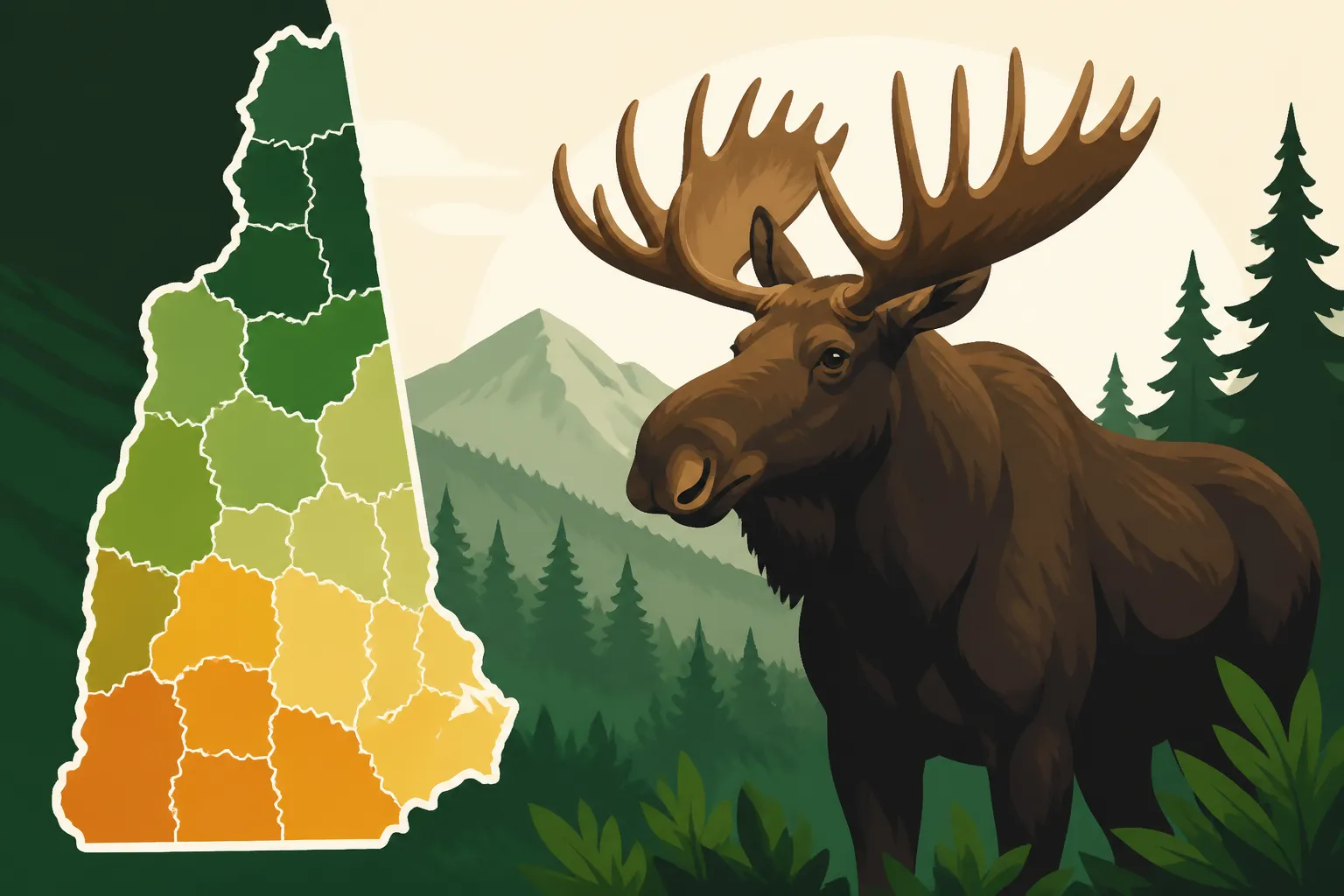
When we talk about moose density, we're essentially asking: "How many moose can we expect to find in a given square mile?" This isn't just an academic question; for hunters, it directly impacts scouting efforts and success rates. New Hampshire's moose aren't evenly distributed; their numbers vary dramatically from the wild northern reaches to the more settled southern regions.
North Country WMUs: The Heart of Moose Country
If you're dreaming of seeing a moose in New Hampshire, your best bet is undoubtedly the North Country. WMUs like A, B, C, D2, and E are historically, and continue to be, the strongholds of New Hampshire's moose population. These units boast extensive tracts of undeveloped forest, including vast areas of regenerating timber, swampy lowlands, and critical riparian zones along rivers and streams – all prime moose habitat.
In these northern WMUs, you'll find higher densities compared to other parts of the state, though even here, the numbers have seen adjustments due to the aforementioned winter tick challenges. WMU A, for example, which encompasses the expansive Connecticut Lakes Headwaters region, often leads the state in moose sightings and harvest success, reflecting a relatively higher density. Similarly, WMU B, covering much of the Dartmouth/Lake Umbagog area, and WMU D2, stretching along the Connecticut River Valley, offer significant moose habitat. Even with population management efforts, these units remain the best places to encounter these magnificent animals.
Here’s a general overview of New Hampshire's moose-permit WMUs, their approximate density trends, and characteristics:
| WMU | General Location | Primary Habitat Characteristics | Moose Density Trend (Relative) | Notes |
|---|---|---|---|---|
| A | Far North (Pittsburg, Clarksville area) | Vast timberland, clearcuts, extensive bogs, wetlands | Highest, but managed down | Historically prime. Significant logging creates good browse. |
| B | North (Dartmouth, Umbagog Lake area) | Mixed forest, lakes, wetlands, managed timber | High, but managed down | Good mix of habitat, strong population, though still tick-affected. |
| C | North-Central (Errol, Milan area) | Mountainous, mixed forest, river valleys, clearcuts | Moderate-High | Diverse terrain, good pockets of browse. |
| D1 | Central (Lake Winnipesaukee, Squam Lake) | Lakes, mixed forest, more developed areas | Low-Moderate | Transition zone, fragmented habitat, increasing human presence. |
| D2 | Northwest (Connecticut River Valley) | River bottoms, agricultural fringe, mixed forest | Moderate | Good riverine habitat, but narrower strip. |
| E | White Mountain National Forest | High elevation, dense forest, regenerating clearcuts | Moderate | Challenges with high-elevation habitat, but still holds good numbers. |
| F | Southwest (Monadnock Region) | Mixed forest, hilly terrain, some agriculture | Low | Fringe habitat, lower carrying capacity for moose. |
| G | Southeast (Seacoast, Lakes Region fringe) | Fragmented forest, residential, agricultural | Very Low | Extremely rare, not a moose management unit for hunting permits. |
Note: "Managed down" refers to active management strategies to reduce overall moose density to combat winter tick impacts and improve herd health.
Transitional and Southern WMUs: Where Moose are Less Common
As you move south and east from the North Country, moose densities typically decrease quite dramatically. WMUs like D1, E, and F represent more transitional zones, while anything further south or along the populated eastern corridor sees very low to virtually non-existent moose populations. These areas simply don't offer the same expansive, undisturbed habitat that moose thrive in. WMU D1, for example, covers the Lakes Region, an area characterized by significant residential development, busy roads, and smaller, more fragmented forest blocks. While a moose might occasionally wander through, consistent populations are not found here.
Similarly, WMU F, in the Monadnock region, offers some dense forestland but lacks the continuous, regenerating clearcuts and vast wetland complexes that support higher moose numbers. The mild winters also contribute to higher tick survival rates, making it even harder for moose to thrive. For hunters, obtaining a moose permit in these lower-density WMUs is exceptionally rare, and even with a tag, success rates are historically much lower than in the northern units. It’s a testament to the fact that while moose are adaptable, they have very specific habitat requirements that are best met in New Hampshire's true wilderness. Understanding How Many Moose Live in New Hampshire across the state can give you a broader picture.
Interpreting Moose Density Data for Hunters
For those lucky enough to draw a moose permit in New Hampshire, or even those just scouting for wildlife photography, understanding moose density isn't just a biological curiosity—it's a critical component of successful outdoor pursuits. The numbers, combined with habitat knowledge, can inform your entire strategy.
What Density Means for Hunting Success and Strategies
If you’ve drawn one of the coveted moose permits, the density of moose in your assigned WMU will heavily influence your hunting plan. In high-density WMUs like A or B, you might expect to encounter more moose in general, potentially offering more opportunities for spot-and-stalk or calling. These areas often have more fresh sign, like tracks, rubs, and browse, making scouting a bit more productive. You might focus on still-hunting through younger clearcuts or spending time glassing large open bogs, knowing that a moose is likely within a reasonable distance. You can read more about specific tactics in Moose Hunting New Hampshire's North Country and Calling a Bull Moose in Late October.
Conversely, in lower-density WMUs, a moose’s home range tends to be larger, meaning they might be more spread out and harder to locate. Here, your strategy might shift to more extensive scouting prior to the season, focusing on finding specific feeding areas, water sources, or bedding cover that might concentrate moose. Persistence becomes even more critical, as you might need to cover more ground to find fresh sign. Understanding these differences allows you to adjust your expectations and tactics, making the most of your limited time in the field.
Utilizing Resources for Up-to-Date Moose Information
The New Hampshire Fish and Game Department is the primary source for the most accurate and up-to-date moose density and population data. They release annual harvest reports and often provide detailed breakdowns of population trends by WMU. Staying current with these reports is paramount for any serious hunter or wildlife enthusiast. These documents offer insights into population health, calf recruitment rates, and specific WMU trends that can help you anticipate permit allocations and plan your hunting approach.
Beyond official reports, modern mapping applications are invaluable. Tools like GoHunt or onX Hunt, when combined with your knowledge of moose habitat, can help you identify promising areas within a WMU. You can overlay property boundaries, topographic maps, and satellite imagery to pinpoint potential feeding areas, dense bedding cover, or travel corridors that moose might use. These digital resources, especially when used for Scouting With the New Hampshire Fish and Game App or exploring onX Layers for New Hampshire Land Status, allow you to virtually scout vast areas, saving precious time and energy in the field and helping you focus your efforts where moose are most likely to be found, based on their known densities and habitat preferences.
Challenges and Future Outlook for New Hampshire's Moose
The story of New Hampshire's moose is one of resilience, but also of ongoing challenges. While their presence is deeply cherished, the future of these magnificent animals remains a critical conservation concern, especially as environmental factors continue to shift.
The Persistent Threat of Winter Ticks and Climate Change
As mentioned earlier, the winter tick isn't just a nuisance; it's an existential threat to New Hampshire's moose population, particularly at the southern edges of their range. Warmer fall temperatures extend the period when tick larvae are active, allowing more of them to latch onto moose. Milder, shorter winters mean more ticks survive to infest moose the following year, leading to a devastating cycle. A single moose can host tens of thousands of ticks, causing severe blood loss, hair loss (from obsessive scratching), and ultimately, hypothermia, anemia, and starvation. This issue is a primary driver behind the New Hampshire Moose Population Decline Since the 1990s.
Climate change is exacerbating this problem, creating conditions that favor the tick while stressing the moose. Beyond ticks, increased summer heat can also stress moose, which are well-adapted to cold climates. Scientists are actively researching these impacts, but the prognosis for a rapid recovery of moose populations to their former highs, especially in the more southern WMUs, is guarded. It's a complex, long-term challenge that requires continued monitoring and adaptive management strategies.
Conservation Efforts and the Hunter's Role
Despite the challenges, there are ongoing efforts to support New Hampshire's moose. The Fish and Game Department continues its rigorous research, studying moose health, survival rates, and the dynamics of winter tick infestations. This data-driven approach informs their adaptive management strategies, including the careful adjustment of harvest quotas within specific WMUs to alleviate pressure where it's most needed. While some may see reduced permit numbers as a negative, it's a direct reflection of these conservation efforts aimed at ensuring the long-term viability of the herd.
Hunters play a crucial, often unsung, role in these conservation efforts. The revenue generated from hunting licenses and moose permits directly funds wildlife research, habitat management, and enforcement programs that benefit moose and countless other species. Furthermore, hunters provide invaluable data through mandatory reporting of their harvest, offering biologists real-time insights into the health and distribution of moose across the state. Every successful hunter who participates in the field dressing and reporting process contributes to a larger scientific understanding. Learning Field Dressing a Moose in the North Country and then accurately reporting helps paint a clearer picture for wildlife managers. It's a testament to the symbiotic relationship between responsible hunting and effective wildlife conservation in the Granite State.
Disclaimer
Please note: Hunting regulations, season dates, and WMU boundaries can change. Always consult the most current New Hampshire Fish and Game Department hunting digest and official resources before planning any hunting activity. This article provides general information and should not be used as the sole basis for making hunting decisions or interpreting legal regulations.