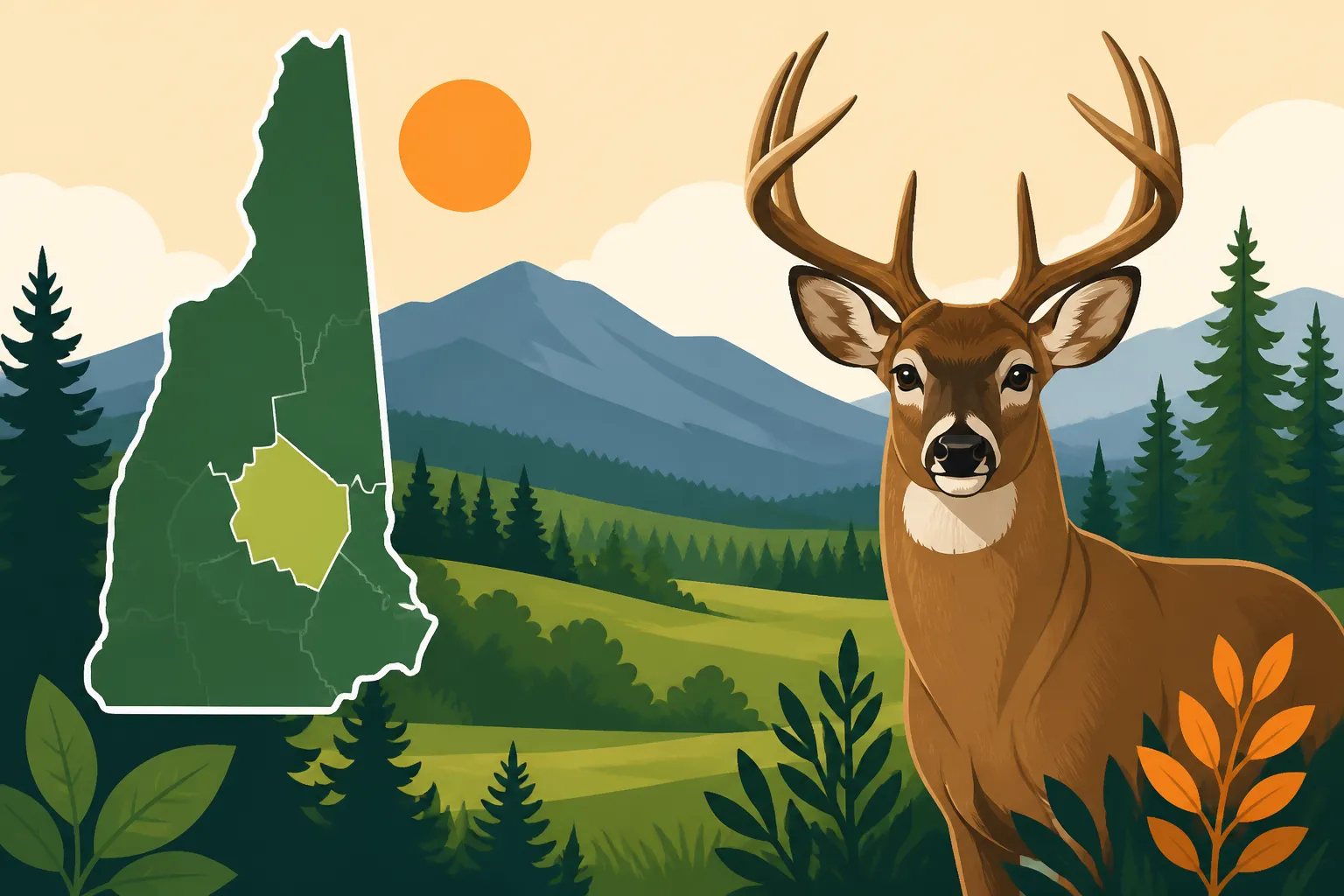
Hillsborough County Public Land for Deer
Hunting for deer in Hillsborough County can feel like a whole different ballgame compared to the sprawling timberlands of the North Country. Here, you're often dealing with smaller, fragmented parcels of public land nestled among growing suburban areas, which can lead to unique challenges and frustrations for the deer hunter. This guide is here to walk you through how to successfully navigate and hunt these public lands for white-tailed deer, offering practical advice to help you find success in a more densely populated region of New Hampshire.
Understanding the Public Land Landscape in Hillsborough County
Let's be real, when most folks think of New Hampshire hunting, they picture vast, remote wilderness. Hillsborough County, with its bustling towns like Manchester and Nashua, doesn't immediately spring to mind as a deer hunting paradise. However, beneath the surface of its more developed areas, there's a surprising amount of public land that holds deer, even if it demands a different approach than what you might be used to further north. The key is understanding what you're up against and adjusting your expectations and tactics accordingly.
The Reality of Southern New Hampshire Public Land
The public land in Hillsborough County is rarely contiguous for miles on end. You'll find a patchwork of state forests, town forests, Wildlife Management Areas (WMAs), and conservation lands, often broken up by private property, roads, and residential areas. This means your hunting parcel might be 50 acres here, 100 acres there, rather than thousands of acres of unbroken timber. This fragmentation can be a blessing and a curse. On one hand, it concentrates deer into smaller cover pockets; on the other, it means more pressure from other hunters and requires constant vigilance regarding property boundaries.
You'll also encounter different deer behavior. While North Country deer might be accustomed to vast, quiet woods, deer in Hillsborough County are often more habituated to human presence and suburban sprawl. They learn to navigate backyards, road crossings, and small woodlots with incredible stealth. This doesn't mean they're easier to hunt, quite the opposite. It means they're incredibly adept at using even the smallest patches of cover to their advantage and often move more during the low-light hours. Don't expect to see them just strolling through an open field at noon.
One of the biggest frustrations is often feeling like you're constantly on top of other hunters, especially during peak seasons like the firearms opener. It's a reality of hunting smaller public tracts close to population centers. But don't let that discourage you. With smart scouting and strategic planning, you can still find pockets of unpressured deer, even if they're just a few hundred yards off a main trail. It's about working smarter, not necessarily harder, to locate those deer that have learned to avoid people.
Identifying Potential Deer Habitat on Smaller Parcels
Even small parcels of public land can hold deer, but you need to know what to look for. Deer, especially in these fragmented environments, are always seeking three things: food, water, and cover. In Hillsborough County, cover might be a dense, overgrown clear-cut, a thick cedar swamp, or even just a steep, brushy hillside that other hunters tend to avoid. Water is usually abundant, but specific sources like small ponds or creek bottoms can act as natural funnels.
Food sources can vary widely. While agriculture is less dominant than in some other regions, you might find pockets of old apple orchards, abandoned farms that still produce some soft mast, or natural browse in regenerating timber cuts. Look for transition zones – where a swamp meets a hardwood ridge, where a dense pine stand borders an open field, or where a powerline cut provides abundant forage. These edges are where deer feel safe transitioning between bedding and feeding areas. Mapping tools like onX Hunt are invaluable here, allowing you to examine aerial photos for these subtle habitat changes and dense cover patches before you even set foot in the woods.
Remember, deer don't read property lines. They will utilize cover and food on private land, often only retreating to the safety of public land when pressured. This means understanding the surrounding private land can inform where deer will enter or exit a public parcel. Look for natural corridors, like hedgerows, creek bottoms, or narrow strips of woods that connect larger blocks of habitat, even if those blocks are mostly private. A small public woodlot might serve as a crucial bedding area if it's surrounded by agricultural fields or low-density housing on private ground.
Key Public Hunting Areas in Hillsborough County
Hillsborough County offers a mix of state-managed and locally-managed lands that can provide deer hunting opportunities. While none of these will compare to the vastness of the White Mountain National Forest, they are still viable options for the dedicated hunter. The key is knowing where to look and being diligent about checking specific regulations for each area.
State Forests and Wildlife Management Areas
New Hampshire Fish and Game manages several Wildlife Management Areas (WMAs) and numerous state forests across Hillsborough County. These areas are specifically managed for wildlife habitat and public recreation, including hunting. While they might not be huge, they often contain excellent habitat features that concentrate deer. For example, some WMAs might feature a mix of dense wetlands, uplands with diverse tree species, and even designated food plots. Always check the New Hampshire Fish and Game website or the current hunting digest for specific rules and regulations pertaining to each WMA or state forest, as some may have unique restrictions or special draw hunts.
A good example might be an area like the Powwow River WMA, even though it's technically in Rockingham County, it demonstrates the type of management you might find. In Hillsborough County, look for places like the Fox State Forest in Hillsborough or the Ponemah Bog Wildlife Sanctuary near Amherst (check for specific hunting permissions as sanctuaries sometimes have different rules). These aren't typically "destination hunts" but are vital resources for local hunters. Remember that these areas often see significant use from hikers, dog walkers, and other outdoor enthusiasts, so situational awareness and patience are paramount. Consider hunting mid-week or during less popular times to avoid crowds.
Familiarize yourself with New Hampshire's WMU-Based Deer Season Structure, as regulations, including season dates and bag limits, can vary by Wildlife Management Unit (WMU). Hillsborough County falls into several WMUs depending on your exact location, such as WMU H1, H2, or I1, all of which have slightly different characteristics and deer densities. Knowing your WMU is critical for understanding specific season dates and any special antlerless permits that might be available.
Town Forests and Conservation Lands
Beyond state-managed lands, many towns in Hillsborough County have their own town forests or conservation lands. These parcels, often managed by a town's conservation commission, can be excellent, albeit smaller, places to hunt. The challenge here is that regulations vary wildly from town to town. Some town forests are explicitly open to hunting, while others might restrict it entirely, limit it to archery-only, or require special permits. It's absolutely crucial to contact the specific town office or conservation commission for the parcel you're interested in before you hunt. Don't assume anything.
These smaller, often overlooked parcels can sometimes be less pressured than larger state lands simply because they require more homework from the hunter. You might find a 100-acre town forest with a mix of hardwoods, pines, and a small swamp that holds a surprising number of deer, especially if it's bordered by private agricultural land or larger tracts of timber. These spots can be great for a morning or evening sit, or a careful still-hunt. Often, residents are unaware these areas are open to hunting, which can mean less competition.
When investigating town forests or conservation lands, look for areas that provide good escape cover. Deer are experts at finding the path of least resistance when pressured, and these smaller tracts often have dense thickets or wetlands that act as natural sanctuaries. A small, brushy ravine or a cedar stand that's too thick for easy walking can be a dynamite bedding area. Keep in mind that "posted" land rules can apply differently on town land, so confirm all signs and regulations directly with the town to avoid any misunderstandings.
Leveraging Mapping Tools to Find Hidden Gems
In the fragmented landscape of Hillsborough County, mapping tools are not just helpful; they are essential. Forget paper maps and guesswork; digital mapping apps like onX Hunt or GoHunt provide incredible detail, showing property lines, public land boundaries, topography, and even satellite imagery that can reveal subtle habitat changes. These tools are your best friend for Scouting New Hampshire Public Land Before Season without putting boots on the ground, especially when dealing with countless small parcels.
Before you ever head out, spend time on these apps. Look for those dark green blobs indicating dense cover—pockets of pines, thick regenerating forest, or swampy areas—that might hold bedding deer. Identify pinch points, funnels, and natural travel corridors between these cover areas and potential food sources. Pay close attention to terrain features like small ridges or creek beds that can create natural advantages. You might discover a small, unappealing-looking patch of public land that, when viewed from above, reveals a perfect bottleneck where deer are likely to travel.
The property line overlay feature is invaluable in Hillsborough County. It lets you identify every square inch of public land and, just as importantly, where that public land abuts private property. This helps you avoid accidental trespass and can inform your strategy. For instance, if a public parcel is surrounded by agricultural fields, you know deer are likely using that public land for bedding cover and moving to the private fields at night. Use these apps to plan your entry and exit routes, locate potential stand sites, and identify escape routes for deer. This level of detail can genuinely help you in Finding Ground That Sees Fewer Hunters by allowing you to spot those overlooked nooks and crannies that other hunters miss.
Strategies for Success on Hillsborough County Public Land
Hunting public land in Hillsborough County demands a refined approach. It's not about covering vast distances, but about precise, calculated moves. The deer here are often more pressured and accustomed to human activity, meaning your strategy needs to be adaptable and subtle.
Adapting Your Hunting Style to High-Pressure Zones
When you're hunting smaller public parcels that might see a lot of foot traffic, you have to assume the deer are smart and wary. This isn't the place for crashing through the woods. Instead, think about still-hunting very slowly and deliberately, focusing on micro-terrain features and using the wind to your advantage. Early mornings and late evenings, right at the edges of legal shooting light, are often your best bets, as deer feel safer moving under the cloak of darkness and just barely into dawn or dusk.
Consider setting up a ground blind, especially if you're targeting a specific pinch point or food source. Using a Ground Blind on Public Land can provide excellent concealment in areas with limited tree stand options or heavy cover. Just make sure to brush it in naturally and allow the deer to get accustomed to it if possible. Mobility can also be an advantage. Instead of committing to one spot all day, consider a more "run-and-gun" approach, moving to different strategic locations throughout the day based on intel from your scouting or observations.
Another tactic that can be surprisingly effective in smaller, pressured areas is a well-coordinated deer drive. If you have a few hunting partners, you can strategize Deer Drives With Three or Four Hunters to push deer out of dense cover towards standers. This is particularly effective in compact woodlots or thickets where deer tend to hunker down. Careful planning and communication are essential to ensure safety and effectiveness, and always ensure everyone involved knows the boundaries and safety zones.
Effective Scouting and Access Planning
Scouting is paramount for success on Hillsborough County public land. Since the parcels are smaller and more fragmented, you can't just wander in and expect to find deer. You need to know exactly where they are, how they're moving, and when. Start your scouting long before the season opens, looking for historical sign like old rubs, scrapes, and bedding areas. These provide clues about deer habits year after year. As the season approaches, look for fresh sign: recent tracks, fresh droppings, and newly rubbed trees.
Pay close attention to human activity. Identify common trails used by hikers or dog walkers and avoid setting up directly on them. Instead, look for deer trails that parallel these human paths but stay tucked into thicker cover. Deer will often use these "edges" of human activity, relying on the presence of people to deter other predators while maintaining a safe distance. Access planning is also critical. Always ensure you have legal access to the public land. If there's a small strip of private land blocking easy access, you might need to seek permission from that landowner, which can be a challenge.
When planning your access, consider prevailing winds and thermals. In New Hampshire's varied terrain, even small elevation changes can cause thermals to rise in the morning and fall in the evening. This is particularly important if you're hunting a Hanging a Stand on a Granite Ridge or a small hill. Always approach your stand or hunting area quietly, especially in the pre-dawn hours, to avoid alerting deer that might be feeding or bedding nearby. A silent, scent-free approach is key to encountering unsuspecting deer.
Dealing with Hunting Pressure and Limited Space
Hunting public land in Hillsborough County means you're almost certainly going to encounter other hunters. This can be frustrating, but it's a reality you need to adapt to. Instead of getting discouraged, try to use it to your advantage. Other hunters, particularly those who stick to main trails or easily accessible areas, can actually push deer towards less-pressured pockets of cover. If you've done your scouting and found those overlooked sanctuaries, you might find deer moving right to you.
One effective strategy is to hunt the "transition times." Most hunters are out at first light and last light. Consider hunting during the middle of the day, especially if you're still-hunting or trying to bump deer out of dense bedding cover. Deer often move surprisingly well between 10 AM and 2 PM, particularly during the rut or on cloudy, drizzly days when human activity might be lower. Knowing New Hampshire Blaze Orange Requirements is also crucial, not just for legal compliance but for safety when other hunters are out.
Finally, manage your expectations. Hunting deer on smaller, pressured public land parcels in Hillsborough County can be challenging. You might not see as many deer as you would in the vast northern woods, but the satisfaction of tagging a mature buck in these conditions is immense. Celebrate every learning experience, every piece of new sign you find, and every deer encounter. Persistence, adaptability, and a deep understanding of local deer behavior will be your greatest assets.
Navigating Regulations and Ethical Considerations
Successfully hunting public lands in Hillsborough County isn't just about finding deer; it's also about respecting the law and practicing ethical hunting. Given the close proximity to residential areas and the varied nature of public access, understanding the nuances of regulations and landowner relations is critical.
Understanding Local Laws and WMU Specifics
New Hampshire's hunting regulations are designed to manage wildlife populations and ensure safety, but they can sometimes feel complex, especially when you factor in local ordinances. Always consult the most current New Hampshire Fish and Game Hunting Digest. This is your bible for statewide regulations, but remember that individual towns or even specific public parcels can have additional rules. For example, some town forests might have stricter setback distances from roads or residences for discharging firearms, or may only permit archery hunting.
Hillsborough County spans multiple Wildlife Management Units (WMUs), and each WMU can have slightly different season dates, bag limits, and even antlerless permit allocations. Double-check which WMU your chosen hunting area falls into. For instance, knowing if you're in WMU H1 versus WMU I1 can impact your strategy significantly. Ignoring these details can lead to fines, loss of hunting privileges, or worse. The Fish and Game website often has maps and tools to help you pinpoint your exact WMU, which is a key step in responsible hunting.
Additionally, pay close attention to rules regarding baiting and feeding. While legal in some forms in New Hampshire, there are specific regulations concerning what you can use, where you can place it, and when you can do so, particularly in relation to CWD prevention rules. As New Hampshire continues its vigilance against Chronic Wasting Disease, new regulations around carcass movement and natural lures can be implemented. Staying informed means checking the digest every year and understanding how these rules might impact your hunt in Hillsborough County.
Respecting Private Land and Public Access Points
One of the biggest challenges and ethical considerations in Hillsborough County is navigating the mosaic of public and private land. Public land parcels are often bordered by private residences, farms, or timber lots. It is your absolute responsibility to know where you are at all times and to avoid trespassing. This is where mapping apps like onX Hunt or GoHunt truly shine, allowing you to see property lines with precision right on your phone. Even with these tools, it's wise to carry a physical map or GPS unit as a backup, especially if you're in an area with spotty cell service.
Always assume land is private unless you have explicit confirmation that it's public and open to hunting. "No Trespassing" signs in New Hampshire mean exactly that. If you need to retrieve a downed animal from private land, you must gain permission from the landowner before crossing their property line. Showing respect and asking politely can go a long way. Building positive relationships with landowners can even open up opportunities for future hunting on private tracts, which can be invaluable in a county with limited public access.
When parking, ensure you are not blocking private driveways, town roads, or access points. Be mindful of where you leave your vehicle, as inconsiderate parking can lead to negative perceptions of hunters and potentially jeopardize future public access. Remember, as hunters, we are ambassadors for our sport. Our actions reflect on the entire hunting community, and in a populated area like Hillsborough County, that visibility is heightened. A small act of courtesy can make a big difference in maintaining public support for hunting.
Minimizing Your Impact and Practicing Ethical Recovery
Because Hillsborough County public lands often see heavy recreational use, minimizing your impact is more important than ever. Pack out everything you pack in—and then some. Leave no trace of your presence, whether it's spent shell casings, food wrappers, or flagging tape. If you use a ground blind or tree stand, ensure it's removed at the end of the season according to regulations. The goal is for the land to look undisturbed, showing respect for both the environment and other users.
Ethical recovery of game is paramount. In the event you make a shot, do everything in your power to recover that animal quickly and efficiently. This means knowing your limitations as a shooter, using appropriate equipment, and being prepared for a blood trail. Blood Trailing After Dark in New Hampshire can be challenging, but it's often necessary to prevent spoilage or loss of an animal. Carry a good headlamp, a reliable knife, and perhaps some flagging tape to mark the trail. If you believe your shot was marginal, wait an appropriate amount of time before trailing to allow the animal to bed down.
If you are fortunate enough to harvest a deer, handle the carcass respectfully and efficiently. This includes prompt field dressing to cool the meat, especially during warmer early season hunts. Be discreet when transporting your deer, especially through more populated areas. While most people understand hunting is a legal activity, avoiding unnecessary display can prevent discomfort for non-hunters. By acting responsibly and ethically, you help ensure that hunting opportunities in Hillsborough County remain available for generations to come.
Table: Comparing Public Land Types for Deer Hunting in Hillsborough County
| Public Land Type | Typical Size | Key Features | Potential Challenges | Best for (Hunting Style) |
|---|---|---|---|---|
| State Forests | Medium | Managed timber, varied habitat, established trails | Moderate pressure, shared with other recreation | Still-hunting, tree stand/ground blind near edges |
| Wildlife Management Areas | Medium-Large | Dedicated habitat management, food plots, wetlands | Moderate pressure, specific regulations | Ambush hunting, still-hunting, waterfowl/small game |
| Town Forests | Small | Woodlots, local access, varied management | High variability in rules, often high pressure | Quick sits, stealthy still-hunting, archery-only |
| Conservation Lands | Small-Medium | Preserved natural areas, often sensitive habitats | High variability in rules, potentially restricted | Archery, highly-pressured deer tactics |
Disclaimer
This article is for general informational purposes only and does not constitute professional advice. Laws, prices and regulations vary by location and change over time. Consult a qualified professional for guidance on your specific situation.