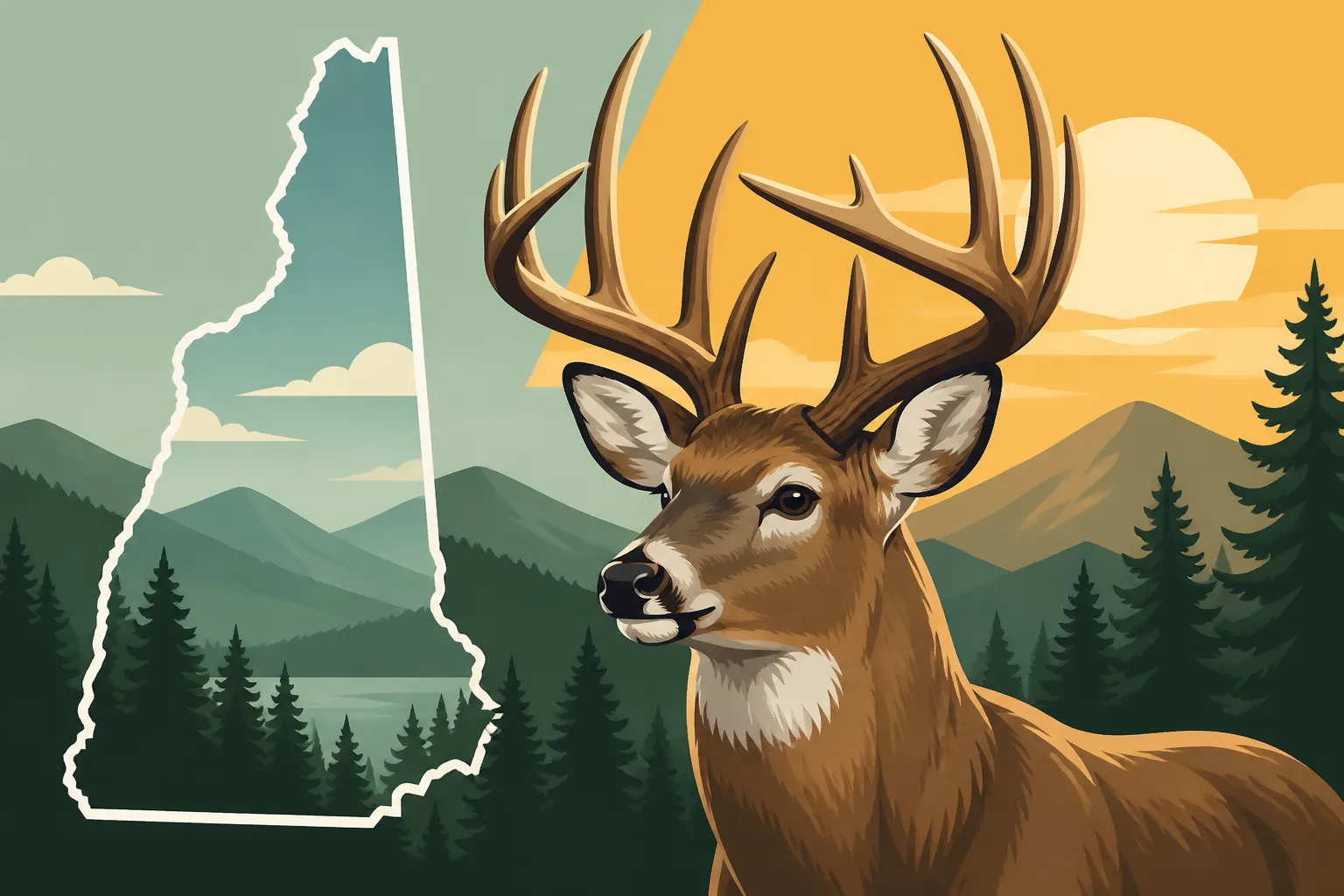
New Hampshire Boone and Crockett Whitetails
For many New Hampshire hunters, the dream of bagging a Boone and Crockett whitetail feels like something reserved for the big deer states out west or in the Midwest. It’s a common frustration to see those monster racks gracing magazine covers and wonder if such a creature even exists in our granite state, let alone if you'll ever cross paths with one. This guide isn't here to promise you a record breaker, but it will pull back the curtain on what it really takes to pursue a New Hampshire Boone and Crockett buck, explaining the factors at play and offering realistic strategies to increase your odds against all expectations.
Understanding New Hampshire's Whitetail Potential for Record Books
Let's be honest, New Hampshire isn't generally touted as a Boone and Crockett hotbed. You won't find the same statewide high densities of massive-antlered deer as you might in, say, Iowa or Kansas. This often leaves hunters feeling a bit deflated, thinking our deer simply don't have the "juice" to grow truly giant racks. But that's not entirely true; the potential is here, albeit in smaller, more scattered pockets, and it requires a different kind of dedication to find it.
Genetic Factors and Deer Nutrition
The foundation for any trophy-class buck lies in genetics. While we don't have specific data pointing to "super genes" in New Hampshire, the underlying genetic potential is certainly present in some of our deer. However, genetics are only part of the equation. What really allows that genetic potential to express itself fully is superior nutrition.
Think about it: a deer needs consistent, high-quality food sources year-round to build bone and body mass. This means a rich variety of mast crops like acorns and beechnuts, abundant natural browse, and in some localized areas, access to agricultural fields or managed food plots. In parts of New Hampshire, especially in the more rugged, forested areas, the natural browse can be less robust than in agriculturally rich regions elsewhere. This means our deer often expend more energy just surviving and maintaining, rather than dedicating excess resources to massive antler growth. Hunters often lament a poor acorn year, for example, knowing it directly impacts the deer's health and antler development. It’s a constant dance with nature’s larder. You might be surprised to learn more about the broader picture of White-Tailed Deer Across New Hampshire.
Age Class and Hunter Pressure
Perhaps the single most critical factor in a buck reaching Boone and Crockett status is age. A buck typically doesn't grow its largest antlers until it's 4.5, 5.5, or even 6.5 years old. The problem in many areas, including some parts of New Hampshire, is that hunter pressure often prevents bucks from reaching this mature age class. When a buck is harvested at 1.5 or 2.5 years old, he simply hasn't had the time to develop that big rack.
This isn't a criticism of hunters, mind you. Everyone has different goals, and putting meat in the freezer is a worthy one. But if your goal is a Boone and Crockett buck, you're essentially looking for a unicorn – a buck that has somehow evaded hunters, coyotes, and accidents for half a decade or more. This is particularly challenging on public lands or in areas with high hunting intensity. Finding those elusive pockets where older bucks can thrive, even if the overall New Hampshire Deer Population Estimate might not be as high as other states, becomes paramount.
Where to Look: Hotspots and Habitat Types
So, if New Hampshire isn't a "big buck state" in the traditional sense, where do you even begin to look for that elusive B&C caliber deer? It’s not about finding specific coordinates, but rather understanding the types of areas that are more likely to harbor older, bigger-antlered bucks. It's about searching for the exceptions, not the rule.
North Country Versus Southern New Hampshire Deer
When we talk about New Hampshire deer, it's really a tale of two regions. The deer in the North Country, particularly in the northernmost WMUs like A and B, tend to be physically larger, boasting impressive body weights. This is often attributed to the colder climate and deeper snow, which favors larger body size for survival. However, ironically, these same conditions often mean the deer expend more energy just existing, and the habitat, while vast and wild, might not consistently offer the nutritional bounty needed for top-tier antler growth. So, while you might find a massive-bodied buck, his rack might not match the scale of his frame.
Contrast that with the southern regions of the state – WMUs like I2, J2, K, and M. Here, you often find smaller-bodied deer overall, but in some specific pockets, the antler potential can actually be higher. Why? Because these areas often border suburban landscapes, scattered farmlands, or privately owned woodlots that might offer more consistent, high-energy food sources (like leftover agricultural crops, orchards, or even well-maintained private land food plots) and perhaps less hunting pressure in localized "sanctuaries." The challenge here is access and often lower overall deer densities, but the deer that do reach maturity often have better antler development. You can dive deeper into this comparison in our article on North Country Versus Southern New Hampshire Deer.
Key Habitat Features for Mature Bucks
Regardless of whether you're in the north or south, truly mature bucks, especially those with B&C potential, are masters of evasion. They seek out very specific types of habitat that provide maximum security, excellent food sources, and plenty of cover to escape detection.
Look for areas that are difficult to access or have natural barriers. This could be a dense, impenetrable cedar swamp in the middle of a larger forest block, a steep, rocky ravine, or thick clear-cuts that offer incredible bedding and browse but are a nightmare to navigate. These areas are often overlooked by casual hunters who stick to easily accessible logging roads or gentle terrain. Mature bucks will often bed in these areas during the day and only move out to more open feeding areas under the cover of darkness or during the peak of the rut. You might find them utilizing Hunting a Beaver Flowage Edge or hiding deep within a Hunting a Cedar Thicket for Late-Season Deer.
Also, seek out "edge" habitat where different cover types meet. A mature hardwood ridge transitioning into a dense softwood stand, or a field edge bordering a swamp, provides both food and security. Bucks use these transition zones as travel corridors. Areas with historical mast crops – old growth oak or apple orchards that haven't been heavily disturbed – are also goldmines during certain times of the year, especially if they are surrounded by heavy cover.
Strategies for Targeting Mature, Record-Book Bucks
Chasing a Boone and Crockett whitetail in New Hampshire isn't a passive endeavor. It demands a deliberate, year-round strategy that focuses on intelligence gathering, timing, and flawless execution. This isn't just "hunting"; it's a dedicated pursuit.
Extensive Scouting and Reconnaissance
This cannot be stressed enough: if you want a B&C buck in New Hampshire, you need to be scouting almost as much as you're hunting. Start immediately after the season closes, or even in late winter, to find shed antlers (which confirm a mature buck survived the season) and identify prime bedding and feeding areas before spring green-up obscures everything. Learn to read the landscape, understand prevailing winds, and identify pinch points and funnels that deer use for travel. Using tools like GoHunt mapping applications can be incredibly beneficial for this, allowing you to pour over satellite imagery, topo maps, and land ownership data to identify potential sanctuaries and travel routes. You need to become an expert on every inch of the property you intend to hunt. Our article on Scouting New Hampshire Public Land Before Season offers a great starting point for this crucial step.
Trail cameras are another invaluable tool. Place them strategically on suspected travel corridors, rub lines, or mock scrapes to identify specific bucks, understand their movement patterns, and estimate their age. Pay close attention to historical data from your cameras year after year. A buck you see as a 2.5-year-old might be the B&C contender in a few more seasons. But remember, adhere to all local regulations regarding trail camera use, especially on public land. Learning to use a Using a Ground Blind on Public Land or properly Hanging a Stand on a Granite Ridge all comes down to scouting and understanding movement.
Hunting the Rut and Beyond
Timing is everything when it comes to mature bucks. While they are incredibly elusive during much of the early and late season, the rut is when their guard drops significantly. Their singular focus shifts to breeding, making them more vulnerable to daylight movement and responsive to calling. Understanding When New Hampshire's Rut Peaks (generally early to mid-November) is critical. This is the window where you need to be in the woods as much as possible, focusing on travel corridors, pinch points, and areas where does congregate.
During the rut, bucks will often throw caution to the wind, traveling long distances in search of receptive does. This is when rattling antlers and grunting can be particularly effective, mimicking the sounds of rival bucks challenging for dominance. Our guide on Hunting the Rut in Early-to-Mid November provides more specific tactics.
After the rut, mature bucks revert to their elusive ways. However, the late season can offer another opportunity. With cold temperatures and dwindling food sources, deer become highly reliant on consistent, high-calorie food. If you've identified a prime late-season food source – be it a standing cornfield, an overlooked apple orchard, or a cut-over with abundant browse – and it's close to thick cover, you might find a mature buck hitting it regularly. This is a cold, patient game, often requiring long sits, but it can pay off.
Patience, Persistence, and Precision
Let's be realistic: finding and harvesting a Boone and Crockett buck in New Hampshire is a monumental challenge. It requires immense patience and persistence. You might spend years hunting the same property, seeing countless deer, but never that truly enormous one. You might pass up numerous smaller bucks, holding out for the ghost you know is there. It’s a mental game as much as a physical one.
Once you do get an opportunity, precision is paramount. A record-book buck often offers only a fleeting window for a shot. That means knowing your weapon intimately, practicing relentlessly, and being able to make an ethical, clean shot under pressure. You won't get a second chance with a buck of this caliber. Ensure your gear is in top condition, from your rifle to your optics. And remember, New Hampshire proudly maintains its New Hampshire's CWD-Free Deer Herd, so responsible hunting practices are always important.
The Boone and Crockett Score and Requirements
So you've done the work, put in the time, and you've found a buck that looks like he could make the book. What does that actually mean? The Boone and Crockett Club has a very specific scoring system, and understanding it is key to appreciating the achievement.
Minimum Scores and Typical vs. Nontypical
The Boone and Crockett Club has different minimum scores for typical and nontypical whitetail deer.
- Typical Whitetail Deer: For a minimum entry score into the All-time Records (the Boone and Crockett Club's highest recognition), a typical whitetail needs to score 170 inches. For Awards recognition (which are regional achievements), the minimum is 160 inches. A "typical" rack is one that is largely symmetrical, with points growing off the main beams in a standard fashion.
- Nontypical Whitetail Deer: Nontypical bucks have abnormal points (drop tines, kickers, stickers) that diverge from the standard antler configuration. These are scored differently, with the abnormal points adding to the total. The minimum entry score for All-time Records is 195 inches, and for Awards, it's 185 inches.
The scoring process measures various aspects of the antlers: beam length, circumferences at specific points, length of each point, and inside spread. Deductions are made for asymmetry in typical racks. It's a precise, objective system.
Official Measurers and Entry Process
If you believe you have a potential Boone and Crockett animal, the first step is usually to wait the mandatory 60-day drying period after harvest. This allows the antlers to fully shrink and settle, preventing an inflated green score. After this period, you would need to contact an official Boone and Crockett Club measurer. These individuals are certified to accurately measure and score trophies according to the club's strict guidelines. You can often find a list of official measurers through the Boone and Crockett Club's website. They will conduct the official measurement, and if the score meets the minimum requirements, they can guide you through the formal entry process, which includes paperwork and sometimes a panel scoring for very large animals. It’s a painstaking process, but the recognition is a testament to the animal and the hunter's dedication.
Table: Key Factors Influencing Antler Growth & Record Book Potential
| Factor | Impact on Antler Growth | Relevance to New Hampshire Hunting |
|---|---|---|
| Age of the Buck | Most critical factor; antlers peak at 4.5-6.5 years. | High hunter pressure often limits bucks reaching full maturity. |
| Genetics | Determines potential for antler size, mass, and symmetry. | Present in New Hampshire, but not as concentrated as "big buck" states. |
| Nutrition | Consistent access to high-quality food (mast, browse, crops). | Variable across NH; better in mixed habitat or agricultural fringes. |
| Health | Absence of disease or injury; overall physical condition. | Generally good in NH, New Hampshire's CWD Testing Program ensures vigilance. |
| Hunter Pressure | High pressure reduces age class; low pressure allows growth. | Significant challenge on public land; pockets of low pressure exist. |
| Habitat Quality | Provides food, water, and security cover. | Diverse in NH; seek out dense, inaccessible sanctuary areas. |
Disclaimer
This article is for general informational purposes only and does not constitute professional advice. Laws, prices and regulations vary by location and change over time. Consult a qualified professional for guidance on your specific situation.