New Hampshire Fisher Diet and Range
The deep, dark woods of New Hampshire hold many secrets, and perhaps none are as shrouded in mystery for the casual observer as the fisher. Many folks only ever catch a fleeting glimpse of this elusive creature, a darting shadow crossing a logging road, or maybe a set of tracks etched into fresh snow. This lack of direct observation can leave people wondering about this often-misunderstood forest dweller. If you've ever heard tales of their ferocity or wondered how they thrive in our rugged landscape, you're in the right place. This guide is dedicated to pulling back the veil on the New Hampshire fisher, delving deep into its fascinating diet and the expansive range it calls home across our great state.
The Elusive Shadow of the Forest: What is a New Hampshire Fisher?
When you hear "fisher," your mind might conjure images of some kind of aquatic cat, perhaps pouncing on fish in a stream. But that couldn't be further from the truth! The fisher, Pekania pennanti, is actually a large member of the weasel family, more closely related to mink and martens than to any feline. They're often called "fisher cats," a misnomer that probably stuck due to their cat-like agility and ferocity, but they rarely, if ever, eat fish. These are creatures of the deep woods, highly adapted to navigating dense forest environments, and they are incredibly efficient predators.
Physically, fishers are truly striking animals. They possess a long, slender body, powerful short legs, and a magnificent, bushy tail that can be nearly as long as their body. Their fur is dense and dark, ranging from deep brown to almost black, often with a grizzled appearance on the head and shoulders, especially in older males. Males are significantly larger than females, sometimes weighing up to 12-15 pounds, while females typically top out around 6-8 pounds. Their paws are broad, equipped with retractable claws, perfect for climbing trees and moving silently through the underbrush. If you've ever seen tracks in the snow, you might notice their distinctive five-toed pattern, often with claw marks, and they have a unique bounding gait that creates paired tracks. New Hampshire Small Game and Furbearers are a vital part of our ecosystem, and the fisher stands out among them for its stealth and predatory prowess.
For much of the 20th century, fishers faced significant challenges in New Hampshire. Over-trapping and extensive deforestation in earlier eras led to dramatic declines in their populations, even to the point of near extirpation in some areas. However, thanks to dedicated conservation efforts, including reintroduction programs and thoughtful management of trapping seasons, these resilient furbearers have made a remarkable comeback. Their recovery is a testament to the adaptability of wildlife and the importance of responsible stewardship. Today, while still elusive, fishers are once again a vital component of New Hampshire's forest ecosystem, playing a crucial role in maintaining ecological balance. Their presence speaks to the health of our woodlands.
A Hunter's Table: The Diverse Diet of the New Hampshire Fisher
The diet of a New Hampshire fisher is nothing short of fascinating, showcasing their incredible adaptability and predatory skill. They are often described as opportunistic predators, meaning they'll take advantage of whatever food source is most readily available, but they do have some preferred meals that highlight their unique hunting strategies. What truly sets them apart from most other predators in our woods is their specialization in hunting porcupines, a feat few other animals attempt.
Primary Prey: The Forest's Abundant Meals
The two mainstays of a fisher's diet in New Hampshire's forests are the snowshoe hare and the porcupine.
- Snowshoe Hare: These quick, camouflaged mammals are a prime food source, especially in the thick coniferous and mixed forests where both species thrive. Fishers are incredibly agile, capable of chasing hares through dense cover and even up trees. Their speed and relentless pursuit make them formidable hare hunters. If you're out Running Beagles on a New Hampshire Snowshoe Hare, you're seeing firsthand the kind of habitat both share.
- Porcupine: This is where the fisher truly earns its reputation. While most predators avoid the porcupine's prickly defense, the fisher has developed a specialized hunting technique. They repeatedly attack the porcupine's face, a quilled-free zone, eventually incapacitating and killing it. They then flip the porcupine over to access its vulnerable, quill-free belly. This unique skill makes fishers one of the few natural predators that can effectively control porcupine populations, which can sometimes be detrimental to forest health when unchecked.
Beyond these two, squirrels (red squirrels, gray squirrels, flying squirrels) are also a significant part of their diet, especially during times of high squirrel populations and mast crop availability. Fishers are excellent climbers and will readily pursue squirrels through the canopy.
Secondary & Opportunistic Sources: Making the Most of What's Available
While hares and porcupines might be their favorites, fishers are far from picky eaters. Their menu expands to include a wide array of other forest creatures and food sources:
- Small Mammals: Mice, voles, shrews, and chipmunks are regularly consumed, providing a consistent source of calories. They are adept at sniffing out and digging up these burrowing creatures, especially when snow cover is light.
- Birds and Eggs: Ground-nesting birds, their eggs, and nestlings are vulnerable to a hungry fisher, particularly in the spring and summer. They will also opportunistically catch adult birds if the chance arises.
- Carrion: Fishers are not above scavenging. They will readily feed on the carcasses of deer, moose, or other animals they discover, especially during the lean winter months. This makes them an important part of the clean-up crew in the forest. You might find them on a deer carcass after you've been Tracking a Deer in Fresh White Mountain Snow.
- Insects, Berries, and Fruits: While primarily carnivores, fishers will supplement their diet with insects, berries, and wild fruits when they are ripe and abundant in warmer months. This dietary flexibility ensures their survival even when primary prey populations fluctuate.
This diverse diet demonstrates the fisher's resilience and its crucial role as a generalist predator within New Hampshire's complex forest ecosystem. Their presence helps regulate populations of various small mammals and even provides a natural check on porcupines, making them an invaluable part of our wild landscape.
Mapping the Territory: Where New Hampshire Fishers Roam
Understanding the diet of the New Hampshire fisher naturally leads to the question: where exactly do these adaptable predators live and hunt across our state? Their range is closely tied to the availability of their preferred habitat and prey, and their story in New Hampshire is one of remarkable recovery and expansion.
Preferred Habitat: Dense Forests and Secure Cover
Fishers are true forest dwellers. They thrive in extensive, unfragmented tracts of mature coniferous and mixed forests, though they will use deciduous areas if good cover is present. Key habitat features include:
- Dense Canopy Cover: They prefer areas with dense tree cover that offers protection from aerial predators and deep snow. This is crucial for their survival and for stalking prey.
- Thick Undergrowth: Areas with a rich understory of shrubs, young trees, and downed logs provide excellent concealment and hunting opportunities for small mammals.
- Hollow Trees and Logs: Fishers use hollow trees, logs, rock crevices, and abandoned burrows for denning, especially for raising their young. These secure, secluded spots are vital for their reproductive success.
- Proximity to Water: While they don't primarily eat fish, many of their prey species, like snowshoe hares and some small game, thrive near wetlands, beaver flowages, or riparian zones. Hunting near a Beaver Flowage Edge could put you in prime fisher territory.
Forest connectivity is also incredibly important. Fishers need to be able to move freely between different patches of suitable habitat without encountering too many human-dominated landscapes that can pose threats or reduce hunting opportunities.
Geographic Range in New Hampshire: A Story of Comeback
Historically, fishers were found throughout New Hampshire's forested regions. However, as mentioned, habitat loss and trapping pressures severely restricted their distribution. Today, thanks to extensive conservation efforts, fishers have successfully recolonized much of their former range.
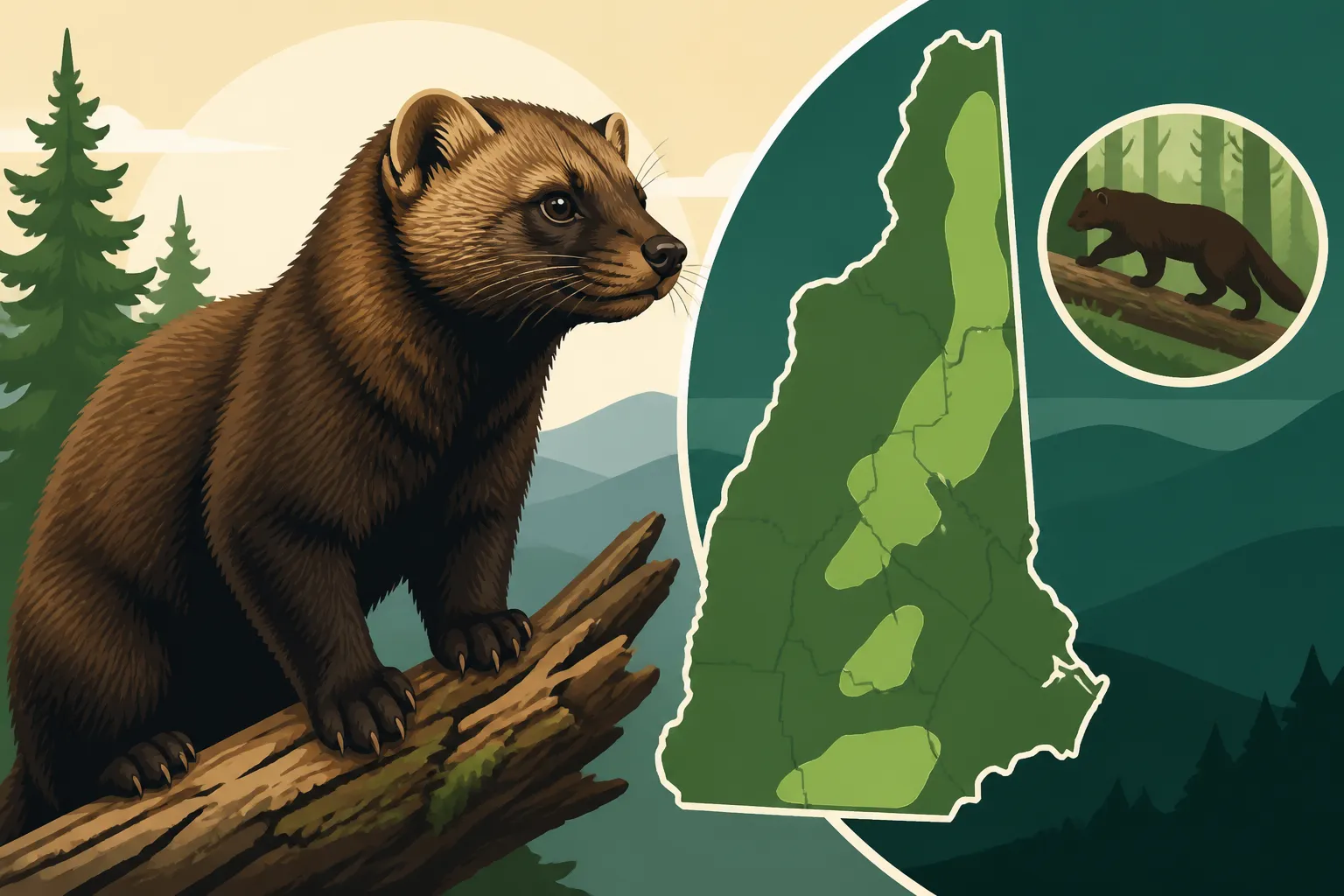
- Widespread Presence: You can now find fishers across most of New Hampshire's forested counties, from the deep woods of the North Country down into the more fragmented but still wilder parts of the southern tier.
- Concentrated in Forested Regions: While widespread, their populations tend to be densest in the extensive forest blocks of central and northern New Hampshire, particularly within and around areas like the White Mountain National Forest and other large state and private timberlands. Here, the continuous forest provides ample habitat and prey.
- Expansion into Southern New Hampshire: As populations have grown, fishers have expanded into more suburban-adjacent woodlands. While these areas might be more fragmented, if there's enough contiguous forest and prey, fishers will establish territories. This is why residents in more developed areas sometimes report sightings, though they are often still fleeting.
Factors influencing their local distribution include the density of their primary prey species, forest age and composition, and the presence of human development. Tools like GoHunt can be incredibly useful for both hunters and conservationists in understanding and visualizing these factors. For instance, using a robust mapping platform like GoHunt can help you identify critical habitat components such as dense softwood stands or areas with abundant downed timber, which are prime locations for fisher activity. Hunters or trappers looking to understand fisher movements might leverage tools like GoHunt to analyze forest density and topographical features to predict where these elusive animals might travel or set up a territory.
Understanding their range and habitat preferences is key not only for wildlife enthusiasts but also for anyone living or recreating in New Hampshire's wild spaces. Their successful return is a true conservation success story, showcasing the resilience of nature when given a chance.
| Season | Key Habitat Usage | Movement Patterns (General) |
|---|---|---|
| Winter | Dense coniferous/mixed forests, secure den sites | Focused on optimal hunting areas, less travel |
| Spring | Den sites for kits (female), diverse hunting | Increased range for males, females localized |
| Summer | Mixed forests, areas with berries/fruit, ample cover | Wider foraging, opportunistic |
| Fall | Hardwoods for mast crops, dense thickets for prey | More active, covering larger territories |
Coexistence and Conservation: Living Alongside New Hampshire's Fishers
The successful comeback of the fisher in New Hampshire is a source of pride for wildlife enthusiasts, but it also means learning to coexist with a powerful and sometimes surprising neighbor. Understanding their ecological role and how to minimize potential conflicts is essential for maintaining healthy populations of fishers and a balanced ecosystem.
Ecological Role: Nature's Balance Keepers
Fishers play a crucial role as mesopredators within the New Hampshire ecosystem. They are not at the very top of the food chain like a wolf or mountain lion (which, for the record, we don't have here!), but they are incredibly effective hunters of smaller prey.
- Prey Population Control: By preying on snowshoe hares, squirrels, and especially porcupines, fishers help regulate these populations, preventing overbrowsing of vegetation and reducing the spread of diseases. A healthy fisher population contributes to overall forest health.
- Scavenging: Their willingness to consume carrion means they also act as natural clean-up crews, recycling nutrients back into the ecosystem and helping to prevent the spread of disease from decaying animals.
- Biodiversity: The presence of a healthy, diverse predator community, including fishers, indicates a robust and resilient ecosystem. It's a sign that the various trophic levels are functioning well.
Their interactions with other predators, such as coyotes or bobcats, are often about resource partitioning and avoidance, though occasional competitive encounters can occur. Fishers tend to be more arboreal and specialized in denser cover than coyotes, allowing them to carve out their niche.
Furbearer Status and Management
Fishers are classified as furbearers in New Hampshire, and a regulated trapping season helps manage their populations. This management is carefully designed by New Hampshire Fish and Game to ensure sustainable populations while providing opportunities for trappers. The trapping season is usually set to coincide with the best fur quality and to avoid the critical denning periods. Trapping New Hampshire Furbearers is a practice that dates back centuries, but today it's much more science-driven to ensure animal welfare and population stability. Detailed rules regarding traps, reporting, and season dates are published annually in the state's hunting and trapping digest. Hunters, whether they're after deer, bear, or furbearers like the fisher, understanding the landscape is key, and services like GoHunt offer invaluable insights into public and private land boundaries, as well as habitat types, which can be critical for legal and ethical trapping.
Avoiding Conflicts: Living Safely with Fishers
As fishers expand their range, they sometimes venture closer to human habitation. While naturally shy and primarily nocturnal, understanding a few key things can help prevent conflicts:
- Protect Pets: Small cats and dogs left unattended outside, especially at night, can be vulnerable to any predator, including fishers, coyotes, or even larger raptors. Keeping pets supervised, leashed, or indoors, especially from dusk till dawn, is the best defense. A secure, covered kennel or run is also effective.
- Secure Food Sources: Like bears and coyotes, fishers are attracted to easy meals. Secure your garbage in robust, animal-proof containers. Avoid leaving pet food, birdseed, or other potential attractants out overnight. Even compost piles can draw in curious wildlife.
- Chicken Coops and Livestock: If you have backyard chickens or other small livestock, ensure their enclosures are predator-proof. Fishers are incredibly adept at finding weaknesses, so sturdy wire mesh, secure latches, and digging barriers are essential. They can squeeze through surprisingly small openings.
- Respect Their Space: If you're lucky enough to see a fisher in the wild, admire it from a distance. Never approach or try to feed wild animals. Their natural fear of humans is important for both their safety and ours.
The return of the New Hampshire fisher is a success story, highlighting the state's healthy forest ecosystems. By respecting their role in nature, adhering to sound wildlife management practices, and taking simple precautions around our homes, we can continue to share the granite state with these captivating and vital forest residents.
Disclaimer
This article is for general informational purposes only and does not constitute professional advice. Laws, prices and regulations vary by location and change over time. Consult a qualified professional for guidance on your specific situation.