New Hampshire’s Fall Turkey WMU List
It’s a truly frustrating experience to pour over the New Hampshire hunting digest, flipping page after page, trying to pinpoint exactly where you can chase fall turkeys. The regulations can feel like a tangled web, especially when you’re just trying to figure out which Wildlife Management Units (WMUs) are open for fall gobblers and jakes. This guide is here to untangle that web, clearly laying out New Hampshire's fall turkey WMU list, so you can plan your autumn hunt with confidence and avoid any unwelcome surprises.
Understanding New Hampshire's WMU System for Fall Turkey Hunting
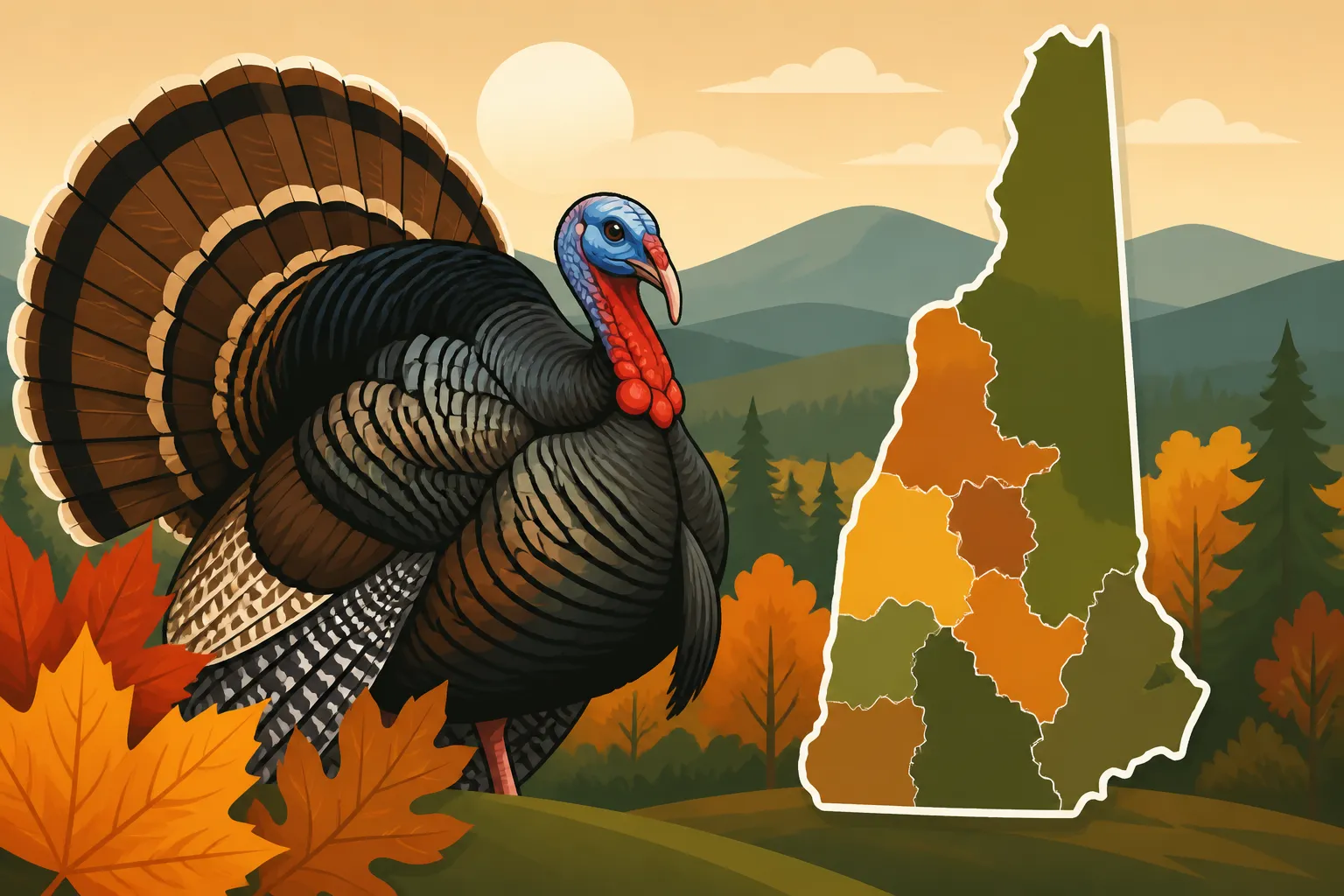
New Hampshire, like many states, divides its hunting landscape into specific Wildlife Management Units (WMUs). These aren't just arbitrary lines on a map; they're carefully drawn boundaries that allow the New Hampshire Fish and Game Department to manage game populations, including wild turkeys, on a more localized level. What might be perfectly legal and abundant in one WMU could be completely restricted or scarce in another, and this is especially true when it comes to fall turkey hunting.
Why WMUs Matter for Turkey Hunters
For turkey hunters, particularly in the fall, understanding the WMU system isn't just a suggestion—it's absolutely critical. The rules for hunting wild turkeys in New Hampshire can vary significantly depending on which WMU you find yourself in. This includes everything from whether a fall season is even open, to specific dates, and even bag limits. Imagine driving hours, scouting for weeks, only to realize the area you've chosen is closed for fall turkey hunting. It's a disheartening scenario that many hunters have inadvertently faced, often due to a slight misunderstanding of these crucial boundaries. These WMU designations allow Fish and Game to respond to local population dynamics, habitat conditions, and harvest goals. For example, a WMU with a booming turkey population might have a more liberal season, while another experiencing declines or recovering from environmental stressors might be closed entirely to ensure the flock's health and future sustainability.
How to Find Your WMU and its Boundaries
Pinpointing your exact WMU can sometimes feel like a treasure hunt, but with modern tools, it's more accessible than ever. The official New Hampshire Fish and Game website is always your first and best resource. They provide interactive maps that allow you to zoom in and identify WMU boundaries with relative precision. Additionally, the annual hunting digest contains static maps, though these can be less detailed for specific property lines. For hunters who want to be absolutely sure where they stand, GPS mapping applications like GoHunt are invaluable. These apps layer WMU boundaries over detailed topographic maps, often showing public and private land ownership as well. This means you can be standing in the woods, pull out your phone, and instantly know which WMU you're in, right down to the foot. It saves a tremendous amount of stress and ensures you're always hunting within the correct regulatory framework. Before heading out, especially if you're exploring a new area, take the time to mark your intended hunting spots on one of these maps to confirm the WMU. This foresight can prevent any potential legal issues or wasted hunting efforts.
Navigating the Annual Digest for Fall Turkey Rules
The annual New Hampshire hunting digest is the bible for all hunters, but let's be honest, it can be a bit intimidating. It’s packed with information, often presented in a dry, legalistic fashion that can be hard to parse, especially for specific seasons like fall turkey. When looking for fall turkey rules, don't just skim. Look for the "Turkey Hunting" section, and then specifically seek out the "Fall Season" subsection. Pay close attention to tables or lists that explicitly detail WMUs and their corresponding regulations. The key is to cross-reference the WMU you're interested in with the dates and rules listed for that specific unit. Don't assume that if one WMU is open, its neighbor automatically is too. Often, there will be a table clearly indicating which WMUs are open for fall turkey and which are closed or have specific nuances. Remember, these regulations can change year to year, so always check the current year's digest, not one you might have saved from a previous season. A quick read through the "General Turkey Hunting Rules" also helps ensure you're up to date on tagging, reporting, and other statewide requirements, even if you’re just trying to confirm New Hampshire Turkey Season Rules.
The Specific WMUs Open for Fall Turkey Season
New Hampshire doesn't offer a statewide fall turkey season. Instead, it's a carefully managed, WMU-specific affair. This means that hunters need to be hyper-aware of their location to ensure they are hunting legally. This localized approach allows the state to maintain healthy turkey populations, focusing conservation efforts where they are most needed and allowing hunting pressure in areas that can sustain it. For the most part, the southern and central parts of the state tend to have more robust fall seasons, while the more sparsely populated and colder northern WMUs are often closed.
A Deep Dive into WMU Regulations
Currently, for the fall turkey season, most of the southern and central WMUs are open. These generally include WMUs such as G, H1, H2, I1, I2, J1, J2, K, L, and M. Each of these WMUs has a specific fall season length, usually a designated "shotgun-only" week and an extended "archery-only" period. For example, a WMU like H1, which encompasses parts of the Merrimack Valley, will have a different set of dates than, say, WMU J2, which stretches down towards the seacoast. It’s imperative to consult the official Fish and Game digest for the exact dates for each WMU annually, as they can shift slightly. This granular control is a testament to New Hampshire's commitment to sustainable wildlife management. While the dates are specific, the general idea is to provide opportunities where turkey populations are strong and resilient, often in areas with better food sources and milder winters compared to the higher elevations or deeper North Country. Understanding these specific regulations ensures you're fully compliant, particularly when planning to Hunting the Shotgun-Only Fall Turkey Week.
Understanding Bag Limits and Weapon Restrictions by WMU
The bag limit for New Hampshire's fall turkey season is typically one bird of either sex, except for specific periods in some WMUs where it might be male only or even antlerless for deer overlap, though the latter is more specific to deer hunting. However, the most significant restriction often revolves around legal weapons. Historically, New Hampshire's fall turkey season has featured an "archery-only" period, sometimes followed by a shorter "shotgun-only" period. This means you can't just grab your scattergun and head out for the entire season. You absolutely must know which weapon is legal for which dates within your chosen WMU. Crossbows are also legal during the archery-only season in these open WMUs. This staggered weapon legality is another tool for managing harvest rates and providing different hunting experiences. Always double-check the current digest to confirm if your WMU allows both archery and shotgun, and for what specific dates. These regulations are designed to spread out hunting pressure and provide diverse opportunities while still managing the overall turkey harvest. You can learn more about general permit rules in New Hampshire Fall Turkey Permit Rules.
Prime Fall Turkey Habitat Across Open WMUs
Turkeys in the fall have shifted from the breeding behaviors of spring to a more nomadic, food-seeking existence. This means their prime habitat changes. In the open WMUs, you'll want to focus your scouting on areas rich in mast crops—acorns, beechnuts, and even wild apples are huge attractants. Look for mature hardwood stands, especially oaks, and areas near agricultural fields, particularly those with leftover corn or other grains. Water sources are always important, as are areas with diverse cover, from mature timber for roosting to dense brush for loafing and escape.
For instance, in WMU H2, characterized by its ridge country terrain, turkeys might be found feeding on acorns in the higher elevations and then moving down into creek bottoms for water. In the more agricultural WMUs like I1 (Merrimack Valley) or J1 (Seacoast approach), you might find flocks concentrated near cornfields or even suburban edges. The key is to observe food sources. If the acorn crop is poor in one area, turkeys will travel to find better foraging. Utilizing resources like GoHunt or other land mapping apps can help identify these prime habitat features, allowing you to focus your scouting efforts before the season even begins, dramatically increasing your chances of success.
Here's a quick summary table of WMUs typically open for New Hampshire's Fall Turkey Season:
| WMU | General Location (Approx.) | Fall Season Status (Typical) | Legal Weapons (Typical) | Bag Limit (Typical) | Notes |
|---|---|---|---|---|---|
| G | Southwest Hill Country | Open | Archery & Shotgun | 1 Bird (Either Sex) | Consult specific dates in digest |
| H1 | Farmland (South Central) | Open | Archery & Shotgun | 1 Bird (Either Sex) | Archery usually longer than shotgun |
| H2 | Ridge Country (South Central) | Open | Archery & Shotgun | 1 Bird (Either Sex) | Focus on mast crop availability |
| I1 | Merrimack Valley | Open | Archery & Shotgun | 1 Bird (Either Sex) | Often good agricultural food sources |
| I2 | Suburban Fringe (South Central) | Open | Archery & Shotgun | 1 Bird (Either Sex) | Proximity to human development |
| J1 | Seacoast Approach | Open | Archery & Shotgun | 1 Bird (Either Sex) | Mix of hardwoods and coastal influence |
| J2 | Coastal Plain | Open | Archery & Shotgun | 1 Bird (Either Sex) | Watch for private land access |
| K | Southern Tier | Open | Archery & Shotgun | 1 Bird (Either Sex) | Dense turkey populations |
| L | Border Country (Southeast) | Open | Archery & Shotgun | 1 Bird (Either Sex) | Mix of habitat types |
| M | Far Southeast | Open | Archery & Shotgun | 1 Bird (Either Sex) | Highest turkey densities often found here |
Note: This table represents typical regulations. Always refer to the most current New Hampshire Fish and Game Hunting Digest for precise dates and rules.
WMUs with No Fall Turkey Season: What You Need to Know
While many WMUs in New Hampshire offer a fall turkey season, it's just as important, if not more so, to know which ones do not. Heading into a closed WMU with your turkey vest and calls is not only a waste of time but a serious violation of hunting regulations. This can be especially frustrating if you’re used to hunting deer or other species in a particular WMU, and then find out the turkey rules are different.
Identifying Closed WMUs
Generally, the northern WMUs of New Hampshire—those characterized by extensive logging operations, vast tracts of White Mountain National Forest, and harsher winter conditions—are closed to fall turkey hunting. These typically include WMUs A, B, C, D1, D2, E, and F. If you're planning a hunt in the North Country for species like moose or bear, don't assume you can double-dip for turkeys in the fall. It's a common misconception, especially for those who primarily hunt deer throughout the entire state. A quick check of the digest or a mapping app like GoHunt will confirm these closures, ensuring you don't inadvertently break the rules. This is where cross-referencing becomes indispensable; never rely on memory alone when it comes to specific season regulations.
Reasons for Fall Season Closures
The reasons behind these closures are rooted in sound wildlife management principles. Northern New Hampshire, while beautiful, presents significant challenges for wild turkey populations. Historically, turkeys struggled to thrive in these colder, snowier regions. While restoration efforts have been successful in expanding their range, populations in the far north are generally less dense and more vulnerable to severe winters. Deep snow and prolonged cold can make foraging difficult, leading to higher mortality rates.
Closing these WMUs to fall hunting helps protect these recovering or more fragile populations, allowing them to continue to grow and expand without additional pressure. New Hampshire Turkey Population Trends indicates that while overall numbers are healthy, regional variations exist. Fish and Game uses these WMU closures to ensure that the turkey population remains robust enough to withstand natural stressors and maintain a healthy breeding base for future generations. It’s a conservation measure designed to ensure the long-term sustainability of the species in those areas.
Hunting Other Game in Closed WMUs
Just because a WMU is closed for fall turkey doesn't mean it's closed for everything else! Many of these northern WMUs offer fantastic opportunities for other game species during the fall. For example, WMUs A and B in the North Country are renowned for their moose hunting, and the White Mountain National Forest, which spans several northern WMUs, offers incredible challenges for deer hunters willing to put in the work in rugged terrain.
You might be heading to WMU C or E to chase ruffed grouse or snowshoe hare. The rules for deer hunting, bear hunting, or small game hunting are entirely separate from turkey regulations. So, while your turkey calls might need to stay in the truck, you can still enjoy a productive fall hunt for other species. Always check the specific regulations for the game animal you are pursuing in that particular WMU. For instance, if you're venturing into the North Country, you might be focused on Moose Hunting New Hampshire's North Country or Bear Hunting New Hampshire's Bait and Hound Season, both of which have their own distinct seasons and rules.
Key Differences: Spring vs. Fall Turkey Regulations in New Hampshire
Hunting New Hampshire turkeys in the fall is a distinctly different endeavor than the spring season, not just in terms of turkey behavior but also in the regulations governing the hunt. Many hunters who are familiar with the spring gobbler season often assume the fall rules are similar, and that's a mistake that can lead to frustration or, worse, a violation. It’s important to understand these nuances to avoid any confusion and ensure a successful, legal hunt.
Changes in Legal Hunting Methods
One of the most significant differences between spring and fall turkey hunting in New Hampshire lies in the legal methods and equipment. In the spring, shotgun and archery (including crossbows) are broadly legal statewide for gobblers. However, the fall season often has specific periods where only archery equipment is permitted, followed by a shorter window where shotguns may also be used in certain open WMUs. This means if you head out with your favorite 12-gauge during an archery-only period, you're breaking the law.
The rationale for this often comes down to population management and hunting pressure. An archery-only season can offer a longer hunting window with generally lower harvest rates, while a shorter shotgun season allows for a more focused harvest in areas that can sustain it. For those new to archery or crossbows for turkey, it’s a good idea to spend some time practicing. Consider reviewing Crossbow Hunting New Hampshire's Twelve WMUs if you're thinking of using one in the fall archery season, as specific units allow them. This also highlights the importance of checking the current digest annually; never assume last year's weapon regulations are identical to this year's.
Bag Limits and Bird Selection in Fall
The bag limit is another crucial distinction. In the spring, hunters are generally permitted to take up to two bearded turkeys (gobblers). This often allows for hunting during two distinct periods or taking two birds within a single period, depending on the WMU. In the fall, however, the bag limit is typically restricted to one bird of either sex. This "either sex" rule is a major departure from the spring and dramatically changes your hunting strategy.
The ability to harvest a hen or a jake (young male) opens up different tactical opportunities, as fall flocks often consist of mixed hens, jakes, and sometimes mature gobblers grouped together. This is a critical factor for managing turkey populations; by allowing harvest of hens in the fall, it helps to manage the overall population growth, which is often robust in the southern WMUs. It’s important to remember that even though you can take an "either sex" bird, you still only get one. Don't let the excitement of a full flock tempt you into exceeding your legal limit.
Understanding Tagging and Reporting Differences
While the general principles of tagging and reporting remain consistent—you must tag your bird immediately after harvest and report it—there can be subtle differences in the details between spring and fall. For instance, the timing of when online registration portals are active might differ slightly, or there might be specific instructions for fall birds versus spring birds. Always ensure you are using the correct tag (if provided with separate spring/fall tags) and following the reporting instructions for the current fall season.
New Hampshire Fish and Game has made reporting easier with their online system and mobile app, but it's crucial to understand the deadlines. While there isn't usually an "in-person registration blackout" like there can be for deer, it’s still important to report your bird swiftly. Accurate reporting helps Fish and Game gather crucial data on New Hampshire Turkey Harvest Numbers by WMU, which in turn informs future season structures and bag limits. Always carry a pen and your license/permit to ensure you can fill out your tag accurately at the moment of harvest.
Planning Your Fall Turkey Hunt: Tactics and Considerations by WMU
Fall turkey hunting is a beast all its own. Gone are the booming gobblers on the roost and the intense calling duels of spring. Autumn turkeys are focused on survival: finding food, staying safe, and maintaining their flock structure. This means your approach, from scouting to calling to gear, needs to adapt significantly from what you might be used to in May.
Scouting Strategies for Fall Flocks
Scouting for fall turkeys is primarily about locating food sources and fresh sign. Forget listening for gobbling; in fall, you're looking for tracks, droppings, scratchings in the leaves, and most importantly, actual turkeys. Start by identifying areas with abundant mast crops. Hardwood ridges loaded with acorns or beechnuts are gold. Also, focus on agricultural fields, especially cut cornfields, where turkeys will feed on leftover grain. Rivers and creek bottoms are also key, as turkeys need water and often travel these corridors.
Utilize tools like GoHunt's mapping features to identify these habitat types before you even set foot in the woods. Pay attention to transition zones—where hardwoods meet softwoods, or where a field meets a thick woodlot. Turkeys will often travel these edges. Spend time driving quiet roads at dawn and dusk, glassing fields for feeding birds. Once you locate a flock, observe their patterns: where do they feed, where do they water, and where do they roost? This intelligence is far more valuable than trying to call a lonely gobbler in the spring. You can get more insights on Scouting New Hampshire Public Land Before Season.
Calling Techniques for Autumn Birds
Calling in the fall is less about seductive hen yelps and more about mimicking the sounds of a lost bird trying to rejoin its flock, or a flock communicating as they feed. The most effective fall tactic involves breaking up a flock. If you can get into a group of turkeys and scatter them, they will naturally want to regroup. Immediately after the flush, find a spot to set up and start making a series of excited "kee-kee" or "kee-kee run" calls, which imitate young birds trying to find their way back. Soft clucks and purrs, mimicking feeding birds, can also be effective to draw in wary birds.
Often, it's the jakes and younger hens that respond first. Mature gobblers might take longer or come in silently, so patience is key. Avoid aggressive calling unless you know you're dealing with a dominant bird that you've observed. The goal is to sound like another turkey, or several turkeys, that the scattered birds want to join. If you’re hunting in a particularly open WMU like I1 or J2, use your terrain to your advantage to hide your approach after the flush, then settle in quickly. Understanding how to effectively Breaking Up a Fall Turkey Flock is paramount to fall turkey success.
Gear Considerations for Cooler Weather
New Hampshire's fall weather can be notoriously unpredictable, swinging from mild, sunny days to cold, damp, and even snowy conditions. Layering is your best friend. Start with a moisture-wicking base layer, add insulating layers (fleece or synthetic down), and top it with a waterproof/windproof outer shell. Early season might just require light camo, but as you get into November, you’ll want serious insulation, a warm hat, and gloves. Don't forget your blaze orange if you're hunting during the firearms deer season overlap (check regulations carefully!).
Footwear is also critical. Good waterproof, insulated boots are a must, especially if you’re traversing dewy fields or wet forest floors. A good backpack for carrying extra layers, water, snacks, and your game bag is also essential. Since you're often covering more ground in the fall, a comfortable pack is important. And, of course, your chosen weapon – whether it's your bow, crossbow, or shotgun – needs to be sighted in and ready for action. Having reliable gear means you can stay out longer and focus on the hunt, rather than battling the elements.
Disclaimer
The information provided in this guide is for general informational purposes only and is subject to change. Hunting regulations, WMU boundaries, season dates, and bag limits are determined by the New Hampshire Fish and Game Department and can be updated annually. It is the sole responsibility of the hunter to consult and comply with the most current official New Hampshire Hunting and Trapping Digest and all applicable state and federal laws before engaging in any hunting activities. Failure to do so may result in legal penalties.