New Hampshire Turkey Population Trends
It's disheartening, isn't it, when you head out to your favorite turkey woods and don't hear as many gobblers as you used to, or perhaps you're just not seeing the numbers of birds scratching through the leaves that you remember? Many hunters worry about the long-term health of our wild turkey flocks here in the Granite State. This comprehensive guide is dedicated to shedding light on the historical journey, current status, and future outlook of New Hampshire's wild turkey populations, offering a deep dive into the trends that shape our seasons.
The Remarkable Resurgence of New Hampshire's Wild Turkeys
The story of the wild turkey in New Hampshire is one of the greatest conservation success stories, a true testament to dedicated wildlife management and the resilience of these magnificent birds. It wasn't always a tale of abundance, though. For a long time, the gobble was silenced in our woods.
A Look Back: From Extirpation to Restoration
Picture New Hampshire centuries ago. Wild turkeys were once a common sight, thriving in the expansive forests and clearings across the state. They were a vital food source for Native Americans and early European settlers alike. However, the relentless march of westward expansion, coupled with widespread habitat destruction from logging and agriculture, and unregulated market hunting in the 18th and 19th centuries, pushed these birds to the brink. By the mid-1800s, the wild turkey was completely extirpated from New Hampshire, meaning they were entirely wiped out from our landscape. Not a single wild gobbler was left to strut through the spring woods.
Several early attempts were made to reintroduce turkeys in the early to mid-20th century, primarily by releasing pen-reared birds. Unfortunately, these efforts consistently failed. Domesticated or semi-domesticated turkeys simply lack the survival instincts, wildness, and disease resistance needed to thrive in the challenging New Hampshire environment. It was a frustrating period for conservationists who deeply missed the iconic sound and presence of these birds.
The turning point came with the development of modern trap-and-transfer techniques. Starting in the early 1970s, the New Hampshire Fish and Game Department embarked on an ambitious restoration program, learning from successful efforts in other states. They live-trapped truly wild turkeys from robust populations in states like New York, Vermont, and Pennsylvania, and then carefully released them into suitable habitats here in New Hampshire. These initial releases were strategically chosen, focusing on areas with a good mix of mature hardwoods for roosting, agricultural fields for foraging, and dense cover for nesting. This scientific, hands-on approach marked the beginning of a true comeback. If you want to dive deeper into this fascinating history, check out this guide on How Turkeys Were Restored to New Hampshire.
How the Population Exploded
The success of the trap-and-transfer program was nothing short of phenomenal. The wild turkeys, once established, exhibited an incredible ability to adapt and reproduce. Several factors converged to fuel this population explosion across the state. Abundant, high-quality habitat, which had rebounded significantly from the agricultural clearings of previous centuries, provided ample food and cover. A series of relatively mild winters also played a crucial role, allowing more birds, especially vulnerable young poults, to survive their first critical year.
From those initial release sites, primarily in the southwestern part of the state, turkeys rapidly expanded their range. They moved into central New Hampshire, then east towards the Seacoast, and gradually even established footholds in the challenging terrain of the White Mountains and North Country. It wasn't just a slow creep; it felt like an overnight invasion to many long-time residents and hunters. Suddenly, turkeys were everywhere, strutting through backyard fields and crossing logging roads where they hadn't been seen in over a century.
This swift and successful reintroduction led directly to the establishment of hunting seasons, first in the spring and then in the fall, offering new and exciting opportunities for New Hampshire hunters. The population grew so robustly that for years, it seemed like turkeys were continually expanding and increasing in numbers, making for fantastic hunting seasons. This widespread success meant that hunters could enjoy Spring Turkey Hunting in New Hampshire across a vast area, a far cry from the days when the bird was a mere memory.
Current Population Status and Distribution
Understanding the current state of New Hampshire's wild turkey population is crucial for both hunters and wildlife managers. It's a dynamic picture, influenced by a myriad of environmental and human factors.
Estimating Turkey Numbers: The Challenges
Getting an exact, real-time count of wild turkeys across the entire state is incredibly difficult, if not impossible. Unlike deer, which can be somewhat estimated through aerial surveys in certain conditions or spotlight counts, turkeys are highly mobile, often in dense cover, and their populations fluctuate quite a bit year-to-year. New Hampshire Fish and Game relies on several key methods to estimate trends and population health, rather than precise numbers. One of the most important is the annual summer brood survey, where volunteers and staff report sightings of hens and their poults. This data provides a crucial snapshot of reproductive success and recruitment for the upcoming year.
However, these methods have their limitations. Brood survey results can be heavily influenced by weather conditions during the observation period; a few rainy days might mean fewer turkeys are seen, regardless of actual population. Hunter harvest data, while invaluable for tracking success and distribution, only tells us about the birds that were taken, not the total population. Plus, hunter effort can vary significantly, which impacts harvest numbers.
Despite these inherent challenges, combining various data points over many years allows biologists to identify patterns and general trends. They don't aim for a perfect census but rather a robust understanding of whether the population is growing, stable, or declining in various regions. This long-term trend analysis is what truly guides their management decisions and ensures sustainable hunting opportunities for species like the turkey and even for White-Tailed Deer Across New Hampshire.
Where Turkeys Are Densest Across the Granite State
Wild turkeys are now widely distributed throughout New Hampshire, but their densities aren't uniform. The southern regions of the state, particularly the fertile river valleys of the Merrimack and Connecticut, and the mixed agricultural and forested lands of the Monadnock and Seacoast regions, generally boast the highest turkey densities. These areas offer an ideal blend of mature mast-producing hardwoods for roosting and foraging, coupled with open fields, pastures, and agricultural lands that provide excellent brooding habitat and abundant insects and seeds. Milder winters in these southern zones also contribute to higher survival rates.
Central New Hampshire, including the Lakes Region and the lower elevations of the White Mountains, also supports healthy turkey populations. Here, densities might be slightly lower than in the south, but localized pockets of prime habitat, often around human development, farms, and managed timberland, can hold significant numbers of birds. Hunters often find success scouting around the fringes of developed areas where food sources are plentiful.
As you head further north into the true North Country and higher elevations of the White Mountains, turkey densities tend to decrease. The harsher winters, deeper snow, and less diverse agricultural landscape make survival more challenging. However, even here, turkeys have carved out a niche, often found along river corridors, logging clear-cuts, and around small farms where food and shelter are more readily available. While using traditional maps is helpful, digital tools like GoHunt provide invaluable layers that can pinpoint these habitat features, helping you identify potential hotspots even in lower-density areas. This is especially useful when you're looking for Where New Hampshire Turkeys Are Densest.
New Hampshire Turkey Population Trends: What the Data Shows
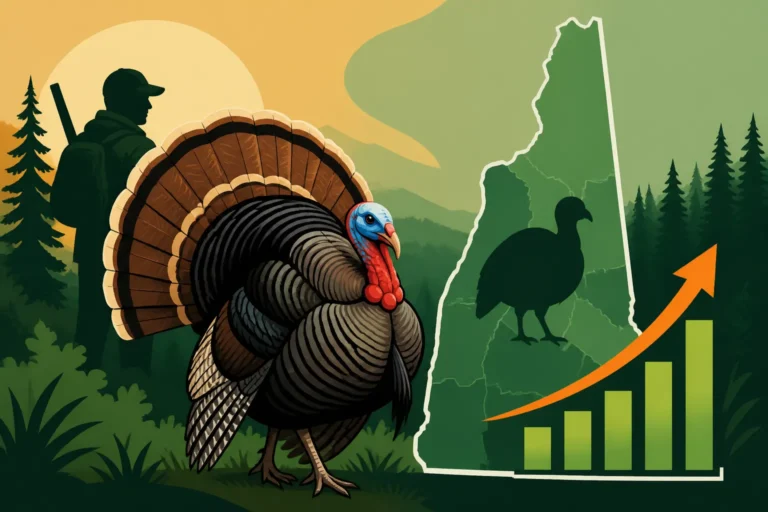
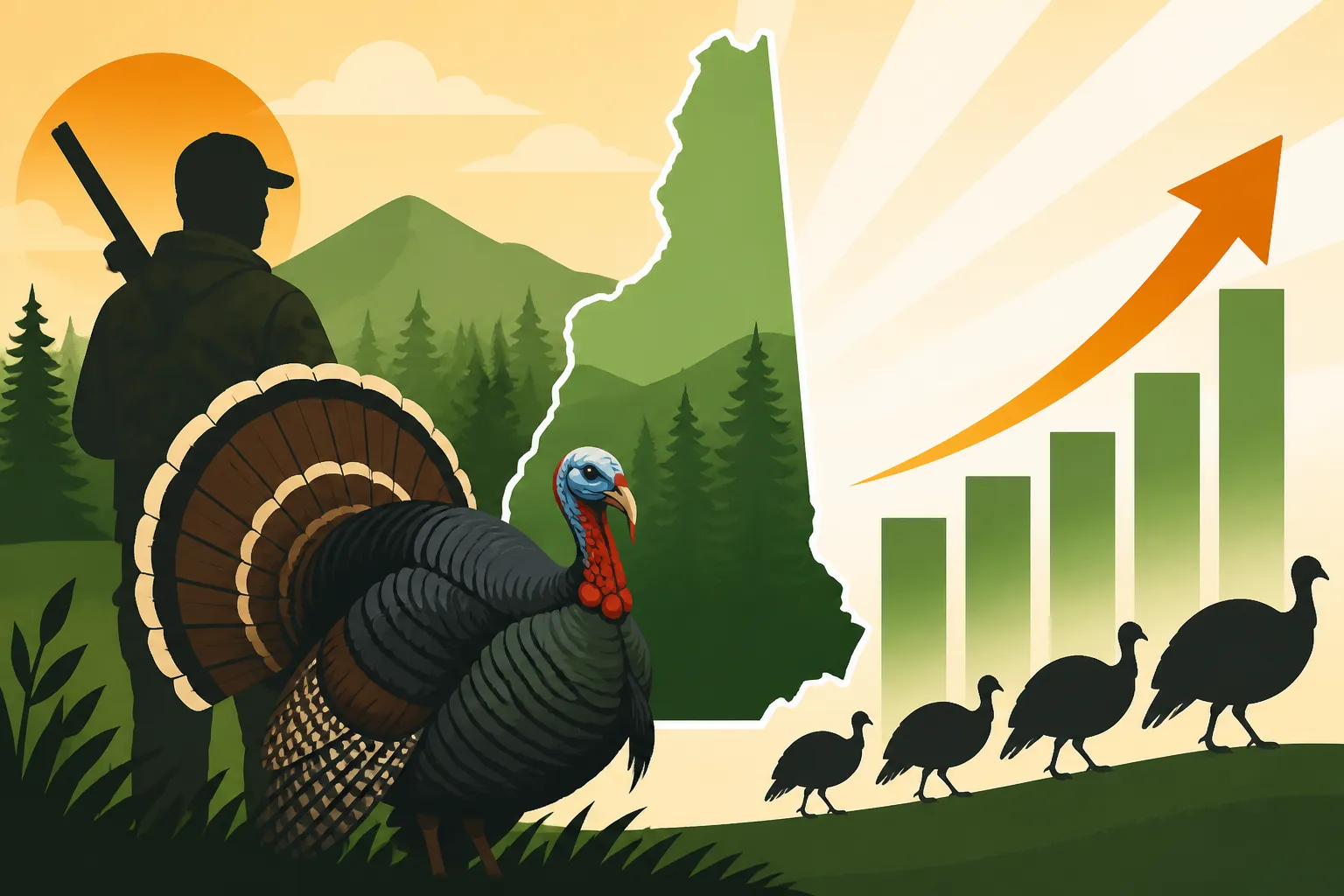
After the initial explosive growth following reintroduction, New Hampshire's wild turkey population has largely stabilized. The period of rapid expansion has naturally slowed as birds have filled most of the available prime habitat. While overall numbers remain robust, the trend data from New Hampshire Fish and Game indicates that after peaking, the population is now fluctuating more, sometimes showing slight declines in certain areas or during particular years.
These fluctuations are a normal part of wildlife ecology in a mature population. They are influenced by a complex interplay of factors, including habitat maturation (as young forests grow dense, they can become less ideal), increased predation pressure from a recovering predator base, and, perhaps most critically, weather patterns that impact poult survival. Disease, while generally not a widespread population-killer, can also cause localized dips. It's important to understand that a "stable" population doesn't necessarily mean a continuously increasing one; it means the population is generally maintaining itself within a healthy range, adapting to its environment.
Here’s a snapshot of recent New Hampshire turkey harvest numbers, which often correlate with population trends (data is simplified and illustrative):
| Year | Spring Gobbler Harvest (Statewide) | Fall Turkey Harvest (Statewide) | Total Harvest (Statewide) |
|---|---|---|---|
| 2020 | 4,025 | 1,150 | 5,175 |
| 2021 | 3,980 | 1,070 | 5,050 |
| 2022 | 4,150 | 1,210 | 5,360 |
| 2023 | 3,890 | 1,100 | 4,990 |
Note: These numbers are illustrative and do not reflect exact, real-time New Hampshire Fish and Game data for these specific years, but represent typical fluctuations. For precise figures, always consult the official NHF&G harvest reports.
As you can see, while there are ups and downs, the total harvest remains fairly consistent, indicating a stable, healthy population overall. For more specific breakdown, you can review the New Hampshire Turkey Harvest Numbers by WMU directly from the state's wildlife reports.
Factors Influencing Turkey Populations
Wild turkey populations are incredibly dynamic, constantly responding to their environment. It’s not just about how many birds are out there, but how well they can survive and reproduce. Several key factors weigh heavily on these trends.
The Crucial Role of Habitat
Habitat is, without a doubt, the foundation of any thriving wildlife population. For wild turkeys, the ideal habitat is a rich mosaic, not just one type of environment. They need mature forests, particularly those with plenty of oak, beech, and other nut-producing trees, which serve as crucial roosting sites and provide abundant hard mast for food, especially during the lean winter months. These big trees also offer critical escape cover from predators.
But it’s not just about old growth. Turkeys also heavily rely on open fields, pastures, and agricultural lands. These areas are vital for poult rearing, providing a buffet of insects – essential protein for rapidly growing young birds. Hens also favor these open areas for nesting, often along the edges where cover meets food. Suburbanization presents a complex challenge; while it often fragments large tracts of forest, it also creates new edges and food sources in the form of bird feeders, gardens, and ornamental plantings, which turkeys readily exploit.
Forestry practices, paradoxically, can be both a benefit and a challenge. Timber harvesting, when done thoughtfully, can create early successional habitat – young, brushy growth that provides excellent escape cover and food for poults and adult turkeys. Clear-cuts, after a few years, become dense thickets perfect for hiding nests and finding insects. However, poorly planned or excessively aggressive logging can temporarily displace birds and reduce crucial mature forest components. It's a delicate balance that land managers constantly strive to achieve. This interplay of habitat types is also a major driver for Where New Hampshire Bucks Bed in Thick Cover, as deer utilize similar forest characteristics.
Weather's Impact on Reproduction and Survival
Weather might be the single biggest driver of year-to-year fluctuations in turkey populations. The most critical period is spring, specifically during nesting and the first few weeks after poults hatch. Cold, prolonged wet weather during this time can be devastating. Young poults, especially those just a few days old, are highly susceptible to hypothermia. A soggy, chilly spring can lead to very poor poult survival rates, meaning fewer young birds will enter the fall population. This directly impacts the number of jakes and young hens seen the following year.
Winter severity also plays a significant role. While adult turkeys are remarkably tough, prolonged periods of deep snow make it incredibly difficult for them to access ground-level food sources like acorns, beechnuts, and leftover agricultural grains. This limited access to food, coupled with the increased energy expenditure to stay warm in bitter cold, can weaken birds, making them more susceptible to disease and predation, and impacting their breeding condition come spring. A series of harsh winters can slowly chip away at the overall population health.
Conversely, a string of mild winters followed by dry, warm springs can lead to boom years for turkeys. When conditions are just right, hens are in excellent health for breeding, poult survival is high, and the population can rebound quickly. This delicate balance means that what you see in the woods one year might be a direct reflection of the weather conditions of the previous spring and winter. For hunters trying to gauge success, understanding these weather patterns is almost as important as understanding how to use Grunt Calls in Mature New Hampshire Hardwoods.
Predators, Disease, and Other Challenges
While habitat and weather are significant macroscopic factors, more localized and acute pressures also influence turkey populations: predators and disease. Turkeys, especially eggs and poults, are prey for a wide array of animals. Coyotes, bobcats, foxes, raccoons, opossums, and even skunks are all opportunistic predators that will readily take turkey eggs or young poults. While a healthy predator population is natural and important for ecosystem balance, an unusually high local predator density can put a noticeable dent in turkey recruitment. Adult turkeys, though capable of flight and vigilant, can still fall prey to larger predators.
Disease is another silent but potent factor. While widespread, population-decimating turkey diseases are rare, localized outbreaks can occur. Common issues include Avian Pox, which manifests as wart-like lesions on the head and neck, and Lymphoproliferative Disease Virus (LPDV), which can cause internal tumors. These diseases, while often not immediately fatal, can weaken birds, making them more vulnerable to other stresses or predators. The spread of these diseases can be exacerbated by high turkey densities or prolonged periods of stress from harsh weather.
Beyond natural challenges, human-related factors also play a role. Vehicle collisions, especially during spring and fall when turkeys are more active and visible, account for a surprising number of mortalities. Illegal hunting, though thankfully rare, also has an impact. Lastly, competition with other wildlife for limited food resources can become a factor, especially in areas where several species rely on the same mast crops. All these elements combined create a complex web of influences on the overall health and size of New Hampshire's turkey flocks.
New Hampshire Fish and Game's Management Strategies
The New Hampshire Fish and Game Department (NHF&G) plays a crucial role in ensuring the long-term health and sustainability of the state's wild turkey population. Their approach is multi-faceted, combining science, regulation, and public involvement.
Monitoring and Data Collection
At the heart of effective wildlife management is robust data collection. NHF&G biologists utilize several key programs to monitor turkey populations. The annual summer brood survey is perhaps the most critical. This citizen-science initiative encourages the public, especially hunters and outdoor enthusiasts, to report sightings of hens and poults during July and August. This data provides invaluable insight into the year's reproductive success and helps predict the number of young birds that will enter the fall and subsequent spring populations.
Another cornerstone of data collection is the mandatory hunter harvest report. Every hunter who successfully harvests a turkey is required to report their bird, either online or at a traditional registration station. This data, which includes information on the bird's sex, age, and location of harvest, provides a direct measure of hunting pressure and population health. For example, consistently low harvest of adult gobblers in a specific Wildlife Management Unit (WMU) might signal a localized decline, prompting further investigation. This is vital, and you can learn more about New Hampshire Turkey Checking Requirements.
Technology has also revolutionized data collection. Online reporting systems make it easier for hunters to comply, and Geographic Information System (GIS) mapping helps biologists visualize harvest data and brood sightings in relation to habitat features. Tools like GoHunt can also be used by individual hunters to record their observations, helping them personally track trends and plan hunts on public or private land. This blend of citizen science, mandatory reporting, and technological integration provides a comprehensive picture for wildlife managers.
Habitat Improvement and Conservation Efforts
Recognizing that healthy turkeys need healthy habitat, NHF&G, often in partnership with other conservation organizations like the National Wild Turkey Federation, actively engages in habitat improvement projects. These efforts frequently focus on state-owned Wildlife Management Areas (WMAs) and other public lands. Projects might include creating and maintaining early successional habitat through brush cutting or prescribed burns, planting food plots (such as clover or chufa) that provide supplemental forage, or thinning dense timber to encourage the growth of mast-producing trees.
Beyond direct intervention on public lands, NHF&G also works to educate and assist private landowners. Much of New Hampshire's prime turkey habitat is privately owned, so encouraging responsible land management on these parcels is crucial. This can involve providing technical advice on forest management for wildlife, promoting practices that benefit ground-nesting birds, or even assisting with planting native shrubs and trees that provide food and cover.
Protecting critical habitat from development and fragmentation is also a key conservation goal. This involves working with land trusts and other agencies to conserve large blocks of forest and agricultural land, ensuring that turkeys have enough contiguous habitat for all their life cycle needs, from winter survival to nesting and brood rearing. These broad-scale efforts benefit not only turkeys but a host of other wildlife, creating a richer, more diverse ecosystem.
Hunting Regulations as a Management Tool
Hunting regulations are one of the most direct and effective tools NHF&G has to manage turkey populations. By carefully setting season lengths, bag limits, and legal hunting methods, the department can influence harvest pressure and ensure that hunting remains sustainable. For example, New Hampshire has specific regulations for both spring and fall seasons. The spring season targets gobblers, focusing on male birds after the breeding season to avoid impacting hens and their nests. Hunters can take Hunting the Two-Bearded-Bird Spring Limit in most areas.
Regulations are often tailored to specific Wildlife Management Units (WMUs) to reflect local population dynamics. If data suggests a particular WMU has a lower turkey density or slower recruitment, managers might shorten a season or adjust bag limits in that specific area. Conversely, areas with thriving populations might have more liberal opportunities. For instance, the regulations around Which WMUs Allow Fall Turkey Hunting demonstrate this adaptive approach, as not all WMUs are open to fall hunting.
The success of these regulations hinges on hunter compliance and ethical practices. Reporting harvests accurately, knowing and following all local and state rules, and practicing responsible hunting methods are all critical contributions from the hunting community. These regulations, codified in the New Hampshire Turkey Season Rules, are designed not to limit opportunity unnecessarily, but to safeguard the resource for future generations, ensuring healthy populations and continued hunting traditions.
The Hunter's Role and Future Outlook
As hunters, we are not just consumers of wildlife; we are its most ardent stewards. Our actions, both individually and collectively, have a profound impact on the future of New Hampshire's wild turkeys.
Contributing to Conservation
One of the most direct ways hunters contribute to conservation is financially. Every time you purchase a hunting license, turkey permit, or specific hunting gear, a portion of that money goes directly to wildlife management and conservation efforts through the "user pays, public benefits" model established by the Pittman-Robertson Act. These funds are the lifeblood of agencies like New Hampshire Fish and Game, supporting everything from habitat restoration to disease monitoring and law enforcement. Without hunter dollars, many of the programs that brought turkeys back from extirpation simply wouldn't exist.
Beyond financial contributions, active participation is vital. Accurately reporting your harvest data is not just a legal requirement; it's a critical component of sound wildlife management. Every reported bird helps biologists paint a clearer picture of population health, distribution, and the impact of hunting pressure. Without this information, management decisions would be based on guesswork, not science. You can learn about the specifics of New Hampshire Turkey Checking Requirements to ensure your compliance.
Furthermore, participating in citizen science initiatives, like the summer brood survey, is incredibly valuable. Your observations from the field, whether you're actively hunting, scouting, or just enjoying nature, provide eyes and ears on the ground that biologists simply can't replicate statewide. Reporting sightings of hens and poults, or even just general turkey observations, helps validate population models and informs future management strategies. Even an informal log of your sightings using an app like GoHunt can contribute to your personal understanding and appreciation of the local turkey population.
What the Future Holds for New Hampshire Turkeys
Looking ahead, the future for wild turkeys in New Hampshire appears bright, albeit with a realistic understanding that the population has likely reached its carrying capacity in many areas. While we might not see another dramatic "explosion" in numbers like the post-reintroduction era, the expectation is for a robust, huntable population to persist across much of the state. These birds are highly adaptable and have demonstrated their ability to thrive in a variety of landscapes.
However, challenges remain. Continued habitat loss and fragmentation from development, particularly in southern New Hampshire, will require vigilant conservation efforts. Climate change could bring more unpredictable weather patterns, potentially impacting nesting success and winter survival in new ways. Disease monitoring will also remain crucial to quickly identify and manage any new threats. These challenges are shared across many species, including Moose in New Hampshire's North Country.
Ultimately, the long-term health of New Hampshire's wild turkey population depends on sustained scientific management by NHF&G, ongoing habitat conservation, and the continued support and ethical participation of the hunting community. By staying informed, contributing to conservation, and respecting the resource, hunters will continue to enjoy the thrilling challenge of chasing gobblers for generations to come. The sound of a thunderous gobble echoing through the spring woods is, for many of us, the very essence of the Granite State's wild heart.
Disclaimer
Please remember that hunting regulations, season dates, and license requirements can change. Always consult the most current New Hampshire Fish and Game Department regulations digest or their official website before planning any hunting activity. This article is intended for informational purposes only and should not be considered a substitute for official sources.