Spotting Scopes for Long Timber Country Shots
There’s a unique frustration that comes with hunting New Hampshire’s timbered country: you catch a flicker of movement, a subtle shape far off in a distant clear-cut or across a steep ravine, and your binoculars just aren't quite enough to tell you if it's a buck, a bear, or just a branch moving in the wind. This guide is all about bridging that gap, diving deep into how spotting scopes can be a game-changer for those challenging, long-distance identification shots in our dense woods.
Why Spotting Scopes Are a Game Changer in New Hampshire's Timber
Hunting in New Hampshire often means contending with vast expanses of timber, steep terrain, and deep valleys. Unlike wide-open western states where you can glass for miles, our woods present a different kind of challenge. You might only get glimpses of game through small openings, or across significant distances where dense cover begins to break up. This is precisely where a spotting scope stops being a luxury and starts becoming an essential tool. It’s about more than just seeing something; it’s about definitive identification and making informed decisions without spooking game by trying to get closer than you need to.
Bridging the Gap Beyond Binoculars
We all love our binoculars. They're quick, they're easy to carry, and for most situations in the woods, they do the trick. A good pair of 10x42s or even 12x50s can help you scan a close-range thicket or identify deer sign at a hundred yards. But when that deer is four hundred yards across a steep draw, silhouetted against a dark hillside, or peeking out from behind a stand of pines, even the best binoculars often fall short. You might see a shape, but can you count points? Can you tell if it's a doe or a legal buck? Can you discern if that dark patch is a bear or just a rock?
A spotting scope, with its significantly higher magnification (often starting at 15x or 20x and going up to 60x or more), brings that distant image into much clearer focus. It allows you to resolve fine details that binoculars simply cannot. It’s like having a miniature telescope in your pack, giving you the power to pick apart distant cover and eliminate doubt. This capability is invaluable in New Hampshire, where opportunities can be few and far between, and confirming legal game from a distance can save you a lot of wasted effort, or worse, making a mistake. It transforms an ambiguous blob into a discernible animal, helping you decide whether to make a move or hold your position.
Identifying Game and Scouting from Afar
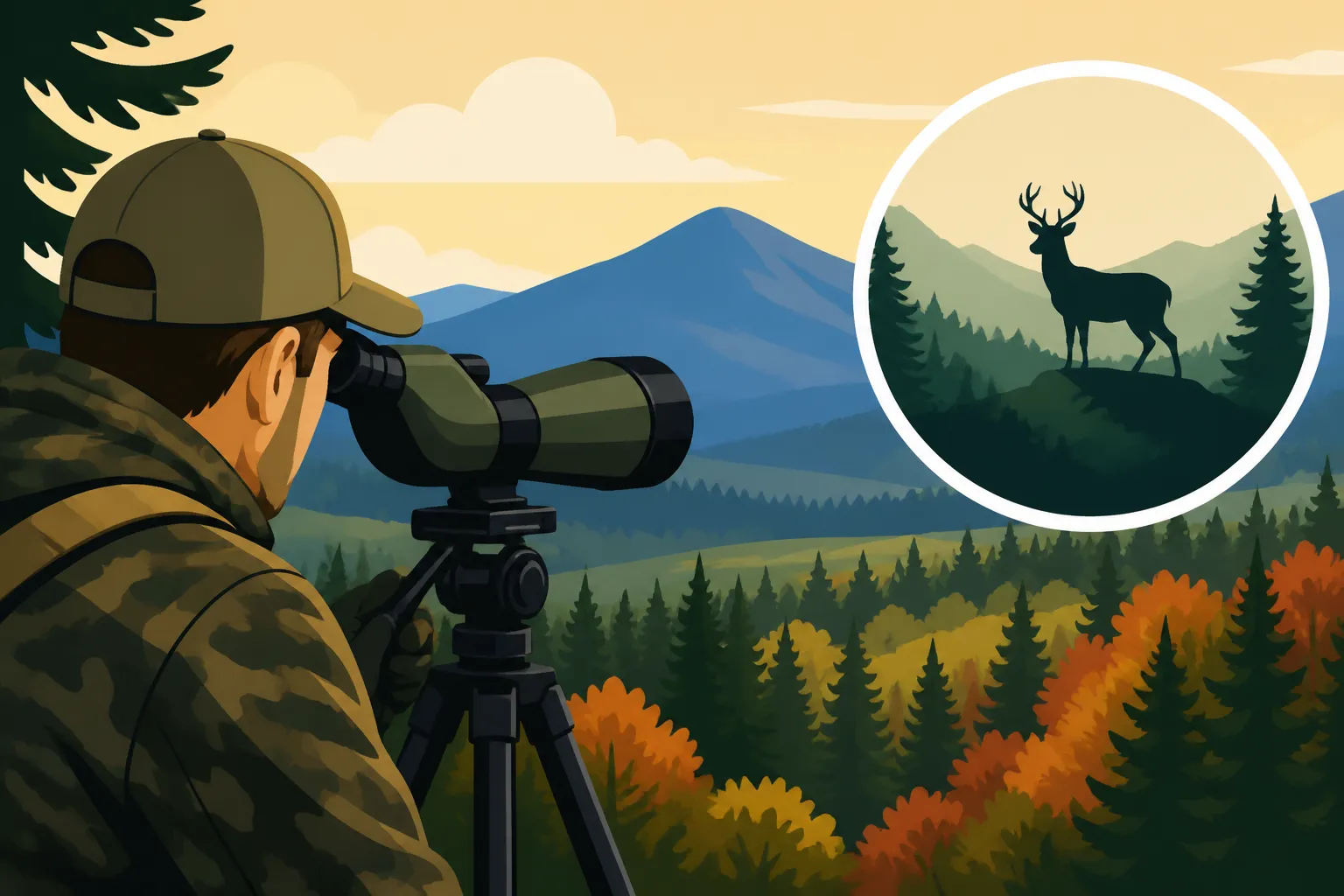
Imagine you've hiked into a remote section of the White Mountain National Forest, perhaps scouting for deer sign along a ridgetop. You notice a clear-cut far below you, hundreds of yards away, bordering a dense stand of timber. With your binoculars, you might catch glimmers of movement, but you can't quite tell if it's deer feeding or just squirrels scrambling amongst the fallen timber. Pulling out your spotting scope, you can dial in and, suddenly, those distant shapes resolve into a small group of does, confidently feeding. This confirms deer activity in the area and helps you pinpoint their preferred feeding spots without needing to walk directly into the zone and risk leaving scent.
This ability to identify game from a significant distance also extends to identifying specific animals, not just general species. When you’re looking for a legal buck during New Hampshire's November Firearms Deer Season, being able to count antler points from 500 yards away is a huge advantage. Or, if you’re Hunting Bear With Hounds by WMU, and you’ve got a bear treed high up on a distant ridge, a spotting scope can help you confirm its size and whether it’s a sow with cubs, which would be illegal to harvest, long before you start the arduous trek up. It’s about minimizing disturbance and maximizing ethical decision-making, allowing you to confirm your target before committing to a stalk or approach.
Key Features to Look For in a Timber Spotting Scope
Choosing a spotting scope for New Hampshire’s timber doesn't mean just grabbing the biggest one you can find. It’s a balance of performance, portability, and practicality. The ideal scope for our varied terrain will have specific features that cater to the challenges of dense woods and variable light conditions. You need something that can handle the elements, offer clear images, and won't weigh you down too much on those long hikes to your favorite glassing knobs.
Objective Lens Size and Light Gathering
The objective lens is the large front lens of your spotting scope, and its size directly impacts how much light the scope can gather. In New Hampshire's deep timber, especially at dawn and dusk when game is most active, light gathering is paramount. A larger objective lens (e.g., 80mm or 85mm) will generally provide a brighter, clearer image, especially in low light conditions. This can be the difference between seeing a vague silhouette and clearly making out a deer's shoulder or a bear's ear at last light. However, a larger objective lens also means a heavier, bulkier scope.
For our timber country, many hunters find a sweet spot with objective lenses in the 65mm to 85mm range. While a 95mm or 100mm scope might offer slightly more light, its increased size and weight can be prohibitive for packing deep into the backcountry, where every ounce counts. Consider your typical hunting scenarios: are you setting up a static glassing spot near a clear-cut where weight is less of an issue, or are you constantly on the move, still-hunting through thick cover? For those who prefer a more mobile approach, a 65mm or 70mm scope might be a more practical compromise, offering decent light gathering without excessive burden. It’s about finding the balance that works for your personal hunting style in our region.
Angled vs. Straight Eyepieces
This is a really personal choice, and it significantly affects how you use your scope.
- Angled Eyepieces (typically 45-degree): These are often favored for prolonged glassing sessions, especially when you're set up on a hillside or trying to pick apart a valley from an elevated position. They allow for a more relaxed head and neck posture, as you typically don't have to crane your neck as much. If you're sharing the scope with others, or if you plan to use it to glass uphill or downhill frequently, an angled eyepiece often proves more comfortable. This design also allows for a lower tripod setup, which can be advantageous when trying to stay concealed or glassing from a prone position in fields or along Entry Routes Through a Cut Cornfield.
- Straight Eyepieces: These are generally preferred for quick target acquisition, especially when following moving game or using the scope for ranging with a reticle. Some hunters find them more intuitive to look through, similar to binoculars, and quicker to get on target, which can be crucial when a fleeting opportunity arises. For those who primarily hunt from a treestand or use their scope more like a high-power monocular for quick checks, a straight eyepiece might feel more natural.
Consider how you mostly hunt. Are you setting up for long sits on a ridge, patiently scanning a distant timber block, or are you on the move, making quick stops to glass openings? Many New Hampshire hunters, especially those who appreciate comfortable glassing on uneven terrain, lean towards an angled eyepiece. Others, valuing speed and simplicity, stick with straight models.
Glass Quality and Coatings
This is where the rubber meets the road in terms of image clarity, color fidelity, and contrast. You can have the biggest objective lens in the world, but if the glass is poor, the image will be blurry or distorted. High-quality glass, often referred to as Extra-low Dispersion (ED) glass, significantly reduces chromatic aberration (color fringing), which is that annoying purple or green halo you sometimes see around high-contrast objects. In the nuanced greens and browns of New Hampshire's forests, this clarity is critical for distinguishing subtle details like an antler tine against a dark tree trunk.
Beyond the raw glass, multi-coatings on all air-to-glass surfaces are paramount. These coatings minimize light reflection and maximize light transmission, ensuring that as much light as possible reaches your eye. This is especially vital in those deep shadows or at twilight when every photon counts. Reputable brands invest heavily in proprietary coatings, which can enhance brightness, sharpen contrast, and improve color rendition, making it easier to spot camouflaged game. While these features come at a higher cost, they are arguably the most significant factor in a scope's optical performance, directly impacting your ability to truly resolve distant images in challenging New Hampshire hunting conditions.
Durability and Waterproofing
New Hampshire weather is, shall we say, unpredictable. A beautiful sunny morning can turn into a cold, driving rain or even snow by afternoon. Your spotting scope needs to be built to withstand these conditions. Look for scopes that are fully waterproof and fogproof. This usually means they are O-ring sealed and purged with an inert gas like nitrogen or argon, which prevents internal fogging due to rapid temperature changes or humidity.
Beyond just resisting water, the overall construction needs to be robust. Our granite terrain, slippery trails, and sometimes less-than-gentle handling demand a tough instrument. Rubber armoring provides an extra layer of protection against bumps and scrapes, and also offers a more secure grip, especially when your hands are cold or wet. While you'll always treat your optics with care, knowing your scope can take an accidental knock against a tree or withstand a sudden downpour adds a lot of peace of mind when you're miles into the backcountry. Investing in a durable, weather-sealed scope is not just about protecting your gear; it's about ensuring it performs when you need it most, regardless of what Mother Nature throws at you.
Here's a quick comparison of common objective lens sizes and their typical uses in New Hampshire:
| Feature/Size | 65mm Objective Lens | 80-85mm Objective Lens | 95mm+ Objective Lens |
|---|---|---|---|
| Weight/Portability | Lighter, more compact, excellent for mobile hunting or backpacking. | Moderate weight, good balance of light and portability. | Heavier, bulkier, best for static setups or vehicle-based hunts. |
| Light Gathering | Good, but noticeable drop in very low light. | Excellent, performs well in low light conditions (dawn/dusk). | Superior, gathers maximum light for ultimate low-light performance. |
| Field of View | Generally wider, easier for scanning. | Good balance, slightly narrower than 65mm. | Often narrower, more focused on fine detail at extreme distance. |
| Resolution | Very good for identifying game at moderate-long distances. | Outstanding, picks out fine details at long range. | Exceptional, for discerning tiny features at maximum distances. |
| Typical Use | Mountain hunting, quick setups, scouting distant clear-cuts in varied terrain. | Most versatile for New Hampshire, great for timber edges, ridgetop glassing, or identifying species. | Dedicated long-range glassing, specific open areas, often in a fixed position. |
Using Your Spotting Scope Effectively in New Hampshire's Woods
Having a top-notch spotting scope is only half the battle. Knowing how to use it effectively in the unique environments New Hampshire offers is the other. It's not just about pointing it at something far away; it's about stability, systematic scanning, and knowing how to make the most of the magnified view to find and assess game that might otherwise remain unseen. The challenge isn't always distance, but often the patchwork of thickets, clearings, and elevation changes that demand a refined approach to glassing.
Stability is Everything: Tripod Selection
You simply cannot get the most out of a high-magnification spotting scope without a stable platform. Trying to hand-hold a 20x or 60x scope will result in a shaky, frustrating image that negates all the optical quality you've paid for. A sturdy tripod is non-negotiable. When choosing a tripod for New Hampshire, think about a few key aspects:
- Weight vs. Stability: Just like the scope itself, there's a trade-off. A heavy-duty tripod offers maximum stability but will be a burden on long hikes. Carbon fiber tripods offer an excellent balance of light weight and rigidity, though they come with a higher price tag. Aluminum options are more budget-friendly but heavier. For those Still-Hunting White Mountain National Forest Timber, every ounce can feel like a pound by the end of the day, so consider how far you typically range from your vehicle.
- Head Type: A pan-and-tilt head offers smooth, precise movements, which is essential for slowly scanning timbered hillsides and tracking game. Some hunters prefer ball heads for their quick adjustability, but they can be less precise for fine adjustments at high magnification.
- Height and Leg Sections: Ensure the tripod can extend to a comfortable height for standing or sitting, depending on your preferred glassing position. Fewer leg sections generally mean greater stability but a longer collapsed length. More leg sections mean more compact storage but potentially less rigidity. For uneven ground, independent leg adjustments are a blessing. Investing in a good tripod is just as important as the scope itself, because even the best glass is useless if you can't hold it steady. Think of it as the foundation of your long-range observation system. You can also explore options for Tripod Setups for Glassing a Clear-Cut to optimize your glassing positions.
Locating Game with a Spotting Scope
Once your scope is stable, the art of finding game begins. In New Hampshire's timber, this often means methodically picking apart areas, rather than just broadly scanning. Start by using your binoculars to locate general areas of interest – a distant feeding area, a thick bedding patch, or a distinct terrain feature like a saddle or bench. Once you have an area identified, then move to your spotting scope.
Begin your scan at the lowest magnification setting on your scope. This provides the widest field of view, making it easier to initially spot something. Systematically work your way across the area, overlapping each scan by about 10-20%. Look for anything that seems "out of place": a horizontal line in a vertical forest, a patch of different color, a subtle movement, or a break in the uniform pattern of the woods. Don't just look for a deer; look for parts of a deer – an ear flick, a leg, a patch of white rump. Many hunters use the "grid" method, imagining a grid over the area and systematically scanning square by square. If you spot something, slowly increase the magnification to resolve details. Remember to be patient; sometimes it takes several passes over the same area to reveal an animal that was there all along.
Range Estimation for Ethical Shots
For many hunters, a spotting scope becomes an integral part of their ethical shot process, especially with longer-range opportunities in more open timber or across larger clear-cuts. While a laser rangefinder is your primary tool for pinpointing exact distances, a spotting scope can play a supportive role in two ways:
- Identifying Ranging Points: When a deer is standing in heavy cover, it might be impossible to get a laser reading on the animal itself. With your spotting scope, you can often identify a tree, rock, or other landmark directly beside or behind the animal that you can range. Once you have the distance to that landmark, you can then make a more educated estimation of the animal's exact position. This is particularly useful in broken terrain where direct lines of sight are scarce.
- Assessing Terrain and Obstacles: The high magnification of a spotting scope lets you meticulously examine the terrain between you and your target. You can identify potential deflections (small branches, tall grass), assess the angle of the shot (steep uphill or downhill), and verify that your bullet's path will be clear. This detailed assessment ensures that if you decide to take the shot, you've accounted for as many variables as possible, leading to a more precise and ethical outcome. Combining your spotting scope with a dedicated Rangefinders for New Hampshire's White Mountain Ridge Shots gives you an unparalleled advantage in making those critical distance and trajectory calculations. This careful attention to detail is paramount to being a responsible hunter.
Complementing Your Spotting Scope with Other Optics
While a spotting scope is powerful, it’s not a standalone solution for all your optical needs in the New Hampshire woods. Think of your optical kit as a team, with each member having a specific role. A truly effective setup for timber country hunting involves a smart combination of tools, ensuring you have the right magnification and field of view for every situation, from close-quarters scanning to long-distance observation. It’s about being versatile and efficient, so you're never fumbling for the wrong tool when time is of the essence.
Binoculars as the Primary Scanning Tool
Your binoculars should remain your primary glassing tool for most hunting situations. They are lighter, faster to deploy, and offer a much wider field of view compared to a spotting scope at its lowest magnification. This wide field of view is crucial for quickly scanning large areas for general movement, locating distant game, or checking your immediate surroundings for anything approaching your position. Imagine you're sitting on a knob overlooking a beaver flowage, you'll use your binoculars to systematically check the entire area for movement. Once you spot something intriguing – a flicker of movement, a distinct shape that your binoculars can't quite resolve – that's when you transition to your spotting scope.
Think of it this way: your binoculars are the wide-angle lens, excellent for taking in the whole scene and finding points of interest. Your spotting scope is the telephoto lens, allowing you to zoom in on those points of interest and capture the fine details. You wouldn't use a telephoto lens to find your subject in a vast landscape, just as you wouldn't typically use a spotting scope to continually scan for hours. Many experienced New Hampshire hunters carry both, keeping their binoculars readily accessible on a chest harness while the spotting scope is packed securely until needed for detailed inspection. For more information on your primary glassing tool, check out Binoculars for Glassing a North Country Bog.
Handheld Rangefinders for Precise Distance
As mentioned earlier, while a spotting scope can help you identify ranging points, a dedicated laser rangefinder is essential for precise distance measurements. You simply cannot rely on reticles or estimations for critical shot placement, especially in the undulating terrain and varied cover of New Hampshire. Modern rangefinders are compact, lightweight, and incredibly accurate, providing instant feedback on distance, and often angle compensation for uphill or downhill shots.
Use your rangefinder to confirm the exact distance to your target after you’ve identified it with your spotting scope. This two-step process—identification with the scope, then precise ranging with the rangefinder—ensures you have all the necessary information to make an ethical shot decision. Some advanced rangefinders even integrate with mapping apps like GoHunt to show you the terrain profile and help with shot planning, making them an invaluable companion to your spotting scope. Don't leave your rangefinder at home, especially if you're planning on hunting areas where longer shots might be possible.
Maintenance and Care for Your Timber Scope
Your spotting scope is a significant investment, both in terms of cost and its crucial role in your hunting success. The harsh conditions of hunting in New Hampshire – fluctuating temperatures, rain, snow, dust, and the occasional jostle on rugged trails – demand diligent maintenance and care. Neglecting your optics can lead to degraded performance, frustrating hunts, and a shortened lifespan for your gear. A few simple habits can ensure your scope remains crystal clear and performs flawlessly season after season.
Cleaning Lenses Properly
The lenses are the heart of your spotting scope, and keeping them clean is paramount for optimal image quality. However, improper cleaning can do more harm than good, scratching delicate coatings. Always follow these steps:
- Remove Loose Debris First: Before touching the lens, use a can of compressed air (designed for optics, not general-purpose cleaning) or a soft lens brush to gently blow or brush away any dust, dirt, or grit. If you rub a dusty lens, you’re essentially sanding it.
- Breathe and Wipe (Carefully): Lightly breathe onto the lens to create a slight fog. Then, using a clean, dedicated microfiber lens cloth, gently wipe the lens from the center outwards in a circular motion. Use a fresh part of the cloth for each wipe. Avoid using paper towels, shirt sleeves, or anything abrasive.
- For Stubborn Smudges: If there are still smudges (like fingerprints or water spots), use a small amount of specialized lens cleaning fluid designed for optics. Apply a drop or two to your microfiber cloth (never directly to the lens) and then gently wipe as before.
- Avoid Harsh Chemicals: Never use household glass cleaners, alcohol wipes (unless specifically designed for optics), or solvents, as these can damage lens coatings.
- Clean Exterior Regularly: Don't forget the body of the scope. Wipe down the rubber armor and other exterior surfaces with a damp cloth to remove mud, sweat, and grime. This prevents buildup and keeps the scope looking good. Regular lens cleaning ensures that your scope is always ready to give you the clearest possible view, whether you're Glassing a Bog for a Bull Moose or trying to pick apart a distant deer yard.
Protecting Your Investment in the Field and Off-Season
Beyond cleaning, proactive protection is key to longevity.
- Lens Covers: Always use your objective lens and eyepiece covers when the scope is not in active use. This is the simplest and most effective way to prevent dust, moisture, and scratches.
- Carrying Case/Pouch: Most spotting scopes come with a soft case or "stay-on" case. Use it! These cases offer protection from minor bumps, scrapes, and the elements while allowing you to use the scope without fully removing it. A good case also provides insulation, helping to prevent rapid temperature changes that can lead to internal fogging.
- Tripod Protection: When moving through thick brush, it's often best to collapse your tripod as much as possible and secure the scope to prevent it from snagging branches or getting knocked. Some hunters carry their scope and tripod in a dedicated compartment in their pack for ultimate protection when making a long hike or navigating particularly rugged terrain, such as when you’re Packing Out a New Hampshire Moose.
- Drying Out: If your scope gets wet, always open the lens caps and allow it to air dry completely in a warm, dry place (not direct sunlight or high heat) before storing it in its case. Storing a damp scope can lead to mold or mildew growth internally.
- Off-Season Storage: When the hunting season is over, store your spotting scope in a cool, dry place away from direct sunlight and extreme temperatures. Ensure it's clean and dry before putting it away for the off-season. Some hunters even keep small desiccant packs in their storage cases to absorb any residual moisture. By treating your spotting scope with care, you ensure it will perform reliably for many New Hampshire seasons to come. You've made an investment, now take care of it!
Choosing the Right Spotting Scope for Your New Hampshire Hunt
Deciding on the perfect spotting scope for your New Hampshire hunting adventures involves weighing several factors specific to our state's diverse landscapes and your personal hunting style. There's no single "best" option, but rather a best fit based on how you hunt, where you hunt, and what you prioritize in your gear. Are you a meticulous long-range scout, or a mobile hunter who occasionally needs to confirm a distant target? Understanding these nuances will guide you to a choice you won't regret when it matters most.
Balancing Size, Weight, and Performance
New Hampshire presents a unique challenge: the North Country often demands long hikes and navigating challenging terrain, while the southern regions might involve more static observation from field edges or suburban zones. This means the balance between a scope's size, weight, and optical performance is critical.
If your hunting takes you deep into the White Mountain National Forest, miles from any road, carrying a massive 95mm scope might quickly become a regret. A compact 65mm or 70mm scope, paired with a lightweight carbon fiber tripod, might be the more practical choice, even if it means a slight compromise on low-light performance. It’s better to have a slightly less powerful scope that you actually carry and use, than a high-end beast that stays in your truck. For those who frequently hunt open clear-cuts, powerline corridors, or across large valleys, the extra bulk of an 80mm or 85mm might be a worthwhile trade-off for the superior light gathering and resolution. Similarly, if you're setting up on a Hanging a Stand on a Granite Ridge for the day, a slightly heavier, more stable scope won't feel like as much of a burden. Consider how much you're willing to carry and how often you'll be covering significant ground on foot.
Budgeting for Quality Optics
Let's be realistic: quality optics are an investment. You'll find spotting scopes ranging from a few hundred dollars to several thousand. While it's tempting to go for the cheapest option, particularly with something as specific as a spotting scope, remember that image quality, durability, and light gathering capability often directly correlate with price. A cheap scope might offer high magnification, but if the image is blurry, dim, or distorted, it’s virtually useless.
For New Hampshire's timber hunting, you generally want to aim for the best quality you can reasonably afford within your budget. Mid-range scopes from reputable brands often offer an excellent balance of performance and value, incorporating good quality glass and decent coatings that will serve you well in our conditions. Consider your scope as a tool that will enhance your hunting experience for years, not just a single season. Many hunters save up, or choose to prioritize quality optics over other gear, understanding the profound impact they can have on success and enjoyment. Researching different brands and models, and checking reviews from fellow hunters who face similar conditions, can help you make an informed decision. Resources like GoHunt often provide detailed gear reviews and comparisons, helping you align your budget with the best possible performance.
Practical Considerations and Accessories
Beyond the scope itself, think about the practical accessories that will enhance its usability in the field.
- Lens Cleaning Kit: As discussed, a dedicated lens cleaning pen or kit is a must-have for field maintenance.
- Stay-on Case: These padded cases allow you to use your scope without fully removing it, protecting it from bumps and the elements while keeping it accessible.
- Digiscoping Adapter: If you enjoy taking photos or videos of your discoveries, a digiscoping adapter allows you to attach your smartphone to the eyepiece, turning your spotting scope into a powerful telephoto lens. This is a fantastic way to document wildlife sightings or even share a distant trophy buck with friends.
- Harness/Carrying System: While you'll likely pack your scope in your backpack for long treks, a comfortable carrying system for shorter movements or when transitioning between glassing spots can be beneficial. Some hunters even adapt binocular harnesses for smaller spotting scopes.
- Cold Weather Gloves: Using a spotting scope in freezing New Hampshire temperatures means dexterity is key for adjusting focus and magnification. Invest in thin, warm gloves that allow you to manipulate the scope controls without having to remove them. When combined with a good layering system, like those discussed in Layering for New Hampshire's Cold Hunting Season, you'll be set for comfortable glassing no matter the weather.
Ultimately, choosing a spotting scope for New Hampshire’s timber country means making an informed decision that enhances your ability to identify game, make ethical choices, and truly appreciate the details of our wild landscape.
Disclaimer
This article is for general informational purposes only and does not constitute professional advice. Laws, prices and regulations vary by location and change over time. Consult a qualified professional for guidance on your specific situation.