Binoculars for Glassing a North Country Bog
The dense, often unforgiving landscape of New Hampshire's North Country bogs can present a truly unique challenge to hunters. You’re often dealing with thick cover, subtle movements in low light, and vast expanses that demand a keen eye to spot game like a trophy moose or a mature whitetail buck. This guide is all about helping you understand how to choose and use binoculars to effectively cut through the bog's visual clutter and locate your quarry.
The Unique Challenges of Glassing North Country Bogs
Hunting in the bogs of New Hampshire’s North Country is an experience unlike almost any other. It’s a place of contrasts: serene beauty juxtaposed with impenetrable thickets, open water reflecting the sky alongside shadowed pockets where game can vanish in an instant. This specific environment places distinct demands on your optics, and understanding these challenges is the first step to choosing the right pair of binoculars.
Dense Cover and Limited Visibility
Anyone who has spent time creeping through a New Hampshire bog knows it's rarely open country. You're typically navigating a mosaic of dense balsam fir, towering white pines, and tangles of alder thickets that create a literal wall of vegetation. While these thickets are prime bedding and feeding areas for deer and moose, they make seeing anything beyond a few yards an absolute nightmare. Traditional still-hunting, relying solely on your naked eye, can feel like you're constantly walking blind.
This dense cover means that when you do find a vantage point – perhaps a slightly elevated hummock or the edge of a small clearing – your binoculars become your most critical tool. You're not just scanning for an entire animal; you're often looking for a flick of an ear, the horizontal line of a back, or the subtle glint of an antler tip against a chaotic backdrop of vertical branches. Being able to resolve these minute details through your optics, effectively extending your vision into the shadows, is the difference between an empty walk and spotting that bull moose you've been dreaming of. Hunting a New Hampshire North Country Moose Bog demands this kind of careful, extended observation.
Vast, Undulating Terrain
New Hampshire’s bogs aren't just dense; they're also surprisingly vast and often undulating, with subtle rises and depressions, fingers of high ground, and expanses of open water. From a distance, it can look like a flat, uniform carpet of green and brown, but up close, it's a topographical maze. This means you need to be able to scan broad areas, covering significant ground visually, even if you’re physically moving slowly or are somewhat stationary.
The challenge here is two-fold: first, needing a wide field of view to take in a large swath of the bog without constant repositioning, and second, having enough stability to hold those optics steady for extended glassing sessions. Trying to pick out movement across a hundred yards of bog with shaky hands or an unstable view is incredibly frustrating and largely ineffective. You need binoculars that can provide a stable, wide-angle "sweep" of the landscape, allowing you to methodically pick apart the cover, identifying potential game trails, feeding areas, or bedding spots from a safe distance.
Low Light Conditions
Hunting in a North Country bog often means being out during the prime times: first light in the pre-dawn gloom and last light as dusk settles. These are the hours when deer and moose are most active, moving between bedding and feeding areas. Unfortunately, these are also the times when natural light is at its poorest. Add to this the heavy canopy cover provided by mature conifers and the overall damp, shadowed environment of a bog, and you're constantly fighting against dim conditions.
This reality makes superior low-light performance in your binoculars not just a luxury, but a necessity. You need optics that can gather and transmit as much available light as possible, allowing you to see definition and color when your naked eye perceives only shadows and muted tones. Being able to discern the shape of an animal blending into the dark timber at legal shooting light, or to track movement in the fading evening light, is paramount. Choosing binoculars specifically designed for excellent light transmission will significantly increase your effective hunting time and your ability to spot game when they are most likely to be on the move. Hunting the Rut in Early-to-Mid November often means these low-light conditions are critical for success.
Essential Binocular Features for Bog Hunting
When you're out there, fighting through the alders and scanning the dark edges of a New Hampshire bog, your binoculars need to perform. It's not just about having a pair; it's about having the right pair. Several key features dictate how well your optics will serve you in this demanding environment.
Magnification and Objective Lens Size
This is often the first thing hunters look at, and for good reason, but it's a balance, not a race for the biggest numbers. Magnification (the first number, e.g., 8x, 10x) makes objects appear closer. In a bog, where dense cover often limits extreme long-range viewing, excessive magnification can be a hindrance. While it might seem appealing to have a 12x or 15x power to really zoom in, these higher magnifications significantly narrow your field of view, making it much harder to scan broad areas quickly. They also amplify natural hand shake, turning subtle movements into frustrating jiggles, especially when you're trying to pick out a detail in low light. For bog hunting, where you're often looking into pockets of cover, a more stable 8x or 10x is often more effective.
The objective lens size (the second number, e.g., 42mm, 50mm) refers to the diameter of the front lenses. This is directly related to how much light the binoculars can gather. Larger objective lenses gather more light, which translates to a brighter image, particularly critical in the perpetually shadowed and low-light conditions common in bogs. However, larger lenses also mean more weight and bulk. Hauling around a massive, heavy pair of binoculars through boggy terrain can quickly become tiresome. Most bog hunters find that a 42mm objective lens provides an excellent balance of light-gathering capability and manageable weight, though some might opt for 50mm if stationary glassing is their primary method.
Field of View and Eye Relief
Field of view (FOV) is the width of the area you can see through your binoculars at a specific distance (usually 1,000 yards). For scanning vast, complex bog terrain, a wide FOV is your best friend. Imagine trying to find a needle in a haystack through a tiny peephole versus a wider window – the wider window makes the task infinitely easier. In a bog, where a moose might appear suddenly from behind a clump of spruce or a deer might be moving subtly through thick underbrush, a wide FOV allows you to cover more ground, detect movement faster, and follow game more easily without constantly shifting your head.
Eye relief is the distance your eye needs to be from the eyepiece to see the full field of view. This is a crucial, yet often overlooked, feature, especially for hunters who wear eyeglasses or sunglasses – which, let's be honest, is most of us in the field. Adequate eye relief (typically 15mm or more) ensures that you can comfortably view the entire image without having to press the binoculars hard against your face or remove your glasses. In the often damp and cold environment of a New Hampshire bog, being able to glass comfortably with your protective eyewear on is a significant advantage, preventing eye strain and ensuring you don't miss any critical details.
Durability and Weatherproofing
Let's face it, hunting in New Hampshire means encountering all kinds of weather, often within a single day. A North Country bog is inherently a wet, damp, and sometimes muddy environment. Your binoculars are going to get rained on, splashed, and potentially dropped. This is why robust durability and uncompromising weatherproofing are non-negotiable. Look for binoculars that are described as "fully waterproof" and "fog-proof." This typically means they are O-ring sealed and nitrogen or argon purged to prevent moisture and internal fogging, which can render your optics useless in a critical moment.
Beyond just being waterproof, the external armor and overall construction matter. Rubber armoring provides a protective layer against bumps and scrapes, and also offers a better grip, which is essential when your hands are cold, wet, or gloved. A solid, well-built chassis, often magnesium or aluminum alloy, ensures that the internal components remain precisely aligned even after a jostle. Investing in optics that can withstand the rigors of the New Hampshire wilderness means they'll be reliable year after year, no matter what Mother Nature throws at you.
Understanding Optical Performance in a Bog Environment
It's one thing to read about objective lens sizes and magnification; it's another to understand how these features translate into the actual image you see. The optical performance of your binoculars is paramount, dictating clarity, brightness, and your ability to discern subtle details in the challenging light and dense cover of a North Country bog.
Lens Coatings and Light Transmission
Think of your binocular lenses as tiny windows. Every time light hits a glass surface, some of it is reflected away, meaning less light makes it to your eye. Lens coatings are microscopic layers applied to the glass surfaces to reduce this reflection and improve light transmission. In the deep shadows and often overcast conditions of a bog, maximizing every photon of available light is crucial. You want binoculars with "fully multi-coated" lenses, meaning all air-to-glass surfaces have multiple layers of anti-reflective coatings.
These coatings dramatically increase the amount of light that reaches your eye, resulting in a brighter, higher-contrast image. This allows you to differentiate between shades of green, brown, and gray, making it easier to spot the brown hide of a deer or moose against the dark timber. Beyond just brightness, good coatings also improve color fidelity, ensuring that what you see through your binoculars accurately reflects the natural environment, aiding in game identification and preventing eye fatigue during long glassing sessions. Many hunters utilize resources like GoHunt to research and compare the specific lens coatings offered by various manufacturers, as these can vary widely in quality and effectiveness.
Prism Types and Image Quality
Binoculars use prisms to invert the image, so you don't see things upside down, and to shorten the optical path, making them more compact. The two main types are Porro prisms and Roof prisms.
- Porro Prisms: These create the traditional, wider-set binocular shape where the objective lenses are offset from the eyepieces. They are often less expensive to manufacture and can offer a naturally wide field of view and excellent depth perception. Historically, they were known for brighter images due to simpler light path designs.
- Roof Prisms: These create a more streamlined, "H" shaped binocular. They are generally more compact, lighter, and often more durable because of their internal alignment. Modern roof prism designs, especially higher-end ones, utilize sophisticated phase-correction coatings and dielectric coatings to achieve image quality that rivals or even surpasses Porro prisms, with excellent brightness and sharpness.
For bog hunting, the compact and durable nature of high-quality roof prism binoculars often makes them the preferred choice, as they are easier to carry and less prone to misalignment from bumps and jostles. Regardless of prism type, look for optics that offer edge-to-edge clarity, meaning the image remains sharp and undistorted from the center of the view all the way to the periphery. This is vital when you're trying to pick out subtle movements or parts of an animal that might be right at the edge of your field of view, helping you spot game like a New Hampshire Boone and Crockett Whitetail ghosting through the cover.
Ergonomics and Handling in the Field
It might seem secondary to optical quality, but how a pair of binoculars feels in your hands is incredibly important, especially when you're spending hours glassing or moving through challenging terrain. Good ergonomics mean the binoculars fit comfortably in your hands, with a natural grip that allows for steady holding. This is critical for reducing fatigue during extended glassing sessions and for quickly bringing them up to your eyes without fumbling.
Consider the focus wheel: is it smooth and easy to operate with gloved hands? Can you make fine adjustments quickly and silently? The diopter adjustment (for balancing the focus between your eyes) should also be easy to set and ideally lock in place. The weight and balance of the binoculars also contribute significantly to handling. A pair that is too heavy will quickly cause arm fatigue, leading to shakiness and frustration. Conversely, a pair that feels too light might compromise durability or optical performance. When you're Still-Hunting White Mountain National Forest Timber or the dense cover of a bog, you want your gear to feel like an extension of yourself, not a cumbersome burden.
Magnification and Objective Lens Combinations for Bog Hunting
Choosing the right magnification and objective lens size is a balancing act, and what's perfect for one hunter in one type of terrain might not be ideal for another in a different situation. For the specific challenges of glassing New Hampshire's North Country bogs, certain combinations tend to stand out.
The All-Around 8×42
The 8×42 binocular is often considered the "sweet spot" for many hunters, and it truly shines in a bog environment. The 8x magnification provides enough power to pick out details at reasonable hunting distances without being overly powerful. This lower magnification significantly reduces noticeable hand shake, giving you a much steadier image, which is invaluable when you're trying to resolve subtle shapes in low light or amidst dense cover. The wider field of view typical of an 8x binocular makes scanning large areas of bog faster and more efficient, allowing you to quickly spot movement or identify potential game trails.
The 42mm objective lens provides ample light gathering for those crucial dawn and dusk hours when moose and deer are most active in the bogs. It strikes an excellent balance between brightness and manageability, keeping the binoculars relatively lightweight and compact for easy carrying. You'll find that an 8×42 is comfortable to hold for extended periods, and its robust light transmission means you're seeing clearer, brighter images when your naked eye is struggling. For hunters who want a versatile, reliable binocular that performs exceptionally well across most bog hunting scenarios, the 8×42 is hard to beat. Layering for New Hampshire's Cold Hunting Season and carrying gear are always considerations, and an 8×42 doesn't add undue bulk.
The Versatile 10×42
While the 8×42 is often championed, the 10×42 offers a compelling alternative for specific bog hunting styles. The 10x magnification gives you a bit more "reach," making objects appear slightly closer. This can be advantageous if you frequently find yourself glassing across wider sections of bog or trying to pick out distant details on a far bank. It allows you to resolve finer details that an 8x might miss, which can be critical for judging antler size on a moose or confirming legal shooting light on a deer.
However, the increased magnification comes with trade-offs. The field of view will be slightly narrower than an 8x, meaning you'll need to pan more to cover the same area. Also, hand shake is more pronounced at 10x. If you plan to use 10×42 binoculars for extended glassing sessions, especially if you're holding them freehand, you'll benefit immensely from using a tripod adapter. A tripod provides rock-solid stability, eliminating shake and allowing you to truly take advantage of the 10x magnification for meticulous observation. This stability is particularly useful when you've spotted potential game and need to confirm details before making a move.
Larger Options (10×50, 12×50) and Their Niche
For hunters who prioritize maximum light gathering and are often stationary for long periods, larger objective lens binoculars like 10×50 or 12×50 can have their place, though they are generally less versatile for active bog hunting. The 50mm objective lens will indeed gather more light than a 42mm, providing an even brighter image in the deepest shadows of a bog or during the absolute lowest light conditions. This can be a significant advantage if your primary method involves finding a strategic overlook and meticulously dissecting the terrain.
The downside, as you might expect, is weight and bulk. These larger binoculars are heavier and more cumbersome to carry, especially when navigating dense underbrush or wading through boggy ground. They are less ideal for run-and-gun or highly mobile hunting styles. If you choose a 12x magnification, a tripod is almost mandatory for any serious glassing, as hand shake becomes very disruptive. Therefore, consider these larger options if your bog hunting involves sitting for extended periods at a fixed vantage point, patiently waiting for game to reveal itself, and you prioritize every bit of light-gathering capability over portability. For most active bog hunters, the lighter, more balanced 8×42 or 10×42 will offer superior all-around performance.
Here's a quick comparison of common binocular specifications for bog hunting:
| Feature | 8×42 | 10×42 | 10×50 / 12×50 |
|---|---|---|---|
| Magnification | Good for close/mid-range, stable | More reach, more shake | High power, requires tripod for stability |
| Objective Lens | Excellent light gathering, balanced size | Excellent light gathering, balanced size | Max light gathering, heavier/bulkier |
| Field of View | Wider, easier for scanning | Slightly narrower, requires more panning | Narrowest, best for static observation |
| Low Light | Very good | Very good | Exceptional |
| Weight/Bulk | Manageable for active hunting | Manageable, slightly heavier than 8×42 | Significant, less ideal for mobile hunting |
| Hand Stability | Very good, less fatigue | Good, benefits from tripod | Poor, tripod highly recommended |
| Best Use | All-around bog hunting, mobile, scanning | Cross-bog glassing, detailed observation | Stationary glassing, extreme low light |
Accessories and Best Practices for Bog Glassing
Having the right binoculars is only part of the equation. To truly maximize their effectiveness in New Hampshire's North Country bogs, you need to think about how you carry them, stabilize them, and maintain them. These accessories and best practices can make a significant difference in your comfort and success.
Harnesses and Straps for Comfort and Accessibility
The standard neck strap that often comes with binoculars is, quite frankly, insufficient for serious hunting, especially in terrain like a bog. It allows your binoculars to swing and bounce against your chest as you move, making noise, getting in the way, and creating uncomfortable neck strain. A quality binocular harness is an absolute game-changer.
A good harness distributes the weight of your binoculars across your shoulders and back, rather than concentrating it on your neck. This makes them much more comfortable to carry for hours on end, particularly when you're also wearing a pack or heavy layers for a Cold-Weather Sitting Strategy in the North Country. More importantly, a harness keeps your binoculars secure against your chest, preventing them from swinging and getting snagged on branches or splashing in water as you wade. Most harnesses also feature quick-release clips or a simple design that allows you to quickly bring your optics up to your eyes when you spot something, then return them securely when you need your hands free for navigation or shooting. Some even offer integrated pockets for lens cloths or small calls, adding to their utility.
Tripod Adapters for Stability
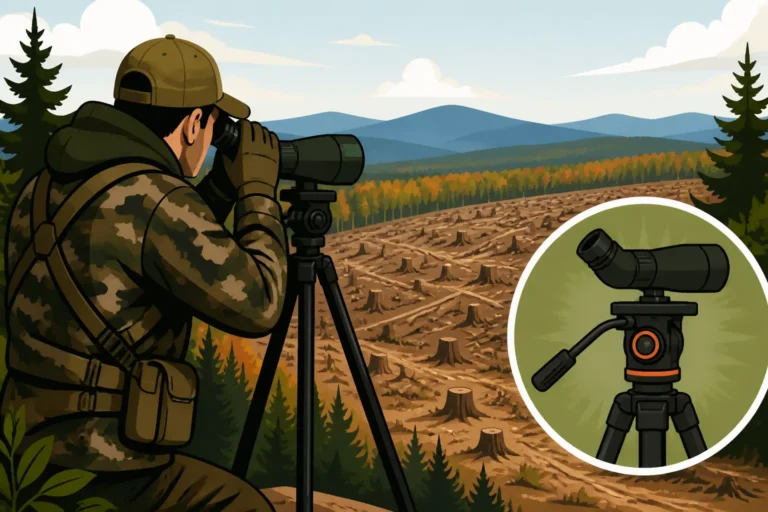
While an 8x magnification can be held fairly steady, any extended glassing, or the use of 10x or higher magnification, will greatly benefit from a tripod. Even the steadiest hands will eventually fatigue, leading to subtle shakes that blur details, especially in low light. A tripod completely eliminates this issue, providing a rock-solid platform for your binoculars. This stability allows you to pick apart distant cover with meticulous detail, spotting subtle movements or distinguishing game from background clutter that you'd simply miss with a freehand view.
Most quality binoculars have a threaded port on the front hinge designed for a tripod adapter. These adapters are typically small, L-shaped brackets that screw into this port and then attach to a standard photography tripod. While carrying a tripod adds weight, the increased stability and image quality it provides for long glassing sessions, particularly when trying to locate a bull moose across a large bog, can be well worth the effort. It allows you to relax, minimize eye strain, and concentrate solely on what you're seeing, rather than fighting to keep the image steady.
Maintaining Your Optics in Damp Conditions
New Hampshire bogs are wet. It's a fact of life. Your binoculars, even if waterproof, require care to ensure they perform optimally year after year. First and foremost, resist the urge to wipe lenses with your shirt or a dirty cloth. This can scratch the delicate coatings. Always carry a dedicated lens cleaning kit, which typically includes a soft brush to remove grit, a lens cleaning solution, and a microfiber cloth. Use the brush first to gently remove any dust or debris, then a small amount of solution on the cloth to wipe smudges or water spots.
After a wet day in the bog, especially if your binoculars have been exposed to mud or prolonged rain, it's crucial to dry them properly. Don't store them immediately in an airtight case. Allow them to air dry in a warm, dry place with the lens caps off. If water has splashed onto the objective or eyepiece lenses, gently blot it dry with a clean microfiber cloth. Even with fog-proof optics, extreme temperature changes can sometimes cause external condensation; simply letting them equalize temperature or wiping the exterior will resolve this. Proper maintenance not only ensures clear viewing but also extends the lifespan of your valuable optical investment. Best Rain Gear for a Wet White Mountain Hunt often goes hand-in-hand with good binocular care.
Making the Investment: Choosing Your Bog Binoculars
Investing in a good pair of binoculars for hunting New Hampshire's North Country bogs is a long-term decision. It’s not just about a purchase; it's about equipping yourself with a tool that will significantly enhance your hunting experience and success for years to come.
Budget Considerations and Value
Let's be realistic: high-quality optics can be a significant investment. You'll find binoculars ranging from under a hundred dollars to well over a thousand. While it's tempting to go for the cheapest option, remember that with optics, you generally get what you pay for, especially when it comes to low-light performance, clarity, and durability. However, that doesn't mean you need to break the bank for excellent performance. There's a sweet spot where diminishing returns start to kick in.
Many mid-range binoculars today offer incredible value, providing exceptional optical performance, robust construction, and reliable waterproofing at a price point that is accessible to many hunters. When considering your budget, think of your binoculars as a critical piece of safety and success equipment, on par with your rifle or bow. While a more affordable pair might get you by, a quality pair will elevate your hunting experience, reduce eye strain, and ultimately help you spot more game in challenging bog conditions. Researching detailed reviews on hunting gear sites, or platforms like GoHunt, can help you identify binoculars that offer the best value within your price range.
Trying Before You Buy
Specifications on paper are one thing; real-world feel and performance are another entirely. Whenever possible, make an effort to physically handle and look through different binocular models before making a purchase. Visit a local sporting goods store or an optics dealer. This allows you to assess the ergonomics firsthand: how do they feel in your hands? Is the focus wheel smooth and accessible? Can you comfortably adjust the diopter?
More importantly, try to look through them, ideally in varying light conditions. While a brightly lit store isn't the same as a shadowy bog, you can still get a sense of the image clarity, brightness, and field of view. Compare different brands and models side-by-side. Pay attention to how quickly your eyes adjust, if there's any eye strain, or if the image seems to have a "tunnel" effect. What feels right for one person might not feel right for another, so personal comfort and preference are huge factors in a tool you'll be using extensively in the field.
Comparing Features for Your Specific Needs
Ultimately, the "best" binoculars for glassing a North Country bog are the ones that best suit your individual hunting style and the specific bogs you frequent. Do you spend most of your time meticulously picking apart a distant clear-cut from a stationary position, or are you actively still-hunting through dense, wet timber? Do you primarily hunt during peak low-light hours, or are you more of a mid-day mover?
Create a mental checklist of what matters most to you:
- Mobility vs. Stability: If you're constantly on the move, prioritize lighter, more compact binoculars. If you glass from fixed positions, you can afford a bit more weight for larger objective lenses and can plan to use a tripod.
- Low Light Priority: If dawn and dusk are your prime times, focus on excellent light transmission and objective lens size.
- Durability Needs: If you're particularly hard on gear, or plan to hunt in extremely harsh conditions, prioritize robust construction and waterproofing above all else.
- Budget Alignment: Find the best balance of features and quality that fits comfortably within your financial plan.
By thoughtfully weighing these factors and trying out different options, you'll be well on your way to choosing a pair of binoculars that will be an indispensable companion in New Hampshire's challenging North Country bogs. They are not just a tool; they are your extended eyes in the wild, helping you unlock the secrets of the landscape and bringing you closer to the game you pursue. For extensive trips, knowing Packing for a Nine-Day Moose Hunt includes the right optics is crucial.
Disclaimer
This article is for general informational purposes only and does not constitute professional advice. Laws, prices and regulations vary by location and change over time. Consult a qualified professional for guidance on your specific situation.