Best Stabilizer for a Treestand Shot
There's nothing quite like the vantage point of a treestand in the crisp New Hampshire autumn air, waiting for that tell-tale rustle in the leaves. But let's be honest, shooting from a treestand presents its own unique set of challenges. Whether you're dealing with an awkward angle, that sudden rush of adrenaline when a big buck steps out, or the gusty winds that seem to pick up exactly when you're at full draw, maintaining stability and accuracy can be a real battle. This guide is all about helping you understand how a good stabilizer can be your best friend in the stand, enhancing your shot and boosting your confidence when it matters most.
Understanding the Role of a Stabilizer for Treestand Hunting
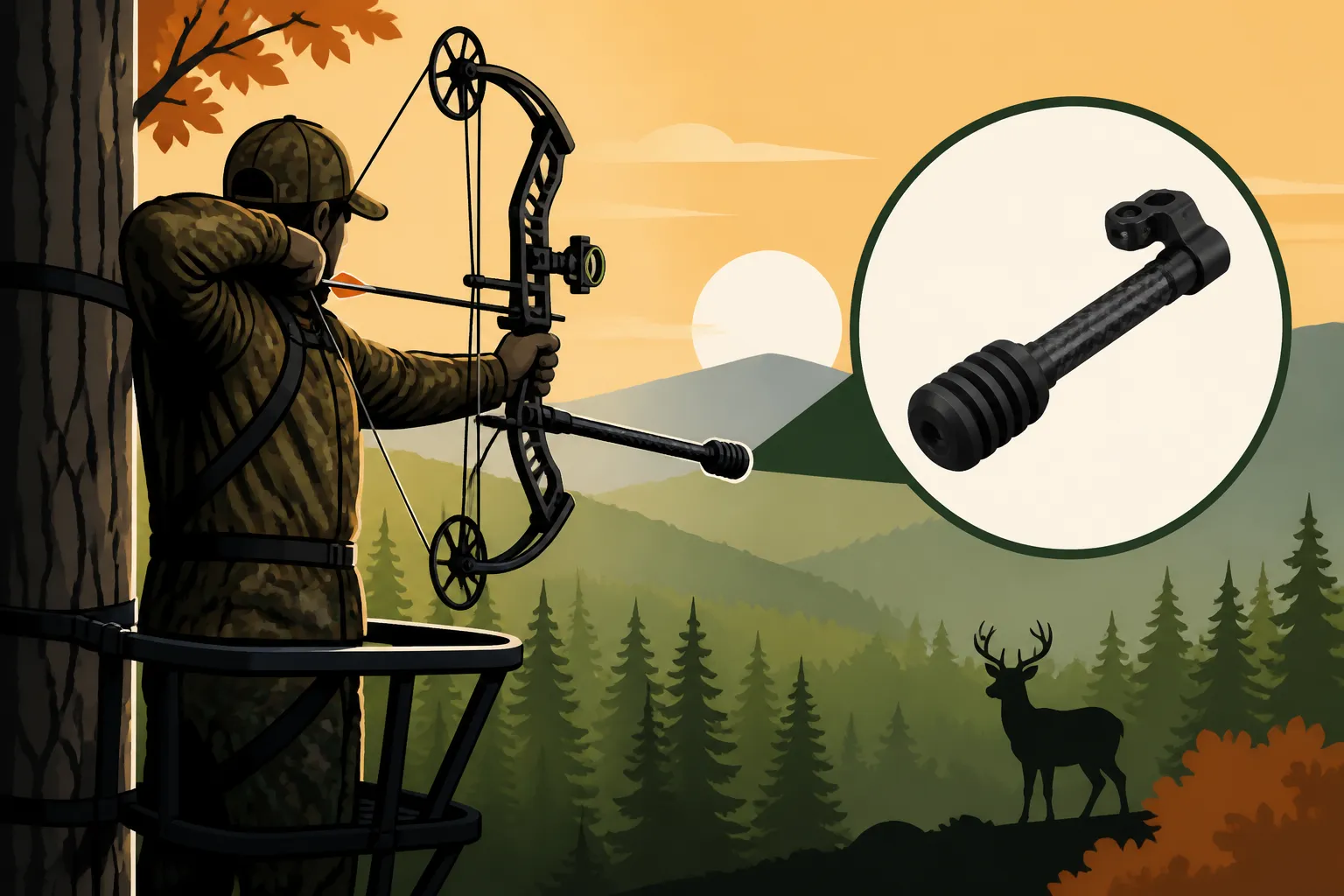
For many New Hampshire bowhunters, a treestand is a second home during the archery season. We spend hours perched up there, observing the woods, reading the terrain, and trying to anticipate deer movement. But when it's time to make a shot, the game changes. That stable, perfectly balanced feeling you get on the practice range might just disappear when you're 20 feet up, twisted slightly, with your heart hammering. That's where a stabilizer steps in to help.
Why Treestand Shots are Different
Shooting from a treestand isn't like shooting on flat ground. You're elevated, which immediately changes the geometry of your shot. Gravity works a little differently, and you might find yourself needing to bend at the waist or twist your torso to get a clear lane. This can lead to less-than-ideal shooting form, increasing the chances of hand torque or an unsteady aim. Think about trying to draw your bow while wearing bulky cold-weather gear for Layering for New Hampshire's Cold Hunting Season; it adds another layer of restriction and can throw off your natural balance.
The wind is another major factor. Even a gentle breeze can feel like a gale when you're up high, causing your bow to sway. This can be particularly true if you're set up in a more exposed location, perhaps on a ridge line or near a field edge. The psychological pressure of a shot opportunity, often called "target panic," can also amplify any unsteadiness you feel. A stabilizer helps to mitigate these issues by adding weight and length to the bow, making it more forgiving and easier to hold steady. It's about giving you every possible advantage when that fleeting moment arrives.
The Core Functions of a Good Stabilizer
At its heart, a stabilizer serves several critical functions. First and foremost is weight distribution. By extending weight out from the riser, a stabilizer shifts the bow's center of gravity. This makes the bow feel more balanced in your hand, reducing the tendency for it to tip or torque, especially when you're at full draw. A well-balanced bow is simply easier to hold still, allowing you to settle your pin more quickly and precisely.
Secondly, a good stabilizer excels at vibration dampening. After an arrow is released, the bow experiences a burst of energy and vibration. Without proper dampening, this vibration travels through the riser and into your hand, causing an unpleasant "hand shock" and often making the bow louder. A stabilizer absorbs much of this energy, resulting in a quieter, smoother shot. This noise reduction is absolutely critical in New Hampshire's quiet timber, where every decibel counts, especially if you're trying for a follow-up shot or if there are other deer nearby.
Finally, a stabilizer increases the moment of inertia. Simply put, a longer object is harder to move once it's still, and harder to stop once it's moving. By extending the stabilizer out, you increase the bow's resistance to rotational movement. This means less pin float and a more stable aiming experience at full draw. It helps counteract minor shakes and tremors, providing a more confident and steady platform for your shot, whether you're Hunting a Funnel Between Two Woodlots or in a wide-open apple orchard.
Key Features to Look For in a Treestand Stabilizer
Choosing a stabilizer isn't a one-size-fits-all situation. What works for a target archer on a calm range might be utterly impractical for a hunter nestled in a treestand on a blustery New Hampshire morning. There are specific features that truly shine when your primary goal is consistent accuracy from an elevated position.
Length and Weight Considerations
This is perhaps the most debated aspect of stabilizer selection. Generally, longer stabilizers provide more leverage and therefore more stability. They extend further from the bow, increasing that moment of inertia we talked about, and making the bow steadier at full draw. However, a long stabilizer can also be a significant hindrance in a treestand. It can catch on branches, bang against the stand's platform, or get tangled in your harness, making maneuvering for a shot cumbersome and noisy. When you're trying to stay quiet and discreet, the last thing you need is a noisy metallic clunk.
For treestand hunting, many New Hampshire hunters find a sweet spot in the 6- to 10-inch range. This length often provides a good balance of added stability without becoming overly long and unwieldy. The actual weight of the stabilizer, and crucially, the ability to adjust that weight, is also vital. Many stabilizers come with removable weights that allow you to fine-tune the balance of your bow. You might prefer more weight forward to drive your pins down, or you might need to counter a heavy sight or quiver on the other side. Consider how your bow feels with a loaded quiver and your preferred Best Bow Sight for New Hampshire Archery Season attached. The ability to fine-tune means you can achieve that perfect, natural balance that feels right for you and your specific setup.
Vibration Dampening Technology
Nobody wants a bow that kicks like a mule and sounds like a thunderclap after the shot. Effective vibration dampening is a non-negotiable feature for any treestand stabilizer. The materials used play a big role here; carbon fiber, for example, is known for its excellent strength-to-weight ratio and ability to absorb vibration. Aluminum stabilizers, while durable, often rely more heavily on internal dampening systems, such as proprietary rubber compounds or fluid-filled chambers, to mitigate shock.
When you're perched silently in a treestand, every sound is amplified. A quiet shot isn't just about comfort; it's about not alerting other game. A deer might not bolt at the sight of you, but a loud bow can send it sprinting. Look for stabilizers that specifically mention advanced vibration-dampening technologies. Some brands integrate specialized elastomers or multi-rod designs to absorb more shock and sound. You want a stabilizer that makes your bow feel dead in your hand after the shot, minimizing hand shock and keeping the noise profile as low as possible. When researching gear, platforms like GoHunt often have user reviews and expert breakdowns that can highlight how well different models perform in terms of dampening.
Mounting and Quick-Detach Options
The practicality of mounting and removing your stabilizer might seem like a minor detail, but it can make a big difference, especially for those long treks to your favorite spot. Most stabilizers attach via a standard screw-in thread, but the rise of quick-detach (QD) systems has been a game-changer for many hunters. With a QD system, you can easily remove your stabilizer for packing your bow in and out of the woods, then quickly reattach it once you're in your stand. This is particularly useful if you're on a long hike to Hunting a Granite Ridge Saddle or Still-Hunting White Mountain National Forest Timber before settling into a stand.
Imagine navigating through thick brush or climbing into a stand with a long, cumbersome stabilizer constantly getting snagged. A QD system solves that problem, allowing you to protect your stabilizer from damage and making your bow more compact for transport. Just be sure that any QD system you choose is robust and doesn't introduce any play or instability into the connection. You want it to be rock-solid once attached. Think about how you typically transport your bow, whether it's slung over your shoulder or in a dedicated pack like the kind you'd use for Packing for a Nine-Day Moose Hunt. Ease of attachment and removal can significantly improve your overall hunting experience.
Choosing the Right Stabilizer for Your New Hampshire Hunt
Ultimately, the "best" stabilizer is the one that works best for you and your specific hunting setup in the unique New Hampshire environment. It's a personal choice that requires a bit of experimentation, but by understanding the key factors, you can make an informed decision that will genuinely improve your accuracy and confidence in the treestand.
Matching to Your Bow Setup and Hunting Style
Every bow has its own personality, and every hunter has their own shooting style. Before you even think about buying a stabilizer, take some time to understand your bow's natural balance. Does it tip forward, backward, or to one side when you hold it loosely at full draw? This information will help you determine how much weight and what length of stabilizer you might need to achieve optimal balance. You might even find that your quiver, full of arrows, or your choice of Best Arrow Rest for a Hunting Setup significantly impacts this natural balance.
Your hunting style also plays a crucial role. If you exclusively hunt from small, compact hang-on stands where space is at a premium, a super-long stabilizer might be more trouble than it's worth. If you prefer larger ladder stands or ground blinds (and yes, we do sometimes use Using a Ground Blind on Public Land), you might have more leeway for a slightly longer setup. Consider your physical build too; a stronger shooter might handle more forward weight, while someone who finds their bow feels heavy might prefer a lighter, more compact option. The goal is to find a stabilizer that complements your bow and your form, making the entire setup feel like a natural extension of yourself.
Testing and Fine-Tuning Your Stabilizer
Once you've got a stabilizer, the real work begins: testing and fine-tuning. Don't just screw it on and head to the woods. Spend time at the range, but try to simulate treestand conditions as much as possible. Practice shooting from elevated positions, perhaps from a hill or a shooting tower, if your range has one. Experiment with different angles and body positions that you might encounter in a real treestand scenario. This is also where GoHunt's detailed gear reviews and tuning guides can be incredibly helpful, offering insights into how other hunters have optimized their setups.
If your stabilizer has adjustable weights, play with them! Start with a neutral setup and then add or remove weights until your bow feels perfectly balanced. Pay attention to how your pins settle at full draw and how the bow recovers after the shot. Sometimes even a quarter-ounce difference can make a noticeable impact on how stable your bow feels. Don't forget to practice with your hunting broadheads as well. Tuning a Bow for Broadhead Flight is essential, and sometimes the flight characteristics can change with the added or subtracted weight of a stabilizer. Remember that accessories like a quiver full of arrows, your sight, and even your release aid can affect the overall balance, so tune with your full hunting setup.
Here's a quick comparison of common stabilizer characteristics for treestand hunting:
| Feature | Short Stabilizer (4-6 inches) | Mid-Length Stabilizer (6-10 inches) | Long Stabilizer (10+ inches) |
|---|---|---|---|
| Length | Compact, less likely to snag | Good balance, common choice for treestands | Maximum stability, but can be cumbersome |
| Weight | Often lighter, less added mass | Moderate, often with adjustable weights | Can be heavier, provides more inertia |
| Dampening | Typically good, but less surface area to absorb vibration | Very effective, often has advanced internal systems | Excellent at vibration absorption due to length and mass |
| Maneuverability | Excellent in tight spaces, easy to transport | Good, generally manageable in most stands | Can be challenging in tight treestands or thick brush |
| Pin Stability | Moderate improvement | Significant improvement | Maximum improvement |
| Pros | Great for dense woods, very portable, lightweight | Versatile, balances stability and practicality, popular choice | Superior stability, ideal for open shots or less movement |
| Cons (Treestand) | Less overall stability compared to longer options, less leverage | Might still catch on some smaller stands, heavier than short | Very prone to snagging, challenging to maneuver in tight spots |
Cost vs. Performance
Like most hunting gear, stabilizers come in a wide range of price points. You can find basic models for a modest outlay, all the way up to high-end, custom-tuned systems that represent a significant investment. For the average New Hampshire treestand hunter, you don't necessarily need the most expensive model on the market to see a significant improvement.
Entry-level stabilizers will offer basic weight and some dampening, which is often a big step up from no stabilizer at all. Mid-range options usually provide better dampening technology, more precise adjustable weights, and often better materials (like carbon). These are often the sweet spot for hunters, offering excellent performance without breaking the bank. High-end stabilizers are typically favored by competitive target archers or hunters who demand the absolute peak of performance and have the budget for it. They might feature highly advanced dampening systems, ultra-light yet strong materials, and extremely precise adjustability.
My advice? Don't just buy the cheapest one, but don't feel pressured to buy the most expensive either. Focus on finding a stabilizer that offers good vibration dampening, a reasonable length for your treestand setup (6-10 inches is a great starting point), and ideally, some adjustable weights. Read reviews, talk to other hunters, and consider how much you value that extra ounce of stability and quietness. The peace of mind and improved accuracy you get from a well-chosen stabilizer can be invaluable when that New Hampshire buck steps into your shooting lane. Investing in a quality stabilizer is investing in better shots and more confident hunting trips.
Disclaimer
This article is for general informational purposes only and does not constitute professional advice. Laws, prices and regulations vary by location and change over time. Consult a qualified professional for guidance on your specific situation.