Best Camo for New Hampshire Hardwood Timber
The New Hampshire hardwood timber stands, with their towering oaks, maples, and birches, offer some of the most challenging yet rewarding hunting experiences in the Northeast. However, successfully blending into this dynamic environment is a constant battle, especially as the seasons shift. This guide will walk you through the nuances of choosing the best camouflage patterns and strategies to help you disappear into New Hampshire's iconic hardwood forests, from the vibrant greens of early autumn to the stark grays of late fall.
Understanding New Hampshire's Hardwood Timber Environment
Hunting in New Hampshire's hardwood timber isn't just about finding the right tree; it's about becoming part of the landscape. The very nature of our hardwood forests means a constantly shifting palette of colors and textures that challenge any static camouflage pattern. You're not just dealing with trees; you're dealing with light, shadow, undergrowth, and the keen senses of the local wildlife.
The Shifting Seasons and Their Impact on Color
Think about a year in our New Hampshire woods. It's a visual kaleidoscope, isn't it?
In spring, after the last snow melts, the forest floor erupts with a carpet of muted greens, while the trees themselves are just hinting at their summer splendor, with tender, light green leaves unfurling. Then summer arrives, painting everything in deep, lush greens, dense canopies casting heavy shadows, and thick undergrowth creating a verdant wall. This is a time when movement is often more critical than specific color, as the sheer density of foliage can help conceal you.
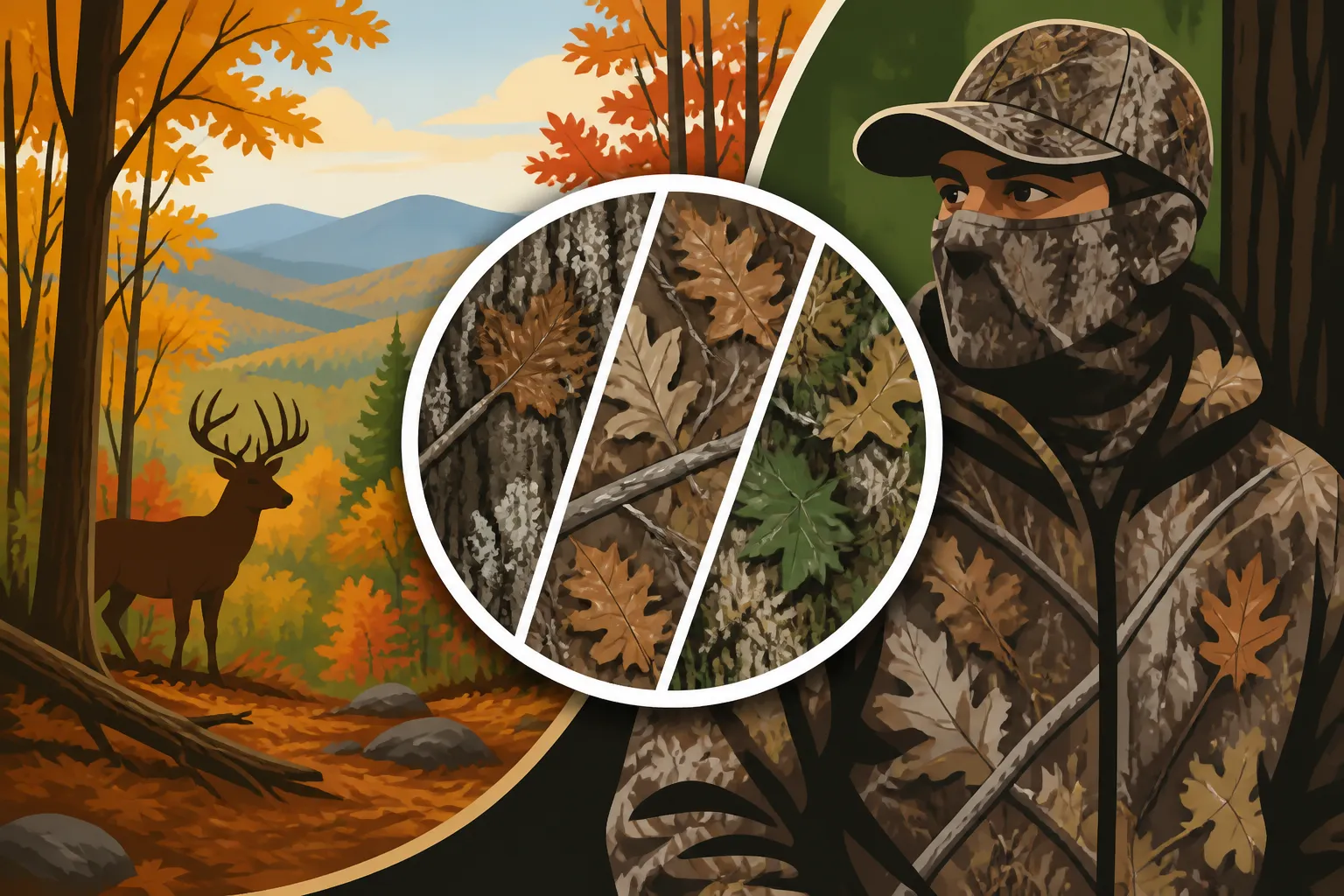
But for most deer hunters, the real challenge begins in the fall. Early archery season often catches the tail end of summer green before the explosive change of autumn. Suddenly, the woods transform into a riot of reds, oranges, and yellows – a spectacle for us, but a major hurdle for a hunter trying to remain unseen. A pattern that worked perfectly in September might now make you stick out like a sore thumb against a backdrop of flaming maples. As October deepens into November, those brilliant leaves turn brown, shrivel, and eventually fall, leaving behind a stark, skeletal forest of gray and dark brown trunks, with patches of evergreens offering contrast. Then, if you're out for the late muzzleloader season, you might find yourself hunting against a backdrop of bare branches and the first dusting of snow, demanding an entirely different visual strategy. This constant evolution is why a "one-size-fits-all" approach to camo simply doesn't cut it in the Granite State.
Key Characteristics of Granite State Hardwoods
Beyond the color changes, the physical characteristics of New Hampshire's hardwood forests present their own unique challenges. We're talking about a mix of northern hardwoods like sugar maple, red maple, yellow birch, American beech, and various oak species. Each has its own distinct bark texture – from the smooth gray of beech to the deeply furrowed bark of older oaks. These textures create intricate patterns of light and shadow, which savvy camo patterns try to mimic.
Consider the undergrowth too. In many hardwood stands, especially those with past logging activity or good sunlight penetration, you'll find thick tangles of young saplings, ferns, briars, and low-growing shrubs. These layers add depth and complexity to the visual environment. Then there's the forest floor itself, often littered with fallen leaves, branches, rocks, and moss-covered logs. A good camo pattern isn't just about matching the trees; it's about breaking up your human silhouette against all these elements. Generic patterns designed for vast open country or uniform pine forests simply won't have the varied detail and contrast needed to truly disappear into the diverse, close-quarters environment of a New Hampshire hardwood stand. You need patterns that incorporate natural elements and varying depths of field, not just flat color blocks.
Decoding Camo Patterns: What Works in New Hampshire Hardwoods
Choosing camouflage isn't just about picking a cool-looking pattern off the rack. It's about understanding how animals perceive their world and how your gear can exploit those perceptions. Especially when you're deep in the New Hampshire's November Firearms Deer Season, every detail counts.
The Science of Deer Vision and Camouflage
Let's clear up a common misconception: deer don't see the world in black and white. They're not completely colorblind, but their color vision is different from ours. Humans are trichromatic, meaning we have three types of cone cells in our eyes that detect red, green, and blue light. Deer, however, are dichromatic. They primarily see in shades of blue and yellow, and they struggle to distinguish between reds, oranges, and greens. To a deer, many of the vibrant red and orange leaves of autumn might appear as muted yellows or browns. This is crucial for us as hunters.
What deer excel at is detecting movement and discerning contrast. Their eyes are highly sensitive to movement, and they have excellent night vision, allowing them to pick up subtle changes in light and shadow. So, while your blaze orange vest might look screamingly bright to another human hunter, to a deer, it often appears as a dull gray or brown blob. The real challenge for camo, then, isn't necessarily mimicking exact colors, but rather breaking up your human outline and disrupting the hard lines that give away your shape. A solid blob of any color, even one a deer can't distinguish from green, will still look like a solid blob if it doesn't interrupt your form against the background. This is why patterns that create a fractured, irregular appearance are so effective.
Pattern Types and Their Effectiveness
When you walk into a sporting goods store, the array of camo patterns can be overwhelming. But they generally fall into a few categories, and some are definitely better suited for New Hampshire's hardwood timber than others.
First, you have photorealistic patterns. These are designed to mimic actual elements like leaves, branches, and bark down to intricate detail. Brands like GoHunt often feature patterns that excel in specific environments. For dense hardwood timber, these patterns can be incredibly effective, especially if they incorporate a good mix of light and dark elements to create depth and shadow. Look for patterns with larger, more distinct natural elements, rather than overly "busy" or small-scale patterns that tend to blob together at a distance. If the pattern is too small, it loses its effectiveness in breaking up your outline from even a moderate distance, especially against the varied textures of bark and undergrowth.
Then there are digital or geometric patterns. These use pixilated shapes to create a "digital" breakup of your form. While popular, they can be hit or miss in hardwoods. In very open, uniform environments, they might work, but in the complex, organic chaos of a hardwood forest, they sometimes lack the natural texture and depth needed to truly blend. Deer, with their keen ability to detect contrast, might pick up on the unnatural angularity if the pattern doesn't perfectly match the surrounding environment's shapes.
Finally, you have abstract or naturalistic patterns. These patterns don't necessarily mimic specific leaves but use irregular shapes, blotches, and color variations to create a disruptive effect. Many traditional "stick and leaf" patterns fall into this category. These can be very effective in hardwoods because they create an illusion of depth and break up your silhouette without being overly specific. The key is to find patterns that incorporate the right balance of light and dark, along with colors that align with the season. For example, a good abstract pattern for late season Hunting the December Archery Close would feature strong contrasts of grays, dark browns, and perhaps a touch of muted green from moss or evergreens. The aim is to create visual "noise" that prevents a deer's brain from recognizing a distinct, threatening shape.
Color Palettes Through the Seasons
The most challenging aspect of camo in New Hampshire hardwoods is adapting to the seasonal color shifts. What works in September won't necessarily work in November.
-
Early Archery Season (September/Early October): This is often the tail end of summer, with lush greens still dominating the landscape. You'll want patterns that incorporate plenty of greens, muted browns, and some lighter tan elements to mimic dappled sunlight. Look for patterns that are a bit "busier" to blend with the dense foliage. A mix of olive greens, forest greens, and bark browns will serve you well. Bowhunting New Hampshire's Long Archery Season often means you're still hunting against a lot of green.
-
Peak Fall Foliage (Mid-October/Early November): This is where it gets tricky. The reds, oranges, and yellows are dazzling. While deer don't see red and orange as we do, a bright, unbroken swath of color will still stand out. Here, you want patterns that lean heavily into deeper, richer browns, some muted yellows, and even hints of burgundy or rust. The critical factor is high contrast within the pattern itself to break up your outline against the vibrant, yet often muted to a deer's eye, background. Think deep bark browns, shadowy grays, and patches of "leaf litter" colors.
-
Late Season (Late November/December Muzzleloader): The leaves are down, the woods are bare, and the dominant colors are grays, dark browns, and the occasional evergreen patch. This is when stark contrast and deep, shadowy patterns become paramount. You need something that blends with the skeletal branches and dark tree trunks. Patterns featuring heavy doses of dark grays, charcoal, and deep browns, often with vertical elements to mimic tree trunks, are ideal. If there's snow, a pattern that incorporates some white or very light gray can be beneficial, but often, simply blending with the dark trunks is more important than matching the snow, as deer will often be focused on the contrasting shapes of trees. For hunters during Hunting a Muzzleloader Tag Before Firearms Opens, the sparse timber demands a pattern that really helps you disappear against the bare branches.
| Season | Dominant Colors | Recommended Camo Color Palette | Key Pattern Feature |
|---|---|---|---|
| Early Archery (Sept/Early Oct) | Lush greens, light browns | Olive greens, forest greens, muted tans, bark browns | Dense, varied foliage/leaf patterns; high green content |
| Peak Foliage (Mid Oct/Early Nov) | Reds, oranges, yellows, browns | Rich browns, deep grays, muted yellows/golds, hints of burgundy | High contrast, natural elements like bark and branches |
| Late Season (Late Nov/Dec) | Grays, dark browns, occasional white | Charcoal, deep browns, grays, sparse muted green from evergreens | Strong vertical elements, stark light/dark contrast |
Practical Considerations for Choosing Your Hardwood Camo
Selecting the right camo goes beyond just the pattern. It's about the entire system of gear you wear and how it works together in the challenging New Hampshire environment.
Layering Your Camo for Comfort and Concealment
New Hampshire weather is famously unpredictable. A crisp, cool morning can turn into a surprisingly warm afternoon, or a beautiful day can suddenly be interrupted by a cold, driving rain. This is why layering is not just about comfort; it's also part of your concealment strategy.
You can't expect one heavy camo jacket to serve you for the entire season. Instead, think of your camo as a system. Your base layers, worn directly against the skin, should be moisture-wicking and comfortable, even if they aren't camo-patterned. Many hunters opt for solid, neutral colors like dark green, gray, or brown for their base and mid-layers, as these are less likely to contrast sharply if a outer layer shifts or opens.
Your mid-layers, like fleece or insulated jackets, provide warmth. While these can be camo-patterned, it's more important that they provide the necessary warmth without being bulky and restricting movement. The outermost layer is where your primary camo pattern truly shines. This shell layer needs to be durable, quiet (no swishy fabrics!), and provide adequate protection from wind and rain. For instance, if you're layering up for a late-season sit, you'll want an insulated jacket or vest with a suitable camo pattern that can be worn over your Best Mid-Layer for a November Firearms Hunt but still allow for quiet movement. A common mistake is to pick a camo pattern for the outer shell but neglect the quieter materials underneath, leading to unnecessary noise when drawing a bow or shouldering a rifle. The best approach is to choose a system where all layers, when combined, maintain your visual breakup and minimal noise profile.
Balancing Camo with Blaze Orange Requirements
New Hampshire has very specific New Hampshire Blaze Orange Requirements during certain hunting seasons, particularly during the peak firearms deer season. This can feel counterintuitive when your goal is to disappear, but it's crucial for safety. The good news, as we discussed with deer vision, is that blaze orange often appears as a dull gray or brown to a deer. The bad news is that it does stand out vividly to other human hunters, which is its intended purpose.
The key is strategic placement. Regulations typically require a certain amount of blaze orange to be worn and visible from all sides. Many hunters opt for a blaze orange vest worn over their camo jacket, or a blaze orange hat. Some outer camo jackets now come with integrated blaze orange panels that can be deployed. When choosing your camo, think about how it will integrate with your blaze orange. Avoid patterns that have large, open areas of a single dark color on your outer layer where the orange might need to be placed, as this can create too much of a stark contrast against a drab background. Instead, try to layer your orange in a way that allows your primary camo pattern to still break up your silhouette, even if the orange is clearly visible. For instance, a patterned orange vest might provide better disruption than a solid block of orange. The goal is to meet safety regulations without completely sacrificing your ability to blend into the complex patterns of the hardwood forest.
Beyond the Pattern: Scent, Movement, and Sound
Camo is undeniably important, but it's just one piece of a much larger puzzle, especially in the close-quarters environment of New Hampshire's hardwood timber. Deer, bear, and turkey rely heavily on their sense of smell, hearing, and ability to detect the slightest movement.
- Scent Control: A deer will smell you long before it sees your perfectly chosen camo pattern if you haven't taken scent control seriously. This means showering with scent-free soap, washing your hunting clothes in scent-free detergent, storing them in airtight bags, and using scent-eliminating sprays. Pay particular attention to your boots, as you leave a scent trail with every step. In the still air of a quiet hardwood stand, your scent can carry surprisingly far, especially on calm mornings.
- Minimizing Movement: This is arguably more important than your camo pattern. Deer are incredibly sensitive to movement. Even the best camo will fail if you're fidgeting, reaching for gear, or making quick, jerky motions. Learn to move slowly, deliberately, and only when a deer's head is down or it's looking away. Practice drawing your bow or raising your rifle slowly at home so you can execute the motion fluidly and quietly in the field. This is why having your gear easily accessible, perhaps in a quiet pocket or a GoHunt pack designed for silence, is crucial.
- Controlling Sound: Every rustle, crunch, or scrape can send game bolting. Choose clothing made from quiet fabrics like fleece, wool, or brushed synthetics. Avoid noisy zippers, buckles, or stiff materials. Be mindful of branches and leaves as you move through the woods, especially when Still-Hunting White Mountain National Forest Timber. Take slow, deliberate steps, placing your feet carefully to avoid snapping twigs or rustling dry leaves. Even the quietest hunter can give themselves away with a careless step in dry fall leaves. Remember, in the dense hardwoods, deer often approach silently, and their ears are constantly scanning for any unnatural sound.
By paying attention to these three critical factors, you elevate your chances of success far beyond what camo alone can provide. Camo gets you close; scent, movement, and sound are what seal the deal.
Recommended Camo Styles for Different New Hampshire Hardwood Scenarios
Given the dynamic nature of New Hampshire's hardwood forests, it's helpful to think about camo not as a single solution, but as a flexible approach tailored to specific seasonal conditions.
Early Season Archery in Leafy Woods
When the New Hampshire Archery Season Opening Day arrives, our hardwood forests are typically still bursting with lush green foliage. The leaves are vibrant, the undergrowth is dense, and shadows are deep and distinct. This environment calls for a camo pattern that mirrors this verdant backdrop.
For early season archery, you want patterns that incorporate a significant amount of deep, forest green, alongside some lighter greens, browns, and tans. Look for patterns with large, somewhat blurred leaf and branch elements. These will help you blend with the dense canopy and understory, breaking up your outline effectively against a sea of green. Avoid patterns with too much stark contrast or too many light areas, as these can create unnatural "hot spots" when viewed against the deep shadows of a full-foliage forest. Patterns that mimic a leafy canopy or dense brush are ideal. Consider options from reputable brands like GoHunt that offer patterns specifically designed for heavily vegetated environments. The key is to disappear into the overall green mass, letting the varied tones and textures of the pattern melt into the actual leaves around you. Remember, deer will be focused on horizontal lines and unnatural shapes, so a good pattern will disrupt those visual cues.
Peak Firearms Season in Colorful Fall Forests
This is arguably the most challenging time for camouflage in New Hampshire. The woods explode with the vibrant reds, oranges, and yellows of peak foliage, making it a breathtaking sight but a camouflage nightmare if you're not prepared. The New Hampshire Firearms Season Opening Day often falls right in the middle of this spectacle.
For peak fall foliage, you need patterns that lean heavily into the browns, tans, and grays of bare branches and fallen leaves, but with enough contrast to break up your outline against the remaining bursts of color. Don't try to match the bright red maples; instead, focus on disappearing into the darker elements and textures of the forest. Look for patterns with strong, dark vertical and horizontal elements to mimic tree trunks and fallen limbs. A good pattern will incorporate deep browns, grays, and perhaps some muted golden or rust tones. The contrast within the pattern is crucial here. Photorealistic bark patterns or abstract patterns with strong dark and light areas work well. The goal is to prevent your human silhouette from standing out as a solid, unnatural shape against the background of varied, sometimes intense, colors. A pattern that looks a bit "busy" up close but effectively blurs and breaks up your form at a distance will serve you best. It's less about matching the bright leaves and more about becoming invisible against the chaos of the changing woods.
Late Season Muzzleloader in Sparse Timber
As the calendar turns towards late November and December, the hardwood forests have shed most of their leaves. The landscape transforms into a stark, muted environment dominated by grays, dark browns of tree trunks, and perhaps patches of lingering evergreens or the first dusting of snow. Hunting Into the December Muzzleloader Close requires a refined approach to camo.
For late season, your focus should shift to patterns that emphasize dark grays, charcoal, and deep, muted browns. Look for patterns with strong vertical elements that mimic the bare tree trunks and branches. Digital or abstract patterns with a high degree of contrast between dark and light shades can be very effective here, as they excel at breaking up your outline against the repetitive vertical lines of the bare woods. If hunting areas are known to have patches of snow, a pattern that incorporates subtle hints of white or very light gray can be an advantage, but generally, blending with the dark, skeletal structure of the trees is paramount. The key is to avoid large, unbroken expanses of light color that would make you stand out against the darker trunks. The goal is to look like another piece of the forest, an old stump, a shadowy tree trunk, or part of a dense thicket. In this environment, even the best camo from GoHunt will be enhanced by finding naturally shaded areas or setting up near dense evergreens for added concealment.
Disclaimer
This article is for general informational purposes only and does not constitute professional advice. Laws, prices and regulations vary by location and change over time. Consult a qualified professional for guidance on your specific situation.