Best Satellite Communicator for North Country Land
There's nothing quite like the feeling of venturing deep into New Hampshire's North Country, whether you're chasing deer, calling a moose, or just soaking in the incredible wild beauty. But that expansive, rugged landscape, for all its splendor, often comes with a glaring challenge: absolutely zero cell service. Suddenly, a twisted ankle, a sudden white-out, or an unexpected mechanical issue with your vehicle can turn a great day into a terrifying ordeal. This guide is here to walk you through why a satellite communicator isn't just a gadget, but a vital piece of gear for anyone spending time off-grid in the Granite State, and how to pick the right one.
Why a Satellite Communicator is Absolutely Essential in New Hampshire's North Country
Let's be honest, we all love the idea of disconnecting, escaping the endless pings and notifications. But in the vast wilderness of northern New Hampshire, especially in areas like the Connecticut Lakes Headwaters or deep within the White Mountain National Forest, that "disconnect" can quickly become a serious safety concern. Your cell phone, often your lifeline in daily life, becomes nothing more than a camera and a clock when there's no tower to pick up its signal. This isn't just about calling for help; it's about peace of mind, for you and for those back home.
The Treacherous Nature of Remote Terrain
New Hampshire's North Country is beautiful, but it's also incredibly unforgiving. You've got towering peaks, dense timber, vast bogs, and a spiderweb of logging roads that often dead-end miles from civilization. A simple slip on wet leaves while Still-Hunting White Mountain National Forest Timber could mean a broken leg. A sudden, unexpected storm, which can roll in with surprising speed, might leave you disoriented or hypothermic. These aren't just hypothetical scenarios; they're real risks that seasoned hunters and outdoors enthusiasts face every season. When you're miles from the nearest paved road, and perhaps even further from another human, a satellite communicator is your only reliable link to the outside world.
Think about scouting new ground in a WMU that's heavily timbered, or pushing deep into the woods during Moose Hunting New Hampshire's North Country. You might be tracking a deer or working your way around a beaver flowage, and suddenly you realize you're much deeper than anticipated. If an emergency arises, yelling for help won't do much good, and waiting for someone to find you could be a matter of hours, or even days, in these remote areas.
Peace of Mind for You and Your Loved Ones
Beyond pure survival, a satellite communicator offers an invaluable sense of security. I can't tell you how many times I've heard stories from spouses or parents worried sick because their loved one went into the woods for a planned hunt and didn't check in by nightfall. With a communicator, you can send quick "I'm OK" messages or let family know your progress, even when you're completely off the grid. This simple act can alleviate so much stress for everyone involved.
Consider the winter months when you might be Tracking a Deer in Fresh White Mountain Snow. The days are shorter, temperatures drop dramatically, and any incident becomes far more serious. Being able to send a message confirming your location and status, or even requesting a later pick-up time, allows everyone to rest a little easier. It's about being prepared, yes, but it's also about fostering trust and communication, ensuring that your adventures don't inadvertently become a source of anxiety for those you care about.
Key Features to Look for in a Satellite Communicator for New Hampshire Hunting
Choosing the right satellite communicator isn't a one-size-fits-all decision. The market has grown, offering a range of devices with varying capabilities and price points. For hunting in New Hampshire's diverse terrain, from the rugged mountains to dense lowlands, certain features become more critical than others.
SOS Functionality and Two-Way Messaging
This is the non-negotiable, absolute must-have feature. Every satellite communicator worth its salt will have a dedicated SOS button that, when activated, sends a distress signal with your exact GPS coordinates to a 24/7 emergency response center. These centers are staffed by professionals who will contact local search and rescue teams, including New Hampshire Fish and Game, to initiate a rescue. This isn't just an alert; it's a direct connection to help.
Equally important is two-way messaging. Many older or cheaper devices might only allow you to send a pre-programmed "I'm OK" message or a one-way SOS. However, modern communicators allow you to send and receive custom text messages. This is crucial for non-life-threatening situations. Imagine your buddy gets a flat tire miles up a gated logging road, or you need to coordinate a meeting point after a successful Field Dressing a Moose in the North Country. Being able to send specific messages back and forth means you can relay details, clarify needs, and get help that's tailored to your situation, rather than just activating a full-blown emergency response. Some communicators even allow you to pair them with your smartphone via an app, making typing messages much easier.
Battery Life and Durability
New Hampshire weather can be fickle, and a dead battery is as useless as no signal at all. Look for devices with excellent battery life, especially when used in cold conditions, which can significantly drain power faster. Some devices offer extended battery modes or the ability to replace batteries in the field. Carrying a portable power bank is always a good idea, but the device itself should have a robust internal power source.
Durability is another huge factor. You're going to be out in the woods, potentially in rain, snow, or sleet. Your communicator will likely get dropped, bumped, and covered in mud. Look for devices with a high IPX rating for water and dust resistance. A rugged, impact-resistant casing is also paramount. You don't want your lifeline to shatter the first time it takes a tumble off your pack while Hanging a Stand on a Granite Ridge. Consider devices that are designed for outdoor enthusiasts, rather than just casual use.
GPS Tracking and Mapping Integration
While your primary mapping might come from a dedicated GPS unit or an app like GoHunt on your phone, a satellite communicator with built-in GPS tracking can provide an extra layer of safety. Many devices can send your location at set intervals, allowing loved ones or a designated contact to track your progress online. This "breadcrumb" trail is invaluable if something goes wrong, as it gives search teams a clear path to follow.
Some advanced communicators also offer basic mapping capabilities on their screens or, more commonly, integrate seamlessly with smartphone mapping apps. This means you can view your location on a detailed topo map, even when your phone has no service, and then use the communicator to send those coordinates to someone. This combination of onX Layers for New Hampshire Land Status on your phone and a satellite device for communication provides a robust navigation and safety system for navigating complex terrain.
Understanding Service Plans and Costs
A satellite communicator isn't a one-time purchase like a compass. To actually use its messaging and SOS features, you'll need an active subscription plan. This is where many people get tripped up, thinking the upfront cost is all there is. Understanding the different plan structures is key to budgeting and ensuring you have the right level of service for your hunting needs.
Monthly vs. Annual Plans
Most satellite communicators offer both monthly and annual subscription options.
- Monthly Plans: These are often more flexible, allowing you to activate service only for the months you plan to be in the backcountry. If you only hunt deer in the fall and then put your gear away for the winter, a monthly plan might save you money. You can pause or reactivate your service as needed. However, the monthly rate for these plans is typically higher than if you committed to a full year. They might also come with activation fees each time you reactivate.
- Annual Plans: Committing to an annual plan usually results in a lower overall cost per month, as you're paying for a full year of service upfront or through a recurring monthly charge. This is a good option for those who are in the woods frequently, throughout various seasons like Spring Turkey Hunting in New Hampshire or Bear Hunting New Hampshire's Bait and Hound Season, or for anyone who wants continuous peace of mind. Some annual plans might include a certain number of free messages per month or other perks.
When comparing, always look at the total cost over a year, factoring in any activation fees or reactivation charges.
Message Bundles and SOS Inclusions
Service plans typically revolve around message bundles. You'll often find tiers like:
- Basic/Emergency Only: This might include unlimited SOS capability but very few, if any, included custom text messages. You'd pay per message beyond the base allowance. This is the barebones option, purely for emergencies and very limited communication.
- Mid-Tier: These plans usually include a set number of messages (e.g., 20-50 messages) per month, with additional messages billed per use. This is a popular choice for many hunters, offering a balance of communication and cost.
- Unlimited: Some providers offer unlimited messaging plans, which are great for peace of mind but come at a higher monthly cost. If you plan on sending frequent updates or coordinating extensively with a hunting party, this might be worth the investment.
All reputable satellite communicator plans will include SOS functionality as part of the base service, as that's their primary safety feature. However, ensure you understand how often your location is tracked and sent on your chosen plan, as some basic plans might only send a location ping with an SOS, while others offer more frequent tracking points.
Here's a generalized look at plan considerations:
| Feature/Consideration | Monthly Plan Example | Annual Plan Example |
|---|---|---|
| Flexibility | High (activate/deactivate as needed) | Low (commitment for a year) |
| Cost per month | Higher individual monthly rate | Lower individual monthly rate |
| Activation fees | Possible each reactivation | Typically none after initial setup |
| Best for | Seasonal hunters, occasional trips | Frequent users, year-round peace of mind |
| Included messages | Varies, often fewer than annual, pay-per-message extras | Varies, often more generous bundles |
| SOS & Tracking | Included, but tracking frequency may vary by tier | Included, tracking frequency may be better on higher tiers |
Always check the provider's website for the most current plans, pricing, and terms, as these can change.
Best Practices for Using Your Communicator in the Field
Having a satellite communicator is a fantastic step towards safer hunting and outdoor adventures, but it's not a magic bullet. To truly leverage its capabilities, you need to understand how to use it effectively and incorporate it into your overall trip planning and safety routine. Just like knowing New Hampshire Hunter Education Requirements before you hit the woods, knowing your communicator is vital.
Pre-Trip Preparation and Testing
Before you even step foot onto North Country land, get familiar with your device. Don't wait until you're in an emergency to figure out how to press the SOS button.
- Read the Manual: I know, I know, it's boring, but it’s crucial. Understand all its features, from basic messaging to advanced tracking options.
- Send Test Messages: Many providers allow you to send a few test messages without counting towards your plan, or you can use your initial message allowance. Send messages to your primary contacts to ensure they are received.
- Charge It Up: Always start your trip with a fully charged device. Bring a portable power bank, especially for longer excursions or when hunting in cold weather that drains batteries faster.
- Inform Your Contacts: Let your emergency contacts know you'll be carrying a satellite communicator and how they can expect to hear from you. Give them clear instructions on what to do if they receive an SOS or a specific type of message from you. Some apps even allow contacts to track your route proactively.
Consider using a mapping tool like GoHunt to scout your intended hunting area thoroughly before you leave home. Identify potential hazards, escape routes, and key landmarks. While GoHunt helps you avoid trouble, your satellite communicator is your backup if the unforeseen happens.
Positioning for Optimal Signal and Message Transmission
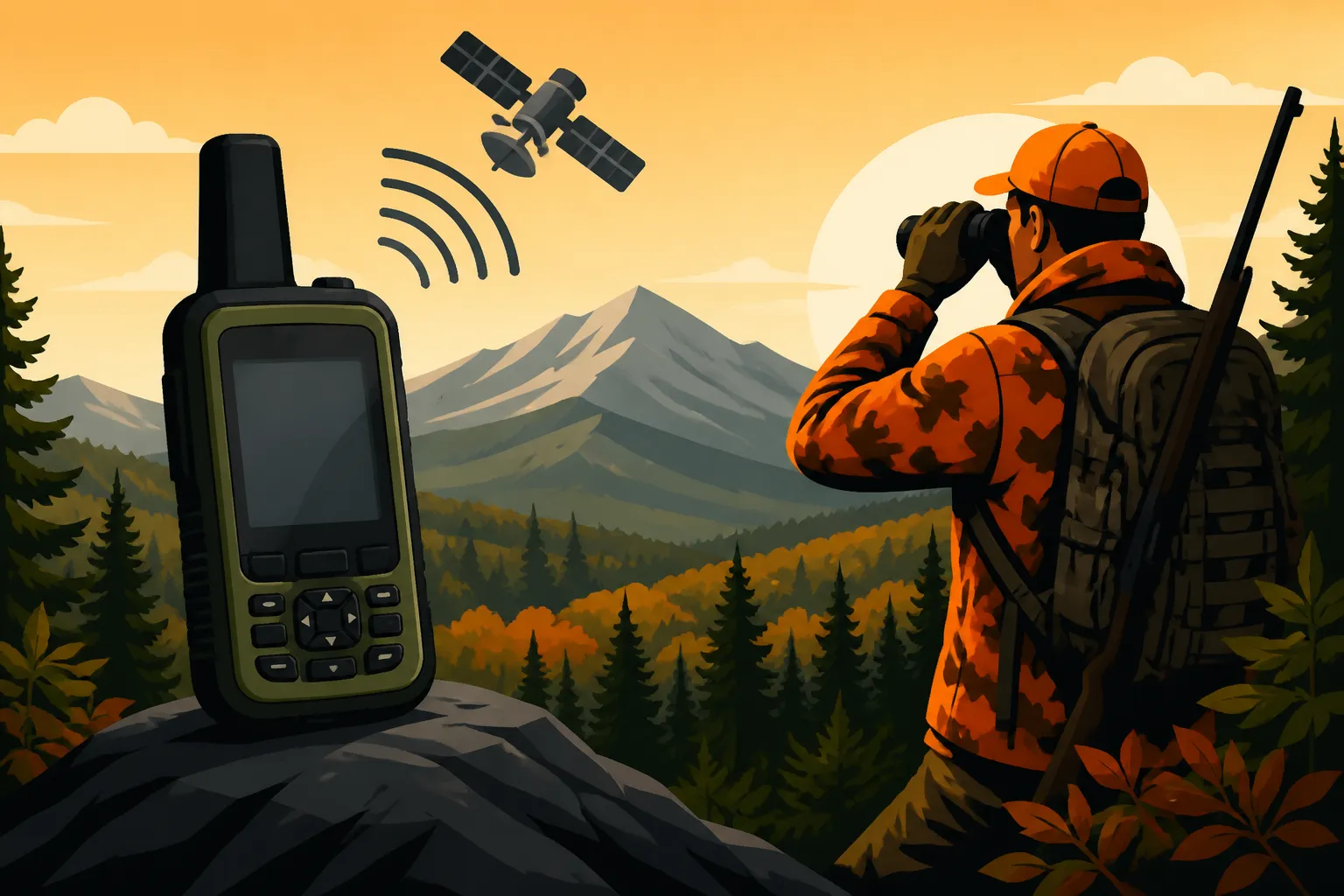
Satellite communicators work by sending signals to satellites orbiting the Earth, which then relay those signals to ground stations. This isn't like a cell tower where you just need to be "in range."
- Clear View of the Sky: For the best results, you need as clear a view of the sky as possible. Dense tree cover, deep ravines, or being right up against a granite cliff can obstruct the signal. If you're having trouble sending a message, try moving to a more open area – perhaps a clearing, a ridge line, or even just standing up out of a low depression.
- Hold It Correctly: Many devices have a specific orientation that works best for signal transmission. Read your manual to understand if there's a particular way to hold it or position it on your pack.
- Be Patient: Unlike cell service, satellite communication can sometimes have a slight delay. It might take a few minutes for a message to send or for a satellite to pass overhead. Don't panic if your message doesn't go through instantly. Give it a reasonable amount of time before trying to reposition or resend.
For example, when Hunting a Granite Ridge Saddle, you'll likely have an excellent view of the sky, making signal acquisition quick. But if you're deep in a cedar swamp or a thick spruce stand, you might need to move to the edge of the cover for reliable transmission.
Emergency Protocols and Responsible Use
The SOS button is for genuine emergencies where life, limb, or property are in immediate danger. It's not for asking your buddy to bring you a sandwich or to check if the game is still on. Misusing the SOS feature can divert critical resources from real emergencies and may even result in fines or charges.
- Understand When to Use SOS: Before pressing that button, ask yourself: Is this a life-threatening situation? Am I injured and unable to move? Am I lost and hypothermic? Is someone in my party in immediate danger?
- Follow Instructions: If you activate an SOS, stay calm and follow any prompts on your device. Search and rescue will try to communicate with you if your device supports two-way messaging.
- Be Descriptive in Messages: When sending regular two-way messages, be clear and concise. Provide your exact location, describe the situation, and state what help you need. "Leg broken, need help, currently at N44.1234, W71.5678" is far more helpful than "Help me!"
- Conserve Battery: In a true emergency, every bit of battery life counts. Use the device sparingly, keeping it powered off between necessary communications to prolong its charge.
Whether you're exploring Hunting the Great North Woods Region or tackling a remote fishing trip, a satellite communicator is a modern essential. It bridges the gap between the wild beauty of New Hampshire's backcountry and the safety net of civilization, giving you the freedom to explore with confidence.
Disclaimer
This article is for general informational purposes only and does not constitute professional advice. Laws, prices and regulations vary by location and change over time. Consult a qualified professional for guidance on your specific situation.