Muzzleloader Deer Hunting in New Hampshire
The crisp air of a New Hampshire autumn, hinting at the winter just around the corner, brings with it a unique blend of challenge and opportunity for deer hunters. Many of us feel the rush of the archery season, then the intensity of firearms, but there's a special window that often gets overlooked or misunderstood: the muzzleloader season. This guide will walk you through everything you need to know to make the most of those precious few days, addressing the common frustrations and questions that arise when preparing for a successful black powder hunt in the Granite State.
Understanding New Hampshire's Muzzleloader Deer Season
Muzzleloader hunting in New Hampshire isn't just a niche activity; it's a deeply rewarding experience that connects hunters to a more traditional form of the sport. However, like any specific season, it comes with its own set of rules, dates, and equipment requirements that can feel a bit overwhelming to newcomers or even seasoned hunters crossing over from firearms or archery.
Season Dates and WMU Variations
New Hampshire's muzzleloader deer season typically runs for a specific, relatively short period, often bridging the gap between the end of archery and the main firearms season, or sometimes following the firearms season in certain areas. It's a critical ten-day window that usually falls in mid-November, strategically placed to offer hunters a chance when deer might be settling into their post-rut patterns but before deep snows fully set in. While the general statewide season is quite uniform for muzzleloaders, it's always, always paramount to check the current year's New Hampshire Fish and Game Department Hunting Digest. Occasionally, you might find slight variations or special considerations tied to specific Wildlife Management Units (WMUs), especially if there are particular harvest objectives in place. For example, some WMUs might have slightly different antlerless permit regulations during certain times, though the core muzzleloader season dates for legal bucks usually remain consistent across the state. Understanding these nuances is key to staying legal and making the most of your time in the woods, so be sure to consult the official regulations. You'll want to be familiar with the specifics of New Hampshire Muzzleloader Season Dates to ensure you're heading out during the correct window.
Legal Muzzleloader Definition and Requirements
Before you even think about stepping into the woods with a muzzleloader, you need to ensure your chosen firearm meets New Hampshire's legal definition. This isn't just a suggestion; it's a strict requirement to avoid any issues with game wardens. Generally, New Hampshire defines a legal muzzleloader as a single-barrel, single-shot firearm loaded from the muzzle. It must be either .40 caliber or larger, and specifically, only original or reproduction flintlock, percussion, or in-line muzzleloading rifles and shotguns are permitted. This means no breech-loading black powder rifles, and certainly no modern cartridge firearms. When it comes to ignition, exposed hammer percussion lock or flintlock actions are the standard. Electronic ignition systems are generally not allowed. For sights, you're permitted to use iron sights, open sights, or even telescopic sights (scopes), but there may be restrictions on magnification or electronic enhancements, so checking the digest for specifics is vital. The use of sabots (a plastic sleeve that allows a smaller-diameter bullet to be fired in a larger bore) is typically legal, as are various powder types like granular black powder, Pyrodex, or other approved black powder substitutes. The main takeaway here is that you're using a firearm that truly embodies the spirit and limitations of traditional black powder hunting.
Tagging and Registration Rules for Muzzleloader Deer
Successfully harvesting a deer with a muzzleloader is an incredible accomplishment, but the job isn't finished until you've properly tagged and registered your animal. Just like with archery or firearms, every deer taken during the muzzleloader season in New Hampshire must be tagged immediately upon harvest. This means filling out your deer tag (which comes with your regular New Hampshire hunting license) with all the required information – date, time, location (WMU), and sex of the deer – and attaching it securely to the animal before you move it. This tag must remain attached until the deer is registered. The registration process itself has evolved over the years, and New Hampshire Fish and Game now offers both online and in-person options. It's often fastest to use the online system or the Fish and Game mobile app to report your deer, especially if you're in an area with good cell service. However, it's crucial to be aware of specific periods, known as "blackout days," when online registration is temporarily unavailable, usually coinciding with the peak of the firearms season opener, which can overlap with or immediately follow the muzzleloader season. During these times, you must register your deer in person at an official registration station. Missing the registration deadline or failing to properly tag your deer can result in serious penalties, so make sure you're well-versed in New Hampshire Deer Reporting Requirements and understand the implications of New Hampshire's In-Person Registration Blackout Days.
Essential Muzzleloader Gear and Setup
Diving into muzzleloader hunting means embracing a different set of tools and a slightly different approach than you might be used to with modern firearms. The gear you choose, and how you set it up, will directly impact your accuracy, reliability, and ultimately, your success in the field. It’s not just about having a gun; it’s about having the right gun, and knowing how every component works in harmony.
Choosing Your Muzzleloader
The world of muzzleloaders offers a fascinating array of options, each with its own advantages and historical charm. For deer hunting in New Hampshire, most hunters gravitate towards in-line muzzleloaders. These are often referred to as "modern muzzleloaders" because their ignition system (primer, powder, projectile) is aligned in a straight line, leading to more consistent ignition, better accuracy, and generally easier cleaning compared to traditional designs. Brands like Thompson/Center, CVA, and Traditions are popular choices, offering models that are robust, reliable, and capable of excellent accuracy out to reasonable muzzleloader ranges. They typically use 209 shotshell primers, which are hot and reliable even in damp conditions.
On the other hand, you have traditional percussion lock or flintlock muzzleloaders. These are often chosen by purists who enjoy the historical aspect and the greater challenge. Flintlocks use a piece of flint to strike steel, creating sparks to ignite the powder in a pan, which then flashes into the main charge. Percussion locks use a cap that's struck by a hammer. While incredibly rewarding to hunt with, they demand more practice, are more susceptible to weather (especially rain and humidity), and require meticulous attention to detail. For a deep dive into the practical considerations, you might want to look into Choosing a Muzzleloader for the Ten-Day Season. When making your choice, consider your comfort level with maintenance, your desired level of historical immersion, and the typical weather conditions you'll be hunting in. An in-line offers more modern convenience and reliability, while a traditional style offers a unique connection to hunting heritage.
Optics and Sights for Muzzleloader Hunting
Given the single-shot nature and often limited range of muzzleloaders compared to modern rifles, your choice of sights is incredibly important. New Hampshire allows the use of telescopic sights (scopes) on muzzleloaders, which is a huge advantage for accuracy, especially for those with aging eyes or in low-light conditions. When selecting a scope, simplicity and durability are key. Since most muzzleloader shots on deer occur within 150 yards, a fixed 4x, 1-4x, or 2-7x variable scope is often more than sufficient. You don't need high magnification, which can actually hinder quick target acquisition in thick timber or brushy country. A scope with good low-light gathering capabilities and a clear, simple reticle will serve you best during those critical dawn and dusk hours.
Alternatively, many muzzleloader hunters still prefer iron sights or fiber optic sights. These offer an uncluttered field of view and are incredibly robust, not prone to fogging or losing zero like scopes can be if dropped. Fiber optic sights, in particular, gather ambient light, making them much brighter and easier to see in low-light conditions than traditional black iron sights. Some hunters even opt for red dot sights, which provide rapid target acquisition and parallax-free shooting, but still offer a clear view of the target without magnification. Whatever your choice, ensure it's sighted in precisely at your intended maximum range, usually 75-100 yards, to account for the more pronounced ballistic drop of muzzleloader projectiles.
Projectiles, Powder, and Primers
The components that go into your muzzleloader are just as vital as the firearm itself. This isn't like grabbing a box of factory ammo; you're building each shot, and consistency is paramount.
Projectiles: The most common projectiles today are saboted bullets, which consist of a smaller, often polymer-tipped bullet (like a .45 caliber) encased in a plastic sabot that engages the rifling of a larger bore barrel (like a .50 caliber). Once it leaves the muzzle, the sabot falls away, and the bullet continues to its target. Sabots offer better ballistic coefficients, increased velocity, and superior accuracy compared to traditional lead round balls or full-bore conical bullets. Brands like Hornady, Barnes, and Thompson/Center offer excellent saboted options that perform well on deer. For traditionalists, or in areas where sabots might be restricted (though not typically in NH), full-bore conical bullets (like the Maxi-Ball or PowerBelt) or patched lead round balls are used. Conicals offer heavier weight and good energy transfer, while round balls are classic but have limited range.
Powder: You'll typically choose between granular black powder (true black powder) or black powder substitutes like Pyrodex, Triple Seven, or Blackhorn 209. Black powder substitutes are less corrosive and easier to clean than true black powder, making them a popular choice for modern in-line muzzleloaders. They are also less sensitive to humidity. For most deer hunting scenarios, a charge between 80 and 120 grains (by volume, not weight, if using substitutes) is common, but always follow the manufacturer's recommendations for your specific firearm and projectile. Consistency in loading is crucial, so always use a volumetric powder measure.
Primers: Modern in-line muzzleloaders almost exclusively use 209 shotshell primers. These are hot, reliable, and produce a strong spark that ensures consistent ignition of the powder charge, even in cold or damp conditions. Make sure your primer seating is consistent – a tight fit is important for reliable ignition and accuracy. For traditional percussion systems, you'll use percussion caps (typically #11 or musket caps), and for flintlocks, you'll need high-quality flint and fine-grained priming powder for the pan. Regardless of your system, keeping your primers dry is non-negotiable for a successful shot. It's a system of precision, and neglecting any part of it can lead to a missed opportunity. This is all part of the specific knowledge you'll build while Muzzleloader Gear for New Hampshire's Ten-Day Season.
| Muzzleloader Type | Ignition System | Typical Caliber | Pros | Cons |
|---|---|---|---|---|
| In-Line | 209 Primer | .50, .45 | High accuracy, reliable in weather, easier cleaning, scope-ready | Less traditional feel, can be seen as "modern" |
| Percussion | Percussion Cap | .50, .54 | Traditional aesthetic, good accuracy with practice, simple mechanics | More susceptible to weather, slower loading, more cleaning |
| Flintlock | Flint & Pan Powder | .50, .54 | Ultimate traditional challenge, deeply authentic hunting experience | Most susceptible to weather, requires most skill, slowest loading |
Pre-Season Preparation and Scouting
Muzzleloader season in New Hampshire is often a short, intense window, meaning that your preparation before the season opens is even more critical than during a longer general season. You don't have time to "figure things out" once you're in the woods. Solid practice and effective scouting are the bedrock of success.
Range Practice and Ballistic Familiarity
Accuracy with a muzzleloader is a skill developed through consistent practice. It's not a "set it and forget it" kind of weapon. Unlike modern cartridge rifles where you might sight in once and be good for the season, a muzzleloader demands more attention. You need to become intimately familiar with your specific firearm, projectile, and powder charge combination. Each shot requires loading components, and consistency in that loading process directly translates to consistency on target. Spend ample time at the range, not just shooting for groups, but also practicing your loading routine under simulated hunting conditions. How quickly can you reload if you miss or need a follow-up shot (which is rare but happens)? How does the cold affect your hands, your dexterity, and your ability to load a bullet down a cold barrel?
Understand your muzzleloader's trajectory. A .50 caliber sabot traveling at 2,000 fps will drop significantly more at 150 yards than a .30-06. Knowing your ethical range for a clean kill is paramount. Shoot at 50, 75, 100, and 125 yards. Use a good ballistic calculator to estimate drop at various distances if you're using a scope, but verify it on the range. Clean your rifle between shots or every few shots, just as you would in the field. Practice shooting from various positions – off-hand, kneeling, using a tree as a rest – because you won't always have a bench rest in the woods. This detailed practice will build confidence and ensure that when a New Hampshire deer steps out, you're ready.
Scouting Muzzleloader-Specific Terrain
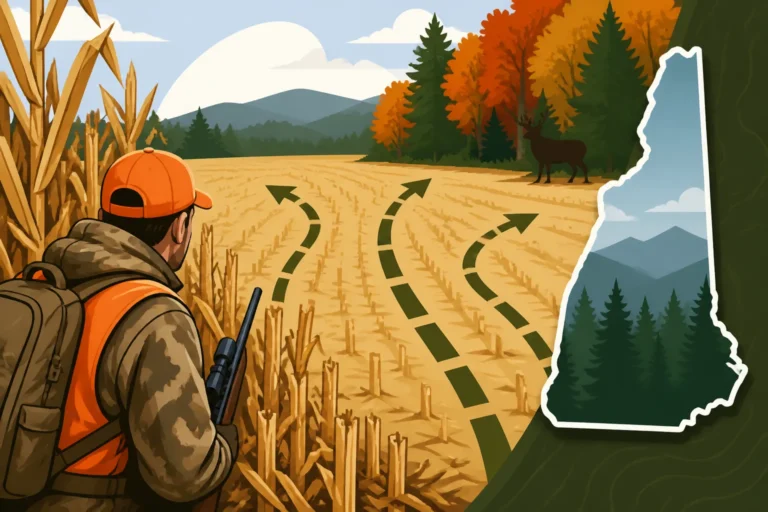
Scouting for muzzleloader season requires a nuanced approach, especially because it falls in a transitional period. Deer behavior will be shifting from the peak rut activity (if the season precedes firearms) towards a more focused search for late-season food sources and bedding in thicker cover. Your scouting should concentrate on these new patterns. Look for areas with remaining mast crops like acorns (if it wasn't a poor acorn year) or beechnuts, or fields of standing corn or brassicas if you're hunting near agricultural areas. New Hampshire's varied landscape means this could be anything from a hidden apple orchard in the southern part of the state to a sheltered cedar swamp in the North Country.
As temperatures drop, deer will prioritize thermal cover. Dense conifer stands, thick clear-cuts, or sheltered ravines can become prime bedding areas. Pay attention to transition zones between these bedding areas and available food. Use mapping tools like GoHunt or OnX to identify likely spots from afar, then put boots on the ground to confirm. With the foliage mostly down by mid-November, deer sign can be easier to spot, but also remember that deer will be much more visible to you. Look for fresh tracks, droppings, and any remaining rubs or scrapes, though rutting activity will likely be winding down. Understanding Scouting New Hampshire Public Land Before Season is invaluable, helping you pinpoint those crucial ambush points or still-hunting routes.
Interpreting Deer Sign for Muzzleloader Season
By mid-November, the rut, while possibly not entirely over, is certainly past its peak. This means the frantic, broad-daylight movement of bucks chasing does will have largely subsided. Therefore, when interpreting deer sign for muzzleloader season, you need to adjust your focus. Fresh rubs (where bucks scrape velvet from their antlers or mark territory) that are still showing sap or fresh wood indicate a buck was recently active there, but don't expect the same intensity you'd see in late October. Similarly, scrapes (patches of ground where bucks paw, urinate, and deposit scent) may still be visited, but many will have gone cold. Focus on fresh scrapes, especially those near bedding areas or consistent food sources, indicating a buck is still periodically checking for does.
The most reliable sign will likely be fresh tracks and droppings. A large, distinct track in damp earth or the first dusting of snow can tell you a lot about the size and direction of travel of a deer. Multiple tracks converging on a specific area, especially leading to or from a food source, are gold. As deer shift to more predictable patterns post-rut, they often become more wary, moving predominantly at dawn and dusk. This means finding fresh sign along travel corridors between bedding and feeding areas becomes paramount. Also, look for signs of deer browsing – nipped twigs or disturbed ground where they've foraged. The ability to read this changing landscape, even with the aid of tools like GoHunt for aerial views, will dictate your success. It's a different game than the chaos of the rut, demanding a more patient and observant approach.
Muzzleloader Hunting Strategies in New Hampshire
The unique challenges and limitations of muzzleloader hunting – particularly the single-shot capability and the need for a clean, close shot – necessitate specific strategies tailored to the New Hampshire environment. Success isn't just about finding deer; it's about positioning yourself for that one, crucial shot.
Still-Hunting and Tracking
Still-hunting is perhaps the most traditional and rewarding method for muzzleloader hunters, especially in New Hampshire's diverse terrain. This involves moving incredibly slowly and deliberately through the woods, pausing frequently to scan, listen, and glass for deer. The key is to blend in with the environment, moving at a snail's pace, often taking minutes to cover just a few yards. This allows you to observe deer before they detect you, giving you time to set up for a shot. Look for natural funnels, ridge saddles, or the edges of dense cover that deer might use for travel. As the season progresses into colder weather, deer often move to more sheltered, south-facing slopes during the day to catch the sun and conserve energy.
If there's a fresh dusting of snow, tracking becomes an incredibly effective technique. Finding fresh tracks, especially a large buck track, and patiently following it can lead you directly to a deer. This requires immense patience and skill, learning to read the nuances of a track – whether the deer is walking, trotting, or running, and how recently it passed. Wind direction is critical; always try to keep the wind in your favor. In the rugged terrain of the White Mountains, still-hunting or tracking takes on an even greater dimension, navigating steep climbs and dense timber. You'll definitely find yourself Tracking a Deer in Fresh White Mountain Snow if you hunt after a late-season storm, and knowing how to approach that is key.
Stand Hunting and Ambush Tactics
For many hunters, stand hunting from a treestand or ground blind remains a highly effective strategy, even with a muzzleloader. The advantage here is that you can set up in a known travel corridor or near a consistent food source, allowing the deer to come to you. This minimizes movement and scent, crucial when you only have one shot. When choosing a stand location, consider the wind direction for the majority of your hunting hours and understand how thermals work, especially in hilly or mountainous areas. Mornings often see thermals rising, carrying your scent uphill, while evenings see them falling, carrying scent downhill.
Look for pinch points, natural funnels between two woodlots, or edges of late-season food sources like old apple orchards or standing cornfields. A good stand setup should offer clear shooting lanes within your effective muzzleloader range (typically under 100-125 yards) and provide concealment. Ground blinds can be particularly effective in areas with dense cover, allowing you to move subtly and offering protection from the elements. However, ensure your ground blind is brushed in naturally to avoid looking like a foreign object. Regardless of the type of stand, the goal is to ambush a deer that is moving predictably, providing you with a calm, well-placed shot. Remember, the limited range of a muzzleloader means you need to be confident in your shot placement.
Understanding Deer Behavior in Mid-November
Deer behavior in New Hampshire during mid-November is a complex mix of post-rut recovery, adaptation to colder weather, and increased hunting pressure. While the peak of the rut, Hunting the Rut in Early-to-Mid November, is generally winding down, some late-breeding does might still attract buck attention, leading to sporadic chasing activity. However, many bucks will be entering a recovery phase, prioritizing food intake to regain weight lost during the rut. They will be actively seeking high-calorie food sources. This means a shift from cruising for does to a more focused, predictable pattern between bedding and feeding areas.
As hunting pressure from archery and early firearms seasons mounts, deer become more nocturnal and seek out thicker, more secure cover for bedding. They'll often move less during daylight hours and use denser routes. Focus your efforts around these thickets, especially at the first and last light. Look for areas that offer both concealment and easy access to a food source. Understanding these subtle shifts in behavior is paramount. It’s not just about what you want to do, but about what the deer are doing. They are driven by survival: finding food, staying warm, and avoiding predators (including hunters). Adapt your strategy to their priorities, and your chances of success will climb.
Challenges and Considerations for Muzzleloader Hunters
Muzzleloader hunting is not without its unique set of challenges, some inherent to the weapon itself, and others amplified by the typical late-fall conditions in New Hampshire. Acknowledging and preparing for these hurdles is as important as knowing your shooting fundamentals.
Weather Impacts and Cold-Weather Shooting
New Hampshire's mid-November weather can be notoriously unpredictable, ranging from crisp, clear days to biting cold, rain, or even early snow. This variability significantly impacts muzzleloader performance and hunter comfort. Moisture is the enemy of black powder. Rain, heavy dew, or even high humidity can degrade granular powder or compromise a percussion cap, leading to a misfire. Protecting your muzzleloader's bore and percussion cap/frizzen from moisture is paramount. Many hunters use electrical tape over the muzzle or a rubber cap, and ensure the primer area is as sealed as possible.
Extreme cold also affects muzzleloader components. Powder burn rates can be slower, and stiff fingers can make loading a follow-up shot excruciatingly difficult. Practicing in cold weather, wearing your hunting gloves, will reveal any issues. Additionally, your body's ability to hold a steady aim can be compromised by shivering. Layering properly with good base, mid, and outer layers is crucial to staying warm and focused. Consider a warm beverage in a thermos to help keep core temperature up during long sits. The saying "there's no bad weather, just bad gear" holds especially true for muzzleloader hunting in the Granite State.
Tracking and Recovery in Varied Terrain
Due to the single-shot nature of muzzleloaders and the ballistics of black powder projectiles, tracking and recovery can be more challenging than with a modern rifle. Muzzleloaders typically create a large, singular entry wound, but without an exit wound, blood trails can sometimes be sparse, especially if the deer doesn't immediately bleed externally. This makes meticulous observation of the hit and the deer's reaction even more critical. Listen for the distinct "thwack" of a good hit and watch the deer's body language closely.
New Hampshire's terrain, from dense softwood thickets to rocky, steep granite ridges and sometimes swampy beaver flowages, can make blood trailing incredibly difficult. A deer shot with a muzzleloader might not go far, but if it ducks into a dense spruce stand or down a steep ravine, finding it can be a monumental task. Give the deer ample time (at least 30-60 minutes, often longer for a gut shot) before beginning to track to allow it to expire. Use bright flagging tape to mark the last known blood, and consider bringing a tracking dog if allowed by local regulations. Having a good headlamp and possibly even a partner is crucial if you anticipate trailing after dark, especially if you're in an area like the White Mountain National Forest. You might find yourself Recovering a Deer From a Beaver Flowage or dragging one out of a Dragging a Deer Out of a Granite Ravine, requiring both mental and physical fortitude.
Public Land Pressure and Ethics
New Hampshire offers vast tracts of public land, from the expansive White Mountain National Forest to numerous Wildlife Management Areas. However, during deer season, these areas can experience significant hunting pressure. The muzzleloader season often falls immediately before or after the main firearms season, meaning deer are already wary and might be moving in response to earlier pressure. Understanding Hunting Pressure on New Hampshire Public Land is vital.
Ethical considerations are paramount when muzzleloader hunting. Given the limitations of the weapon, hunters have an even greater responsibility to ensure a clean, ethical kill. This means:
- Knowing your effective range: Don't attempt shots beyond what you've confidently practiced at the range.
- Waiting for the right shot angle: Broadside or quartering-away shots are ideal to ensure vital organ damage. Avoid Texas heart shots or frontal shots unless absolutely necessary and you are extremely confident in your ability and the deer is close.
- Identifying your target clearly: With a single-shot, there's no opportunity for a quick follow-up if you hit the wrong animal.
- Respecting other hunters: Public land etiquette is crucial. Be aware of other hunters, don't crowd their spots, and communicate if you're tracking a deer in an area where others might be hunting.
- Leaving no trace: Pack out everything you pack in, including spent primers and any trash.
Using mapping tools like GoHunt can help identify less-pressured areas on public land by looking for remote sections, difficult-to-access terrain, or areas far from parking lots. Ethical hunting is about respect – for the animal, the land, and your fellow hunters.
Post-Harvest Care and Regulatory Compliance
The moment of truth with a muzzleloader is exhilarating, but the work isn't over when the deer hits the ground. Proper post-harvest care and diligent regulatory compliance ensure your hard-earned venison is preserved and you remain a responsible New Hampshire hunter.
Field Dressing and Meat Care
Once your deer is down, the clock starts ticking, especially if temperatures are mild. Prompt and thorough field dressing is essential to preserve the quality of the venison. The goal is to remove the entrails quickly to allow the carcass to cool down as fast as possible. This prevents bacterial growth and ensures the meat doesn't spoil. In New Hampshire's mid-November chill, ambient temperatures often work in your favor for cooling, but if it's an unseasonably warm day, you'll need to work even faster.
Start by making a shallow cut from the breastbone to the pelvis, carefully circling the anus. Cut around the diaphragm to free the organs, and then roll the deer onto its side to allow the entrails to spill out. Inspect the organs for any abnormalities that might indicate disease, though New Hampshire's deer herd remains New Hampshire's CWD-Free Deer Herd. After field dressing, wipe the cavity clean with snow or paper towels (pack them in!), but avoid washing with water unless absolutely necessary, as moisture can promote bacterial growth. If you plan to hang the deer whole, prop open the cavity with a stick to maximize airflow. For more detailed instructions on keeping your meat pristine, you can refer to resources on Field Dressing a Deer in Cold Weather or Butchering a Deer at Camp.
Registering Your New Hampshire Deer
Registering your deer is a non-negotiable legal requirement in New Hampshire. As mentioned earlier, immediately after field dressing and before moving the deer from the point of kill, you must fill out your tag completely and securely attach it to the deer. This tag stays on the deer until it's officially registered.
New Hampshire Fish and Game provides multiple avenues for registration:
- Online via the Fish and Game Website: This is often the quickest and most convenient method, available 24/7 during most of the season. You'll need your license number and details about the harvest (date, WMU, sex, antler points).
- Via the NHFG Mobile App: Similar to the online portal, the app allows for mobile registration in the field, assuming you have cell service. This is particularly useful for remote areas if you're lucky enough to have signal.
- In-Person at a Registration Station: During certain "blackout days," particularly around the firearms season opener, online and app registration may be unavailable. During these times, you must take your deer (or at least the head and attached tag, if you've quartered it in the field) to an official registration station. These are often local sporting goods stores, general stores, or Fish and Game offices. Always check the current year's digest for a list of open stations and their hours.
Failure to register your deer by the deadline (typically 12 hours after harvest for muzzleloader season) can result in fines and loss of privileges. It's a small but critical step that completes your hunt legally. Make sure you understand all the specifics for Registering a New Hampshire Deer Online and the requirements if you're forced to register in person.
Maintaining Your Muzzleloader After the Hunt
Unlike modern firearms, muzzleloaders require immediate and thorough cleaning after every use, especially if you've fired it. Black powder and its substitutes are highly corrosive and will quickly pit and damage your barrel if not cleaned properly. Neglecting cleaning can lead to decreased accuracy, misfires, and permanent damage to your firearm.
Here's a basic cleaning protocol:
- Safety First: Ensure the firearm is unloaded and de-primed.
- Disassemble: Follow your manufacturer's instructions for basic field stripping. Remove the breech plug if it's an in-line.
- Clean the Bore: Use a specialized black powder solvent (such as those from Traditions, Hoppe's, or CVA) on patches. Run wet patches through the bore until they come out clean. Then, use a brass brush to scrub the bore, followed by more wet patches. Finish with dry patches until the bore is completely dry and then apply a thin coat of rust preventative oil.
- Clean the Breech Plug and Action: Scrub the breech plug thoroughly with solvent and a brush to remove all powder residue. Clean the action area, hammer, and nipple (for percussion) or frizzen/pan (for flintlock) with solvent and brushes.
- Lubricate and Reassemble: Lightly oil all metal parts to prevent rust, and reassemble the firearm.
- Store Properly: Store your muzzleloader in a dry, safe place.
Even if you didn't fire your muzzleloader during a hunt, moisture or humidity could have entered the barrel. It's always a good practice to run a few dry patches through the bore and check for any moisture, then re-oil before storing. Proper maintenance ensures your muzzleloader remains reliable and ready for your next New Hampshire deer season.
Disclaimer
This guide is intended for informational purposes only and does not supersede the official regulations published by the New Hampshire Fish and Game Department. Hunting laws and regulations can change annually. Always consult the most current New Hampshire Hunting Digest or visit the official NH Fish and Game website before heading afield to ensure full compliance with all laws and ethical hunting practices.