Coyote Calling at First Light
There’s a unique challenge and thrill to pursuing coyotes, especially when you’re trying to catch them during those magical, fleeting moments just as the world wakes up. Many hunters struggle with consistent success when trying to call in coyotes at first light, finding these wily predators incredibly elusive as the eastern New Hampshire dawn breaks. This comprehensive guide is dedicated to equipping you with the knowledge and tactics needed to effectively call coyotes during those crucial early morning hours in the diverse landscapes of New Hampshire, helping you turn frustration into consistent success.
Understanding the Dawn Advantage for Coyotes
Coyotes are creatures of habit and opportunity, and the period around first light offers them a distinct edge, which means it should offer you one too, if you play your cards right. They've spent the night actively hunting or traveling, and as daylight approaches, their movements often become more deliberate, moving towards bedding areas or finishing up a hunt before the woods fill with human activity. Recognizing this natural rhythm is the first step to intercepting them.
Coyote Behavior During Low Light
As the stars begin to fade and a faint glow appears on the horizon, coyotes are typically at their most active. They've been on patrol, scent-checking trails, listening for prey, and perhaps even engaging in pack communication throughout the dark hours. This means they're often already on the move, covering ground, and their senses are incredibly sharp from a night of hunting. They're more inclined to respond to a call that mimics their natural prey or rivals because their guard isn't fully up yet, and they're still in "hunting mode" before retreating to denser cover for the day. Think of it as their last push before daylight forces them into a more cautious, hidden existence. They might be finishing off a rabbit they've been tracking all night, or heading back to a rendezvous point with other pack members.
The Element of Surprise
The early morning gloom provides a natural cloak of concealment that works both ways. While it makes it harder for you to spot an incoming coyote from a distance, it also significantly reduces their ability to detect you. Their eyesight, while excellent, isn't as acutely tuned to subtle human outlines in the dim light as it is in full daylight. This precious window of low light allows you to get into prime positions undetected and set up your calling sequence before the world is fully awake. You can use the last vestiges of darkness to move quietly, position yourself against a dark backdrop, and prepare for their arrival without giving away your presence. A coyote approaching a call in this half-light is relying heavily on sound and scent, making them potentially less wary of a visual anomaly compared to bright daylight. This is your chance to turn the tables on their natural caution.
Gear and Setup for First Light Success
Getting everything in order before the sun peeks over the horizon is paramount. You can't fumble with calls or try to adjust your rifle scope as a coyote is slipping in. Proper gear selection and a meticulous setup are what separate a successful hunt from a frustrating missed opportunity.
Essential Calls and Decoys
When it comes to coyote calling, variety is your friend, but simplicity is key, especially in the dim light of dawn. For first light, I generally favor electronic calls for their versatility and volume, but mouth calls certainly have their place. An electronic call like those from Foxpro or ICOtec allows you to broadcast realistic prey distress sounds (rabbit, fawn, bird) or even coyote vocalizations (howls, barks) at varying volumes, and from a distance, separating the sound source from your position. Having a remote control is invaluable so you can keep your hands warm and ready on your firearm.
A small, lightweight decoy can be a game-changer. A simple rabbit or bird decoy, even a distressed squirrel tail flapping, can grab a coyote's attention and draw its focus away from your concealed position. Often, a coyote will key in on the visual of the decoy, offering you precious seconds to make your shot. Remember, in low light, movement is often more easily detected than intricate detail, so a decoy with some flutter or motion can be highly effective. For more insights on this, you might find our guide on Best Predator Call for New Hampshire Coyotes quite helpful.
Camouflage and Concealment
Even in low light, coyotes have an uncanny ability to pick out unnatural shapes and movements. Top-notch camouflage is non-negotiable. Full head-to-toe camo, including gloves and a face mask, breaks up your silhouette and helps you blend into the natural surroundings. Patterns that mimic the prevalent vegetation in your chosen hunting area – whether it's the mottled browns and grays of bare hardwoods or the greens of pine stands – are ideal. Layering is also important for warmth, as those pre-dawn New Hampshire mornings can be downright chilly, even in early fall.
Beyond camo, the art of concealment is about using the landscape to your advantage. Always set up with a natural backdrop that breaks up your outline – a dense pine tree, a rock outcropping, or a thick brush pile. Avoid open areas where you'd silhouette against the sky. Position yourself downwind or crosswind from where you expect the coyote to approach, and stay absolutely still. Even the slightest twitch can give you away, especially as the light increases. This also applies when considering Using a Ground Blind on Public Land or brushing in a blind.
Optics and Firearm Considerations
Your chosen firearm needs to be reliable and sighted in for accuracy, but your optics are just as crucial for first-light success. A quality rifle scope with excellent low-light gathering capabilities is a must. Look for scopes with larger objective lenses (e.g., 40mm or 50mm) and good glass. Many hunters prefer a lower magnification setting (e.g., 3-9x or 4-12x) for closer, fast-breaking shots, but having the ability to dial up if a coyote hangs up at a distance can be beneficial. Illuminate reticles are fantastic for low-light conditions, allowing you to quickly acquire a clear aiming point without losing it against a dark background.
A sturdy bipod or shooting sticks can provide a stable rest, which is essential for making precise shots when adrenaline is pumping and light is limited. Don't forget a headlamp with a red or green light option to navigate in the dark without spooking game or compromising your night vision. When scouting with tools like GoHunt, you can mark potential shooting lanes and ranges, ensuring you're prepared for various scenarios. For instance, when you're considering Rifles and Calibers for New Hampshire Big Game, remember that while coyotes are smaller, quick, ethical kills are still the goal, so choose a caliber that offers flat trajectory and sufficient energy.
| Call Type | Best Use Case at First Light | Coyote Response Tendency | Volume Recommendation | Notes |
|---|---|---|---|---|
| Distress Calls | Mimics small prey (rabbit, fawn, bird) in trouble. | Strong curiosity, direct approach | Moderate to loud | Start softer, increase if no response. |
| Pup Distress | Calls to instinctual parental aggression. | Aggressive, territorial approach | Moderate to loud | Effective during denning season. |
| Howls | Locating coyotes, challenging territory. | Howling back, or silent approach | Loud | Use to locate coyotes before setting up. |
| Barks/Yips | Can simulate a small pack, territorial challenge. | Caution, circling, sometimes approach | Moderate | Mix with howls or distress. |
| Ki-Yis | Emulates a coyote in pain, can draw dominant coyotes. | Aggressive investigation | Loud | Use sparingly, can alert educated coyotes. |
Strategic Calling Techniques for Early Mornings
Successfully calling coyotes at first light isn't just about blowing a call; it's about understanding their movements, predicting their approach, and executing a well-timed sequence. It’s a chess match played in the twilight, and every move matters.
Locating Prime Dawn Stand Locations
The key to a good first-light stand is anticipating where coyotes will be traveling or finishing their nightly hunts. Look for areas that connect their likely bedding cover with their feeding grounds or travel corridors. This often means scouting out saddles, draws, logging roads, field edges, and creek bottoms. Coyotes frequently use these natural funnels and edges for easy travel. Think about where a coyote might stop to listen or survey an area before daylight pushes them into hiding. A prominent ridge overlooking a valley, a point of woods jutting into a field, or a pinch point where two woodlots come together are all prime candidates.
Before you even step foot in the woods on hunt day, spend time scouting. Use tools like GoHunt to study aerial photos, identify terrain features, and mark potential approach routes. Look for tracks, scat, and kill sites from previous visits. This pre-season work, much like preparing for Coyote Calling New Hampshire Farm Country, is invaluable. When you arrive in the dark, you should already know exactly where you’re going to sit, where your call will be, and your likely shooting lanes. You don’t want to be fumbling around, trying to figure out your setup as the light begins to break.
The Art of the Initial Sequence
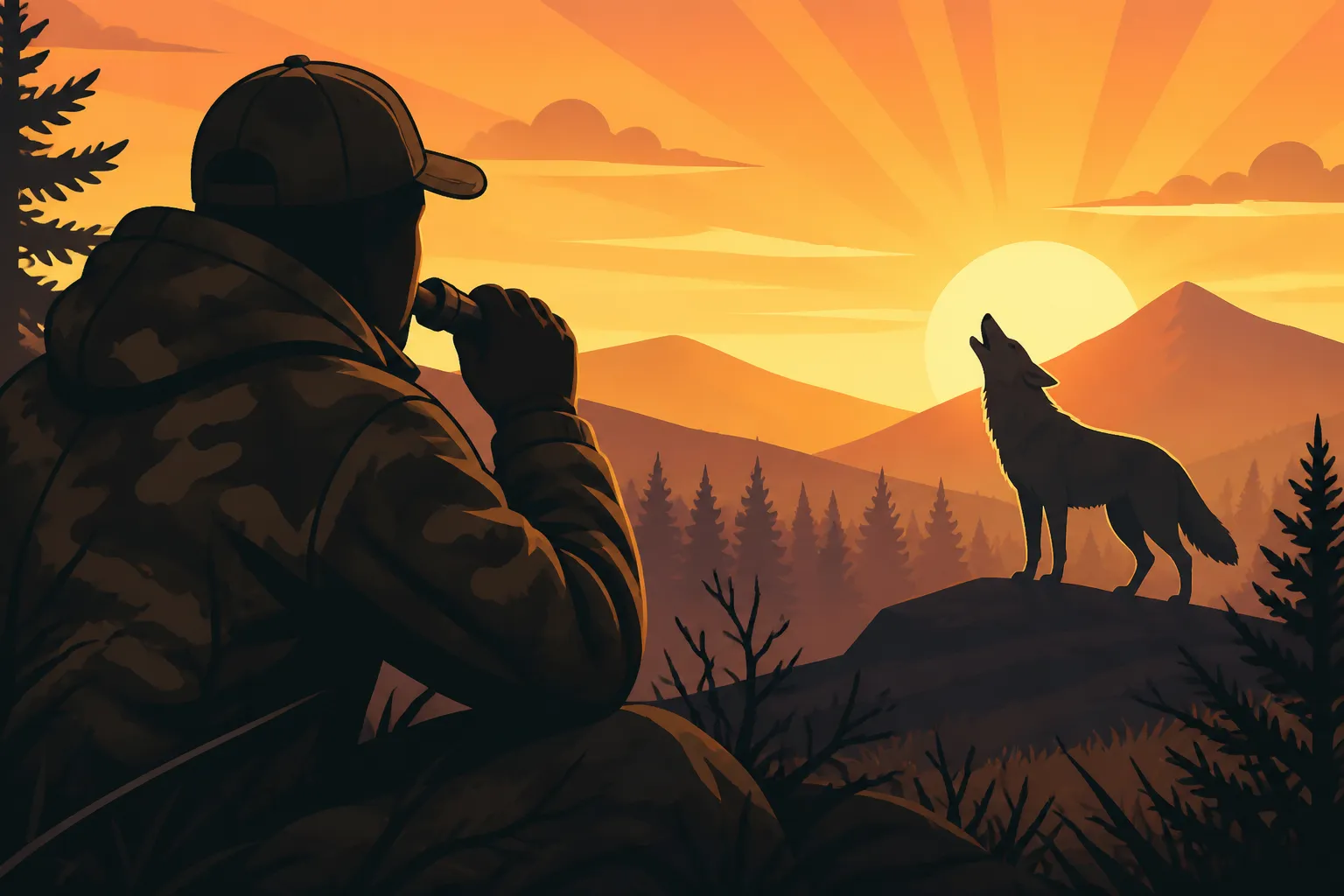
Once you're in position, settled, and camouflaged, it's time to initiate your calling sequence. The first few minutes are critical. I generally start with a soft, short series of distress calls – perhaps a rabbit in mild distress, or a bird in trouble. This isn't to blast out a call, but to mimic a subtle, everyday occurrence. After a minute or two of these soft sounds, I'll pause for several minutes, scanning intently. Coyotes are often already close and might respond to the initial subtle sounds by silently slipping in.
If there’s no immediate response, I’ll increase the volume and duration, moving to a more frantic distress call. Then, another long pause. Patience is vital here. Many hunters make the mistake of calling too much, too soon, or not pausing long enough. After a few distress sequences, if I still haven't had a response, I might try a few soft howls or barks to imitate other coyotes, seeing if I can trigger a territorial response. Remember, your goal is to pique their interest and draw them into shooting range without immediately making them suspicious. It’s a conversation, not a monologue. Our guide on Grunt Calls in Mature New Hampshire Hardwoods has some crossover principles regarding call volume and patience.
Adapting to Coyote Responses
Coyotes are incredibly intelligent, and they rarely follow a script. You need to be ready to adapt. If a coyote howls back, it tells you their location and that they’re interested. You can then try to lure them in with more distress calls, or even mimic a challenging howl to draw them closer. If they approach and then hang up, try a subtle, soft "whimper" or "squeak" with a hand call to draw them that last few yards. Often, that small, almost inaudible sound is enough to break their caution.
Sometimes, a coyote will circle downwind to try and catch your scent. This is why wind direction is so crucial, but even with perfect wind, they might still try. If you see this happening, be prepared to shift your body for a shot, or if possible, have a partner cover that likely approach. Other times, they might come in hot and fast, catching you off guard. This is why constant scanning and anticipating multiple approach angles is crucial. Don't focus solely on the direction the sound is coming from. They can materialize silently from anywhere. Understanding how to react to these varied responses is a skill honed over many mornings in the woods, something that also applies to Rattling Volume in Thick Softwood Cover for deer.
Common Pitfalls and How to Avoid Them
Even experienced coyote hunters make mistakes, especially when the pressure of that first-light opportunity is on. Understanding these common errors and having a plan to avoid them will drastically improve your success rate.
Overcalling and Undercalling
This is a classic dilemma in predator hunting. Overcalling can saturate the air with sound, making your calls seem less natural and potentially spooking wary coyotes. It also reduces the critical listening time you need to detect an incoming coyote or interpret their responses. If you're constantly blowing a call, you might miss the subtle rustle of leaves or the soft pad of paws as a coyote slips in.
On the other hand, undercalling means you might not generate enough interest to pull a coyote in, especially if they are at a distance or less active. The trick is finding that balance. My rule of thumb for first light is to start soft, listen a lot, and only increase volume and frequency if I'm not getting a response. Err on the side of caution. Give each sequence ample time to work. A common sequence might be 1-2 minutes of calling, followed by 3-5 minutes of silent scanning, then repeat. This patience is a skill you also need when Hunting a Green Field Planted for Deer.
Wind Direction and Scent Control
Coyotes possess an incredible sense of smell, arguably their strongest defense mechanism. Ignoring wind direction at first light is a surefire way to have them bust you without ever seeing them. Always approach and set up so that your scent cone is blowing away from where you expect the coyotes to approach or already be present. This usually means sitting with the wind in your face or on your crosswind. Never hunt with the wind at your back, pushing your scent directly into the area you hope to call from.
Beyond wind, meticulous scent control is essential. Wash your hunting clothes in scent-free detergent, store them in airtight containers, and use scent-eliminating sprays on your clothes and gear before heading out. Even your breath can give you away, so chewing gum or using scent-killing mouthwash can help. Remember, coyotes will almost always try to circle downwind of a call to get a whiff of whatever is making the noise. By understanding this, you can set up to intercept them before they get a full nose-full of you. This principle is fundamental to almost any hunting in New Hampshire, whether you're trying to hide from a coyote or a buck during New Hampshire's November Firearms Deer Season.
Patience and Persistence
Coyote hunting, especially at first light, demands immense patience and persistence. Not every stand will produce a coyote, and sometimes they'll hang up just out of range, or simply ignore your calls. It's easy to get discouraged, especially when you've been sitting in the cold for an hour without a sniff. However, the most successful coyote hunters are the ones who stick with it.
Don't give up on a stand too quickly. I generally give a first-light stand at least 30-45 minutes, sometimes longer if the conditions feel right or if I’ve had some interaction. If nothing shows after a good, varied calling sequence, move to a new spot. Sometimes, it’s about making multiple stands across different likely areas. Persistence also means learning from every hunt. What worked? What didn’t? Did the wind shift? Did I choose the right call? Every outing is a lesson. And remember, sometimes the best call is no call at all – sometimes a coyote might slip in purely by chance. This relentless dedication is similar to what's required for Tracking a Deer in Fresh White Mountain Snow or even Bowhunting New Hampshire's Long Archery Season.
Coyote Calling: Mastering the Dawn Patrol
Successfully calling coyotes at first light in New Hampshire is a rewarding challenge that combines keen observation, strategic planning, and careful execution. By understanding coyote behavior in low light, meticulous preparation of your gear and setup, employing thoughtful calling techniques, and exercising unwavering patience, you'll significantly increase your odds. Remember, every sunrise offers a new opportunity to outwit these intelligent predators. Head out early, stay concealed, listen intently, and be ready to adapt. The satisfaction of calling in a wary New Hampshire coyote as the fog lifts and the woods awaken is a truly unforgettable experience.
Disclaimer
Please ensure you are familiar with and adhere to all current New Hampshire Fish and Game Department regulations and local ordinances regarding coyote hunting, including season dates, legal hunting hours, weapon restrictions, and land access rules. Hunter education and safety should always be your top priority. Rules and regulations can change, so always consult the latest official New Hampshire Hunting Digest.