Working a Cedar Thicket for Late-Season Deer
The late season in New Hampshire can be brutal, testing the resolve of even the most seasoned hunter. When temperatures plummet, and the snow piles up, deer aren't just looking for food; they're actively seeking shelter and thermal cover to survive. This is precisely why those dense, often overlooked cedar thickets become absolute magnets for whitetails. If you've been struggling to locate deer once the leaves are down and the mercury drops, understanding how to effectively work these evergreen strongholds is crucial to punching your tag. This guide will walk you through everything you need to know about finding, scouting, and hunting cedar thickets for late-season success.
Understanding Why Cedar Thickets Are Deer Magnets
When the rest of the landscape turns barren and gray, cedar thickets stand out like verdant oases, offering deer exactly what they need to endure the harsh New Hampshire winter. It’s not just about hiding; it’s about survival.
The Thermal Cover Advantage
Think about it: when you're caught in a biting wind or a swirling snowstorm, where do you instinctively seek refuge? Something dense and protective, right? Deer are no different. White cedars, especially when grown in dense stands, create an incredible microclimate. Their tightly packed branches and needles act like a natural windbreak, dramatically reducing wind chill. Even a few degrees difference can be life-saving for a deer trying to conserve energy.
In the depths of winter, with temperatures regularly dipping below freezing and heavy snow covering much of the browse, deer are expending precious calories just to stay warm. A cedar thicket provides that critical thermal advantage. It’s not uncommon to find deer bedded down deep within these thickets, sometimes just inches from each other, leveraging every bit of shared body warmth. You might walk past what looks like an impenetrable wall of green and be completely unaware that several deer are bedded just feet away, totally protected from the elements. This is especially true in the North Country, where winter can be particularly severe, making these thickets even more vital.
Natural Food Sources Within the Thicket
While cedar thickets are primarily prized for their cover, they often offer a crucial late-season food source as well. White cedars themselves are a preferred browse for deer, particularly when other, more palatable options are buried under snow or have been eaten out. Deer will actually browse on the cedar needles and twigs, especially the younger, softer growth. It might not be a prime agricultural field, but it’s sustenance when little else is available.
Beyond the cedars themselves, these thickets often harbor other overlooked browse. Small saplings of maple, birch, or aspen might manage to push up through the understory, offering a bite to eat. Lichens and mosses growing on rocks and fallen timber can also provide some nutrition. Furthermore, the thick canopy prevents snow from accumulating as deeply in some spots, exposing patches of dry leaves where deer might root out residual acorns or other hard mast that fell earlier in the season. For more insights on what deer are eating when the snow flies, take a look at our guide on Late-Season Food Sources for New Hampshire Whitetails. When you're scouting, look for clipped branches and rub marks on the cedars themselves – clear signs that deer aren’t just passing through; they’re living and feeding there.
Security and Escape Routes
Cedar thickets are synonymous with security. For a deer, dense cover means protection from predators, whether that's a coyote, a bobcat, or a hunter. The visibility within a thicket is often only a few yards, if that, making it incredibly difficult for a hunter to spot a deer before it detects them. This low visibility, combined with the often-tangled nature of the branches, provides a feeling of invulnerability for deer.
They know they can easily melt away into the maze of green, disappearing with minimal noise, especially if a hunter is pushing through crunchy snow. This also means that these thickets serve as excellent escape cover. If deer are jumped in more open hardwoods or fields, their first instinct is often to head straight for the nearest cedar swamp or dense stand. They use the labyrinthine interior to evade pursuit, often circling back or bursting out at unexpected angles. Understanding this ingrained behavior is key to anticipating their movements and setting up effectively.
Scouting a Cedar Thicket for Optimal Late-Season Success
You can’t just blindly crash into a cedar thicket and expect to find deer. Careful, patient scouting – ideally before you hunt it – is paramount. Deer don't just occupy these areas randomly; they utilize specific zones within and around them.
Identifying Key Entry and Exit Points
Deer don't typically teleport into the middle of a thicket. They use established trails, often well-worn and easy to spot, especially in snow. These trails will lead from bedding areas within the thicket to feeding areas (either also within the thicket, or a nearby field, oak ridge, or clear-cut). Look for convergence points where multiple trails meet, indicating a high-traffic area. These are often along the perimeter of the thicket or at natural breaks in its density.
Rubs and scrapes, even if old, can also give you clues to travel routes. While fresh scrapes might be less common in deep winter, old rub lines indicate historic travel corridors bucks used to move through the area. Use tools like a mapping app, such as GoHunt, to examine aerial views of the thicket. Look for subtle fingers of cover that extend out from the main body, or slight depressions in the terrain that might funnel deer movement. These mapping tools can help you identify potential access routes and escape avenues without ever stepping foot in the woods, minimizing disturbance. Pay close attention to how these points relate to other important features like water sources or open fields.
Pinpointing Bedding Areas and Travel Corridors
Finding the actual bedding areas within a thicket can be challenging due to the density, but it’s highly rewarding. Look for slightly elevated humps or dry spots within the thicket where deer would naturally prefer to bed. These will often have a panoramic (for a deer) view of their surroundings, allowing them to see or smell approaching danger. In snowy conditions, fresh beds are obvious, often melting slightly into the snow or showing matted vegetation.
Follow tracks into the thicket, but do so carefully and slowly to avoid bumping deer. The most significant sign will be heavily used trails that crisscross the interior, connecting these bedding areas to feeding zones or the thicket’s perimeter. These are the main travel corridors. Sometimes, a thicket might have a slightly more open "pocket" or a drier section where deer congregate. This could be a small rise, a cluster of larger pines, or a natural clearing where they feel a bit more comfortable lingering. Identifying these core areas is crucial for placing a stand or planning a still-hunt route.
Interpreting Tracks and Sign in Snow
Snow is your best friend when scouting cedar thickets in the late season. Fresh snow provides a clean slate, making recent deer activity incredibly obvious. Learn to distinguish fresh tracks from older ones by the crispness of the edges. A deer track made hours ago will have slightly melted or wind-blown edges, while a fresh track will be sharp. Look for track size and gait: large, wide tracks with a long stride often indicate a mature buck, especially if combined with dragging hooves in deeper snow. Our guide on Tracking a Deer in Fresh White Mountain Snow offers even more detailed tips on this skill.
Beyond tracks, look for droppings. Fresh droppings are soft and dark, indicating very recent activity. Heavily browsed cedar branches, often showing clean, angled cuts from deer teeth, are another key indicator. Pay attention to how deer are entering and exiting the thicket, and try to deduce their purpose. Are they just passing through, or are they settling in to bed or feed? The combination of tracks, beds, browse, and droppings will paint a clear picture of how deer are utilizing the cedar thicket.
Effective Hunting Strategies for Cedar Thickets
Once you’ve done your scouting and have a good idea of how deer are using a particular cedar thicket, it’s time to employ specific hunting strategies. These aren't like hunting open hardwoods; they require a different approach.
Still-Hunting the Edges and Interior
Still-hunting is perhaps the most effective method for dense cover like a cedar thicket. It requires immense patience and an understanding of the deer's acute senses. The basic premise is to move incredibly slowly, taking only a few steps at a time, then pausing for several minutes to observe, listen, and scan. Your eyes and ears must do most of the work. You're not looking for a whole deer, but rather a horizontal line, a patch of brown, an ear flick, or the subtle glint of an antler.
Always hunt into the wind, or at least with a crosswind that carries your scent away from where you expect deer to be. The thick cover will help diffuse your scent somewhat, but wind direction remains paramount. Focus on the trails you identified during scouting, moving along them at a snail's pace. Use the natural sounds of the woods (wind gusts, distant traffic, falling snow) to mask your movements. Many hunters will take five slow steps, then stop for five minutes, completely motionless, scanning every shadow and branch. This method allows you to catch deer off guard, often bedded, before they detect you. It's a challenging but highly rewarding way to hunt these dense areas.
Setting Up Ambush Points
If still-hunting isn’t your style, or if you've identified a particularly hot travel corridor, setting up an ambush is a great option. This involves placing a treestand or a ground blind at a strategic location. Ideal ambush points are often found where thickets bottleneck, where a few trails converge, or at the intersection of a thicket and a prime late-season food source. Look for subtle funnels or pinch points that force deer into predictable travel lanes.
For a treestand, you'll want to find a mature tree on the edge of the thicket, or even one within a slightly more open section of the thicket, that offers good cover and a clear shooting lane down a deer trail. Remember, shots will likely be close, so practice your ethical shot placement in tight quarters. Ground blinds can be incredibly effective within cedar thickets, as they offer excellent concealment. You can brush them in naturally, using the dense cedars to break up your outline. Just be sure to set it up well in advance to allow deer to get used to its presence, especially if you’re using something like a pop-up blind. Consider using a ground blind if you plan on Using a Ground Blind on Public Land.
Small Deer Drives in Thick Cover
Sometimes, still-hunting or sitting an ambush point just isn’t enough to dislodge a stubborn buck from a thick cedar swamp. This is where a small, well-planned deer drive can be effective, especially late in the season when deer are concentrated in these coverts. This isn't about running through the woods yelling; it’s a strategic, quiet push designed to gently move deer towards waiting hunters.
Ideally, you'll want three or four hunters for a productive drive in a thicket. Two hunters can act as "pushers," moving slowly and deliberately through the thicket, trying to steer deer towards two "posters" positioned at likely escape routes. Communication is key, often done with quiet whistles or handheld radios. The pushers should move slowly enough to avoid simply blowing deer out of the thicket in a wild sprint, but steadily enough to keep them moving. The posters need to be absolutely still, concealed, and ready for a quick, close shot. For detailed strategies on organizing these small group hunts, check out our piece on Deer Drives With Three or Four Hunters. Remember, safety is paramount, so always know where every member of your hunting party is located.
Leveraging Wind and Thermals
In any hunting scenario, wind is crucial, but in dense cedar thickets during the late season, it's absolutely non-negotiable. Deer rely heavily on their sense of smell, and the swirling air currents within a thicket can make scent control even more challenging. Always plan your approach and hunt direction to keep the wind in your favor. If the wind shifts, you need to adjust your strategy or your position.
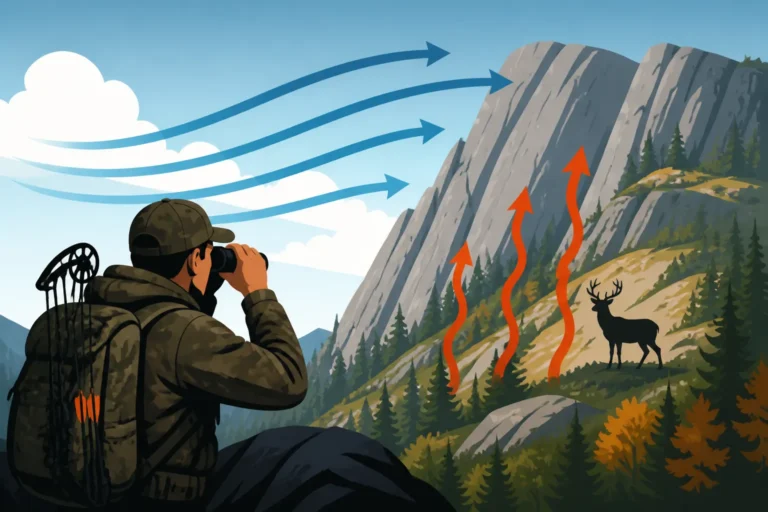
In hilly or mountainous terrain, thermals also play a significant role. As the air warms throughout the day, thermals rise; as it cools in the evening, they fall. In the White Mountains or other parts of New Hampshire with varied topography, these thermals can funnel your scent up or down a ravine or ridge. If you're hunting a thicket on a hillside, understand how the thermals will carry your scent at different times of day. Morning hunts might require you to be above the thicket to avoid rising thermals, while evening hunts might be best from below. This understanding is key to a Cold-Weather Sitting Strategy in the North Country that doesn't blow your hunt. Use a small squeeze bottle of powder or a milkweed pod to test the wind and thermals frequently.
Essential Gear and Mindset for Thicket Hunting
Hunting cedar thickets in New Hampshire’s late season is a physical and mental challenge. Having the right gear and the right attitude can make all the difference between success and frustration.
Clothing and Footwear for Cold, Dense Cover
Your clothing needs to be warm, quiet, and durable. Layering is critical for New Hampshire's unpredictable late-season weather. Start with a good moisture-wicking base layer, add insulating mid-layers, and top it with a quiet, windproof, and waterproof outer shell. You’ll be busting through branches, so your outer layer needs to withstand snags and tears. Avoid noisy materials like stiff nylon. Blaze orange is legally required during certain seasons in New Hampshire, so ensure your outer layer incorporates it effectively, perhaps a quiet fleece vest over your jacket. Our guide on Layering for New Hampshire's Cold Hunting Season provides excellent insights into staying warm and dry.
For footwear, you need waterproof, insulated boots with excellent traction. Cedar thickets often hold moisture, leading to muddy, slushy, or icy conditions underfoot. A good pair of knee-high rubber boots or insulated leather boots, like those from Irish Setter or Schnee's, will keep your feet dry and warm, which is paramount for comfort and safety. You might also encounter boggy areas within thickets, making tall, waterproof boots a necessity. For more on navigating wet terrain, consult our guide on Best Boots for North Country Bog Hunting.
Weapon Choices and Shot Considerations
The dense nature of cedar thickets means shots are almost always close-range. A rifle hunter might opt for a lever-action rifle chambered in a cartridge like .30-30 or .45-70, or a fast-handling bolt-action in .308 or 6.5 Creedmoor, paired with a low-power scope or iron sights. A shotgun with slugs is also an excellent choice for thick cover, offering plenty of knockdown power at close ranges. For specific recommendations, check out Best Rifle Caliber for New Hampshire Whitetails.
For archery hunters, a compound bow set to a comfortable draw weight with good penetration is ideal. Fixed-blade broadheads are often preferred in thick cover over mechanicals due to their reliability if they encounter a twig before impact. Crossbows, which are legal in certain WMUs during archery season, also shine in tight spaces, offering a stable shooting platform. Regardless of your weapon, practice shooting from awkward positions, standing, kneeling, and even from a seated position, as you rarely get textbook setups in a thicket.
The Mental Game of Patience and Persistence
Hunting cedar thickets can be incredibly frustrating. It's often slow, quiet, and you might go hours without seeing a thing, only to spook a deer at 10 yards. The temptation to move faster, or to give up, can be strong. This is where patience and persistence become your most valuable assets. You have to believe that the deer are there and that if you move slowly and deliberately enough, you will eventually encounter one.
Embrace the silence and the challenge. Learn to enjoy the process of slowly deciphering the deer's movements. Every snapped twig, every rustle of leaves, every distant sound becomes a clue. If you bump a deer, don't despair; often, they'll circle back or settle down not far from where they were spooked. Make a mental note of how it reacted and adjust your strategy for next time. Hunting these thickets is a chess match, not a sprint, and the reward of outwitting a savvy late-season buck in his sanctuary is truly unmatched.
| Strategy | Pros | Cons | Ideal Scenario |
|---|---|---|---|
| Still-Hunting | Maximizes stealth; allows you to cover ground; good for locating bedded deer. | Very slow; requires extreme patience and focus; easy to spook deer if not careful; limited visibility for shooting. | Solo hunter, highly dense thicket, fresh snow for tracking, good wind conditions, desire to actively seek out deer in their beds. |
| Stand Hunting | Stationary, less chance of being scented; good for predictable travel routes; allows for longer observation. | Can be cold if not dressed properly; limited to one spot; relies on deer moving past; placement is critical and must be precise. | Identified key funnels, pinch points, or feeding/bedding transitions on the thicket's edge or within a slightly more open pocket. |
| Small Drives | Can push out stubborn, bedded deer; effective for specific, known thickets. | Requires multiple hunters (3-4); safety is paramount; can push deer out too fast for a shot; risks over-pressuring an area. | Group of hunters working a well-defined thicket, especially if other methods have failed to move deer; late season when deer are heavily concentrated in cover. |
Disclaimer
Hunting is an inherently dangerous activity. Always prioritize safety, understand and adhere to all New Hampshire Fish and Game laws and regulations, and obtain proper licenses and permits. Be sure to scout thoroughly and practice ethical hunting practices. This guide is for informational purposes only and does not substitute for professional instruction or direct experience. Always let someone know where you are hunting and when you expect to return.