New Hampshire’s Twelve Crossbow-Legal WMUs
Navigating the ever-evolving regulations for hunting in New Hampshire can feel like trying to hit a moving target, especially when it comes to specific equipment like crossbows. Many hunters find themselves scratching their heads, wondering exactly where and when they can legally wield these powerful tools during the archery season. This comprehensive guide is designed to cut through that confusion, clearly outlining the twelve specific Wildlife Management Units (WMUs) in New Hampshire where crossbows are permitted for deer hunting during the archery season, helping you plan your hunts with confidence and clarity.
Understanding New Hampshire's Crossbow Regulations
For years, the use of crossbows during New Hampshire's traditional archery season was a point of much discussion, and often, frustration, for hunters. The landscape of hunting equipment and hunter participation has changed, leading to adjustments in state regulations. What was once a strict "archery-only" state, primarily focused on vertical bows, has gradually evolved, recognizing the benefits and increased accessibility that crossbows offer to a broader demographic of hunters.
The Evolving Landscape of Crossbow Use
Historically, New Hampshire's archery season was exclusively for traditional bows and compound bows, with crossbows generally restricted to firearms season or for hunters with specific physical disabilities and permits. This created a significant barrier for many, including new hunters, those with physical limitations, or even seasoned archers looking for a different challenge. The debate often centered on the "sporting" nature of crossbows versus traditional bows, as well as their perceived effectiveness and impact on deer populations. However, as more states began to integrate crossbows into their archery seasons, New Hampshire's Fish and Game Department, along with legislative bodies, revisited these rules.
The shift wasn't sudden but a measured process, driven by a desire to increase hunter recruitment and retention, especially among younger generations and those who might find traditional archery physically demanding. Recognizing that an aging hunter population and declining participation rates could impact conservation funding, the state began to look for ways to make hunting more accessible. This led to a phased approach, starting with specific exemptions and eventually culminating in the designation of particular WMUs where crossbows are now permitted during the general archery season for all hunters. This gradual integration reflects a careful balance between tradition, opportunity, and sound wildlife management.
Who Can Use a Crossbow in New Hampshire
It's crucial to understand that while crossbows are now legal for general archery season deer hunting in specific WMUs, there are still nuances. Initially, crossbow use was primarily restricted to hunters with a permanent physical disability permit, allowing them to participate when others couldn't. This provision still exists and is vitally important for many individuals who might otherwise be unable to experience the archery season. These hunters, with their special permits, generally have broader access to crossbow use across the state, even in WMUs where general crossbow use is not permitted during archery season.
However, the significant change that affects most hunters is the expansion of crossbow use for all licensed archery hunters within the designated twelve WMUs. This means if you possess a valid New Hampshire hunting license and an archery permit, and you are hunting in one of these approved WMUs, you can legally use a crossbow during the regular archery season without needing a disability permit. This move has opened doors for many, allowing them to enjoy the archery season's extended timeframe and unique challenges. It’s always best practice to review the current New Hampshire Fish and Game Digest annually, as regulations can subtly shift. For more details on overall requirements, you can check out information on New Hampshire Hunter Education Requirements.
General Equipment Specifications for Crossbows
Even in the legal WMUs, crossbows aren't a free-for-all. New Hampshire Fish and Game has specific requirements for the equipment itself to ensure fair chase and hunter safety. These aren't just arbitrary rules; they're in place to maintain ethical hunting standards and to ensure that the equipment is appropriate for the game pursued. You can't just pick up any crossbow and head into the woods; it needs to meet certain criteria.
Generally, crossbows must have a minimum draw weight and utilize specific bolt and broadhead types. For instance, New Hampshire typically requires broadheads to be a minimum width and have at least two cutting edges. Expanding broadheads are usually permitted, but they also have specific requirements for expansion diameter. Mechanical broadheads have gained immense popularity for their accuracy and penetration, but always ensure yours meet the state's minimum specifications for both closed and open diameter. It's not just about the crossbow; the ammunition is just as important. Knowing your New Hampshire Crossbow Equipment Rules is paramount before you ever step into the timber. Always double-check your setup, practice rigorously, and ensure your gear is in perfect working order, as a missed shot due to improper equipment can lead to unnecessary suffering for the animal and a disappointing hunt for you.
The Core Challenge: Why Not All WMUs Are Equal
The concept of specific WMUs having different rules, particularly for equipment like crossbows, can be incredibly perplexing for hunters, especially those new to New Hampshire or those who hunt across state lines. It seems counterintuitive to have a patchwork of regulations, but there are often sound ecological and management reasons behind these decisions. It's not about making hunting difficult, but about tailoring management strategies to local deer populations and hunter dynamics.
Historical Context of Archery-Only Zones
To understand why only certain WMUs allow crossbows, it helps to look back at the origins of archery hunting. Archery season traditionally served a very specific purpose: to provide an extended, primitive weapon hunting opportunity that was often characterized by closer range, more intimate encounters, and a lower overall harvest rate compared to firearms. Many of the WMUs that still restrict crossbows during the archery season were likely areas where wildlife managers wanted to preserve this "traditional archery" experience or where deer populations were managed very conservatively, and a perceived increase in efficiency from crossbows was a concern.
These older regulations were often rooted in the idea of maintaining distinct hunting experiences. An archery-only zone (meaning vertical bows only) was seen as a way to extend the season without significantly increasing pressure or harvest. The skill set required for traditional archery, with its shorter effective range and steeper learning curve, was often viewed as a defining characteristic. As crossbow technology advanced, becoming more accurate and easier to master for many, the old definitions began to blur, necessitating a re-evaluation in certain areas while maintaining the status quo in others.
Deer Management Objectives Behind Restrictions
The primary reason for varying regulations across WMUs almost always boils down to localized deer management objectives. New Hampshire Fish and Game divides the state into WMUs to manage deer populations more effectively, taking into account habitat, population density, harvest rates, and the impact of factors like winter severity and predation. In WMUs with lower deer densities, sensitive habitats, or specific conservation goals, managers might opt for more restrictive hunting methods to control harvest and promote population growth.
For instance, some WMUs might have experienced greater winter kill, higher predator impact, or simply less optimal habitat to support a robust deer population. In these cases, limiting the overall hunting pressure or increasing the challenge (by restricting to vertical bows only) can be a tool to ensure sustainable deer numbers. Conversely, WMUs where crossbows are allowed might be areas with healthy, stable, or even growing deer populations that can sustain a slightly higher harvest potential, or where managers want to provide more hunting opportunity without significantly impacting the overall herd health. It's a delicate balance, and these decisions are data-driven, based on annual harvest reports, population surveys, and habitat assessments.
Impact on Hunter Strategy and Scouting
The WMU-specific crossbow rules force hunters to be incredibly diligent in their planning. You can't just assume your gear is legal everywhere. This creates a need for precise scouting and an in-depth understanding of not just the terrain, but the regulations specific to that piece of ground. If you primarily hunt a WMU that doesn't allow crossbows, but then decide to venture into one that does, you need to know the rules, not just for your weapon, but also the specific season dates and bag limits for that new area. This is where tools like GoHunt become invaluable, as they can help overlay WMU boundaries and regulations on maps, making it easier to visualize where your crossbow is legal.
This granular approach to regulation means hunters often have to tailor their scouting efforts and hunting strategies not just to the game, but to the legal parameters of the specific WMU. For example, if you're accustomed to Bowhunting New Hampshire's Long Archery Season with a compound bow in a restricted WMU, and then shift to a crossbow-legal WMU, your setup, shot distances, and even how you approach stand placement might change slightly. It demands a more flexible and informed approach to hunting, ensuring you're always within legal bounds and maximizing your chances of success. It also highlights the importance of checking the WMU boundaries meticulously, especially when hunting near their edges, to avoid any unintended violations.
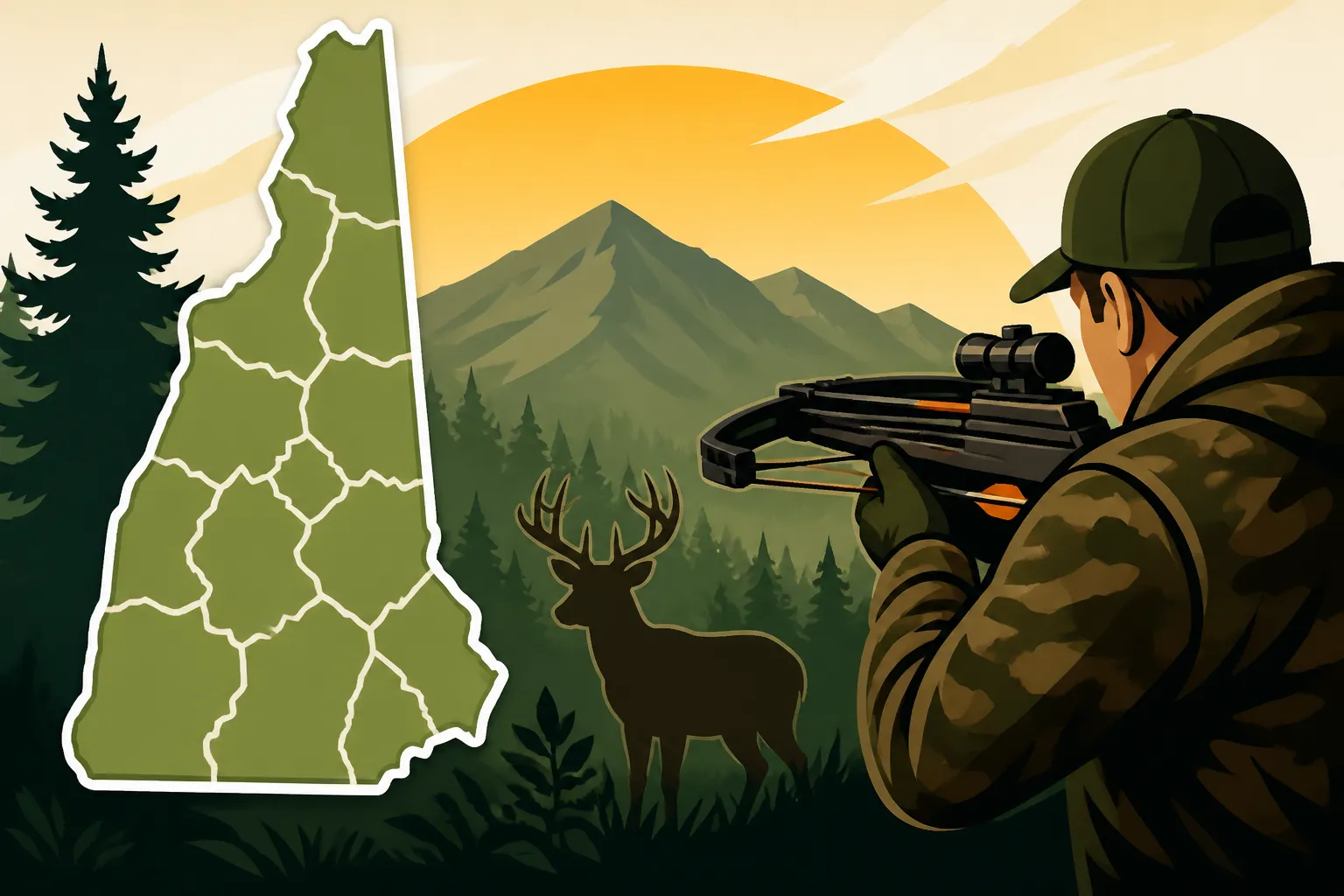
Identifying the Twelve Crossbow-Legal WMUs
The heart of the matter for many hunters is knowing exactly which WMUs permit crossbow use during the archery season. This isn't just a list; it defines where you can leverage the advantages of a crossbow for your deer hunt. Understanding these zones is the first critical step in planning a successful and legal hunt.
Northeastern Legal WMUs: A, B, C, D1, D2
These WMUs represent a significant portion of New Hampshire's northern and central regions, stretching from the Canadian border down through the White Mountains and into the Lakes Region. They cover a vast and diverse landscape, from rugged, remote timber country to more developed areas and agricultural fringes.
- WMU A: Located in the far northern tip of New Hampshire, bordering Canada, WMU A is characterized by vast tracts of public and private timberland. It's largely remote and offers a true big woods hunting experience. The decision to allow crossbows here likely reflects a desire to provide more opportunity in an area with lower hunter density and expansive habitat, where deer populations are more influenced by severe winters than hunting pressure. Hunters here often face challenging terrain and weather conditions.
- WMU B: Immediately south of WMU A, WMU B also encompasses significant portions of the North Country, including the Connecticut Lakes Headwaters. Similar to A, it's rugged, heavily forested, and sparsely populated. This is moose and bear country as much as deer country, and the landscape demands robust gear and physical endurance. The inclusion of crossbows in this WMU aligns with increasing accessibility in challenging environments.
- WMU C: This WMU captures a large swathe of the White Mountains and their foothills, known for its steep terrain, dense timber, and remote wilderness areas. While deer densities can be lower in the highest elevations, the lower valleys and mixed forests offer good hunting. The allowance of crossbows here can provide a reliable, accurate tool for hunters navigating the often-thick cover and variable shot opportunities presented by the mountainous terrain. For those interested in this region, exploring Hunting the North Country offers valuable insights.
- WMU D1: This WMU sits to the east of the central White Mountains, encompassing parts of the Lakes Region and eastern timberlands. It features a mix of rolling hills, hardwood forests, and wetlands. While more accessible than the far North Country, it still offers significant public and private land hunting opportunities. Crossbows provide a solid option for hunters here, whether sitting near a beaver flowage or still-hunting through diverse timber.
- WMU D2: Located west of the central White Mountains and along the Connecticut River Valley, WMU D2 offers diverse habitat from river bottomlands to upland forests. This region often holds a good population of deer, benefiting from varied food sources and cover. Crossbows are particularly effective in the mixed open and dense cover often found here, allowing for accurate shots in diverse scenarios. The proximity to the Connecticut River also means varied hunting scenarios.
Southern and Central Legal WMUs: F, G, H1, H2, I1, I2, M
Moving south, these WMUs span the central and southern portions of the state, including the Lakes Region, Merrimack Valley, and regions bordering Massachusetts. These areas generally have higher deer densities and often more fragmented habitats due to increased development and agriculture.
- WMU F: Situated in the heart of the Lakes Region, WMU F combines a mix of forested hills, lakefront properties, and some agricultural land. Deer populations here are generally healthy, and hunting pressure can be moderate to high. Crossbows offer a flexible hunting tool for the varied terrain and cover types, from dense stands around lakes to more open hardwoods further inland.
- WMU G: This WMU covers parts of the Monadnock Region in southwestern New Hampshire, characterized by rolling hills, mature forests, and a mix of rural and suburban landscapes. Deer thrive in these diverse habitats, and crossbows provide an excellent option for hunters navigating the often-challenging private land access and mixed cover. This region is known for producing quality deer.
- WMU H1: Part of the Merrimack Valley, WMU H1 includes a blend of suburban interface, agricultural fields, and woodlots. Deer populations are robust, and hunters here often contend with smaller parcels of huntable land and close proximity to residential areas. Crossbows are well-suited for these conditions, offering precise, quiet hunting in areas where shot distances might be shorter and opportunities quick.
- WMU H2: Also within the Merrimack Valley, WMU H2 is similar to H1 in its mix of development and rural pockets. It’s an area where understanding deer movement patterns between cover and feed, often across private land, is critical. The accuracy and ease of use of a crossbow can be a distinct advantage when hunting these smaller, often pressured areas.
- WMU I1: Further south into the Merrimack Valley, WMU I1 continues the trend of mixed suburban and rural landscapes. Deer here are often patterned to local food sources like apple orchards or oak flats. Crossbows allow hunters to effectively target deer in these environments, especially when setting up ambush points near travel corridors or feeding areas.
- WMU I2: This WMU extends into the southern tier, closer to the Massachusetts border, featuring a mix of suburban sprawl, industrial areas, and remaining pockets of prime deer habitat. Hunting here often involves seeking out overlooked woodlots or gaining permission on smaller private tracts. Crossbows offer a discrete and effective method for hunting in these constrained environments.
- WMU M: The southeasternmost WMU, M is characterized by coastal plains, wetlands, and dense suburban development. Despite the human presence, healthy deer populations persist in the remaining green spaces and thick cover. Hunting in WMU M often demands adaptability and keen attention to property boundaries. Crossbows are an excellent tool for navigating these unique, often tight, hunting conditions.
Here’s a summary table of New Hampshire's WMUs and their crossbow legality during archery season:
| WMU | Region | Crossbow Legal (Archery Season) | Notes on Terrain/Population |
|---|---|---|---|
| A | North Country (Far North) | Yes | Remote, heavily forested, lower hunter density, challenging terrain. |
| B | North Country (Connecticut Lakes) | Yes | Rugged, vast timberlands, remote wilderness, often harsh conditions. |
| C | White Mountains/Foothills | Yes | Mountainous, dense timber, varied elevation, provides diverse challenges. |
| D1 | Lakes Region (East) | Yes | Rolling hills, mixed hardwoods, wetlands, accessible but still wild. |
| D2 | Lakes Region (West/Connecticut River) | Yes | River bottomlands, upland forests, good deer populations, varied cover. |
| E | White Mountains Core | No | High elevation wilderness, very low deer density, focus on traditional archery experience. |
| F | Lakes Region (Central) | Yes | Mix of forests, lakefronts, some agriculture, healthy deer. |
| G | Monadnock Region | Yes | Rolling hills, mature forests, rural/suburban mix, good deer numbers. |
| H1 | Merrimack Valley (North) | Yes | Suburban interface, agriculture, woodlots, robust deer. |
| H2 | Merrimack Valley (Central) | Yes | Similar to H1, fragmented habitat, high deer numbers. |
| I1 | Merrimack Valley (South) | Yes | Suburban and rural mix, often tight hunting areas, good deer. |
| I2 | Southern Tier (Massachusetts Border) | Yes | Developed areas, pockets of habitat, demands careful hunting. |
| J1 | Seacoast/Southeast (North) | No | Higher population density, often more restrictive for firearms discharge, traditional archery focus. |
| J2 | Seacoast/Southeast (South) | No | Heavily populated, very limited hunting, strong traditional archery preference. |
| K | Southern Tier (West) | No | Mix of suburban/rural, often high pressure, preserves traditional archery. |
| L | Central West (Vermont Border) | No | Diverse habitat, but maintains traditional archery status for management. |
| M | Southeasternmost | Yes | Coastal plains, wetlands, dense development, unique hunting challenges. |
WMUs Where Crossbows Are NOT Permitted in Archery Season
It's equally important to know where you cannot use a crossbow during the archery season if you don't possess a disability permit. As the table above shows, WMUs E, J1, J2, K, and L are currently designated as traditional archery-only zones. These areas maintain the older regulations, preserving a specific hunting experience or managing deer populations under different parameters.
- WMU E: This WMU encompasses the rugged, high-elevation core of the White Mountain National Forest. Deer densities here are generally lower due to harsh conditions and limited food sources, especially at higher altitudes. The focus in WMU E is often on a more wilderness-oriented, low-impact hunting experience, and restricting equipment to traditional bows aligns with that philosophy. If you plan on Hunting New Hampshire's White Mountain National Forest, be aware of the specific WMU you are in.
- WMUs J1 & J2: These WMUs cover the highly populated Seacoast Region of New Hampshire. With dense residential and commercial development, hunting opportunities are already very limited, often confined to small private parcels or specific conservation lands. The decision to keep these traditional archery-only likely reflects an intent to manage very localized, small deer populations with minimal impact, and to maintain a more "quiet" hunting method in close proximity to human activity.
- WMUs K & L: These WMUs are situated in the southern and western parts of the state. While they offer good deer habitat, they also face varying levels of development and hunting pressure. The choice to restrict crossbows in these areas may stem from specific localized deer management goals, population studies indicating a need for more conservative harvest, or simply a desire to retain traditional archery opportunities in areas where they are highly valued by a segment of the hunting community. For hunters in these areas, techniques like Rattling and Grunting New Hampshire Bucks become even more critical when using traditional archery gear.
Strategic Considerations for Crossbow Hunters in Legal WMUs
Having the legal right to use a crossbow in a specific WMU is only the first step. To be truly successful, crossbow hunters need to adapt their strategies, leverage modern tools, and understand the nuances of the local environment. It's not just about pulling a trigger; it's about making smart, informed decisions.
Adapting Tactics to Specific WMU Terrain and Pressure
New Hampshire's WMUs are incredibly diverse, from the high peaks of the White Mountains to the agricultural fields of the Merrimack Valley. A strategy that works well in one WMU might be completely ineffective in another. For crossbow hunters, this means tailoring your approach. In the remote, heavily timbered WMUs like A, B, or C, silent still-hunting or carefully placed ground blinds near known deer travel corridors are often effective. The dense cover here means shots are typically at closer range, where a crossbow's accuracy shines. Conversely, in WMUs like H1 or I1, with more fragmented habitats and higher human activity, focusing on small woodlots, creek bottoms, and field edges becomes paramount. Deer in these areas are often more nocturnal and sensitive to pressure, requiring stealth and patience.
Crossbows, with their consistent accuracy and minimal movement at the shot, can be particularly advantageous when hunting from a treestand or ground blind in higher-pressure areas. They allow you to remain still longer and take precise shots when opportunities arise. It's not just about the weapon, it's about how you integrate it into a comprehensive hunting plan that respects the unique characteristics of each WMU. For example, if you're targeting deer in a WMU that features mixed hardwoods, understanding how to read a New Hampshire Deer Wintering Yards Explained in late season or predict movement around a Hunting a Standing Apple Orchard during the rut can drastically improve your chances.
Scouting and E-Scouting with Tools like GoHunt
In today's hunting world, effective scouting is no longer just about boots on the ground, though that remains critical. E-scouting, using satellite imagery, topographical maps, and other digital resources, has become an indispensable part of planning, especially when navigating WMU-specific regulations. This is where platforms like GoHunt really come into their own. GoHunt allows you to overlay WMU boundaries, public land ownership, terrain features, and even recent harvest data, giving you a powerful bird's-eye view of your hunting area.
Before you even step foot in a legal WMU, you can use GoHunt to identify potential bedding areas, travel corridors, food sources, and pinch points. You can mark stand locations, assess access routes, and evaluate potential retrieves. For a crossbow hunter, understanding shot opportunities and sight lines is paramount, and GoHunt's topographic features can help you anticipate these. Furthermore, many digital mapping apps, including GoHunt, allow you to download maps for offline use, which is essential in the often-spotty cell service areas of New Hampshire's backcountry. This digital reconnaissance, combined with on-the-ground confirmation, creates a powerful advantage, ensuring you spend your valuable hunting time in the most productive locations within the correct legal WMU. For more ideas on how to use modern tech, refer to Scouting With the New Hampshire Fish and Game App.
Maximizing Success in Varying Habitats
Different habitats demand different crossbow hunting techniques. In open hardwood forests, especially during the early season, focusing on oak ridges for acorns or active scrapes can be highly productive. A crossbow allows for precise shot placement on deer that might be feeding or traveling slowly. In dense softwood thickets or clear-cuts, where visibility is limited, still-hunting slowly or setting up on funnels can be effective. The compact nature of many crossbows makes them easier to maneuver in tight cover compared to longer firearms.
For WMUs with significant agricultural components (like H1 or I1), setting up on field edges, near hedgerows, or in transition zones between fields and thick cover can yield results. Deer often move into these fields at dawn and dusk. In river bottoms or wetland areas (common in D2 or M), identifying dry humps, natural crossings, or browse lines can pinpoint deer activity. Always consider wind direction, thermal currents (especially in hilly terrain), and the sun's position relative to your stand to maximize concealment and minimize your scent footprint. Understanding Wind and Thermals in Steep Granite Terrain is just as crucial with a crossbow as it is with a traditional bow. By matching your crossbow's strengths (accuracy, ease of holding aim) to the specific habitat and deer behavior, you can significantly increase your success rate.
Gear and Setup for New Hampshire Crossbow Hunting
Getting your crossbow set up correctly for New Hampshire's varied hunting conditions is more than just tightening a few bolts; it's about meticulous preparation, understanding your equipment's capabilities, and ensuring safety above all else. The right gear can make all the difference between a clean kill and a frustrating miss.
Choosing the Right Crossbow and Bolts
The market for crossbows has exploded in recent years, offering a dizzying array of options. When choosing a crossbow for New Hampshire hunting, consider a few key factors: weight, size, and power. Lighter, more compact models are often easier to carry through dense New Hampshire timber and maneuver in tight treestands or ground blinds. However, don't sacrifice power; ensure your crossbow has sufficient kinetic energy to deliver a clean pass-through on a whitetail. Most modern crossbows from reputable brands like TenPoint, Ravin, or Excalibur will meet New Hampshire's minimum performance requirements.
Selecting the right bolts is just as critical. Bolt weight and FOC (front of center) balance play a significant role in accuracy and penetration. Heavier bolts generally carry more kinetic energy downrange and are less susceptible to wind drift, which can be a factor in open fields or ridge tops. Pair your bolts with quality broadheads that meet New Hampshire's legal specifications. For more insight on what to choose, consider Best Crossbow Bolt Weight for Whitetail. Fixed blade broadheads offer maximum penetration and reliability, while mechanical broadheads provide a larger cutting diameter upon impact, often leading to better blood trails. Whichever you choose, ensure they fly true from your specific crossbow setup.
Optics and Sighting Systems for Accuracy
Crossbows, much like rifles, benefit immensely from quality optics. A good scope will enhance your accuracy, especially in the low-light conditions often encountered at dawn and dusk when deer are most active. Most crossbows come with a multi-reticle scope, featuring multiple aiming points for different distances. It's crucial to sight in your scope meticulously at various ranges (e.g., 20, 30, 40 yards) to understand your holdovers. Practice shooting from various positions you might encounter in the field – from a treestand, off a ground blind window, or kneeling – to build confidence in your aiming system.
Beyond the scope, a high-quality rangefinder is an absolute necessity for crossbow hunting. Unlike traditional bows where hunters often "guesstimate" yardage, the flat trajectory of a crossbow bolt means even small miscalculations in distance can result in a significant point of impact difference. A good rangefinder, especially one that accounts for angle compensation when shooting from a treestand, will give you precise yardage, ensuring you use the correct aiming point on your scope every time. This precision is vital for ethical hunting and clean kills. Don't leave home without your rangefinder, especially when hunting the varied terrain of the Granite State.
Essential Accessories and Safety Practices
Beyond the core weapon, several accessories can significantly enhance your crossbow hunting experience and safety. A sling is invaluable for carrying your crossbow over long distances or through dense brush, freeing up your hands for climbing or navigating. A quiver that holds your bolts securely yet allows for quick, silent access is also key. Cocking devices, whether integrated into the crossbow or external rope cockers, are essential for safe and efficient loading, especially on high draw weight models.
Safety is paramount. Always handle your crossbow as if it were loaded, keep the safety on until you're ready to shoot, and never point it at anything you don't intend to shoot. Be acutely aware of your surroundings, ensuring no one is in your line of fire and that you have a clear backstop. When hunting from a treestand, a full-body safety harness is non-negotiable. Falls from treestands are a leading cause of hunting accidents, and your life is worth more than any deer. Always practice proper loading and unloading procedures, and never dry fire your crossbow, as it can cause significant damage to the limbs and cams. For more details on preparing your gear, you can look at Setting Up a Crossbow in New Hampshire's Approved Units.
Navigating Season Dates and Licensing for Crossbows
Understanding where you can hunt with a crossbow is just one piece of the puzzle; knowing when and ensuring you have the correct documentation are equally vital. New Hampshire's hunting seasons and licensing requirements are clearly defined, but it's up to each hunter to be informed and compliant.
Aligning with New Hampshire Archery Season Dates
In the twelve designated WMUs, crossbows are permitted during the established New Hampshire archery season for deer. This means you must adhere to the same opening and closing dates as traditional archers. New Hampshire's archery season is famously long, often running from early September well into December, providing ample opportunity. However, it's crucial to remember that these dates can vary slightly year to year, and sometimes even by WMU, so always consult the most current New Hampshire Fish and Game Digest.
The advantage of crossbow legality in these WMUs is that it allows hunters to capitalize on this extended season. Early season hunts can be warm, offering opportunities to pattern deer on summer food sources like apples or fresh browse. The rut, typically in late October and early November, sees bucks more active, providing prime hunting. Late season, with colder temperatures and often snow, can concentrate deer around specific food sources. A crossbow allows you to participate in all these phases, adapting your tactics to the conditions within the legal timeframe. Staying up-to-date on New Hampshire Archery Season Dates is your first step.
General Hunting License and Archery Permit Requirements
To legally hunt deer with a crossbow in New Hampshire, you'll need two primary documents: a valid New Hampshire hunting license and a valid New Hampshire archery permit. These permits are non-negotiable, even if you're using a crossbow. The hunting license grants you the general right to hunt, while the archery permit specifically authorizes you to use archery equipment (including crossbows in the legal WMUs) during the archery season.
Both resident and nonresident hunters are subject to these requirements. You can purchase these licenses and permits online through the New Hampshire Fish and Game portal, or from authorized license agents throughout the state. It's crucial to have these documents on your person while hunting, as proof of legality can be requested by conservation officers at any time. Don't risk a fine or revocation of your privileges by hunting without the proper paperwork. Understanding New Hampshire Resident License Options or nonresident options is key to starting your season right.
Reporting Your Harvest from a Crossbow Hunt
Just like with any other method of harvest, successfully taking a deer with a crossbow in New Hampshire comes with reporting requirements. New Hampshire Fish and Game mandates that all deer harvests be reported, typically within 24 hours of taking the animal. This data is critical for wildlife managers to monitor deer populations, assess harvest rates, and make informed decisions for future season structures and regulations.
The reporting process is typically straightforward. You can often register your deer online through the Fish and Game website or app, or in person at an authorized registration station. You'll need to provide details such as the WMU where the deer was taken, the date of harvest, the sex of the deer, and the method of take (e.g., archery/crossbow). Failure to report your harvest is a violation and can result in penalties. Always prioritize this step; it's a vital part of responsible hunting and contributes directly to the conservation efforts that ensure future hunting opportunities for everyone. For specifics, consult New Hampshire Deer Reporting Requirements.
Ethical Hunting and Conservation for Crossbow Users
Beyond the legalities and logistics, ethical hunting and conservation are the bedrock of our hunting heritage. As crossbow users, we have a responsibility to uphold these principles, ensuring our actions reflect positively on the hunting community and contribute to the health of New Hampshire's wildlife populations.
Upholding Fair Chase Principles
The principle of "fair chase" dictates that hunters should not have an unfair advantage over the game they pursue. This means respecting the animal's natural abilities and avoiding methods that would reduce hunting to mere killing. For crossbow hunters, this translates into several key practices. Firstly, knowing your effective range. While a crossbow can be accurate at longer distances than many traditional bows, ethical shots are typically limited to ranges where you can consistently place an arrow into the vital zone. Pushing past that ethical limit risks wounding an animal and failing to recover it.
Secondly, avoid hunting over bait where prohibited or in a manner that creates an unfair advantage. New Hampshire has specific regulations regarding baiting, particularly for deer, and these must be strictly adhered to. Thirdly, practice patience and shot selection. Just because you have a clear shot at a deer doesn't mean it's an ethical one if the angle is poor or if there's an obstruction. Waiting for the right opportunity, where the deer is broadside and calm, demonstrates respect for the animal and ensures a quick, humane harvest. Using a crossbow shouldn't diminish the challenge; it should simply offer another avenue to pursue it ethically.
Contributing to Deer Management and Data Collection
Every hunter, regardless of their chosen weapon, plays a vital role in wildlife management. By purchasing licenses, permits, and equipment, you contribute directly to the funding of wildlife agencies and conservation programs. But your contribution goes beyond financial support. The data you provide through mandatory harvest reporting is invaluable. This information allows New Hampshire Fish and Game to track population trends, assess herd health, and make informed decisions about bag limits, season lengths, and equipment regulations for individual WMUs.
If you observe anything unusual with a harvested deer, such as signs of illness or unusual antler growth, reporting it to Fish and Game can help monitor for diseases like Chronic Wasting Disease (CWD), which New Hampshire has so far successfully kept out of its deer herd. Every piece of information helps managers understand the dynamics of the deer population. Your commitment to honest and timely reporting directly impacts the future of deer hunting in the Granite State, ensuring that future generations will have abundant wildlife resources to enjoy.
Respecting Landowners and Fellow Hunters
A significant portion of huntable land in New Hampshire is privately owned, making landowner relations critically important. When hunting on private land, always obtain explicit permission before entering, and respect the landowner's wishes. This includes adhering to property boundaries, closing gates, not littering, and driving responsibly on access roads. A positive relationship with landowners is essential for maintaining and expanding access for all hunters. Never assume access, and if in doubt, always ask.
When hunting public lands, respect other users, whether they are hikers, bird watchers, or fellow hunters. Be mindful of noise, especially early in the morning, and always practice safety by being aware of your surroundings and the presence of others. Blaze orange requirements during firearms season extend to archery hunters as well in many instances, ensuring visibility. When Hunting Pressure on New Hampshire Public Land is high, remember that courtesy and communication go a long way. Building a positive image for hunters is a shared responsibility, and every interaction you have contributes to that image. By acting as responsible and ethical stewards of the land and its wildlife, crossbow hunters can ensure they are seen as an integral and valued part of New Hampshire's outdoor community.
Disclaimer
Please remember that hunting regulations, season dates, and WMU boundaries can change. While this guide aims to be comprehensive and up-to-date, it is imperative that all hunters consult the current New Hampshire Fish and Game Hunting Digest or visit the official New Hampshire Fish and Game website for the most accurate and recent information before heading afield. It is the hunter's responsibility to know and abide by all applicable laws and regulations.