Best Bow Sight for New Hampshire Archery Season
Navigating the dense timber and rolling hills of New Hampshire with a bow in hand is an experience unlike any other. But let's be honest, trying to decide on the "best" bow sight can feel like trying to pick a single leaf out of an entire forest. The wrong sight, or one not suited to our specific terrain and weather, can easily cost you a shot at a lifetime buck. This guide is here to cut through the confusion, helping you understand what truly matters when selecting a bow sight for the unique demands of New Hampshire's archery season, so you can step into the woods with confidence.
Navigating New Hampshire's Diverse Archery Terrain and Conditions
New Hampshire isn't just one type of woods; it's a tapestry of environments, from the thick, dark softwoods of the North Country to the sprawling, open hardwoods of the southern regions, and the steep, rocky slopes of the White Mountains. Each of these settings presents its own set of challenges and opportunities for the bowhunter, and your bow sight needs to be able to perform optimally across them all.
Understanding Varying Light and Cover
Picture this: you're tucked into a treestand well before dawn, the forest still cloaked in deep shadow. That glowing pin is your lifeline, but if it's too dim, it's useless. Too bright, and it can cause a starburst effect, obscuring your target. Our New Hampshire woods, especially in the early mornings or late evenings that are prime hunting times, can be incredibly dark under dense canopy cover. Pine thickets, cedar swamps, and even mature hardwood stands on an overcast day can reduce ambient light significantly.
A good bow sight for New Hampshire needs pins that are bright enough to be seen in these low-light conditions without overpowering the target. High-quality fiber optics that gather what little light is available are crucial. Some sights even offer adjustable brightness settings, either through rheostats or by shielding the fiber, which can be a game-changer when moving from the deep shadows of a spruce thicket to a more open field edge. You want a clear, crisp aiming point that doesn't bloom out, allowing you to focus on the deer, not the pin itself.
The Impact of Weather and Temperature Swings
If you've spent any time hunting in New Hampshire, you know our weather is as predictable as a whitetail buck's rut behavior – which is to say, not at all. Our archery season often kicks off in pleasant, even warm, early fall weather, but it can quickly transition into the bitter cold of late November and even December. Hunting New Hampshire's Archery Season Into December means you'll encounter everything from warm, sunny days to freezing rain, sleet, and even early snow.
Your bow sight needs to be a trooper through all of it. Durability is paramount. Look for sights constructed from robust materials like aircraft-grade aluminum or high-impact composites that can withstand accidental bumps against a tree or a slip on an icy rock. Moisture resistance is also key; fogged lenses or pins that dim due to water infiltration are simply unacceptable. Some sights feature anti-fog coatings or sealed designs, which can be invaluable when the temperature drops, and your breath or condensation could otherwise obscure your view. Just like you'd meticulously consider Layering for New Hampshire's Cold Hunting Season, you need gear that can handle the elements.
Dealing with Shot Distances in Varied Landscapes
New Hampshire offers a diverse range of shot opportunities. One moment you might be in a thick patch of young timber where a shot might be a mere 15 yards, requiring quick target acquisition. The next, you might be overlooking a powerline cut or a field edge, where a deer could present itself anywhere from 20 to 50 yards, or even further if you're comfortable with those distances. This variability in terrain means your sight needs to be versatile.
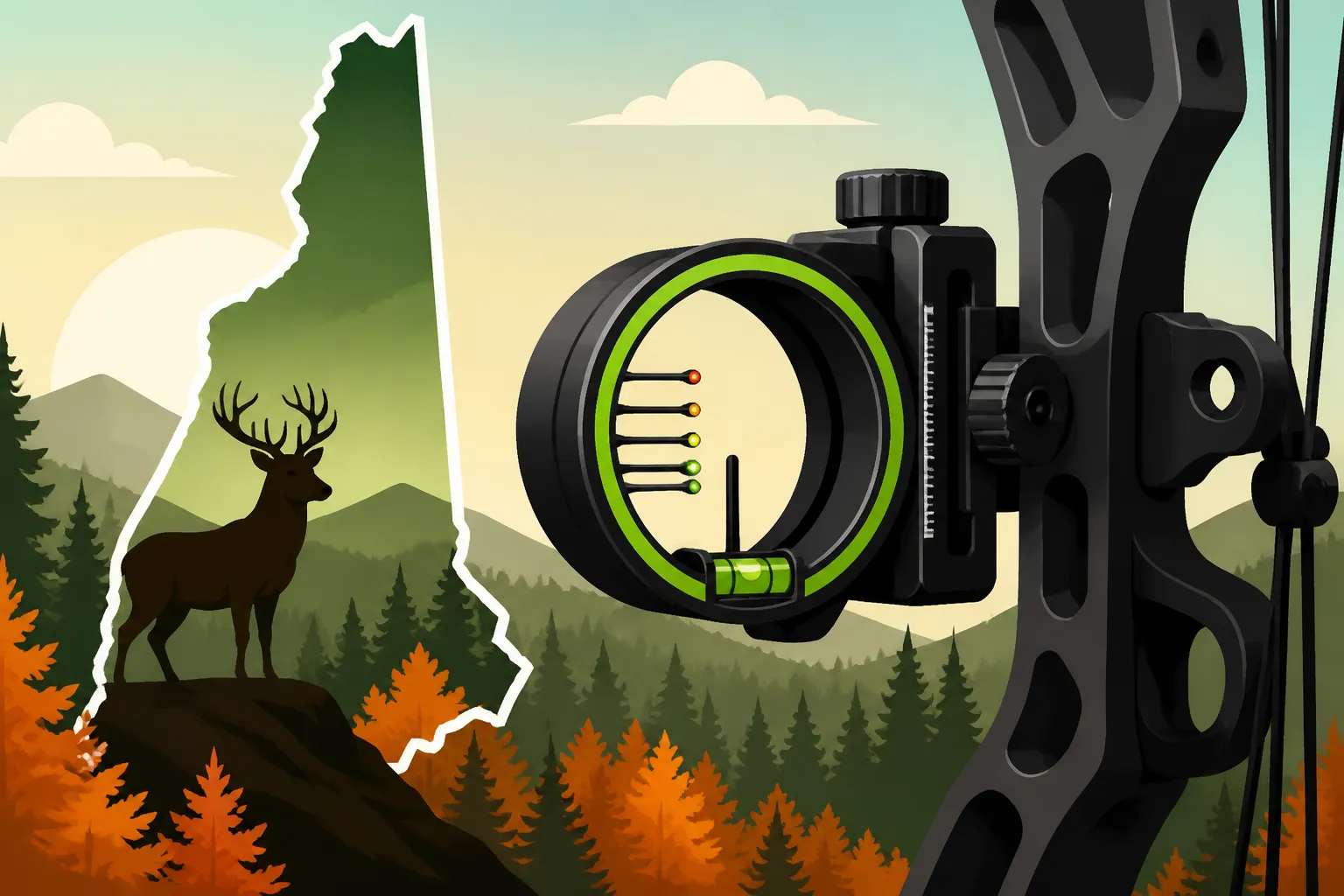
A sight with multiple fixed pins (e.g., 20, 30, 40, 50 yards) is often favored by hunters who want fast target acquisition at common distances. However, if you find yourself frequently ranging unknown distances, a single-pin adjustable sight might offer a cleaner sight picture and more precise aiming. Understanding your typical shot distances in the specific areas you hunt, whether it's the dense cover of a beaver swamp or the more open ground around a logging road, will heavily influence your choice. Using a mapping platform like GoHunt to scout potential shot lanes and identify typical distances can really help you decide what kind of sight best fits your hunting style in a given area.
Deciphering Bow Sight Types for the Granite State Hunter
When it comes to bow sights, you're primarily looking at a few distinct categories, each with its own advantages and disadvantages for the New Hampshire hunter. Understanding these differences is crucial to making an informed decision that suits your personal hunting style and the conditions you'll face.
Fixed Pin Sights: The Traditional Workhorse
Fixed pin sights are, for many, the quintessential hunting bow sight. They feature multiple pins (typically three to five, but sometimes more) set at predetermined distances, like 20, 30, 40, and 50 yards. The beauty of these sights lies in their simplicity and speed. When a deer steps out, you quickly assess the distance, choose the appropriate pin, and shoot. There's no adjusting or dialing, which is a huge advantage in fast-paced situations or when a buck suddenly appears in thick cover.
For a New Hampshire hunter navigating dense woods or hunting from a treestand in a known high-traffic area, fixed pins offer incredible reliability. They are generally very durable, with fewer moving parts to break or come loose. If you primarily hunt areas where shots are typically within a consistent range, say out to 40 yards, a fixed pin sight allows for very quick target acquisition. Many hunters appreciate the confidence of having multiple pins visible, knowing exactly which one corresponds to a specific range without fumbling. It’s a solid, no-frills choice for serious Bowhunting New Hampshire's Long Archery Season.
Single Pin Adjustable Sights: Precision for Ranging Shots
Single pin adjustable sights offer a different approach: one solitary pin that can be moved up or down to dial in the exact yardage for your shot. This type of sight provides an incredibly clean, uncluttered sight picture, as there's only one pin to focus on. For hunters who meticulously range every shot and prefer ultimate precision, a single pin can be a fantastic tool.
In New Hampshire, where shot distances can vary greatly—from a close 10-yard encounter in a cedar swamp to a 60-yard shot across an open cut—a single pin adjustable sight allows you to precisely match your pin to the exact range. This eliminates the need for "gapping" between fixed pins or holding over/under. It's particularly useful if you find yourself in more open country or on clear-cuts where longer, more precise shots might be an option. The trade-off, however, is speed. You have to range, then adjust your sight to that range, which takes valuable seconds. This style might be less ideal for snap shots in dense cover or situations where a deer is moving quickly. However, with the right planning, perhaps using scouting tools on GoHunt to pre-determine potential shooting lanes, you can mitigate some of the speed concerns.
Multi-Pin Adjustable Sights: The Hybrid Approach
Sometimes referred to as a "hybrid" sight, multi-pin adjustable sights attempt to combine the best of both worlds. They typically feature multiple fixed pins (often 2 or 3) for your most common ranges (e.g., 20 and 30 yards), but also allow the entire sight housing to be adjusted up or down for longer shots. This means you can use the fixed pins for quick, close-range shots, and then dial the entire sight for extended distances, maintaining a relatively clean sight picture while still having options for multiple ranges.
This hybrid design offers significant versatility for the New Hampshire hunter. Imagine you're hunting a funnel that could produce a close 20-yard shot, but it also opens up to a logging road where a deer might cross at 55 yards. With a multi-pin adjustable sight, you have your primary fixed pins ready, but can quickly dial for that precise longer shot without the clutter of 7-8 fixed pins. It's a great option for those who want the flexibility to handle a wide array of scenarios without committing fully to the speed of fixed pins or the precision (and slower adjustment) of a pure single-pin slider.
| Sight Type | Pros for NH Hunting | Cons for NH Hunting | Best Use Case in NH |
|---|---|---|---|
| Fixed Pin | Durable, simple, quick acquisition in thick cover | Limited range, requires knowing holdovers at longer distances | Dense timber, short to medium shots, quick reactions |
| Single Pin Adjustable | Clear sight picture, precise ranging, less clutter | Slower to adjust for multiple targets, not ideal for fast shots | Open fields, known distances, methodical hunters |
| Multi-Pin Adjustable | Versatile, covers multiple distances, good for varied terrain | More complex, can be cluttered, heavier | Varied terrain, combo of open and timber, adaptable |
Essential Features for a New Hampshire Archery Sight
Beyond the basic type of sight, there are several key features that can make or break a bow sight's performance in the demanding conditions of New Hampshire's hunting season. Paying attention to these details will ensure your sight is a true asset, not a liability, when that moment of truth arrives.
Pin Brightness and Fiber Optic Quality
We've touched on this, but it bears repeating: the quality of your pins and how they handle light is paramount. New Hampshire's deep woods and rapidly changing light conditions demand a sight that excels in low light. High-quality fiber optics are designed to gather ambient light and funnel it to the pin, making it glow vividly. However, there's a fine line between bright enough and too bright. A pin that's overly bright can create a "halo" or "starburst" effect, making it difficult to precisely aim at your target, especially if that target is in shadow.
Many modern sights offer adjustable brightness, allowing you to fine-tune the intensity of your pins. This might come in the form of a rheostat light, which illuminates the fibers in truly dark conditions, or a system that allows you to cover part of the fiber to reduce its brightness on sunny days. Look for sights that offer clear, crisp pin definition without excessive blooming. This ensures that whether you're catching a buck When New Hampshire's Archery Season Opens on a brilliant September morning or Hunting the December Archery Close in deep shadow, your aiming point is always optimal.
Durability and Construction for Rugged Use
Our New Hampshire landscape is rugged, and your gear needs to be just as tough. Whether you're scrambling over granite ledges, pushing through dense blowdowns, or enduring a nasty rain shower, your bow sight will take a beating. Cheap plastic components or flimsy attachments simply won't hold up.
Look for sights built from solid, high-quality materials. Aircraft-grade aluminum is a popular choice for its balance of strength and light weight. Ensure that all screws, adjustments, and the mounting bracket are robust and secure. Loose parts or sights that creak under pressure are signs of poor construction and will lead to frustrating accuracy issues. Seek out sights that specifically mention being weatherproof or waterproof, as resisting moisture is critical here in New England. A truly durable sight will stand up to years of abuse, giving you confidence even when you're deep in the backcountry, far from any repair shop.
Micro-Adjustments and Tool-Free Settings
Sighting in your bow can be one of the most tedious parts of archery, but precise adjustments are absolutely vital for accuracy. Sights with micro-adjustments for windage and elevation allow you to make very fine, incremental changes, ensuring that your arrows hit exactly where you aim. These adjustments are usually made with small, precise clicks, which are much better than having to loosen a screw and physically slide the housing, often resulting in over-correction.
Tool-free adjustments are another fantastic feature. Imagine you've driven an hour to your hunting spot, set up your treestand, and just before prime time, you realize your arrow is hitting an inch low at 30 yards. If you need an Allen wrench to adjust your sight, you're out of luck. Tool-free adjustments allow you to make small tweaks quickly and quietly in the field without fumbling for tools or potentially spooking game. This feature is particularly valuable when you're doing final preparations like Tuning a Bow for Broadhead Flight, where small adjustments can make a big difference in accuracy.
The Advantage of a Built-In Rangefinder or Integrations
Technology has come a long way, and some bow sights now integrate small rangefinders directly into the unit. This can be a huge advantage, especially for the New Hampshire hunter. Instead of having to draw your bow, then reach for a separate rangefinder, then put it away, then draw your bow again, a built-in rangefinder provides instant, hands-free distance readings.
This can shave critical seconds off your shot process, which can be the difference between getting a shot off and watching a deer vanish into the thick woods. For hunters who prioritize speed and efficiency, this integrated approach can be a game-changer. Alternatively, some sights are designed to integrate seamlessly with external rangefinders or apps, using data from external devices to suggest pin settings or provide additional information. Using a reliable app like the one offered by GoHunt to pre-scout and mark yardages to key landmarks can complement any sight setup. This allows you to hunt more effectively, especially in dynamic situations where every second counts.
Setting Up Your Sight for Optimal New Hampshire Performance
Once you've chosen your new bow sight, the work isn't over. Proper setup and diligent maintenance are just as important as the sight itself. A top-tier sight, poorly installed or neglected, will perform no better than a budget option. Getting it right ensures you're ready for any challenge New Hampshire's archery season throws your way.
Proper Mounting and Leveling
The first, and arguably most critical, step is mounting your sight correctly. It needs to be securely fastened to your bow riser, with no wobble or play whatsoever. Loose screws or an improperly aligned sight can lead to inconsistent accuracy, driving you crazy trying to figure out where your arrows are going. Use a thread locker (like blue Loctite) on the mounting screws to prevent them from vibrating loose over time, especially after hundreds of shots.
Next, you need to level your sight. Most modern bow sights come with a built-in bubble level, and it's there for a reason. Canting your bow (tilting it to the left or right) will cause your arrow to hit left or right of your aiming point, particularly at longer distances. Take the time to ensure your sight's level is true. You can do this by setting your bow in a vise or using a bow vise, and then checking it against a known level surface. For precision, some archers even use a second level placed on the bowstring. This attention to detail is paramount, especially when you're dealing with varied shooting angles, such as when Hunting a Granite Ridge Saddle, where a slight cant can lead to a missed shot.
Sighting In: The Practice Makes Perfect Principle
Sighting in your bow is where you translate the mechanical precision of your equipment into actual arrow flight. This isn't a one-and-done deal; it's a process that requires patience and consistency. Start at your closest pin distance, typically 20 yards. Shoot groups of three, make small adjustments, and repeat until your arrows are consistently hitting the bullseye. Then, move to your next pin distance (e.g., 30 yards) and repeat the process.
It's also crucial to practice from various shooting positions. While you might sight in from a perfectly stable shooting bench, real hunting scenarios often involve shooting from a treestand, kneeling, or even shooting at awkward angles. Practice these scenarios to understand how your form and sight picture change. Remember that your choice of Best Arrow Weight for New Hampshire Deer and Best Broadhead for a New Hampshire Whitetail can affect arrow flight, so you should always sight in with the exact arrows and broadheads you plan to hunt with. This rigorous practice ensures that your sight is perfectly tuned for your specific setup and your hunting conditions.
Maintenance and Protection for Longevity
Our New Hampshire seasons are tough on gear, and your bow sight is no exception. Regular maintenance will extend its life and ensure it performs flawlessly when it matters most. After each hunt, especially if you've been out in rain, snow, or muddy conditions, take a few minutes to clean your sight. Use a soft cloth to wipe down the housing and a specialized lens cloth (never your shirt!) for the pins and any glass components.
Periodically check all mounting screws and adjustment screws to ensure they are tight. Vibration from shooting can slowly loosen fasteners. Apply a small amount of non-petroleum-based lubricant to any moving parts on adjustable sights to keep them operating smoothly. Consider using a sight cover or a soft case to protect your sight when transporting your bow. An accidental bump in the truck or while navigating dense brush can easily knock a sight out of alignment or even damage it. Diligence in maintenance is key to keeping your sight performing year after year, no matter what New Hampshire throws at it.
Disclaimer
This article is for general informational purposes only and does not constitute professional advice. Laws, prices and regulations vary by location and change over time. Consult a qualified professional for guidance on your specific situation.