Hunting the Monadnock Region Hills
Hunting the Monadnock Region of New Hampshire presents a truly distinct challenge, quite different from the vast timberlands of the North Country or the more settled woodlands of the southern tier. If you've found yourself scratching your head trying to decipher how deer move through its rugged, rocky hills, interspersed with old farmlands and winding valleys, you're not alone. This guide aims to break down the unique landscape and deer behavior of the Monadnock area, providing you with actionable strategies and essential insights to increase your success in these historic, often challenging, but ultimately rewarding woods.
Navigating the Monadnock Region's Unique Terrain and Deer Habits
The Monadnock Region, anchored by the iconic Mount Monadnock itself, offers a landscape that's both beautiful and demanding for hunters. It’s characterized by a mix of steep, granite-based hills, mature hardwood forests, pockets of dense softwood thickets, and remnants of old agricultural fields. This varied topography, primarily found within Wildlife Management Unit (WMU) G, means deer behavior here is a fascinating blend of wilderness instincts and adaptation to human-influenced landscapes.
Understanding the Distinct Landscape Features
Unlike the vast, unbroken forests you might find further north, the Monadnock Region's terrain is a mosaic. You’ll encounter significant elevation changes, with numerous smaller peaks and ridges fanning out from the main mountain. These aren't just gentle slopes; many areas feature sharp rises, rocky outcrops, and steep ravines that can be grueling to traverse. Interspersed within this ruggedness are old stone walls, forgotten foundations, and overgrown apple orchards – tell-tale signs of a farming history that still influences deer movement today. The mix of hardwoods (oaks, maples, birches) and softwoods (pines, hemlocks) creates a diverse habitat, offering both food and cover in close proximity. Deer, being creatures of efficiency, will use these transitions to their advantage.
Consider how deer navigate these features. Ridgelines often serve as natural travel corridors, especially during the rut, allowing bucks to cover ground efficiently while scent-checking for does. Saddles – the low points between two peaks on a ridge – act as classic funnel points, concentrating deer movement as they cross from one side to another. Conversely, the dense softwood thickets and laurel patches found on north-facing slopes or in stream bottoms provide excellent bedding cover, especially during inclement weather or periods of high pressure. Old logging roads and even faint game trails tracing along the contours of these hills become high-traffic routes for deer moving between bedding and feeding areas.
How Monadnock Deer Utilize the Environment
Deer in the Monadnock Region are masters of using the terrain to their advantage, often seeming to vanish into thin air even in seemingly open woods. Their daily patterns are heavily influenced by the availability of food, water, and thermal cover, all dictated by the landscape. During the early archery season, you'll find them focused on abundant food sources like white oak acorns, which can be prolific in mature hardwood stands. Later in the season, as those resources deplete, they'll shift to browse, overlooked wild apple trees, or lingering agricultural fields.
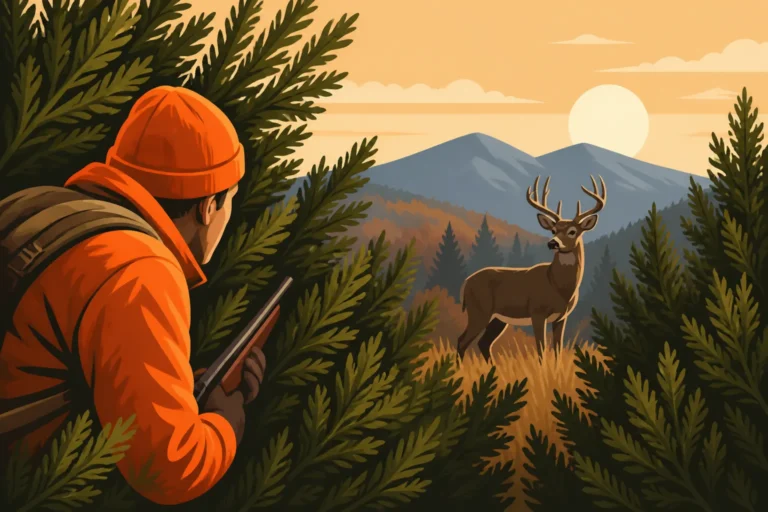
The rolling hills and valleys create complex wind and thermal patterns that are critical to understand. Unlike flatland hunting where the wind direction might be consistent, in the Monadnock hills, thermals will rise in the morning as the ground heats and fall in the evening as it cools. This means a prevailing westerly wind might become an updraft in the morning and a downdraft in the evening within a deep ravine. Deer are acutely aware of this and will often bed on lee slopes where they can smell downwind and see any approaching danger from above. When Hunting a Ridge-Top Saddle for Rutting Bucks, understanding these swirling winds is paramount to not getting busted. They'll use dense cover for bedding, often preferring areas where they can feel secure while still having multiple escape routes down steep slopes or into thick tangles. Understanding these intricate patterns is key to successful still-hunting or stand placement.
Strategic Approaches for Hunting Monadnock's Hill Country
Successfully hunting the Monadnock Region demands a flexible approach, blending patience with aggressive pursuit. You'll need to be physically prepared for the climbs and descents, and mentally ready to adapt your tactics to the ever-changing conditions and terrain. It's not uncommon to hike several miles and gain hundreds of feet in elevation in a single morning.
Mastering Still-Hunting and Stand Placement
Still-hunting is arguably one of the most effective methods in this varied terrain. It allows you to cover ground, scouting as you go, and react to fresh sign. The trick is to move incredibly slowly, often taking only a few steps every minute, stopping frequently to glass ahead and pick apart the cover. Use the contours of the land, old stone walls, or logging roads as linear features to guide your movement. Focus on areas where different habitat types converge, like where a hardwood ridge drops into a softwood swamp or where an old apple orchard borders dense cover. These transition zones are natural travel routes for deer. Pay close attention to Reading New Hampshire Mud for Fresh Deer Movement to identify active trails.
For stand hunting, whether it's a treestand or a ground blind, placement is everything. Don't just pick a tree; choose a location that capitalizes on natural funnels or key food sources. Saddles, as mentioned, are prime spots, especially during the rut. Look for pinch points created by steep terrain features, thick cover, or bodies of water that force deer into a narrower corridor. If you find a productive oak flat, focus your efforts there, but be mindful of the wind relative to approach and bedding areas. Old apple orchards, especially those still producing, can be magnets for deer in early to mid-fall. Hunting a Standing Apple Orchard requires careful planning to approach undetected. Using a ground blind can be particularly effective in areas with limited suitable trees or if you prefer to stay mobile and set up quickly, especially on public land where fixed stands might not be feasible. Using a Ground Blind on Public Land gives you flexibility.
Leveraging Calling and Small Drive Tactics
Calling can be surprisingly effective in the Monadnock hills, particularly rattling and grunting during the rut in late October and early November. The rolling terrain means sound doesn't travel as far as it might in flat open country, but it also creates pockets where a curious buck might investigate. If you're on a prominent ridge or near a known travel corridor, a series of aggressive rattling sequences followed by doe grunts can sometimes draw a territorial buck in for a closer look. However, be mindful of the wind. A buck responding to your calls will almost always try to circle downwind to scent-check the source, so position yourself carefully. You can learn more about Rattling and Grunting New Hampshire Bucks for optimal techniques.
In thicker patches of woods or on smaller parcels where you know deer are bedding, small drives with two or three hunters can be productive, especially during the later firearms season. One or two hunters can slowly still-hunt through a known bedding area, pushing deer gently towards standers positioned on likely escape routes, such as narrow saddles, creek crossings, or breaks in dense cover. This requires good communication and knowledge of the terrain to ensure safety and effectiveness. Just remember, safety is paramount, and ensure everyone involved understands the plan and shooting lanes.
Essential Gear and Scouting for Success in the Monadnock Hills
The Monadnock Region's terrain demands reliable gear and thorough preparation. You’ll be covering ground, often off-trail, and enduring variable weather conditions. Skimping on the right equipment can quickly turn a promising hunt into a miserable slog.
Footwear, Layering, and Optics
Your boots are arguably the most critical piece of gear for hunting these hills. You need something sturdy, waterproof, and with excellent ankle support and grip. The rocky, uneven ground, often covered with wet leaves or snow, will test your footwear. Look for a boot designed for mountainous or rugged terrain, perhaps with a stiffer sole to protect your feet from sharp rocks. Brands like Kenetrek, Schnee's, or even some of the more robust models from Vasque or Salomon, are popular choices. Don't underestimate the importance of good socks to prevent blisters. When considering Boots for New Hampshire's Granite Terrain, prioritize durability and comfort for long days afield.
Layering is equally important. New Hampshire weather, especially in the hills, can be notoriously unpredictable. A crisp, cool morning can turn into a warm, sunny afternoon, or quickly shift to a cold, wet drizzle. Start with a good moisture-wicking base layer, add insulating mid-layers like fleece or puffy jackets, and top it off with a waterproof and windproof outer shell. Having options allows you to adjust to conditions without overheating or getting cold. Good quality gloves and a warm hat are also essential for those frosty mornings or late-season sits.
Optics play a crucial role in picking apart the dense, broken cover. Quality binoculars (8×42 or 10×42 are excellent all-around choices) will help you identify deer movement, distinguish a deer from a stump, or spot faint sign from a distance without constantly lifting your rifle or bow. A rangefinder is also indispensable for accurately judging distances in the undulating terrain, where estimates can be notoriously deceptive.
The Power of Pre-Season Scouting and Mapping
Successful hunting in the Monadnock Region starts long before opening day. Pre-season scouting is non-negotiable. Spend time in the woods looking for sign: rub lines, scrape lines, well-used trails, and especially food sources like oak flats or old apple trees. Identify bedding areas in dense cover and map out potential travel corridors between them and feeding areas. Look for natural funnels created by terrain features.
Modern mapping applications are game-changers for this type of hunting. Tools like GoHunt or OnX Hunt provide invaluable satellite imagery, topographic maps, and property line overlays, which are essential when much of the Monadnock area is a patchwork of public and private land. You can mark waypoints for promising sign, plan your approach routes, identify natural funnels, and know exactly where property boundaries lie, even when you're deep in the woods without cell service. Learning how to effectively Scouting New Hampshire Public Land Before Season with these tools will give you a significant advantage. Being able to visualize the contour lines and potential bedding areas before you even step foot in the woods saves countless hours of aimless wandering. GPS and Mapping Apps for New Hampshire Public Land are indispensable.
Gaining Access and Respecting Boundaries in the Monadnock Region
Unlike the expansive public lands of the northern part of the state, much of the Monadnock Region is privately owned. While there are significant public tracts, understanding where you can legally hunt and how to respectfully gain access to private land is critical for a positive hunting experience.
Public Land Opportunities
The most notable public hunting area in the Monadnock Region is Pisgah State Park, located primarily in Winchester and Chesterfield. Pisgah is New Hampshire's largest state park and offers a rugged, largely undeveloped landscape with extensive hiking trails that double as potential access routes for hunters. The park boasts a good mix of hardwoods and softwoods, elevation changes, and plenty of cover, supporting a healthy deer population. Remember to check specific state park regulations as some areas may have restrictions or require special permits. Beyond Pisgah, there are smaller state forests, town forests, and conservation lands managed by various trusts. These often provide excellent, though sometimes more pressured, hunting opportunities. Always consult the New Hampshire Fish and Game website or use your mapping app to verify public land boundaries and rules before you head out. Don't forget to understand New Hampshire's WMU-Based Deer Season Structure which guides specific hunting dates and regulations for WMU G.
Navigating Private Land and Respecting Landowners
Because private land dominates much of the Monadnock landscape, gaining permission is a key component of successful hunting here. This often means knocking on doors, introducing yourself, and respectfully asking for permission to hunt. Approach landowners well in advance of the season, preferably in the spring or summer, to build rapport. Offer to help with chores, clear trails, or keep an eye on their property. Being a polite, responsible hunter who respects their land can open up fantastic opportunities. Always clarify where you can and cannot hunt on their property and be sure to leave no trace. Asking a New Hampshire Landowner for Permission is a skill worth cultivating.
| Terrain Feature | Deer Utilization | Optimal Strategy |
|---|---|---|
| Steep Ridgelines | Travel corridors, especially for bucks during rut. | Stand placement on saddles, still-hunting along crests. |
| Saddles/Pinch Points | Concentrated travel between drainages or ridges. | Primary stand locations, ambush points. |
| Dense Softwood Thickets | Bedding areas, thermal cover, escape routes. | Still-hunting edges, small drives. |
| Old Apple Orchards | Key early-season food source, especially wild varieties. | Early season stand placement, scouting for fresh sign. |
| Granite Outcrops/Ravines | Security cover, natural barriers, complex wind patterns. | Use for cover while still-hunting, approach carefully. |
| Creek Bottoms | Travel corridors, water sources, natural funnels. | Stand placement, still-hunting into the wind. |
| Old Stone Walls | Linear travel routes, especially when paralleling cover. | Still-hunting, looking for crossing points. |
Remember, hunting the Monadnock Region isn't just about bagging a deer; it's about connecting with a unique and rugged corner of New Hampshire. It's about earning your deer through hard work, smart scouting, and a deep respect for both the land and its wild inhabitants.
Disclaimer
The information provided in this guide is for informational purposes only and is not a substitute for official regulations. Always consult the current New Hampshire Fish and Game Department hunting digest and local ordinances before heading afield. Hunting regulations, seasons, and licensing requirements can change, so staying informed is your responsibility.